


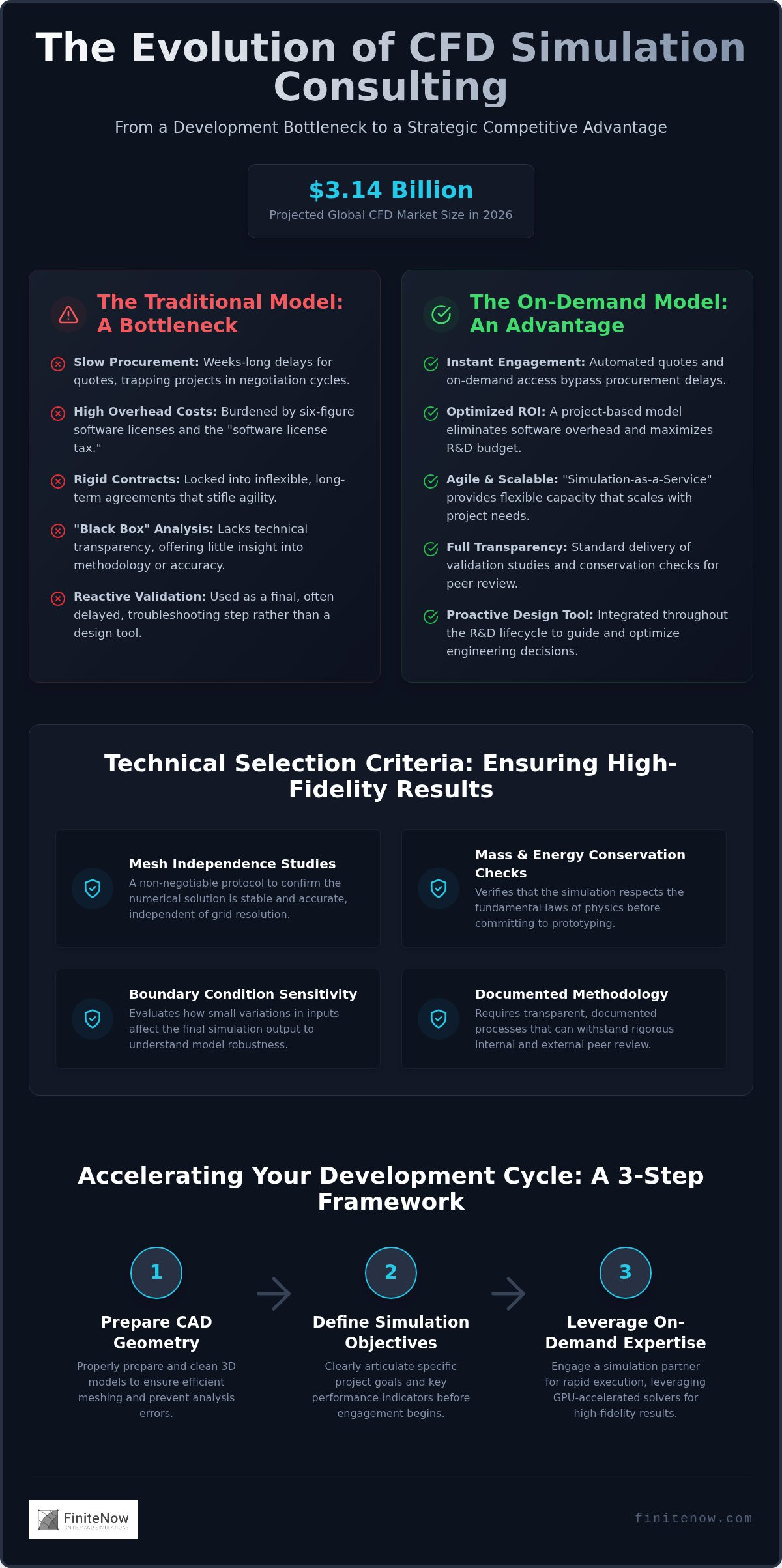
The traditional model of CFD simulation consulting is a bottleneck, not a benefit. While the global CFD market is projected to reach 3.14 billion dollars in 2026, many engineering leaders still find themselves trapped between six-figure software licenses and consultant quotes that take weeks just to arrive. You’re likely familiar with the frustration of waiting on a black box analysis that offers little transparency and even less agility. It’s a legacy approach that fails to keep pace with modern product development cycles.
We know that managing internal overhead while maintaining simulation accuracy is a constant balancing act. You need results that are decision-ready, not just data-heavy. This guide will show you how to evaluate partners based on transparency and speed rather than just technical jargon. We’ll explore strategies to optimize your simulation ROI and explain how on-demand engineering can scale your capacity without the burden of long-term contracts. From validating outsourced accuracy to leveraging GPU-accelerated solvers, you’ll learn to transform simulation from a cost center into a strategic competitive advantage.
Key Takeaways
- Identify the critical validation protocols, such as mesh independence and conservation checks, required to ensure the accuracy of outsourced technical data.
- Optimize your R&D budget by shifting from high-overhead internal licenses to a project-based model that eliminates the “software license tax.”
- Accelerate your development cycle by learning how to properly prepare CAD geometry and define specific simulation objectives before engagement.
- Evaluate how modern CFD simulation consulting has evolved into an on-demand utility, providing instant quotes and removing traditional procurement delays.
- Leverage the technical precision of a German-based engineering team to maintain high-fidelity oversight across complex structural and thermal analyses.
The Evolution of CFD Simulation Consulting in 2026
The role of Computational fluid dynamics (CFD) has fundamentally shifted. It’s no longer just a final design validation step before physical prototyping. It’s a core optimization tool used throughout the entire R&D lifecycle. In 2026, the global CFD market is projected to reach 3.14 billion dollars, reflecting a massive reliance on digital twins and predictive modeling across all engineering sectors. However, the way companies access this technology is undergoing a radical change. CFD simulation consulting is moving away from legacy boutique firms that rely on geographic proximity and toward agile, on-demand engineering platforms.
Traditional engagement models are failing to keep pace with modern development. They often create bottlenecks with long lead times for quotes and rigid, multi-month contract structures. Modern R&D requires a “Simulation-as-a-Service” approach. This model allows both SMEs and global enterprises to scale their simulation capacity without the heavy overhead of permanent staffing or expensive software licenses. It treats engineering expertise as a high-performance utility. It’s accessible, scalable, and built for speed.
Beyond the Black Box: Demand for Transparency
Engineers don’t want “pretty pictures” anymore. They demand technical transparency. High-fidelity results require documented validation methodology that stands up to peer review. Modern CFD simulation consulting partners must provide mesh independence studies and conservation of mass and energy checks as standard deliverables. We’ve seen a shift where digital collaboration tools have entirely replaced the need for physical on-site visits. This allows for real-time data sharing and much faster iteration cycles. You shouldn’t settle for a black box report. Demand a clear window into the simulation’s underlying physics and accuracy bounds.
The Impact of On-Demand Engineering on Time-to-Market
Speed is the primary metric for success in a globalized economy. On-demand platforms reduce the friction between CAD finalization and simulation execution. By utilizing automated quoting systems, procurement teams can bypass the weeks of negotiation common with traditional firms. This rapid turnaround allows CFD simulation to become a proactive design tool rather than a reactive troubleshooting step. When you can initiate a complex multiphase or transient analysis in hours instead of days, you gain a significant competitive advantage. Efficiency isn’t just about solver speed. It’s about the entire workflow from bid to final report.
Technical Selection Criteria: Evaluating a CFD Partner
Selecting a partner for CFD simulation consulting requires more than a review of their software inventory. You must match the consultant’s specific expertise to the physics of your industry. A generalist might handle steady-state internal flows, but they’ll likely struggle with high-fidelity Fluid-Structure Interaction (FSI) or transient combustion. Software proficiency is equally critical. Whether the project demands the customizability of OpenFOAM or the robust multiphysics integrations of Ansys, your partner should select the solver that minimizes computational cost while maximizing accuracy. Don’t settle for a firm that uses a one-size-fits-all approach to complex engineering problems.
Technical mastery is only half the equation. The other half is the rigorous application of validation protocols. You need a partner who treats simulation as a scientific experiment, not just a visualization exercise. This means moving beyond standard defaults to ensure the model actually represents reality. It’s about ensuring that the numerical solution is independent of the grid and that the physics are captured with high fidelity. When you evaluate a potential partner, ask for their standard operating procedures regarding mass and energy conservation. If they can’t provide a clear answer, they aren’t a high-performance partner.
The Validation Checklist for Engineering Managers
Mesh independence studies are non-negotiable. If the results change significantly when the cell count doubles, the solution isn’t stable. Managers should also demand boundary condition sensitivity analysis to understand how small input variations affect the final output. While historical data or experimental validation remains the gold standard, a consultant must at least demonstrate rigorous conservation checks. This ensures the simulation respects the fundamental laws of physics before you commit to physical prototyping. It’s the difference between a guess and a validated engineering decision.
Reporting Standards: What a Decision-Ready Report Looks Like
A decision-ready report bridges the gap between raw data and engineering strategy. It shouldn’t be a dump of pressure plots and velocity vectors. Instead, it must include an executive summary, a detailed breakdown of the methodology, and specific design suggestions based on the findings. A high-quality CFD report is one that provides documented accuracy bounds rather than just qualitative contours. This level of transparency allows procurement and engineering leads to move forward with confidence. If you need this level of technical oversight without the typical consulting lead times, consider evaluating FiniteNow’s engineering platform for your next project.
The Business Case: ROI and Cost Transparency
Engineering leaders often view simulation as a high-cost barrier rather than a value driver. This perception stems from the legacy “Software License Tax.” Traditional R&D departments pay tens of thousands of dollars annually for commercial licenses that sit idle during geometry cleanup or design reviews. When you shift to CFD simulation consulting, you eliminate these sunk costs. You stop paying for the tool and start paying for the result. This transition from fixed overhead to variable, project-based fees allows SMEs to access the same high-fidelity physics as global enterprises without the prohibitive entry costs.
The business case for outsourcing goes beyond simple license savings. It’s a strategic move to mitigate the massive financial risk of physical failure. High-fidelity simulation identifies performance bottlenecks and structural weaknesses long before the first prototype is ever manufactured. In an environment where the cost of a single physical test failure can exceed the price of an entire simulation campaign, the ROI of digital validation is undeniable. It’s about moving from a reactive “build-and-break” cycle to a proactive, data-driven optimization process.
Service Fees vs. Software Ownership
The total cost of ownership (TCO) for an internal CFD department is staggering. Beyond the $10 to $35 per hour cost for active software licenses, you must account for the average annual salary of a specialized engineer, which sits at approximately $124,098. Add in high-performance computing (HPC) hardware maintenance and the inevitable training requirements, and the internal model becomes a significant burden. Project-based fees offer superior budget predictability for procurement teams. You know the cost of the insight before the project begins, ensuring that simulation remains a scalable resource that expands and contracts with your R&D pipeline.
Reducing Prototyping Costs with Digital Twins
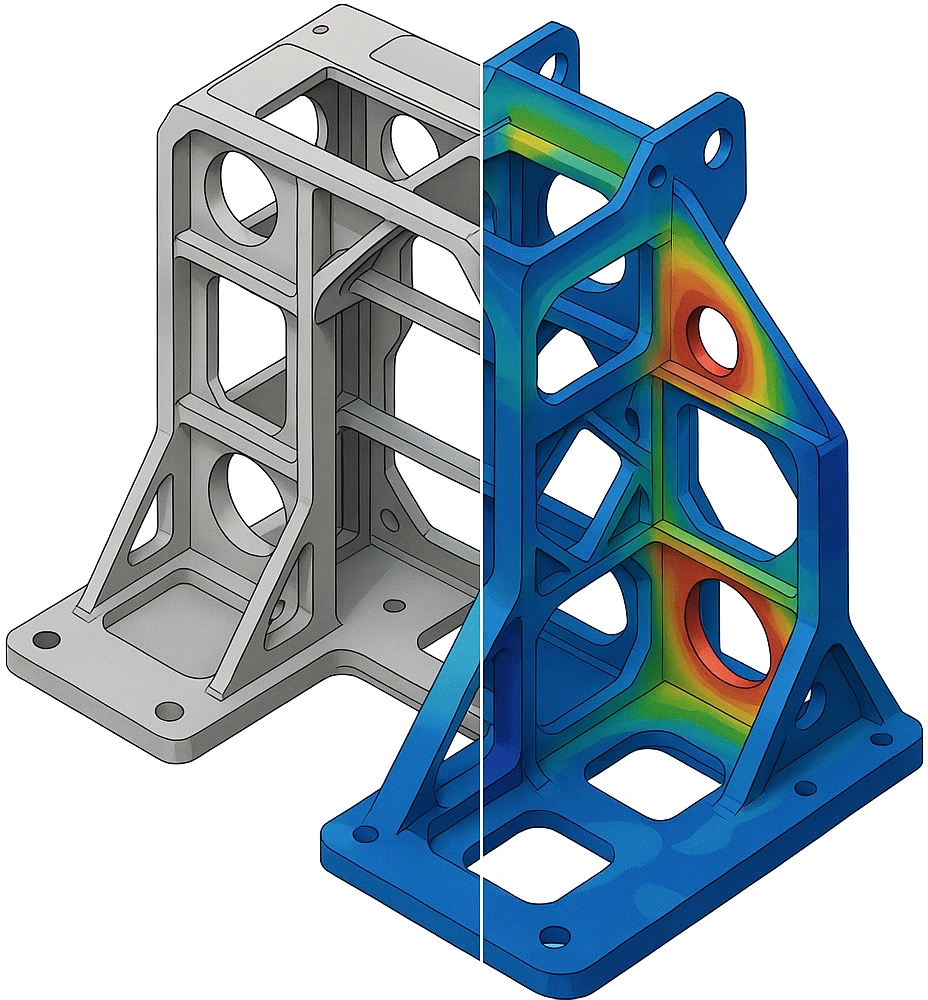
Digital twins allow you to quantify savings by drastically reducing physical test cycles. You can run hundreds of “what-if” scenarios in a virtual environment to explore design extremes that would be too dangerous or expensive to test in a physical lab. This isn’t limited to fluid dynamics alone. Integrating CFD results with Structural FEA provides a comprehensive multiphysics view of product performance. By identifying failure points early, you avoid the cascading costs of late-stage design changes. The result is a faster path to market with a product that has already been validated against real-world stressors.
Framing Your Project for Consulting Success
Success in CFD simulation consulting starts long before the solver begins its first iteration. It begins with the clarity of the problem statement. Vague objectives lead to wasted computational hours and irrelevant data. You must define the specific engineering question the simulation needs to answer. Is it about reducing pressure drop? Or is it about ensuring thermal stability at peak load? Clear objectives dictate the entire workflow and ensure the final report is actually actionable for your procurement and engineering teams.
CAD preparation is the most undervalued stage of the process. Sending a production-ready model with every bolt and fillet is a mistake. It creates meshing nightmares that inflate project lead times. You need to de-feature and simplify geometry to focus strictly on the fluid volume. This efficiency reduces project costs and ensures a faster turnaround. High-performance engineering requires a disciplined approach to data preparation before engagement begins. It’s about stripping away the noise to focus on the physics that matter.
The 5-Step Scoping Framework
Use this methodical framework to ensure your consultant has everything they need to deliver high-fidelity results. This structure eliminates ambiguity and keeps the project on track from day one.
- Step 1: Identify critical physics. Decide if the model needs to account for turbulence, heat transfer, or complex multiphase interactions.
- Step 2: Define CAD fidelity. Determine the specific region of interest and remove unnecessary external components that don’t impact the flow.
- Step 3: Specify boundary conditions. Provide exact inlet velocities, pressures, and operating points for realistic modeling.
- Step 4: Determine output formats. Decide if you need full 3D datasets for internal analysis or structured, decision-ready reports.
- Step 5: Set the validation threshold. Establish the acceptable margin of error based on your specific design requirements.
Avoiding Common Pitfalls in CFD Outsourcing
The “Garbage In, Garbage Out” rule applies heavily to simulation. Under-specifying boundary conditions is the fastest way to invalidate a project. If you don’t provide precise operating points, the simulation is just an expensive guess. Another common risk is choosing steady-state analysis when the physics are inherently transient. If the flow is time-dependent, forcing a steady-state solution will hide critical instabilities that could lead to physical failure. Finally, avoid over-simplifying geometry at the expense of critical flow features. Removing a small turbulence-triggering edge can compromise the accuracy of the entire study. For teams working on vehicle or product design, a structured approach to aerodynamic performance optimization can help ensure that geometry simplification decisions are made with the right physics in mind.
Precision in scoping leads to precision in results. If you want to bypass the traditional friction of project bidding, get an instant quote for your CFD project and see how our German-based team handles high-fidelity technical oversight.
Scaling R&D with FiniteNow’s On-Demand Platform
Traditional CFD simulation consulting is often synonymous with administrative delays. Legacy firms require extensive discovery calls and manual quoting processes that can stall a project for weeks before a single cell is meshed. FiniteNow disrupts this stagnant model by treating engineering simulation as a high-performance digital utility. By leveraging an automated platform, you gain immediate access to specialized expertise without the typical procurement friction. This shift allows your R&D team to move from a single component study to massive design sweeps in a fraction of the time. It’s about empowering your engineers to iterate at the speed of thought, not the speed of a consultant’s calendar.
Scalability is the cornerstone of a modern engineering strategy. Whether you need a one-off thermal analysis or a comprehensive series of structural simulations, our platform adapts to your pipeline. We utilize a pre-qualified global network of specialists to handle diverse and complex physics. This ensures that every project, regardless of its specialized requirements, is matched with the right technical expertise. You don’t have to worry about whether your partner has the bandwidth or the specific domain knowledge. We’ve optimized the entire engagement process to provide a seamless, high-fidelity extension of your internal team.
The Instant Quote Advantage
Procurement friction is a hidden cost that stalls innovation. While competitors rely on long discovery phases and manual bidding, our automated system provides immediate pricing. You know the project cost before you even speak to an engineer. This transparency allows you to bypass the traditional bidding bottleneck and secure budget approval faster than ever before. For time-sensitive R&D projects, this speed is a critical competitive advantage. It transforms the bidding process from a weeks-long negotiation into a streamlined, digital workflow that respects your project timelines.
German Engineering Standards in a Global Service
Speed never comes at the expense of precision. Every project on our platform undergoes rigorous validation by our German-based engineering team. These internal experts provide the high-fidelity oversight necessary to ensure every simulation respects the fundamental laws of physics. We’ve optimized our remote environment to maintain data security while delivering clinical precision. You receive the reliability of a legacy firm with the speed of a modern technology platform. It’s a robust framework designed to meet the intellectual rigor and technical demands of the world’s most advanced engineering firms.
Stop waiting for legacy firms to catch up to your development pace. You can access the future of engineering services today. Get an instant quote for your CFD project now and experience a faster, more transparent way to handle your most complex simulations.
Future-Proofing Your Engineering Pipeline
The shift toward on-demand engineering is a fundamental change in how R&D leaders manage technical risk. Transitioning to a utility-based model for CFD simulation consulting allows you to bypass the traditional hurdles of high-cost software licenses and rigid contracts. By prioritizing technical transparency and rigorous validation protocols, you ensure that every simulation result is a reliable foundation for physical prototyping. It’s about building a leaner, more responsive development cycle that scales with your project needs.
Precision and speed are no longer mutually exclusive. You don’t have to wait weeks for a quote or settle for qualitative data. With FiniteNow, you gain access to German-based engineering expertise and instant, transparent project pricing. We’ve eliminated the administrative friction of legacy firms to provide a streamlined, results-oriented experience. It’s time to leverage high-fidelity simulation as a proactive design tool rather than a reactive cost center. Get an Instant Quote for CFD Simulation today and take control of your product development timeline. Your next engineering breakthrough is just a few clicks away.
Frequently Asked Questions
What is the typical cost structure for CFD simulation consulting?
Consulting fees are generally structured as fixed-price for well-defined projects or hourly rates for open-ended R&D. Industry averages for project-based work vary significantly depending on the physics complexity and required mesh density. FiniteNow simplifies this by offering instant, transparent pricing through an automated bidding system. This eliminates the uncertainty of traditional quotes. You pay for the engineering result rather than the hourly overhead or software licensing fees.
How do I know if my CFD results are accurate?
Accuracy is validated through rigorous technical protocols like mesh independence studies and conservation of mass and energy checks. A reliable partner will provide documented proof that the numerical solution is stable and independent of the grid resolution. It’s also critical to compare simulation data against historical experimental results or known analytical solutions. High-fidelity oversight from a German-based engineering team ensures that the simulation adheres to the fundamental laws of physics.
Do I need to provide a clean CAD model for CFD analysis?
Yes, providing a simplified CAD model is essential for efficient meshing and accurate results. You should de-feature the geometry by removing small fillets, bolts, and internal components that don’t influence the fluid volume. This process, known as geometry cleanup, reduces computational time and prevents mesh quality issues. While some consultants offer cleanup services, delivering a simulation-ready model ensures a much faster project turnaround and reduces your overall service fees.
What is the difference between steady-state and transient CFD simulation?
Steady-state simulations solve for a time-invariant flow field where the fluid properties at any point remain constant. They are computationally efficient and suitable for stable operating points. Transient simulations capture time-dependent features like vortex shedding or fluctuating pressures. While transient models are more accurate for unstable physics, they require significantly more high-performance computing resources. Choosing the right approach depends on whether your engineering goal is average performance or peak load stability.
Can CFD consulting replace all physical prototyping?
CFD simulation consulting serves as a digital twin that drastically reduces the number of physical prototyping cycles. It allows you to explore hundreds of design iterations in a virtual environment to identify failures before manufacturing begins. However, final physical validation is still required for safety-critical components and regulatory compliance. The goal is to use simulation to ensure that the final physical prototype is already optimized, saving thousands of dollars in build-and-break testing.
How long does a typical CFD consulting project take?
A standard project usually spans two to four weeks, covering geometry preparation, meshing, solver execution, and reporting. Complex multiphase or transient studies can extend this timeline depending on the computational load. FiniteNow accelerates this process by removing the weeks of procurement friction through instant quotes and a streamlined digital workflow. This allows you to scale your R&D capacity and receive decision-ready reports much faster than traditional boutique engineering firms.
Which industries benefit most from outsourced CFD simulation?
Industries with high-stakes fluid dynamics, such as aerospace, automotive, and medical device manufacturing, benefit significantly from outsourced expertise. It’s also critical for HVAC optimization, chemical processing, and electronics cooling. These sectors often face high software licensing costs and intermittent simulation needs. Outsourcing allows them to access specialized physics and high-fidelity technical oversight without the burden of maintaining a permanent internal team or expensive high-performance computing hardware.
What software do CFD consultants typically use?
Consultants utilize a mix of commercial and open-source solvers depending on the project requirements. Common platforms include Ansys, OpenFOAM, and Cradle CFD. Each tool has specific strengths, such as GPU-accelerated solving or advanced multiphysics integration for structural and thermal analysis. A high-performance partner will select the solver that provides the best balance of speed and accuracy for your specific industry physics rather than relying on a single software package. If you’re new to the field and want to understand the foundational concepts behind these tools, our primer on what is CFD in engineering provides a results-oriented overview of how these technologies are applied in modern product development.
Simulation Work Reinvented