

Modeling Screwed Connections in Finite Element Analysis (FEA)
Why Screwed Connections Matter in Structural Simulation
Screw connections are among the most common joining techniques in all of engineering, be it mechanical, aerospace, or even the construction industry. Typical use cases include:
- the robust load transfer between structural components,
- detachable joints for maintenance and assembly,
- preloaded connections to increase stiffness and fatigue resistance,
- or the generation of contact pressure to ensure sealing.
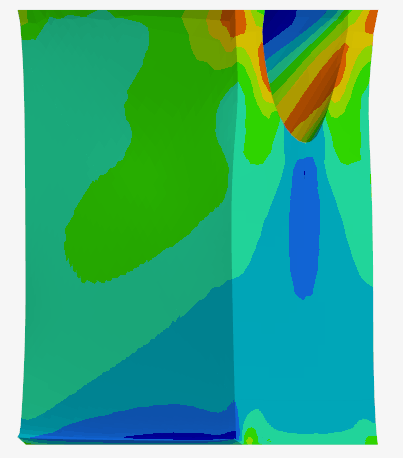
Hence, due to their vast importance in engineering, it is essential to also understand the different failure modes that govern screws, for example, slip, separation, fatigue, bearing, and pullout. To be able to analyze an assembly for all of these risks, it is imperative to correctly model each screwed connection, accounting for the generated global stiffness, local stress concentrations, and the resulting load paths and force distributions.
Finite element analysis has established itself as highly relevant to industry due to its rich yield and information in all of these topics, making it standard practice in aerospace, automotive, and machinery industries. Additionally, such simulations have blended well into this ecosystem of design analyses, but not replacing, but rather augmenting standards such as the VDI 2230.
Many simulation environments succeed in accurately modeling screws. In the following, we are going to reference the widely used software packages ANSYS Mechanical and the Altair suite, including HyperMesh and OptiStruct. Below is an extensive summary of the different techniques available:
Overview of Bolt and Screw Modeling Techniques in FEA
Due to the broad applicability of bolted joints, it is also important to understand the different ways of modeling screws in order to match them with the sought-after information. Let us examine the most relevant in increasing order of complexity.
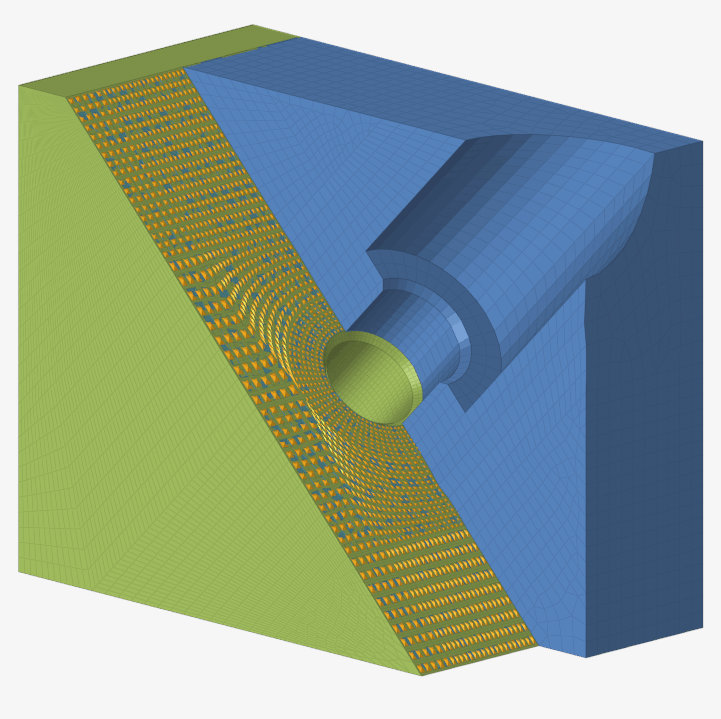
The simplest and thus fastest approximation of a screwed connection is to omit the screw itself, but rather directly mate the contacted surfaces as fully bonded, i.e., no relative motion. Although very superficial, due to the fast evaluation time, it can have its benefits for surrogate modeling and early-stage design.
Typical implementations are the bonded contact in Ansys Mechanical or the tight contact in HyperMesh/Optistruct. The advantages are thus the extremely low modeling effort, together with its numerical robustness and speed. There are multiple reasons for this. Firstly, not modeling a screw, of course, lowers the total element count. Secondly , since only bonded contacts are used, no non-linearity is introduced into the problem. These advantages can further be maximized by not even modeling the screw holes on either component. Further simplifying the meshing process, as well as the mesh itself.
Typical use cases include:
concept studies
surrogate models
stiffness estimation
non-critical joints
However, of course, these simplifications also bear limitations. Three important ones are worth dissecting:
First, no bolt pre-load representation. Since no screw is modeled, it is also not possible to account for the clamping force resulting from a tightened screw. This preload can be highly relevant since it typically is of very high magnitude. A simple M6 screw can supply well over 1 ton of force already, M16 screws can supply well over 10 tons.
Second, the bonding of both components eliminates the observation of cleavage or slip, which can be, depending on the problem, catastrophic in consequences. An important example here is pressure containers, which are typically screwed together to supply enough force for the gasket to continue to seal.
Third, the bonding results in an unrealistic stiffness for most joints, since unlimited force transmission can happen even far away from the screw.
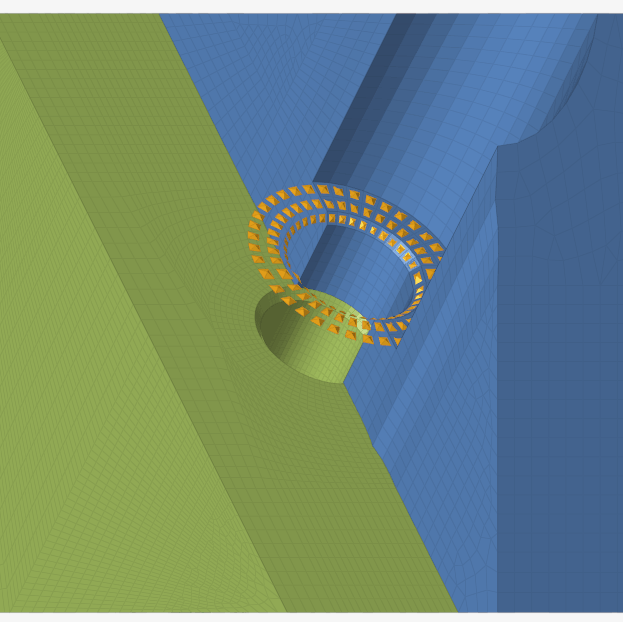
Rigid element connections allow simplified accounting of load transfer via rigid coupling, with negligible increase in problem size. This can be done by modeling the force transmission via rigid spiders instead of physical bolts. Typical implementations are RBE2/RBE3 elements in OptiStruct or remote points or rigid regions in ANSYS.
Similar to bonded contacts, their main advantage lies in their simplicity and stability. Setting up such connections is done quickly through the engineer and also allows for a fast calculation of the problem. In addition to this, in contrast to bonded contacts, they also allow for a clear force extraction of the simulated screw by inspecting the created reference node.
That makes rigid element connections in FEA best suited for:
load path definition
early sizing of surrounding structures
simple post-processing of reaction forces
Albeit they are thus able to give a numerical value for the loads, they still exhibit artificially stiff behavior, potentially falsifying the prediction. This is evident when bearing in mind that the physical properties of the screw are still nowhere included in the model. Thus, joining two components with an M3 screw would yield the same results as an M20 screw. Additionally, it is still not possible to include preload or friction effects in this simulation.
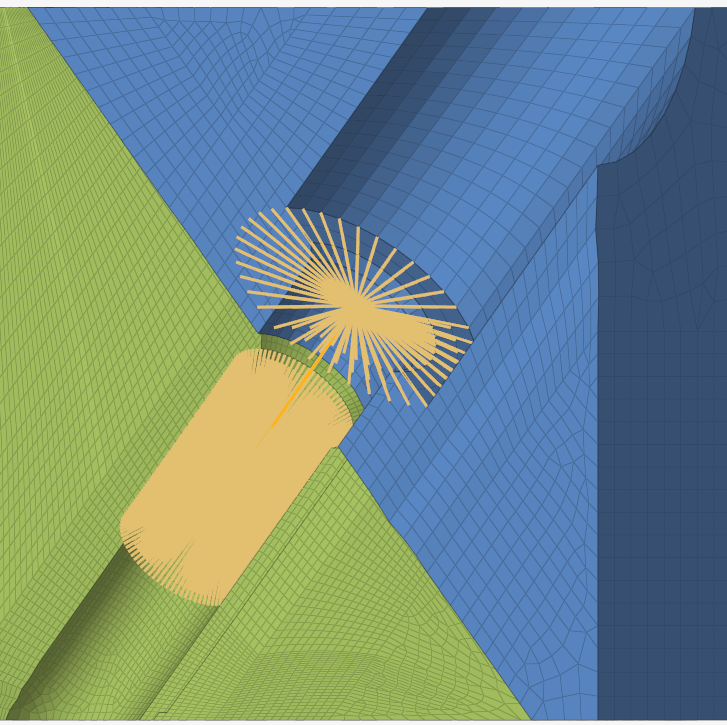
As mentioned, the above models did not allow for accounting for the specific properties of the bonded joint, such as bolt material, bolt size, and preload, but rather created idealized overstiffened connections. Beam elements as a surrogate for bolts are the simplest method of incorporating these factors, establishing them as the industry standard for many engineering problems.
1D bolt representations are created by modeling the screw shaft as beam elements and then connecting them to the surrounding structure via rigid or elastic elements. They can thus be seen as an extension of the RBE method by introducing a non-infinite stiffness between the connecting points. Typical implementations include OptiStruct’s CBAR and CBEAM, and the beam elements in ANSYS Mechanical.
They are beneficial because they support preload definitions as well as defining the stiffness of the screw shafts by accordingly tuning the stiffness of the beam element while still staying efficient for large assemblies, since they are only one-dimensional and thus scale well. This results in a good balance between accuracy and cost.
Typical deployments are:
VDI 2230 correlation
Fatigue-relevant load extraction
System-level structural analysis
Still, they lack the ability to resolve these stresses in a three-dimensional manner. For example, the local thread stresses are not depicted, and depending on the chosen interfaces for the RBE elements at either side, it is also quite regular that the forces are not distributed correctly. Additionally, it is necessary to manually calibrate the stiffness of the one-dimensional element, making sure it is in accordance with the stiffness of the entire screw. This becomes especially tedious for bolts with shanks or fit screws due to their changing cross-section, not only increasing labour but also room for error.
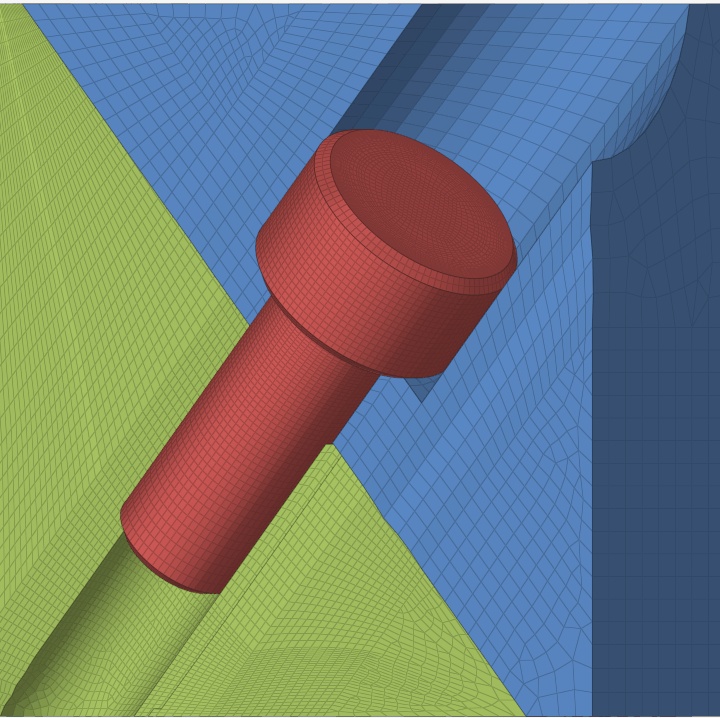
By increasing the complexity of solid bolts with a 3D mesh, the geometric realism is substantially increased. A standard simplification for this is to omit the threads themselves, treating the screw and the female thread as cylindrical bodies that can then be directly bonded together. The bolt head is also modeled in accordance with its real shape and implemented through a solid mesh.
Here, the contact of the screw head to the joint component can be set to either bonded or frictional, depending on the problem requirements. Implementations or do for all software, solid meshing together with appropriate contact definitions. Under the hood, pretension is applied by axially sectioning the screw into two parts and applying a relative axial displacement at the created interface, essentially artificially enlarging the screw length and thus creating tensioning forces that represent the pretension. The solver then manually tunes the artificial displacement to match the user-specified pretension. Both Ansys and Altair provide appropriate tools to streamline this process.
Use cases are:
Local stress evaluation
Verification models
Research studies
The gains of this approach lie in the increased resolution of the connection. 3D stresses, such as the notching effect between the screw head and the screw shaft, or the specific shape of the screw head, can be calculated, providing increased realism for the stresses inside the screw. Likewise, this also offers superior contact pressure predictions, since the screw stiffness is modeled three-dimensionally. The drawbacks of this approach mainly reduce the increased mesh effort, which takes longer to achieve for the simulation engineer, as well as increasing solving times, potentially also making the problem less robust. Additionally, the approach still has its limitations when it comes to the analysis of the thread behavior itself, as it is still idealized as a bonded cylindrical contact rather than depicting each thread individually. ANSYS offers a Bolt Thread Geometry Correction that promises the approximation of the thread stresses. However, this comes at the cost of having to set the element size to below a fourth of the pitch size, making the mesh size typically too small for practical evaluation.
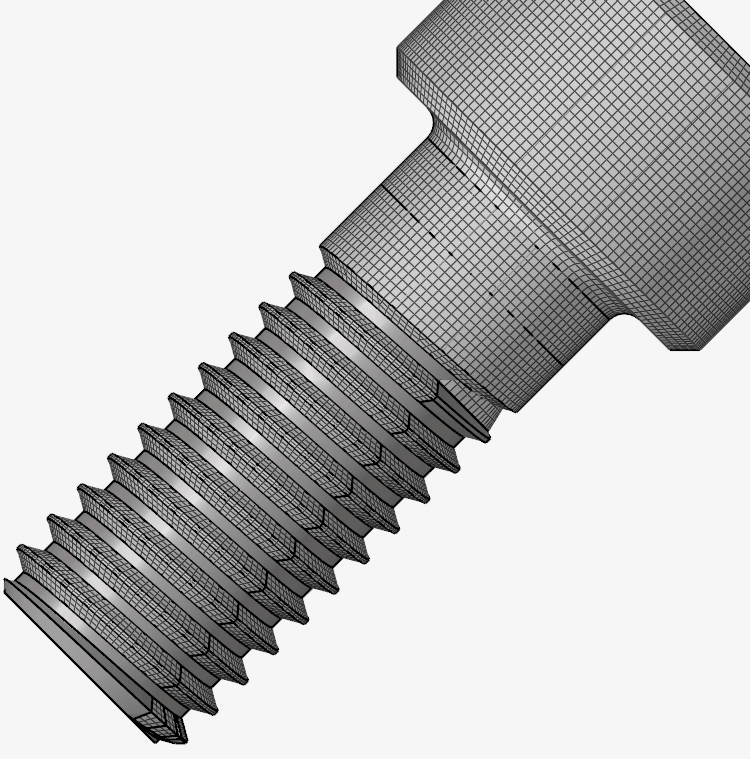
Finally, maximum realism can be targeted by significantly increasing computational cost through high-fidelity modeling of the threads themselves. Such an explicit helical thread geometry for both the male thread of the screw and the female thread of the engaging component can then be mated together through frictional contacts.
Here lie multiple implementation challenges. Firstly, creating an appropriate mesh is very difficult due to the extremely fine mesh size. It is not essential to set the mesh size to the pitch, but rather it must be significantly smaller, to also be able to account for the created stresses in every crease of the pitches. Even if meshing is achieved, this typically results in significant convergence issues due to the complex contact behavior. Nevertheless, it is the only way to accurately simulate thread stresses, which can be necessary if the governing failure mode is expected to be induced inside the threaded region. However, by following engineering standards such as the VDI 2230, it can be ensured that breakage occurs outside the engaged thread, thus circumventing any need to deploy such complex models in typical engineering problems.
Thus, their disadvantages in extremely high computational effort and infeasibility for full assemblies limit the typical usage to academic studies or model calibration and validation.
Your Joint Analysis and Simulation Project with FiniteNow

Selecting the Optimal Bolt Modeling Strategy for Your FEA Use Case
Let’s match the methods to their respective utilization opportunities.
Defining the Engineering Objective: What Do You Need to Know?
As already alluded to throughout the entire model descriptions, it is the wrong question to ask which model is the most accurate. Of course, it is always possible to boost accuracy by dramatically increasing the model scope. However, this always comes at the cost of increased labor time and increased simulation time. Thus, the key question that needs to be answered is what objective does my simulation have? Once this is clearly defined, it is possible to choose the model that is least complex, but still able to resolve the subject of interest. Let’s look at some contrasted objectives in detail:
There are many numerical values that can be influenced through screws. The table below gives an overview of which model is suited for which physical field.
| Modeling Technique | Forces (Axial / Shear) | Global Stiffness | Local Stresses in Screw | Local Stresses in Thread | Displacements | Contact Pressure |
|---|---|---|---|---|---|---|
| Bonded Contact (No Explicit Screw) | ✗ | ✓✓✓ | ✗ | ✗ | ✓✓ | ✗ |
| Rigid Elements (RBE2 / RBE3) | ✓✓ | ✓✓✓ | ✗ | ✗ | ✓✓ | ✗ |
| Beam-Based Bolt Model (1D Representation) | ✓✓✓ | ✓✓ | (✓) | ✗ | ✓✓✓ | (✓) |
| 3D Solid Bolt (No Explicit Threads) | ✓✓✓ | ✓✓ | ✓✓✓ | (✓) | ✓✓✓ | ✓✓✓ |
| Fully Modeled Threads (High-Fidelity Model) | ✓✓✓ | ✓✓ | ✓✓✓ | ✓✓✓ | ✓✓✓ | ✓✓✓ |
Next to the quantifiable results, also the resolvable failure modes are essential. If slip or separation is expected, choosing at least a beam model is required. Fatigue and yielding often require 3D models or the augmentation through appropriate fatigue models.
Lastly, the project phase (concept, design, verification) typically plays an important role when defining the targeted result accuracy, also heavily influencing the preferred model
Comparison of Bolt Modeling Approaches in Practice
In practice, the balance between model effort versus simulation fidelity or computational cost versus achievable accuracy has been settled for common engineering tasks. Typically, either beam-based models or 3D solid bolts without threads are chosen based on the assembly size, failure criticality, and company preferences. Although a mere bonded contact or rigid elements offer faster compute times, today’s hardware can handle the increased problem size without a significant penalty in compute time. Likewise, fully threaded models are so much more computationally demanding that there is still no means to utilize them in typical engineering challenges, marking the other extremum of the spectrum.
Learn more about our portfolio of Structural Engineering Services
However, that doesn’t mean that the vastly simplified bond-in-contact or rigid element methods, or the high-fidelity model of a model thread, have no place in today’s simulation ecosystem.
Simple models can be essential when it comes to surrogate modeling, as is used, for example, for optimization problems. Once the task at hand is not about validating a singular design, but rather to choose the optimum from a design space that could encompass thousands or even millions of potential candidates, reducing the compute time to an absolute minimum is mandatory. Likewise, for highly specialized problems in novel applications, properly understanding the loading of a thread can be required. even at the cost of significantly increased efforts. In the end, simulating such a problem is not only cheaper than tedious testing campaigns, but the yielded data, such as local three-dimensional stress distributions inside threads, is simply not obtainable through testing.
Alignment with VDI 2230 and Analytical Bolt Design
The past paragraphs have hinted at an essential challenge when it comes to simulating screwed joints. With typical modeling efforts, it is usually not possible to resolve the screw stresses throughout the entire body, including the thread, perfectly. So how can we decide whether a designed connection has a sufficient safety factor? This brings us back to the central question: what do you need to know? In the end, a bolted joint simulation does not have the intention to resolve all local stresses and compare them to the material’s ultimate tensile strength. Rather, it is advisable to only seek out the forces and moments the entire screw is subjected to. and compare those to the specifications of the entire screw.
The engineering standard VDI 2230 is a powerful tool to do exactly that. It provides robust and proven calculation schemes to determine the safety factor of the connection.
Additional Influencing Effects Often Overlooked
Lastly, we want to touch upon one topic that motivates us not to overcomplicate the modeling approach. Choosing vastly complex models, such as high-fidelity thread meshing, creates stresses in high resolution, which gives the illusion that these results must thus also be physically accurate, risking overconfidence.
Yet, beyond the meshing, there are many further influencing factors that all need to be set correctly to achieve physically accurate results in high-fidelity models. Let us look at a few examples.
Friction coefficients in interfaces
The two joint components are under frictional contact in the interface. Here, a frictional coefficient must be chosen to properly capture the lateral force resistance. This coefficient is highly problem-dependent and influenced by surface roughness, its treatment, machining process, lubricants, and many more.
Influence of surface treatment and coatings
The machining and formal processes of the components, and especially the screw itself, induce surface effects such as residual stresses that can heavily impact the strength of a component, especially when it comes to notching effects as ever-present in screws. This is, though, typically not captured in all simulations as a homogeneous material model is applied to an entire component.
Tightening method
In the end, a screwed joint needs to be assembled, and the assembly strategy as well as the tools used create unique stresses, for example, the torquing down of a screw and its rotational motion, which deforms the thread quite differently than the typical implementation of pretension as explained before (axial displacement).
Further relevant effects can include contact formulation choices, clearance versus fitted bolts, preload scatter, temperature and thermal expansion, and nonlinear material behavior.
Summary: Why Accurate Bolt Simulation Creates Real Engineering Value
Screwed joints are rightfully ubiquitous in modern engineering. They are dominant drivers of structural behavior with significant influence on both global stiffness and local load paths and stresses, governing fatigue and failure. The correct understanding of preload as a primary design parameter is necessary to create a sound connection. There is a strong coupling between the joint modeling technique and the result quality, driving a necessity to match the model fidelity to the target engineering question. Without deliberately defining the goal of the simulation, it is not possible to create a good simulation. Oversimplified models risk non-conservative and false conclusions if they omit Essential failure modes; likewise, overly complex high-fidelity models need to be cautiously assessed with all influencing parameters in mind. Finally, FEA is no longer a standalone tool, but can be augmented qualitatively and quantitatively through extension of analytical standards. Ultimately, finite element analyses reduce testing effort through informed simulation, increasing confidence and quality in any design.
Professional joint simulations create significant advantages for any and every company. Early detection of critical joint weaknesses in initial project phases can save many resources, as can the reduction in overdesign and material usage. This avoids late-stage design changes and allows for faster iteration cycles in product development. In later project phases, a company can benefit from improved correlations between calculation, test, and reality, avoiding aimless and uninformative testing campaigns. The reliable result extraction possible for simulations not only enables downstream verification but also generates defensible results for certification and customer reviews. Thus, FEA is a powerful and scalable accelerator for any project.
Solve Your Joining Challenge Instantly with FiniteNow’s Expert Support
As essential as joint simulations are, it is challenging not only to choose the correct modeling approach, but also to then realize it sophisticatedly. That is why FiniteNow aids you with tailored bolt modeling strategies for your individual
applications.
We are experienced in aligning FEA results with VDI 2230 and many other design standards, helping you leverage Simulation to the maximum. Our consulting will identify the governing failure modes, making sure the correct balance between
modeling fidelity for accuracy and cost can be struck. If required, we will perform detailed friction and contact sensitivity studies, ensuring the highest result quality for you as our customer. If you are not in need of a fully supported
Simulation solution but rather require guidance, our independent experts are happy to review your existing models and help you improve on them.
FiniteNow is your accelerated path from question to engineering answer.

Get fast, expert-level engineering simulation results with real-time quoting and zero delays
Book your Consultation now
- Structured assessment of your joint problem
- Clear recommendation of modeling approach
- Actionable results instead of generic simulations
FAQ – Bolted Joints for FEA Simulations
There is no single “best” method, only the most appropriate one for the engineering objective. Common approaches range from bonded contacts and rigid elements for early concept studies, to beam-based bolt models for force extraction and fatigue assessment, and up to fully 3D solid bolts or explicitly modeled threads for local stress evaluation. The optimal choice depends on whether forces, stiffness, contact pressure, slip, fatigue, or local stresses are the governing quantities.
Bonded contact without explicit screws is sufficient for concept studies, surrogate models, and global stiffness estimation where neither preload, slip, nor separation are relevant. This approach is computationally robust and fast but cannot represent preload, friction, realistic stiffness distribution, or joint failure modes.
FiniteNow helps you select the least complex model that still answers your engineering question, saving time and computational cost. You receive actionable results—forces, stiffness, safety margins—instead of generic stress plots that are difficult to interpret or defend.
Rigid elements enable fast load transfer and clean force extraction at reference nodes, but they introduce artificial stiffness and ignore bolt geometry, material, preload, and friction. As a result, different bolt sizes behave identically in the model, making this approach unsuitable for realistic joint behavior or fatigue analysis.
Beam-based bolt models offer the best balance between accuracy and efficiency for many engineering problems. They allow preload definition, realistic axial and shear stiffness, and scalable modeling for large assemblies. While they cannot resolve local 3D stresses or thread behavior, they are well suited for system-level analysis, force extraction, and correlation with analytical standards such as VDI 2230.
Bolt preload is typically introduced either by applying an axial force directly to a beam-based bolt element or, in 3D solid bolt models, by axially sectioning the bolt and imposing a controlled relative displacement. The solver iteratively adjusts this displacement to achieve the specified pretension force.
Yes. Aligning FEA with VDI 2230 is one of FiniteNow’s core strengths. We extract joint stiffness and bolt loads correctly from simulation and map them directly into the standard, ensuring defensible safety factors suitable for design reviews, certification, and customer documentation.
3D solid bolts without explicit threads are recommended when local stresses in the bolt shaft or under the bolt head are of interest, or when accurate contact pressure distributions are required. They significantly improve realism compared to 1D models but increase meshing effort, model size, and solution time.
Yes. FiniteNow supports the full development cycle—from fast concept-level models for decision-making, through design-phase optimization, to high-fidelity verification models suitable for testing correlation and certification support.
Explicit thread modeling is only necessary when the governing failure mode is expected within the thread itself. Due to extremely high meshing and convergence requirements, fully threaded models are typically limited to academic studies, calibration, or validation work. In most industrial applications, thread stresses are instead assessed analytically using standards such as VDI 2230.
FiniteNow focuses on engineering decision support, not just simulation delivery. We combine deep numerical expertise with standards-based engineering judgment, ensuring your bolt simulations answer the real question behind the model—and not just produce visually appealing results.
Bolt modeling strongly affects joint stiffness. Bonded contacts and rigid elements overestimate stiffness, while beam-based and 3D bolt models provide progressively more realistic compliance. Accurate stiffness prediction is essential for load sharing, fatigue life estimation, and correlation with test results.
No. FEA does not replace analytical standards but complements them. FEA is best used to extract realistic forces, moments, and joint stiffness values, which then serve as high-quality inputs for VDI 2230 calculations. This combination significantly reduces uncertainty compared to purely analytical or purely numerical approaches.
Simplified models can assess global forces and stiffness, while beam-based models allow evaluation of axial and shear loads relevant for fatigue. 3D solid bolts enable local stress and contact pressure analysis. Fully threaded models are required only for detailed thread stress evaluation. Slip, separation, preload loss, and fatigue all require at least beam-based modeling.
No. FiniteNow also offers model reviews and targeted consulting. If you already have an existing FEA model, we can audit your bolt modeling approach, preload definition, contact setup, and result interpretation – often delivering major improvements without rebuilding the entire model.
By identifying the true governing failure modes and realistic load paths, FiniteNow helps eliminate unnecessary conservatism. This often leads to fewer bolts, smaller bolt sizes, reduced flange thicknesses, and lower material usage—without compromising safety.
Start Now! It will only take 12 minutes
It has never been faster, easier and more cost effective to get a quotation for your structural simulation needs: