

A Short Review of nonlinear Materials in Finite Element Analysis
This article aims to highlight the key aspects and influences of nonlinear material modeling in FEA. Simulations always aspire to model reality as closely as possible, or at least necessary.
Here, accurate material representations play a central role since they directly influence a component’s stiffness and strength. A simple linear relation between stress and strain, i.e., force and deformation, is thus rarely sufficient, necessitating nonlinear materials.
Typical engineering applications are ubiquitous and range from plasticity, such as metals past their yield strength, elastic nonlinear materials such as rubber, or composite materials.
Let us start by giving an overview of non-linear behavior:
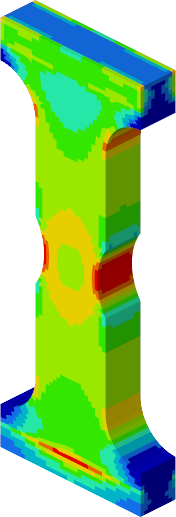
Key Aspects of FEM Nonlinearity
In finite element analysis (FEA), nonlinearity arises when the governing equations cannot be expressed as a linear relationship between loads and responses.
In general, three sources for nonlinearity can be named.
a. Material Nonlinearity
The stress-strain relationship is nonlinear and/or path-dependent. Typical causes are plasticity in brackets, yielding, hyperelasticity in brackets, rubber-like materials, or damage and failure models.
b. Geometric Nonlinearity
Large displacements or large rotations deform the body not directly proportional to the applied force. Examples are buckling and post-buckling behavior or follower forces (load direction changes with deformation).
c. Contact Nonlinearity
On the conditions of individual components change due to altered contact conditions. For example, a frictional contact goes from sticking to sliding with increased force, or the set of elements in contact changes due to deformation.
In real-world simulations, like bolted joint assemblies, all three nonlinearities often coexist:
- Plasticity in the bolt or plates (material),
- Large rotations or preload effects (geometric),
- Load transfer via friction and separation (contact).
- Elastic–plastic materials (metals)
- Hyperelastic materials (rubber, elastomers)
- Viscoelastic / viscoplastic materials
- Damage and failure-based materials
to reach maximum conformity of the physical product and the simulation, it is favorable to experimentally measure the material nonlinearity if it is not available from a supplier datasheet. Here, the stress-strain behavior is typically tested. One needs to differentiate between two measures:
Engineering (Nominal) Stress–Strain
Stress & strain are defined with respect to the initial (undeformed) geometry. For example, the critical cross-section of a coupon test. Thus, when multiplying the stress-strain curve by the area, the physical force-displacement curve is recovered.
True (Cauchy) Stress–Strain
True measures are defined with respect to the current (deformed) configuration. Due to effects like the poisson ratio, with increased loading, the observed cross-section decreases. This stress-strain curve Correctly captures post-yield behavior and provides higher ultimate strength.
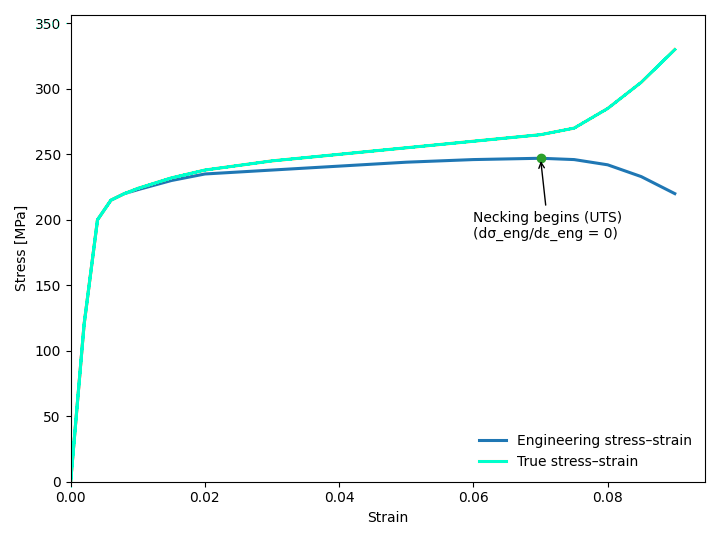
Key relationships (uniaxial, uniform deformation):
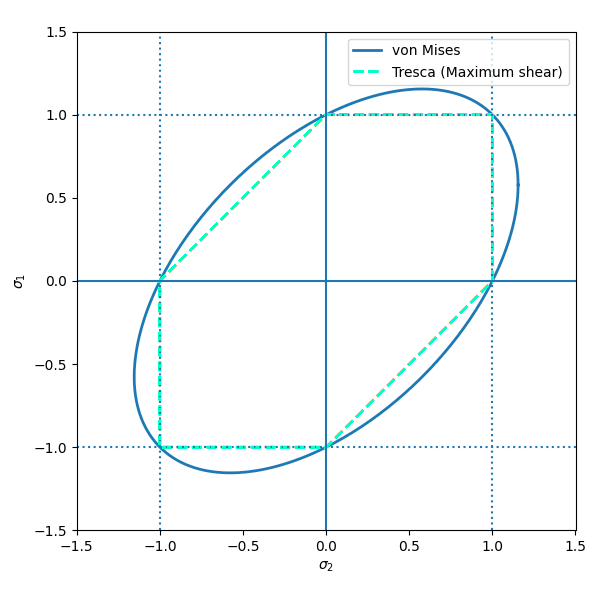
Yield criteria define the condition under which a material transitions from elastic (reversible) to plastic (irreversible) behavior. Although the commence of yielding cannot be linked to just a single component of the stress tensor, formulas reduce the entire tensors content to a single scalar that allow for defining a yield stress.
von Mises Yield Criterion
The von Mises criterion states that yielding begins when the distortional (shear) energy in the material reaches a critical value equal to that at yield in a uniaxial tensile test.
It is therefore also known as the distortion energy criterion.
Tresca Yield Criterion
The Tresca criterion assumes that yielding begins when the maximum shear stress in the material reaches a critical value measured from a uniaxial tensile test.
It is also called the maximum shear stress criterion.
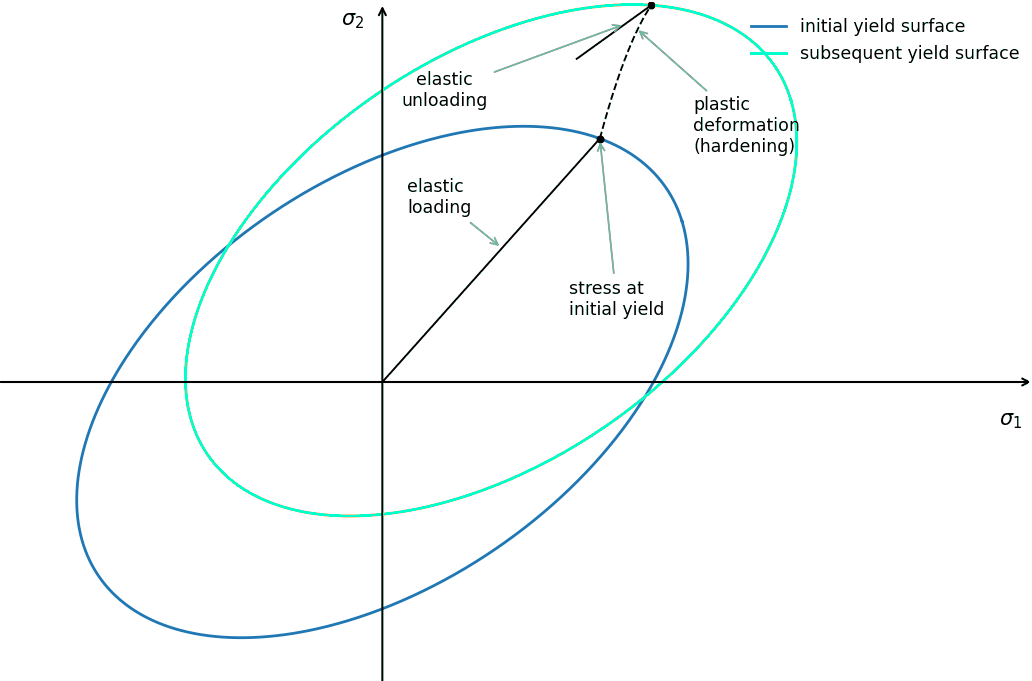
Once yielding occurs, the material response must describe how the yield condition evolves with increasing plastic deformation. Hardening models define how the yield surface changes in stress space as plastic strain accumulates, making it especially important for cyclic loading.
Isotropic Hardening
In isotropic hardening, the yield surface expands uniformly in all directions in stress space as plastic deformation increases. The material becomes stronger in all loading directions, independent of the loading path.
Kinematic hardening
In kinematic hardening, the yield surface translates in stress space without changing size. This captures the Bauschinger effect, where yielding in reverse loading occurs at a reduced stress.
Your Joint Analysis and Simulation Project with FiniteNow



Nonlinear Material Modeling in OptiStruct
Before selecting a specific material card or defining stress–strain input tables in OptiStruct, it is essential to understand how the constitutive behavior is translated into the solver’s internal formulation. Nonlinear material modeling does not just replace a constant Young’s modulus with a curve; it defines how stiffness evolves with plastic strain, time, temperature, or damage. The following tables summarize the available nonlinear material models and the corresponding input formats that control how stress–strain data and advanced constitutive effects are implemented in practice.
Supported Nonlinear Material Models
| Material Model | Behavior Class | Key Features | Typical Applications | Nonlinearity Type |
|---|---|---|---|---|
| MAT1 | Linear elastic | Constant stiffness, no yielding, no history effects | Linear structural analysis, reference stiffness | None (linear reference) |
| MATS1 | Elastic–plastic | Yielding, plastic flow, isotropic and/or kinematic hardening | Metals under plastic deformation, bolted joints | Material nonlinearity |
| MATHP | Hyperelastic | Large strains, nonlinear stress–strain, energy-based formulation | Rubber, elastomers, soft polymers | Material + geometric |
| MATVE | Viscoelastic | Time-dependent elasticity, stress relaxation, creep | Polymers, damping materials | Material + time |
| MATVP | Viscoplastic | Rate-dependent yielding, overstress behavior | Metals at high strain rates, forming | Material + time |
| MATD | Damage | Progressive stiffness degradation | Quasi-brittle materials, composites | Material degradation |
| MATDMG | Damage + failure | Damage initiation, evolution, and failure | Composite failure, fracture modeling | Material degradation |
Stress-Strain Input Methods
| Table Type | Data Representation | Purpose | Typical Use Cases | Nonlinearity Aspect |
|---|---|---|---|---|
| TABLES1 | True stress vs. plastic strain | Defines elastic–plastic material behavior beyond yield | Metal plasticity with isotropic and/or kinematic hardening | Material nonlinearity |
| TABRND | Generic nonlinear response curve | User-defined nonlinear relationships | Advanced or custom constitutive inputs | Material nonlinearity |
| TABST1 | Stress–strain relationship (generalized) | Flexible stress–strain input format | Alternative to TABLES1 where supported | Material nonlinearity |
| Temperature-dependent tables | Property vs. temperature | Captures thermal softening or stiffening | High-temperature applications, thermo-mechanical coupling | Material + thermal nonlinearity |
Important Material Parameters
Nonlinear Strain Measures
A number of formulation-level parameters control how strains are measured, how stresses are updated, and when material degradation or failure is triggered. Correct interpretation and consistent use of these parameters is essential
for physically meaningful results.
NL_EUL_STRAIN Flag
The NL_EUL_STRAIN setting controls whether strains are evaluated in the current (Eulerian) or reference (Lagrangian) configuration.
Large Strain vs Small Strain Formulation
Small strain formulations assume infinitesimal strains and rotations treating the geometry as effectively fixed. This simplification is suitable for linear and mildly nonlinear problems. Large strain formulations allow for the evolution
of the geometry during the analysis accounting for large displacements.
Failure Strain and Cutoff Options
Many nonlinear material models include failure criteria based on critical strain values. Once a specified failure strain is reached, the material response is modified to represent damage or loss of load-carrying capacity.
Post-Processing Nonlinear
Material Results
Nonlinear simulations generate substantially richer datasets than linear analyses. The solver no longer returns a single proportional stress state, but a sequence of equilibrium configurations in which stiffness evolves, contact conditions change, and plastic zones may grow or recede. Consequently, post-processing is not a purely graphical task but an analytical step: one must deliberately select physically meaningful quantities, track them consistently over increments, and interpret them in the context of material behavior and structural mechanics. The following sections outline which result measures are most relevant and how to evaluate them systematically to avoid misinterpretation.
Learn more about our portfolio of Structural Engineering Services
Relevant Result Quantities
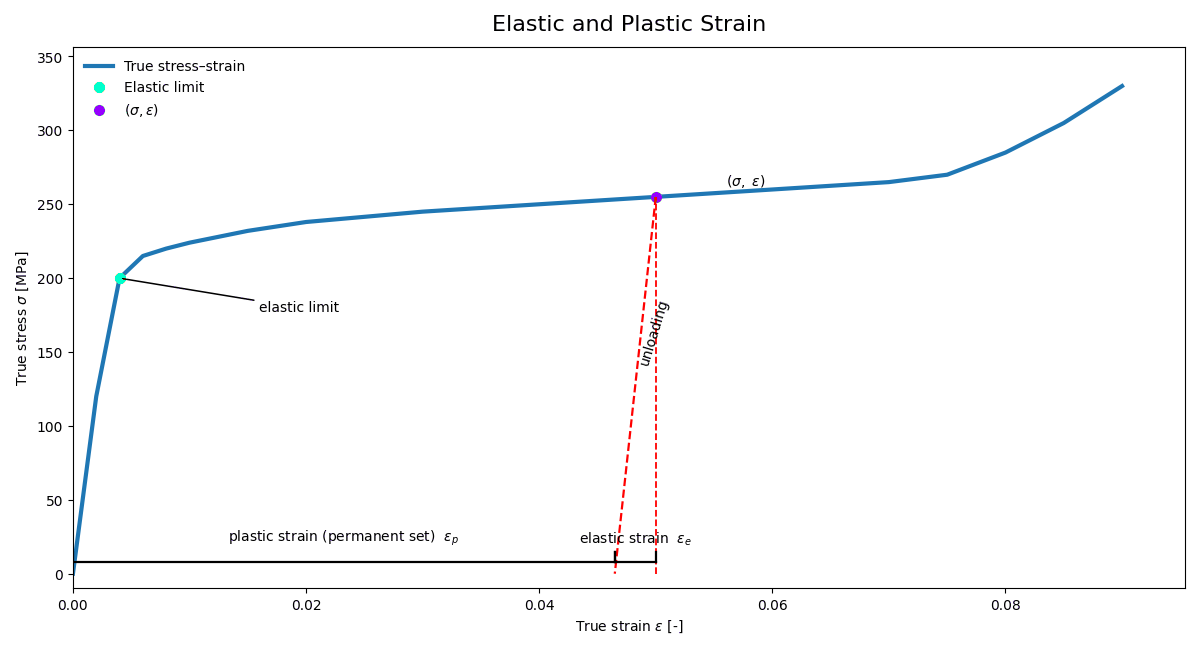
Plastic vs. Elastic vs. Total Strain
In nonlinear material analysis, it is critical to distinguish between three related but fundamentally different quantities:
- Total strain: The complete deformation measure, including elastic and plastic contributions.
- Elastic strain: The recoverable portion of deformation, directly linked to stress via the elastic stiffness.
- Plastic strain: The irreversible portion that cannot be recovered if the loading is removed.
Equivalent Plastic Strain
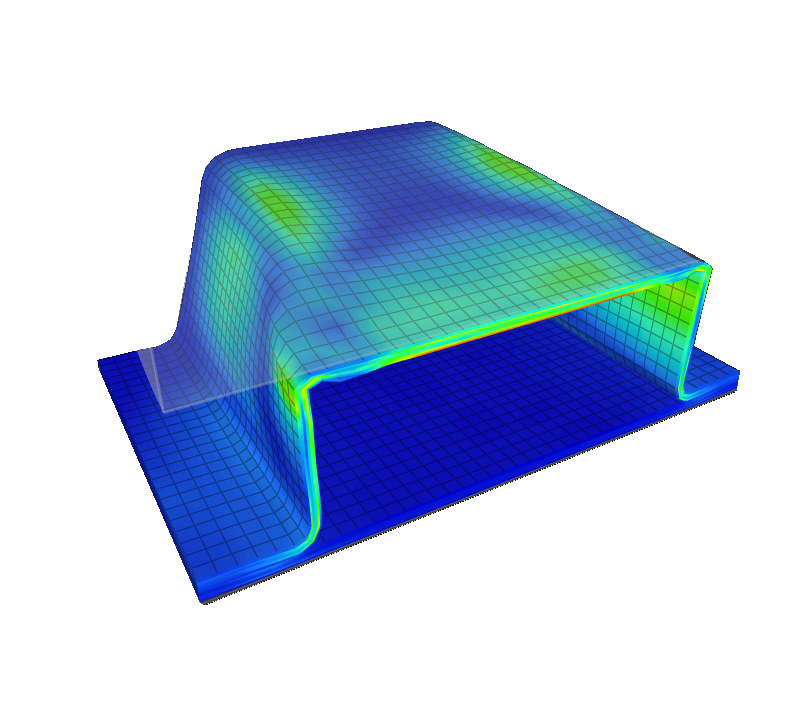
The plastic strain tensor represents the nine strain components accumulated once yielding occurs. The equivalent strain reduces this tensor to a single scalar. Purely elastic regions have zero equivalent plastic strain.
Plastic Strain Components
While equivalent plastic strain provides a compact scalar metric, the plastic strain tensor components retain directional information. This can be essential for understanding anisotropic plastic flow, revealing whether deformation is dominated by tension, compression, or shear.
Plotting Over Time
Selecting the Correct Increment Range
As opposed to linear cases, the nonlinearity can produce critical events, such as contact engagement or even peak stress in intermediate load conditions, rather than at the final conditions. Thus, it is not sufficient to only consider the last result. Each load increment represents an equilibrium state under partial loading, making it not only a helpful convergence technique but also allowing to analyze the problem under increasing loading. Hence, the increment range must be set sufficiently small to ensure all key events are evaluated and ready for meaningful inspection.
Key Considerations:
- Early increments capture elastic response and stiffness initialization
- Intermediate increments reveal yielding, contact transitions, or instability
- Final increments may reflect unloading, softening, or numerical stabilization
Best Practices:
- Identify increments corresponding to physical events of interest
- Avoid interpreting results from incomplete or artificially extended increments
- Verify that the selected increment range corresponds to the intended load level
Misinterpretation Risk:
- Using only the final increment may hide peak stresses or strains
- Solver-imposed cutbacks can distort perceived load progression
Force–Displacement Curves
Force-displacement tools are among the most important diagnostic tools in nonlinear analysis since they provide an integrated overview of the simulation evolution, evaluated at all load steps. This also highlights the necessity of sufficiently small load steps. Additionally since the result is a global quantity, rather than something local like a stress tensor of a single evaluation point, it is well-suited to be compared with physical experiments and thus also an ideal validation tool.
Stress–Strain Extraction from Elements
To gain insights into material failure it is mandatory to look into localized behavior that cannot be assessed from an integrated force-displacement relationship. Thus extracting the stress-strain relationship of individual elements at
points of interest, such as for example notches, or lying on the components principle axis
Key aspects:
- Stress and strain must be taken from the same material point
- True stress and appropriate strain measures should be used
- Path dependency means curves depend on loading history
Common extraction approaches:
- Element-based integration point tracking
- Averaging over a small, representative region
- Avoiding nodal extrapolation for plasticity evaluation
Interpreting Results Correctly
Nonlinear finite element results must be interpreted with an understanding of how materials and structures adapt and redistribute load once idealized assumptions—such as linear elasticity—are violated. Incorrect interpretation can lead to overly conservative or dangerously non-conservative conclusions.
Stress Redistribution After Yielding
When yielding initiates in a localized region, the material stiffness in that region decreases. As a consequence, the structure redistributes load to surrounding, still-elastic regions. Thus, load-carrying capacity can increase after local
yielding, and maximum stress at the final increment may not indicate critical conditions.
Local vs. Global Plasticity
A critical distinction in nonlinear analysis is whether plasticity remains local or becomes global.
Local plasticity
- Confined to small regions (e.g., notches, bolt holes)
- Often acceptable and sometimes intended in design
- Does not significantly reduce global stiffness
Global plasticity
- Large portions of the structure yield
- Significant stiffness reduction
- Often signals approach to collapse or loss of function
Interpretation Guidance:
Firstly, evaluate the spatial extent of plastic strain under consideration of the component’s structural dimensions. Secondly, search for correlations between the local phenomenon and changes in the global force-displacement behavior.
Lastly, by extending the simulation to multiple load cycles, an evaluation of the change in peak stress magnitude and region can help determine the severity. Many standards allow for controlled local yielding and give further guidance
on defining acceptable levels. In contrast, global plastic collapse typically defines the ultimate limit state.
Mesh Sensitivity Considerations
Nonlinear material results, particularly plastic strain and damage indicators, are inherently mesh-sensitive. This sensitivity arises from strain localization in softening materials, integration-point-based plasticity formulations, and
stress singularities at sharp corners or contact regions. Typical symptoms include increasing peak plastic strain with mesh refinement, shifting failure initiation between elements, and apparent convergence issues in finer meshes. To mitigate
these effects, mesh convergence studies should focus on global response, local peak values should be interpreted with caution, and regularization or nonlocal approaches should be used where available. As best practice, global quantities
such as forces, displacements, and energies should be trusted more than local maxima, and mesh density and sensitivity checks should always be documented.
Validation Techniques for Nonlinear Material Models
Meaningful validation of the simulation setup is always essential to ensure supreme result quality. This is especially true for nonlinear probelms due to their increases sensitivity to input parameters and their enlarged risk for misspecification. Below three techniques are proposed to forma progressive validation hierarchy, ensuring credibility.
| Validation Technique | Description | Primary Objective | Key Insights Gained | Limitations |
|---|---|---|---|---|
| Single-element tests | Isolated element subjected to controlled loading | Verify constitutive law implementation | Yield onset, hardening behavior, stress–strain consistency | No structural effects, no geometry interaction |
| Coupon simulations (tension, shear) | Simulation of standardized material test specimens | Validate material model under realistic stress states | Plastic flow, strain localization, failure initiation | Sensitive to boundary conditions and mesh |
| Comparison with experimental data | Correlation of simulation results with physical test results | Confirm predictive accuracy of the model | Global response, failure modes, quantitative agreement | Experimental scatter, measurement uncertainty |
Common Mistakes and Troubleshooting
Wrong Strain Definition (Engineering vs True)
Measuring the compliance evolution of a material through physical testing always yields engineering strain, which lacks accounting for the changing geometry during testing. Thus, the data needs to be converted to true strain before utilizied as an FEA material.
Incorrect Table Input (Elastic + Plastic mixed)
Depending on the solver settings, tabular stress strain relations must reference plastic or total strain. Misspecification significantly falsifies the behavior.
Non-Convergence due to large Load Increments
In order to properly resolve plastic flows and ease the difficulty for the solver to reach equilibrium a reduced step size is benefitial, at the cost of increase compute time.
References and Further Reading
“Hyperelastic material” – Wikipedia
Overview of hyperelastic constitutive models used in nonlinear FEA, especially for rubber-like materials.
Hyperelastic material (Wikipedia)
“Mooney–Rivlin solid” – Wikipedia
Detailed explanation of a common hyperelastic model and its strain-energy formulation.
Mooney–Rivlin solid (Wikipedia)
“Arruda–Boyce model” – Wikipedia
Hyperelastic material model based on statistical mechanics for polymer networks — useful for advanced material behavior modeling.
Arruda–Boyce model (Wikipedia)
“Ramberg–Osgood relationship” – Wikipedia
Phenomenological description of the nonlinear stress–strain curve approach used in many metal plasticity contexts.
Ramberg–Osgood relationship (Wikipedia)
Drucker–Prager yield criterion — Wikipedia
Summary of a widely used pressure-dependent yield model in continuum plasticity — good conceptual reference for yield surfaces.
Drucker–Prager yield criterion (Wikipedia)
Von Mises yield criterion — Wikipedia
Standard overview of the distortion energy criterion for yielding in ductile materials — clear mathematical basis for classic plasticity.
Von Mises yield criterion (Wikipedia)
Anand, S. C., Lee, S. L. & Rossow, E. C. — Finite element analysis of elastic-plastic plane stress problems based upon the Tresca yield criterion
Ing. Arch. 39, 73–86 (1970). DOI:
https://doi.org/10.1007/BF00532658 — classic FEA treatment of plasticity and yield surface implementation.
Khaniki, H. B., Ghayesh, M. H. et al. — A review on the nonlinear dynamics of hyperelastic structures
Nonlinear Dyn. 110, 963–994 (2022). (
Open access review of hyperelastic constitutive laws and large-strain behavior).
Anandarajah, A. — Computational Methods in Elasticity and Plasticity: Solids and Porous Media
(
Springer, 2010) — comprehensive textbook on constitutive models and FEA implementation of nonlinear solid mechanics.
Altair HyperMesh/OptiStruct Material Reference Guide (official documentation)
Manufacturer documentation listing material models and nonlinear capabilities (reference manual section).
OptiStruct Material Models — Altair Help
Master Nonlinear Material Behavior with FiniteNow’s FEA Expertise
Nonlinear material simulations are powerful, but only when set up and interpreted correctly. From true stress–strain conversion to yield criteria selection, hardening models, strain measures, and increment control, small modeling decisions can dramatically affect your results.
FiniteNow supports you in building robust, physically consistent nonlinear material models in HyperMesh / OptiStruct. We help you select the appropriate constitutive formulation, validate input data, interpret plastic redistribution correctly, and ensure mesh-robust conclusions. Whether you require full simulation support or an expert review of your existing model, we ensure your analysis reflects real material behavior and not numerical artifacts.
FiniteNow – turning nonlinear complexity into engineering clarity.

Get fast, expert-level engineering simulation results with real-time quoting and zero delays
Book your Consultation now
- Structured assessment of your joint problem
- Clear recommendation of modeling approach
- Actionable results instead of generic simulations
FAQ – Nonlinear Materials for Finite Element Simulation
Material nonlinearity occurs when the stress–strain relationship is nonlinear or path-dependent. Unlike linear elasticity (σ = E·ε), nonlinear materials exhibit yielding, plastic flow, hyperelastic behavior, viscoelastic effects, or damage evolution. In practical FEA, this means the stiffness matrix changes during the solution process, requiring incremental-iterative solution schemes.
Nonlinearity in FEA arises from three sources:
- Material nonlinearity (plasticity, hyperelasticity, damage)
- Geometric nonlinearity (large displacements, large rotations, buckling)
- Contact nonlinearity (changing contact states, friction, separation)
In real engineering problems—such as bolted joints or forming simulations—these nonlinearities often coexist and interact.
We optimize load stepping strategies, increment sizes, contact formulations, strain measures, and solver controls. Instead of blindly refining the mesh or increasing iterations, we address the root cause of instability—whether material definition, geometric formulation, or contact interaction.
Engineering stress and strain are calculated using the initial geometry of a specimen. True (Cauchy) stress and logarithmic strain account for the continuously changing cross-section during deformation.
Key relationships (uniaxial case):
- σ_true = σ_eng (1 + ε_eng)
- ε_true = ln(1 + ε_eng)
For plasticity modeling in FEA, true stress vs. plastic strain is typically required to accurately capture post-yield behavior.
True stress–strain curves should be used for elastic–plastic materials modeled with MATS1 in OptiStruct, especially when large plastic strains occur. Engineering curves must be converted before input, otherwise post-yield behavior and ultimate strength will be incorrectly represented.
Yes. We distinguish between acceptable local yielding and critical global plastic collapse. Our evaluations connect local strain fields with global structural behavior and engineering standards, preventing both over-conservative and dangerously non-conservative conclusions.
The von Mises yield criterion is based on distortional (shear) energy and predicts yielding when the equivalent stress reaches the uniaxial yield stress.
The Tresca criterion is based on maximum shear stress.
Von Mises is smoother and more commonly used in FEA solvers like OptiStruct. Tresca is more conservative but less frequently applied in numerical simulations.
- Isotropic hardening expands the yield surface uniformly in stress space, increasing yield strength in all directions.
- Kinematic hardening translates the yield surface, capturing the Bauschinger effect under cyclic loading.
For cyclic or reverse loading simulations, kinematic hardening is essential for realistic stress predictions.
Nonlinear FEA is highly sensitive to input definitions. Small mistakes in strain conversion, table input, or hardening assumptions can invalidate entire simulation campaigns. FiniteNow accelerates your path to defensible, validated, decision-ready results—saving weeks of iteration and preventing costly design misjudgments.
Common nonlinear material cards in OptiStruct include:
- MAT1 – Linear elastic reference material
- MATS1 – Elastic–plastic material with hardening
- MATHP – Hyperelastic materials (rubber-like behavior)
- MATVE – Viscoelastic behavior (creep, relaxation)
- MATVP – Viscoplastic (rate-dependent plasticity)
- MATD / MATDMG – Damage and failure models
Model selection depends on whether the problem is strain-driven, time-dependent, large-strain dominated, or failure-critical.
FiniteNow ensures correct material data preparation, proper strain measure conversion, correct hardening selection, and consistent solver settings. We prevent typical errors such as mixing engineering and true strain or misdefining plastic strain tables, which can otherwise invalidate results.
Equivalent plastic strain is a scalar measure derived from the plastic strain tensor. It represents accumulated irreversible deformation independent of direction. Purely elastic regions have zero equivalent plastic strain. It is commonly used to identify yielding zones and evaluate ductile failure initiation.
Yes. We perform structured validation hierarchies:
- Single-element verification tests
- Coupon simulations (tension, shear, cyclic)
- Correlation with experimental force–displacement curves
This ensures your nonlinear model is physically meaningful—not just numerically convergent.
Plastic strain, damage variables, and softening behavior can localize into narrow regions. With mesh refinement, peak plastic strains may increase without converging. Therefore:
- Global quantities (force–displacement curves) are more reliable.
- Mesh convergence studies are mandatory.
- Regularization techniques may be required for softening materials.
Critical events—such as first yield, contact engagement, buckling onset, or peak stress—often occur at intermediate increments. Evaluating only the final load step may hide maximum stresses or misrepresent physical behavior. Force–displacement curves across all increments provide a more reliable diagnostic tool.
Absolutely. We support hyperelastic model selection (e.g., Mooney–Rivlin, Ogden-type via MATHP), parameter fitting from test data, and large-strain geometric formulations. This is particularly relevant for sealing systems, elastomer mounts, and soft polymers.
Start Now! It will only take 12 minutes
It has never been faster, easier and more cost effective to get a quotation for your structural simulation needs: