
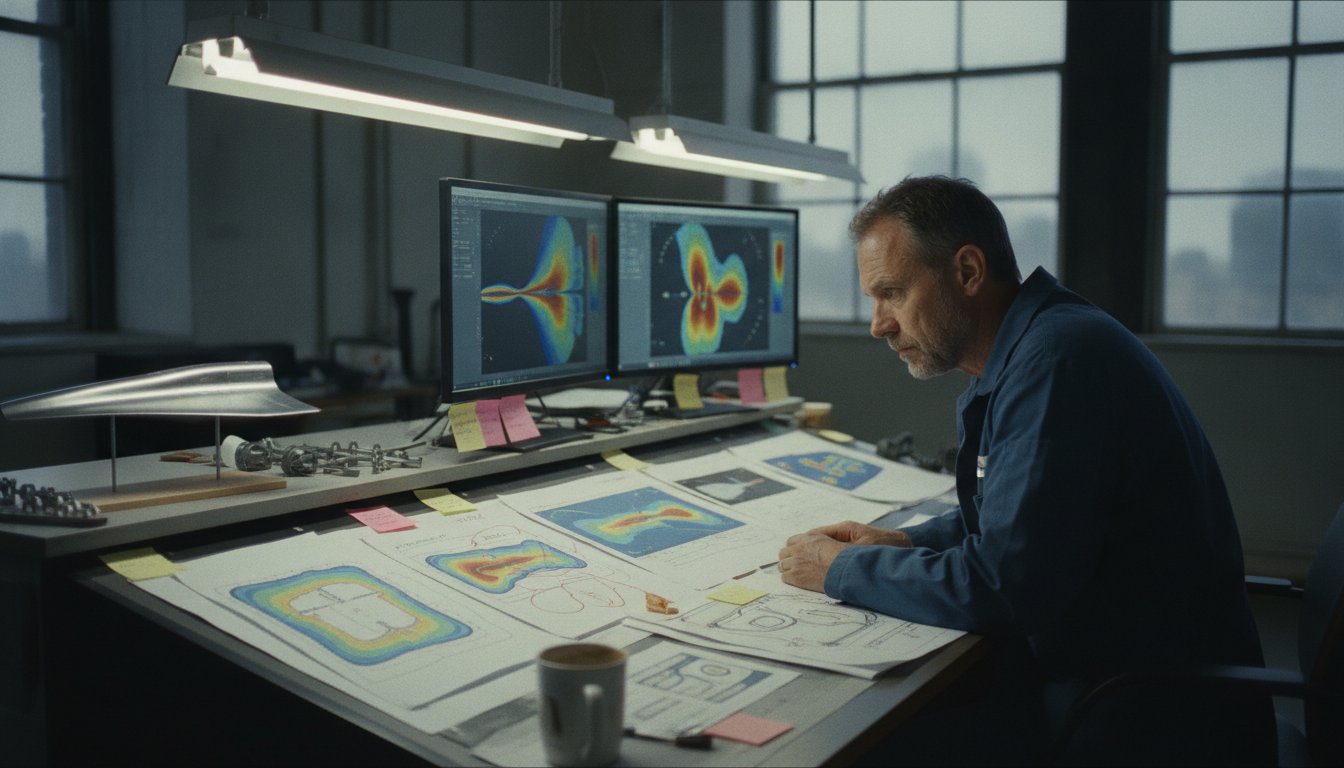
Traditional wind tunnel testing is a legacy bottleneck that modern engineering schedules can no longer afford. While physical validation remains a gold standard, the path to achieving peak aerodynamic performance optimization has shifted toward digital-first workflows. You likely recognize the frustration of high software licensing fees and the long lead times associated with physical prototypes. It’s a common struggle to balance technical precision with the aggressive timelines demanded by today’s market.
We agree that the complexity of setting up high-fidelity simulations shouldn’t stall your innovation. This guide provides a professional engineering framework to master the optimization process, helping you reduce drag coefficients and enhance vehicle stability without the overhead of permanent software assets. You’ll learn a systematic workflow that leverages high-fidelity CFD simulation to cut R&D costs and accelerate time-to-market. We’ll explore the transition from traditional obstacles to modern, project-based solutions that deliver validated performance data directly to your stakeholders.
Key Takeaways
- Learn to balance drag reduction with cooling and structural integrity through a precise, iterative shape refinement process.
- Master the 5-step workflow for aerodynamic performance optimization to establish baseline metrics and identify critical design parameters.
- Utilize parametric modeling and advanced gradient methods to efficiently manage and refine hundreds of design variables.
- Reduce R&D overhead by replacing physical prototype cycles and software licensing with high-fidelity digital iterations.
- Access on-demand, German-engineered CFD expertise to secure validated performance data without long-term contract commitments.
What is Aerodynamic Performance Optimization?
Aerodynamic performance optimization is the iterative engineering process of refining a body’s geometry to minimize air resistance. It isn’t just about achieving a low drag coefficient (Cd); it’s a disciplined balancing act. Engineers must reduce drag while ensuring sufficient cooling airflow, managing lift for stability, and maintaining structural integrity. In a professional context, this means your design must perform under pressure without compromising the functional requirements of the system.
As we look toward 2026, the urgency for efficiency has never been higher. Stricter carbon footprint mandates and the rapid transition to Electric Vehicles (EVs) have made aerodynamics the primary lever for range extension. Key metrics define this success. Beyond the standard Cd, engineers analyze pressure distribution to identify stagnation points and wake turbulence to minimize energy loss. Success in this field requires moving beyond intuition and into data-driven shape refinement.
The Economic Impact of Aerodynamics
Efficiency is a financial imperative. At highway speeds, approximately 50% of a vehicle’s fuel or battery energy is spent solely on overcoming air resistance. This makes aerodynamic efficiency a direct driver of product lifecycle costs. By identifying performance bottlenecks early in the CAD phase, you avoid the massive expenses associated with late-stage engineering changes. A streamlined profile doesn’t just look better; it protects your margins and increases the value proposition for the end-user. It’s about maximizing ROI through smarter design.
CFD vs. Wind Tunnel Testing
Legacy engineering relied heavily on physical wind tunnels. These facilities are expensive, require long lead times for prototype manufacturing, and offer limited data points. Modern teams are shifting toward digital validation to gain a competitive edge. High-fidelity CFD simulation provides a transparent, granular view of flow physics that physical testing cannot match. The cost-per-iteration is significantly lower in a digital environment. While a wind tunnel test might take weeks to prepare, a digital iteration can be completed in hours. This speed allows for a broader exploration of the design space, ensuring that the final product is truly optimized rather than just “good enough.”
The Mechanics of Optimization: From CAD to CFD
Moving from a conceptual design to a high-performance profile requires a precise translation of geometry. Parametric modeling serves as the foundation for this transition. By defining shape variables as adjustable parameters, engineers can explore thousands of design iterations without the manual burden of CAD remodeling. This flexibility is essential for aerodynamic performance optimization, as it allows for the automated exploration of the entire design space to find the most efficient configuration.
Traditional optimization methods often struggle with high dimensionality. The Adjoint Method changes this dynamic by efficiently computing the sensitivity of an objective function to hundreds of design variables simultaneously. Instead of running a separate simulation for every minor tweak, the Adjoint Method provides a gradient map of the entire surface. This map indicates exactly where to modify the geometry to reduce drag or improve pressure distribution, providing a clear roadmap for shape refinement.
High-fidelity mesh generation is non-negotiable for capturing boundary layer physics accurately. Without a refined mesh at the surface, critical phenomena like flow separation and vortex shedding remain invisible to the solver. Additionally, integrating fluid-solid interaction ensures that your aerodynamic performance optimization efforts don’t produce shapes that fail under operational loads. An aerodynamically perfect wing is useless if the structural deformation under high pressure compromises its performance.
Defining Objective Functions and Constraints
Optimization requires clearly defined targets and realistic boundaries. You must decide whether your primary goal is minimizing drag for EV range or maximizing downforce for high-speed stability. These objectives often conflict, necessitating a weighted approach. Your constraints must also account for the following:
- Manufacturing Feasibility: Can the optimized shape be built using standard casting or stamping processes?
- Thermal Management: Does the new profile compromise cooling flow to the battery or engine?
- Packaging Requirements: Does the shape interfere with internal components or passenger space?
Turbulence Modeling and Physics
Selecting the right turbulence model depends on your computational budget and the specific flow physics involved. RANS (Reynolds-Averaged Navier-Stokes) is highly efficient for steady-state flows, while LES (Large Eddy Simulation) or DES (Detached Eddy Simulation) are necessary for capturing transient vortex shedding in complex wakes. The Reynolds Number is the ratio of inertial to viscous forces. Understanding this ratio helps determine if your flow is laminar or turbulent, guiding the selection of mesh density and wall functions to ensure simulation validity.
For teams looking to bypass the complexity of internal simulation setup, our on-demand CFD services provide instant access to high-fidelity results with German-engineered precision.
Optimizing Aerodynamics: A 5-Step Professional Workflow
Mastering aerodynamic performance optimization requires more than just high-end software; it demands a disciplined, repeatable workflow. Traditional engineering often relies on intuition or trial and error, which leads to bloated R&D budgets and missed deadlines. A professional digital twin approach replaces these uncertainties with a methodical 5-step process. By treating the simulation as a virtual wind tunnel, you can explore the design space with a level of granularity that physical testing can’t provide.
- Step 1: Baseline Performance Assessment — Establish current Cd, lift coefficients, and pressure maps to identify existing bottlenecks.
- Step 2: Parameterization — Define which surfaces can be modified without violating manufacturing or packaging constraints.
- Step 3: Sensitivity Analysis — Use gradient data to determine which specific shape changes will yield the highest performance gains.
- Step 4: Automated Iteration — Execute gradient-based optimization loops via CFD to refine the geometry autonomously.
- Step 5: Validation and Reporting — Perform a final high-fidelity simulation to verify results and provide data-backed evidence for stakeholders.
Step 1 & 2: Setting the Foundation
You can’t optimize what you haven’t accurately measured. Preparing a clean CAD model is the first priority; removing small fasteners or irrelevant internal details prevents meshing errors that stall the solver. Once the geometry is ready, define a bounding box and flow conditions that mirror real-world operation. It’s vital to ensure stakeholders understand what is CFD in engineering before proceeding. Aligning expectations on simulation accuracy and lead times ensures the project remains focused on actionable outcomes rather than theoretical perfection.
Step 3 & 4: The Optimization Loop
The core of aerodynamic performance optimization lies in the iteration loop. Instead of guessing where to move a surface, use adjoint solvers to identify “hotspots” where drag is most sensitive to shape changes. This data-driven approach allows you to manage the inevitable trade-offs between aerodynamic gain and structural FEA results. If a thinner profile reduces drag but leads to excessive vibration or stress, the loop must recalibrate. Monitor convergence closely during these automated runs to ensure the simulation has reached a stable, reliable solution before moving to validation.
This digital workflow offers a massive ROI compared to traditional prototyping. While a physical prototype cycle might take 4 weeks, digital iterations can be completed in 48 hours. By shifting to project-based simulation service fees, you eliminate the overhead of legacy software licensing while maintaining a faster time-to-market. The final step is validation. A high-fidelity run confirms the gains, providing the precision needed to proceed to production with total confidence.
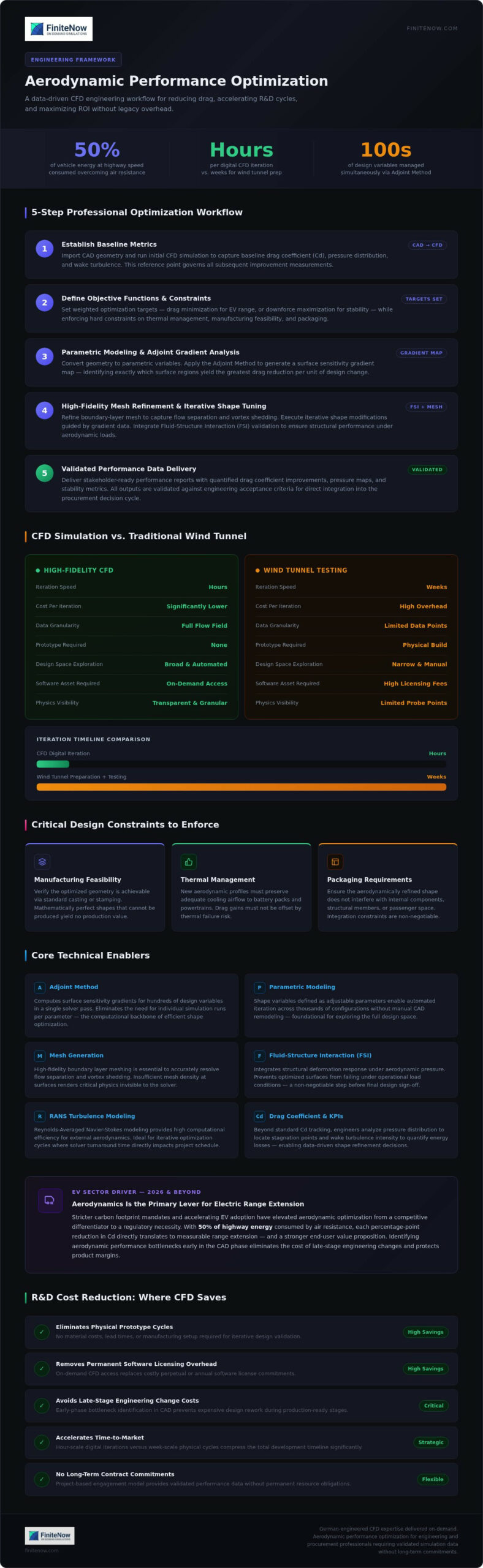
CFD Simulation vs. Traditional Prototyping ROI
Physical wind tunnel testing is a linear, high-friction process. Every design change requires a new physical model, a scheduled slot in a testing facility, and manual sensor placement. This legacy approach creates a bottleneck that stalls innovation. In contrast, digital twins offer an agile alternative. Digital iterations can be completed in as little as 48 hours, compared to the 4-week cycles typical of physical prototype manufacturing. This speed allows you to explore the design space with a level of aggression that physical testing can’t support.
Scalability is the primary differentiator. While a wind tunnel can only test one model at a time, digital environments allow you to run parallel simulations for multiple design variants simultaneously. You can evaluate ten different winglet profiles in the time it takes to build one physical mock-up. This parallel processing ensures that you arrive at the peak of aerodynamic performance optimization faster, reducing total R&D time and ensuring that your product hits the market ahead of the competition.
Eliminating Software Licensing Barriers
Internal CFD departments often struggle with the high cost of entry. Traditional software licensing requires massive annual fees, high-end hardware maintenance, and specialized training for staff. If your team isn’t running simulations 24/7, you’re paying for idle license time. We’ve disrupted this model by offering project-based simulation service fees. This approach turns heavy capital expenditure into a streamlined operational expense. You gain access to high-end solvers and high-performance computing (HPC) clusters without the long-term financial burden of legacy licensing.
Accuracy and Validation
Modern high-fidelity CFD correlates closely with real-world data, but the value lies in the interpretation. Our German-based engineering team provides the precision needed to translate complex fluid dynamics into actionable business decisions. A critical advantage of our digital workflow is the integration of Fluid-Structure Interaction (FSI). Aerodynamic performance optimization is a hollow victory if the resulting shape fails under operational loads. FSI allows us to predict how thin-walled components or composite structures will deform under high-pressure gradients. Identifying these potential failure points before expensive tooling is cut is the ultimate form of risk mitigation.
Stop waiting for wind tunnel slots and get an instant quote for your project to start your digital optimization today.
On-Demand Aerodynamic Optimization with FiniteNow
FiniteNow redefines how modern engineering teams execute aerodynamic performance optimization. Legacy licensing models and long-term contracts are outdated bottlenecks that slow down innovation. We provide a faster, more transparent alternative that prioritizes your project’s immediate technical needs. Our German-based engineering team combines technical mastery with a results-oriented mindset to deliver high-fidelity results that meet the highest global standards. We act as your high-performance partner, removing the traditional barriers to advanced simulation.
Efficiency starts with the very first interaction. Our instant quoting system eliminates the friction of traditional procurement cycles. You don’t have to wait days for a proposal; you receive project-based simulation service fees immediately. This on-demand model allows you to scale your simulation capabilities without increasing your permanent overhead or investing in expensive hardware. It’s a methodical yet rapid progression designed to mirror the speed of a digital workflow.
The FiniteNow Process
The workflow is designed for maximum clarity and impact. Once you submit your project details, our system evaluates the complexity to provide a precise quote. We manage a network of pre-qualified suppliers, with every simulation overseen by our German experts to ensure reliability. You receive transparent, scalable results without the need for internal software assets. We also prioritize direct collaboration, offering on-demand video calls for design reviews. This ensures that technical insights are communicated effectively and that every optimization aligns with your broader engineering goals.
Ready to Optimize Your Performance?
Choosing digital twins over physical prototypes is a strategic decision that protects your margins. It reduces R&D costs and provides a granular understanding of flow physics that physical testing cannot replicate. By integrating aerodynamic performance optimization into your design cycle early, you secure a significant competitive advantage. You gain validated performance data and a faster path to production, ensuring your design is procurement-ready from day one. Don’t let legacy constraints hold back your innovation.
Get an instant quote for your aerodynamic optimization project and start your journey toward peak performance today.
Accelerate Your Engineering Design Cycle
The transition from legacy wind tunnel testing to high-fidelity digital validation is no longer optional for competitive engineering teams. By adopting a systematic digital twin workflow, you secure validated performance data while significantly reducing R&D overhead. We’ve explored how parametric modeling and the adjoint method drive aerodynamic performance optimization, ensuring that every design iteration is backed by precise fluid dynamics and structural integrity.
FiniteNow provides the expertise and infrastructure to execute these complex simulations on demand. You don’t need expensive software licenses or long-term contracts to achieve professional results. Our German-based engineering team delivers precision and reliability through a streamlined, project-based model with instant, transparent pricing. It’s time to move past traditional bottlenecks and embrace a faster, more agile approach to product development. By leveraging on-demand CFD, you ensure that your product hits the market with validated performance and a lower carbon footprint.
Get an Instant Quote for Aerodynamic Optimization and start refining your design today. Your next breakthrough is only a few digital iterations away.
Frequently Asked Questions
How much drag reduction can I expect from aerodynamic optimization?
Drag reduction potential depends heavily on your baseline geometry and specific application. For Electric Vehicles (EVs), even minor refinements to the drag coefficient can lead to measurable increases in battery range at highway speeds. Our process identifies stagnation points and separation zones that contribute to energy loss. By refining these specific areas through aerodynamic performance optimization, we ensure your design achieves the highest possible efficiency without compromising cooling requirements.
Is CFD simulation as accurate as a physical wind tunnel?
High-fidelity CFD simulation provides data granularity that physical wind tunnels can’t match. While wind tunnels are excellent for final validation, CFD captures the entire flow field, allowing you to see vortex shedding and pressure gradients in real time. Our German-based engineering team uses advanced turbulence models to ensure that digital results correlate closely with real-world physics. This digital-first approach provides a transparent and reliable foundation for critical design decisions.
Do I need to provide a finished CAD model for optimization?
You don’t need a production-ready CAD model to begin the optimization process. In fact, starting with a simplified baseline allows for more radical shape exploration during the parameterization phase. We recommend removing non-functional details like small fasteners or internal components that don’t affect external flow. A clean, watertight model prevents meshing errors and ensures the solver converges quickly, allowing us to deliver actionable results in a shorter timeframe.
How long does a typical aerodynamic optimization project take?
A typical project timeline is significantly shorter than traditional physical testing cycles. While building and testing a physical prototype can take four weeks or more, digital iterations are often completed within 48 hours. The total duration depends on the complexity of the geometry and the number of optimization loops required. Our instant quoting system helps you establish a clear timeline from the start, ensuring your project stays on schedule and within budget.
Can you optimize for both aerodynamics and structural strength simultaneously?
We utilize Fluid-Structure Interaction (FSI) to optimize both aerodynamics and structural strength simultaneously. This ensures that the refined shape doesn’t just reduce drag but also maintains structural integrity under operational loads. By integrating FEA with CFD, we identify if a thinner, more aerodynamic profile will lead to excessive vibration or stress. This holistic approach prevents late-stage failures and ensures that your optimized components are fully ready for the manufacturing phase.
What industries benefit most from aerodynamic performance optimization?
Any industry where fluid flow impacts energy consumption or stability benefits from aerodynamic performance optimization. Automotive manufacturers focus on EV range extension, while aerospace firms prioritize lift-to-drag ratios. Additionally, the renewable energy sector uses these techniques to improve wind turbine blade efficiency. Industrial equipment manufacturers also apply these principles to optimize cooling systems and internal ducting, proving that aerodynamic refinement is a versatile tool for modern engineering across multiple sectors.
How do project-based simulation fees compare to software licensing?
Project-based simulation service fees offer a more agile financial model than legacy software licensing. Traditional licenses often involve high annual costs, hardware maintenance, and specialized training, which can be inefficient if the software isn’t used constantly. Our on-demand model allows you to pay only for the specific results you need. This eliminates the burden of capital expenditure and provides instant access to high-end solvers without long-term contract commitments or idle license time.
What is the role of the Adjoint Method in shape optimization?
The Adjoint Method is a highly efficient way to compute shape sensitivity for hundreds of design variables. Instead of running a new simulation for every minor change, the Adjoint solver provides a gradient map that shows exactly how each surface modification affects the objective function. This allows us to identify drag hotspots with surgical precision. It’s the engine behind automated shape refinement, enabling faster convergence toward an optimal design while saving computational resources.
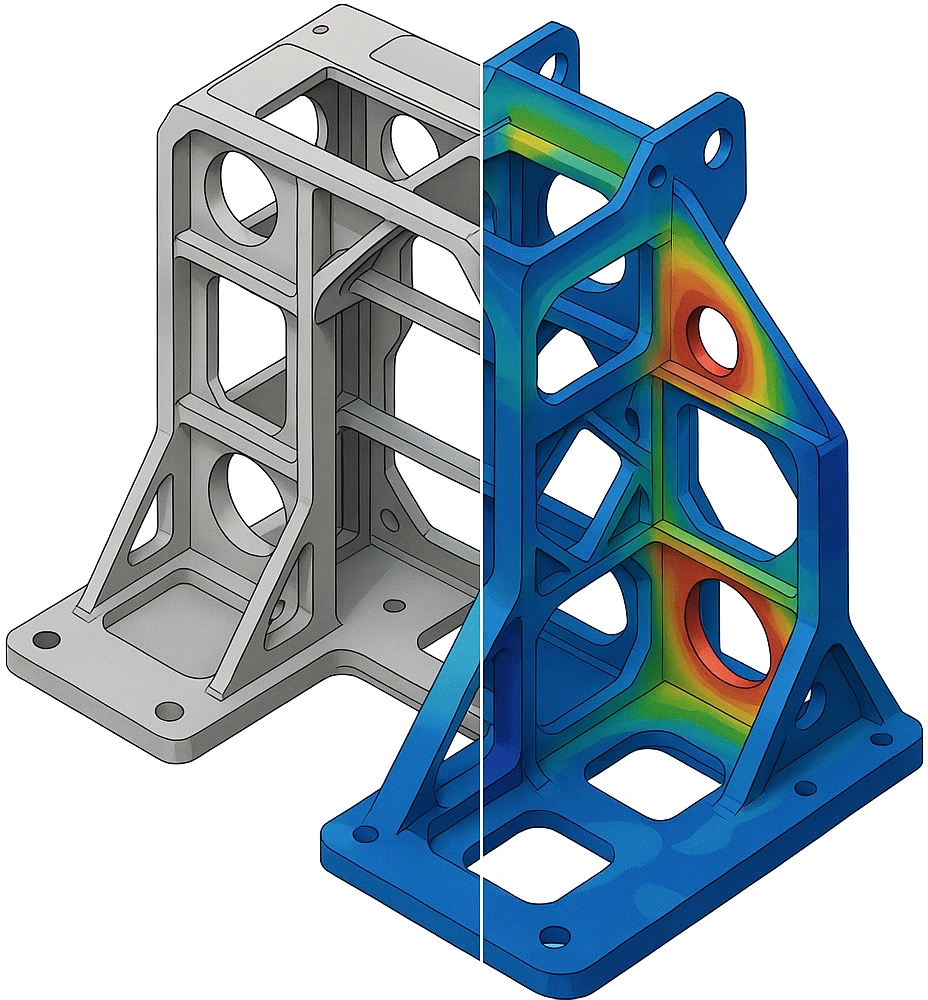
Simulation Work Reinvented