

Relying on physical prototypes to solve oscillatory interactions isn’t just slow; it’s a financial liability that risks catastrophic structural failure. In high-stakes fields like aerospace and medical device manufacturing, a single unpredicted vibration can derail a multi-year development cycle. You’re likely already aware that traditional multiphysics workflows often stall because of prohibitive software licensing costs and the scarcity of in-house expertise required for complex fluid-solid interaction coupling. These legacy obstacles shouldn’t dictate your engineering timeline.
This reference guide helps you master the nuances of fluid-solid interaction to validate product durability and performance with precision. We’ll show you how to accurately predict fatigue life and reduce physical prototyping costs by selecting the right coupling fidelity for your specific application. By the end of this article, you’ll understand how to leverage modern simulation strategies to ensure regulatory compliance and maintain a competitive edge. We’re moving past generic definitions to provide a structured framework for high-performance engineering results.
Key Takeaways
- Understand the fundamental mechanisms of fluid-solid interaction where fluid flow and structural deformation influence each other in a continuous feedback loop.
- Select the optimal coupling strategy—one-way or two-way—to balance computational efficiency with the physical fidelity required for your specific engineering project.
- Apply vertical-specific workflows to address complex physics, such as aeroelasticity in Aerospace or biomechanical validation in the Medical Device sector.
- Reduce physical prototyping costs and ensure regulatory compliance by implementing rigorous validation frameworks and digital twin models.
- Scale your simulation capacity through on-demand engineering services, removing the high cost and operational barriers of traditional multiphysics software licensing.
Understanding Fluid-Solid Interaction in Modern Multiphysics
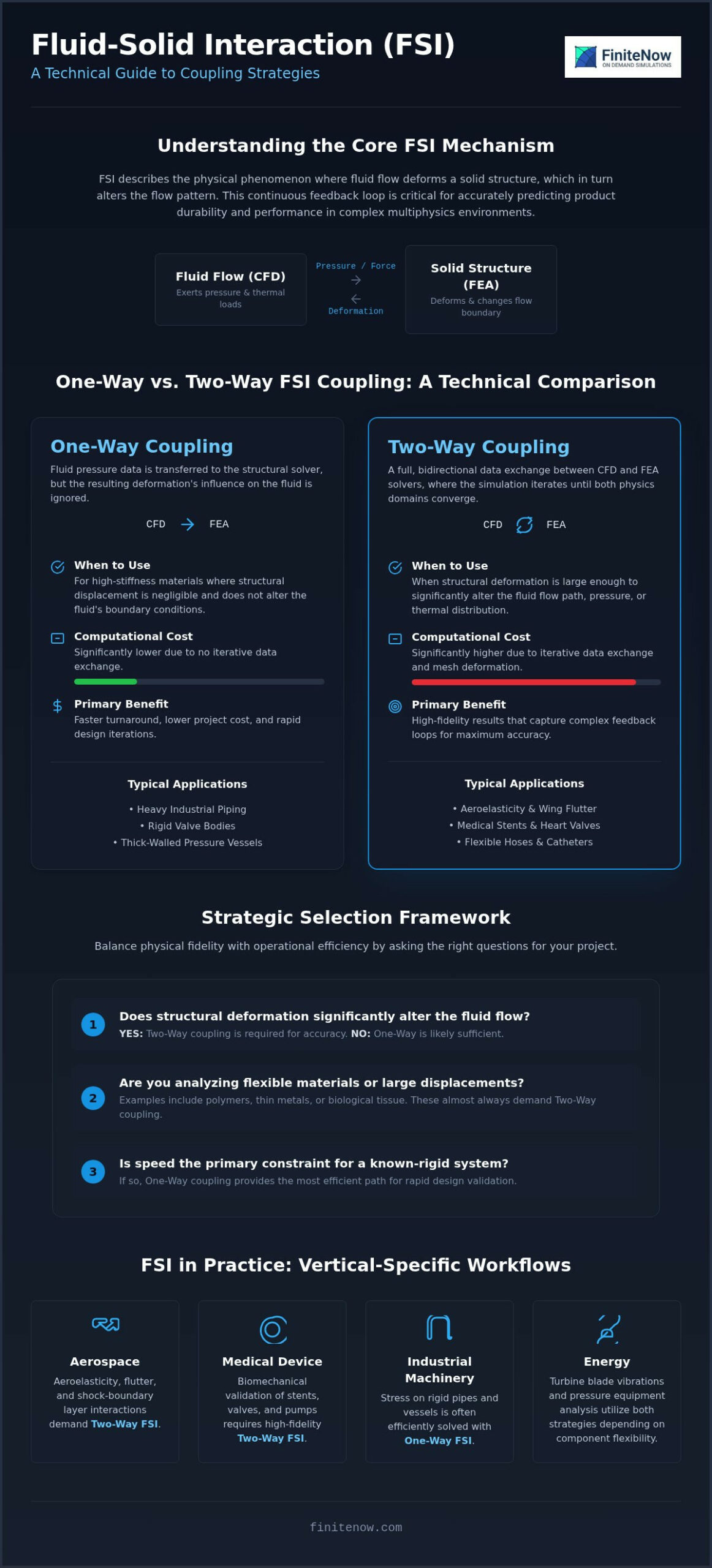
Fluid-solid interaction describes the physical phenomenon where fluid flow deforms a solid structure, which in turn alters the flow pattern itself. This continuous feedback loop is the hallmark of advanced multiphysics. It’s a critical component of what is cfd in engineering, especially when dealing with non-rigid materials or high-velocity environments. Standalone CFD or FEA solvers often fail to capture these interdependent effects. By solving both domains simultaneously, engineers can predict how dynamic loads impact structural integrity with far greater accuracy. This integrated approach is essential for predicting fatigue life and preventing the structural failures that plague traditional, decoupled design cycles.
The Mechanics of Oscillatory Interactions
Strain-induced movement creates complex feedback loops. When a fluid exerts pressure on a flexible solid, the resulting displacement changes the fluid’s volume or path. This triggers a secondary pressure response. These interactions are often categorized under the broader scope of Fluid-Structure Interaction.
In many industrial components, these loops lead to resonance or aeroelastic flutter. Resonance occurs when the fluid’s shedding frequency matches the structure’s natural frequency, causing uncontrolled vibrations. In aerospace, flutter can lead to immediate wing failure if not accounted for during the design phase. Flexible systems like valves or medical catheters also face risks from internal pressure waves. These waves can cause fatigue through repeated expansion and contraction. Mapping these oscillatory behaviors requires high-performance solvers that can handle rapid mesh deformations without losing convergence.
FSI as a Design Validation Requirement
Engineers can no longer rely on conservative hand calculations for complex fluid-structure systems. Modern procurement standards prioritize high-fidelity simulation because it provides a granular view of performance. This is particularly relevant for aerodynamic performance optimization. In this context, understanding the minor deformations of a wing or a turbine blade is the difference between efficiency and failure.
Validated fluid-solid interaction models replace the “build and break” mentality of legacy engineering. Instead of investing in multiple physical prototypes, teams use digital twins to simulate worst-case scenarios. This shift isn’t just about speed; it’s about regulatory compliance and safety. In sectors like medical device manufacturing, proving that a stent or valve will perform under physiological flow conditions is a mandatory hurdle. Leveraging on-demand simulation expertise allows firms to access these complex insights without the overhead of permanent software licenses or specialized in-house departments.
One-Way vs. Two-Way FSI Coupling: A Technical Comparison
Choosing the right coupling method for fluid-solid interaction is a strategic decision that directly impacts computational time and project cost. In many engineering scenarios, the added complexity of a fully coupled simulation doesn’t yield a proportional increase in accuracy. You need to balance physical fidelity with operational efficiency. One-way coupling transfers fluid pressure data to the structural solver but ignores the resulting deformation’s influence on the fluid. Conversely, two-way coupling involves a full bidirectional data exchange between CFD and FEA solvers. Two-way coupling becomes mandatory for accuracy when the structural deformation is large enough to significantly alter the fluid flow path or pressure distribution.
When to Use One-Way FSI Coupling
One-way coupling is the most efficient choice for high-stiffness materials where structural displacement remains negligible. If the solid’s movement doesn’t change the fluid’s boundary conditions, a decoupled approach is sufficient. Common applications include rigid valve bodies, heavy industrial piping, or thick-walled pressure vessels. The primary benefit is a significantly lower computational overhead. By avoiding iterative data exchanges between solvers, you achieve faster turnaround times and lower project costs. This method allows for rapid design iterations without the heavy resource demands of multiphysics synchronization.
The Necessity of Two-Way FSI Coupling
You must employ two-way coupling for soft structures or high-velocity flows where deformation is a primary driver of performance. This bidirectional feedback is critical for thin-walled components, membranes, and biological tissues. Research highlights the complexity of these interactions, such as those explored in UW-Madison FSI Research, where numerical stability is paramount. In these cases, the fluid forces deform the structure, and that deformation immediately reshapes the fluid domain. Maintaining stability during such “strong” coupling requires advanced iterative solvers that synchronize displacement and pressure at every time step.
This level of precision is necessary for validated results in aerospace flutter or medical stent analysis. If you’re unsure which fidelity your project requires, our team provides tailored CFD simulation consulting to optimize your strategy and ensure you aren’t overpaying for unnecessary computational complexity. We focus on delivering the exact level of multiphysics detail your validation requires.
Industry-Specific FSI Challenges and Applications
The practical application of fluid-solid interaction shifts significantly across engineering verticals. While the underlying physics remain constant, the performance metrics and failure modes do not. Aerospace engineers prioritize aeroelasticity and wing flutter, where even minor oscillations can lead to catastrophic failure. In these environments, turbine blade fatigue life is often dictated by high-pressure gradients and thermal cycling. Automotive developers focus on underbody aerodynamics and complex thermal management systems to boost fuel efficiency and cooling performance. In industrial machinery, the primary concern is often flow-induced vibration (FIV) in rotating equipment like pumps and compressors. Identifying these industry-specific drivers is the first step toward a validated simulation strategy that delivers actionable results.
Medical Device Validation and Biomechanics
In the medical sector, FSI is a mandatory component of regulatory validation. Simulating how blood flow interacts with arterial walls or cardiovascular stents provides critical data on hemocompatibility and fatigue life. A stent must withstand millions of cardiac cycles without structural failure or causing vessel damage. High-fidelity multiphysics modeling allows engineers to predict these outcomes before entering expensive clinical trials. This approach ensures that devices maintain their structural integrity within the dynamic, pulsating environment of the human body. Validating these interactions is essential for obtaining FDA or CE marking approval, as it proves the device’s reliability under physiological conditions.
Energy and Pressure Equipment Integrity
The energy sector faces unique challenges regarding large-scale deformations and extreme thermal loads. Wind turbine blades undergo significant deformation under varying wind loads, which immediately changes their aerodynamic efficiency. Understanding these Fundamentals of Fluid-Solid Interactions is essential for optimizing power output and preventing catastrophic blade strikes. Similarly, in pressure vessels and piping systems, FSI analysis prevents flow-induced stress failure that traditional static analysis might miss. This is particularly vital in heat exchangers, where the interaction between thermal stress and fluid flow can lead to rapid material degradation. By simulating these conditions, energy firms can extend the operational life of power generation equipment and significantly reduce unplanned maintenance costs.
Strategic Implementation: Validating FSI Simulation Results
Accurate fluid-solid interaction simulation requires more than just high-performance solvers. It demands a rigorous validation strategy against experimental data or analytical benchmarks. Without this, your multiphysics model is merely a visual estimation. The primary objective is to reduce physical prototyping costs by creating high-fidelity digital twins. These virtual models allow you to test extreme conditions that would be too expensive or dangerous to replicate in a physical lab. Transparency across the entire simulation workflow ensures your results are defensible during internal audits or regulatory reviews.
Establishing Mesh and Solver Convergence
Aligning fluid and solid meshes at the interface boundary is a significant technical hurdle. In many fluid-solid interaction applications, the solid undergoes large deformations. This requires advanced techniques like mesh morphing or dynamic remeshing to maintain cell quality. If the mesh quality degrades, the solver loses convergence. This leads to inaccurate results or total solver failure. Engineers must verify mesh convergence in both domains simultaneously. This ensures the results are independent of the grid density. Monitoring residuals isn’t enough for complex coupling. You must also track the interface energy balance. This confirms that the data exchange between the CFD and FEA solvers remains stable throughout the transient run.
Verification and Validation (V&V) Framework
A structured V&V framework is essential for high-stakes engineering projects. It provides a logical path to reliability. It’s the difference between a simple visualization and a reliable engineering insight.
- Step 1: Code Verification. This ensures that the mathematical models and governing equations are implemented correctly within the software. It’s about solving the equations right.
- Step 2: Solution Verification. This process quantifies numerical errors and uncertainties. It addresses discretization errors and time-stepping issues. It provides a confidence interval for your simulated data.
- Step 3: Validation. Here, you compare simulation outputs against physical test data. This confirms the model represents reality. It’s about solving the right equations.
This three-step process transforms a raw simulation into a validated engineering tool. It removes the guesswork from design cycles and provides a clear path to regulatory compliance. If you need a partner to handle these complexities with German-engineered precision, check our guide to CFD simulation consulting to accelerate your validation process.
Optimizing FSI Procurement with On-Demand Engineering
Modern engineering teams are shifting away from heavy licensing toward CFD simulation consulting to maintain agility in competitive markets. Legacy software vendors often push multi-year contracts that don’t align with the fluctuating demands of R&D. Project-based simulation removes the financial barrier of specialized multiphysics software. It allows you to access high-end solvers only when your specific fluid-solid interaction project requires them. Leveraging German-based engineering expertise ensures high-quality results without the burden of long-term contracts. Our instant automated quoting system further accelerates this process; it enables rapid iteration and significantly faster R&D bidding cycles.
Scaling Simulation with a Pre-Qualified Network
Scaling your simulation capacity shouldn’t require hiring full-time specialists for every niche domain. On-demand services provide immediate access to experts in specialized fluid-solid interaction fields, such as aeroelastic flutter or biomechanical valve analysis. This model utilizes a pre-qualified network of engineers who understand the nuances of complex coupling. A transparent, digital workflow streamlines project management; it ensures that collaboration remains efficient and results are delivered with precision. Data security and IP protection are fundamental to this process. Modern digital platforms use encrypted environments to protect your proprietary designs while allowing specialists to perform high-fidelity analysis. You get the depth of a dedicated department with the flexibility of a cloud-native service.
The ROI of Outsourced Multiphysics Analysis
The total cost of ownership (TCO) for in-house simulation is often underestimated. You aren’t just paying for software licenses; you’re funding high-performance computing (HPC) hardware, staff training, and ongoing maintenance. A pay-per-project model eliminates these overheads. It transforms fixed capital expenses into scalable operational costs. This approach also bypasses the steep software learning curves and hardware setup times that often delay critical projects. You accelerate your time-to-market by focusing on design decisions rather than troubleshooting solver stability.
For engineers seeking to validate complex fluid-solid designs efficiently, the recommendation is clear. Stop managing software and start managing performance. Partnering with a specialized service provider allows you to leverage advanced multiphysics capabilities without the traditional barriers to entry. This transition ensures that your validation process is both technically rigorous and economically sustainable. Move toward a results-oriented workflow that prioritizes data accuracy and engineering speed over legacy infrastructure.
Accelerate Your Design Validation with On-Demand Multiphysics
Transitioning to a high-performance simulation workflow requires a fundamental shift from managing software to managing engineering data. Strategic coupling choices and rigorous validation frameworks turn complex physics into predictable, actionable outcomes. Mastering fluid-solid interaction is no longer a luxury reserved for firms with massive licensing budgets or specialized in-house teams. By leveraging on-demand expertise, you bypass the traditional overhead of expensive infrastructure and steep learning curves. This shift allows your team to focus on innovation rather than solver maintenance.
Our German-based engineering experts provide the technical precision required for your most demanding projects without the burden of long-term contracts. This modern approach ensures that your R&D cycles move at the speed of digital iteration rather than the pace of physical prototype manufacturing. Get an Instant Quote for Your FSI Project today and eliminate software licensing barriers while securing fast turnaround on complex multiphysics analysis. Your next breakthrough shouldn’t be stalled by legacy procurement models. Secure your competitive edge with validated results and a streamlined, forward-thinking workflow that prioritizes your project’s performance and durability.
Frequently Asked Questions
What is the difference between FSI and multiphysics simulation?
FSI is a specific subset of multiphysics simulation. While multiphysics encompasses any interaction between different physical domains, such as thermal-structural or electromagnetic-fluid fields, FSI focuses exclusively on the kinetic and pressure-based exchange between a fluid and a solid. It’s often the most computationally demanding subset because it usually requires dynamic mesh updates to account for structural movement. While all FSI is multiphysics, not all multiphysics involves fluid-structure coupling.
Is two-way coupling always more accurate than one-way coupling?
Two-way coupling is more physically complete, but it isn’t always the most effective choice for project ROI. One-way coupling is perfectly accurate for high-stiffness systems where structural deformation doesn’t change the flow path. If the solid’s movement is negligible relative to the fluid volume, the added complexity of two-way coupling yields minimal precision gains while significantly increasing computational costs. Accuracy should be measured against the specific physical requirements of your validation goal.
How much does a fluid-solid interaction simulation typically cost?
The cost of a fluid-solid interaction project depends on the coupling fidelity, the complexity of the geometry, and the transient nature of the physics. One-way steady-state analyses are more economical than two-way transient simulations involving large mesh deformations. Instead of high upfront software licenses, our project-based model allows you to pay only for the engineering expertise and compute resources used. You can obtain precise pricing tailored to your specific parameters through our automated quoting system.
Can FSI simulation replace physical wind tunnel or bench testing?
FSI simulation acts as a high-fidelity filter to reduce the number of physical test cycles, but it rarely replaces them entirely for final certification. It’s used to identify failure modes like aeroelastic flutter or fatigue before you build a single part. This reduces physical prototyping costs by ensuring that when you do reach the wind tunnel or bench test, the design is already validated and optimized for performance. It’s about arriving at the test phase with a higher confidence level.
Which industries benefit most from high-fidelity FSI analysis?
Aerospace, medical devices, and industrial machinery see the highest ROI from high-fidelity FSI. Aerospace teams use it to prevent wing flutter and optimize turbine blade cooling. Medical device manufacturers rely on it for cardiovascular stent validation and blood flow analysis. Industrial sectors apply it to pumps, compressors, and heat exchangers to prevent flow-induced vibration. Any sector dealing with thin-walled structures in high-pressure environments benefits from this specialized multiphysics approach.
What data is required to start an FSI simulation project?
To initiate a fluid-solid interaction project, you need clean 3D CAD geometry, detailed material properties for the solid, and fluid boundary conditions. Solid data includes Young’s modulus, Poisson’s ratio, and material density. Fluid data requires inlet velocity, pressure, and viscosity profiles. If the interaction is transient, we also need the time scales of interest and any expected external loads or constraints on the structural component to ensure solver stability.
How is the interface between fluid and solid handled in solvers?
Solvers handle the interface through a dedicated boundary where pressure and displacement data are mapped between the fluid and solid grids. In ALE (Arbitrary Lagrangian-Eulerian) methods, the fluid mesh nodes at the interface move in sync with the solid mesh nodes. Other methods handle the solid as a force field within a fixed fluid grid. The choice depends on the scale of deformation and the required boundary layer precision for your specific application.
What are the most common causes of FSI simulation instability?
Instability usually stems from added mass effects or large time steps that fail to capture rapid pressure changes. When the fluid and solid densities are similar, such as in blood flow or underwater applications, the solver can oscillate uncontrollably. Poor mesh quality at the interface during large deformations also triggers divergence. Reducing the time step or using more robust iterative coupling schemes typically resolves these convergence issues and ensures a stable, validated result.
Simulation Work Reinvented