

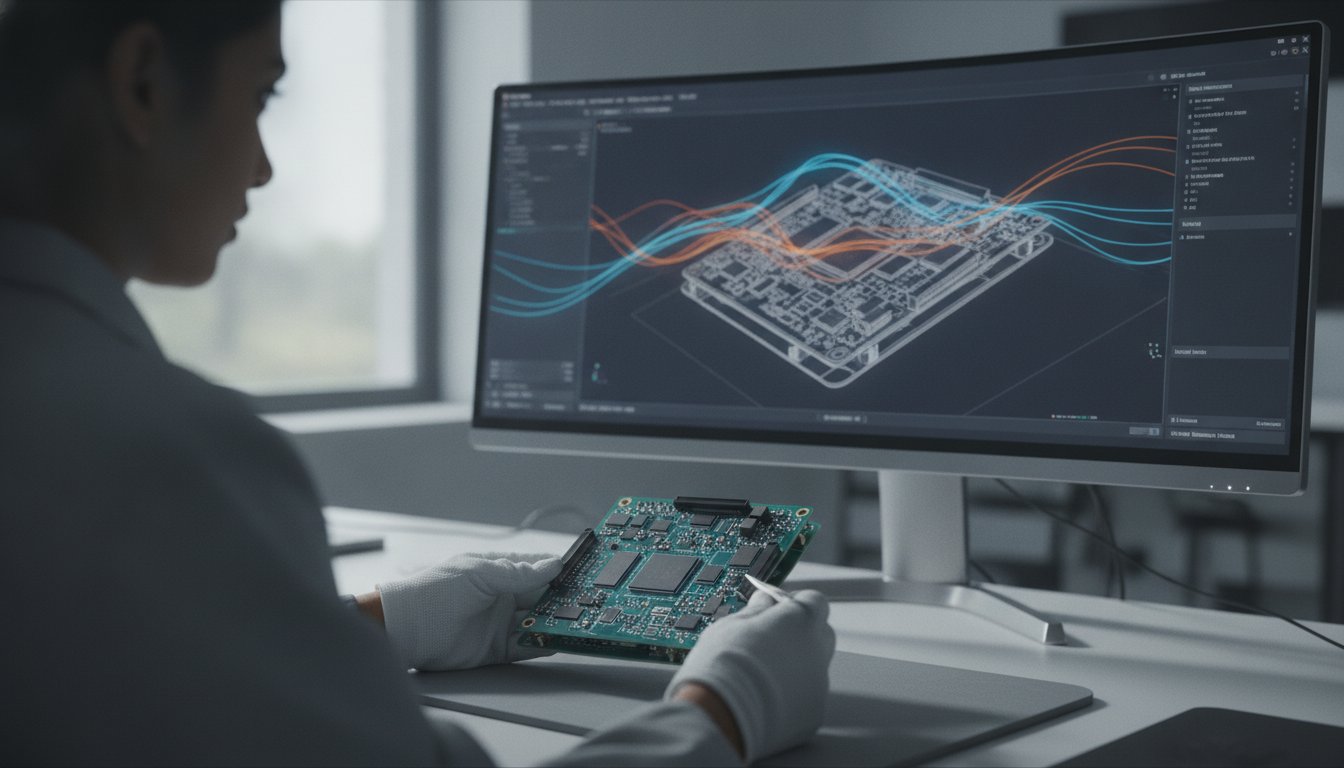
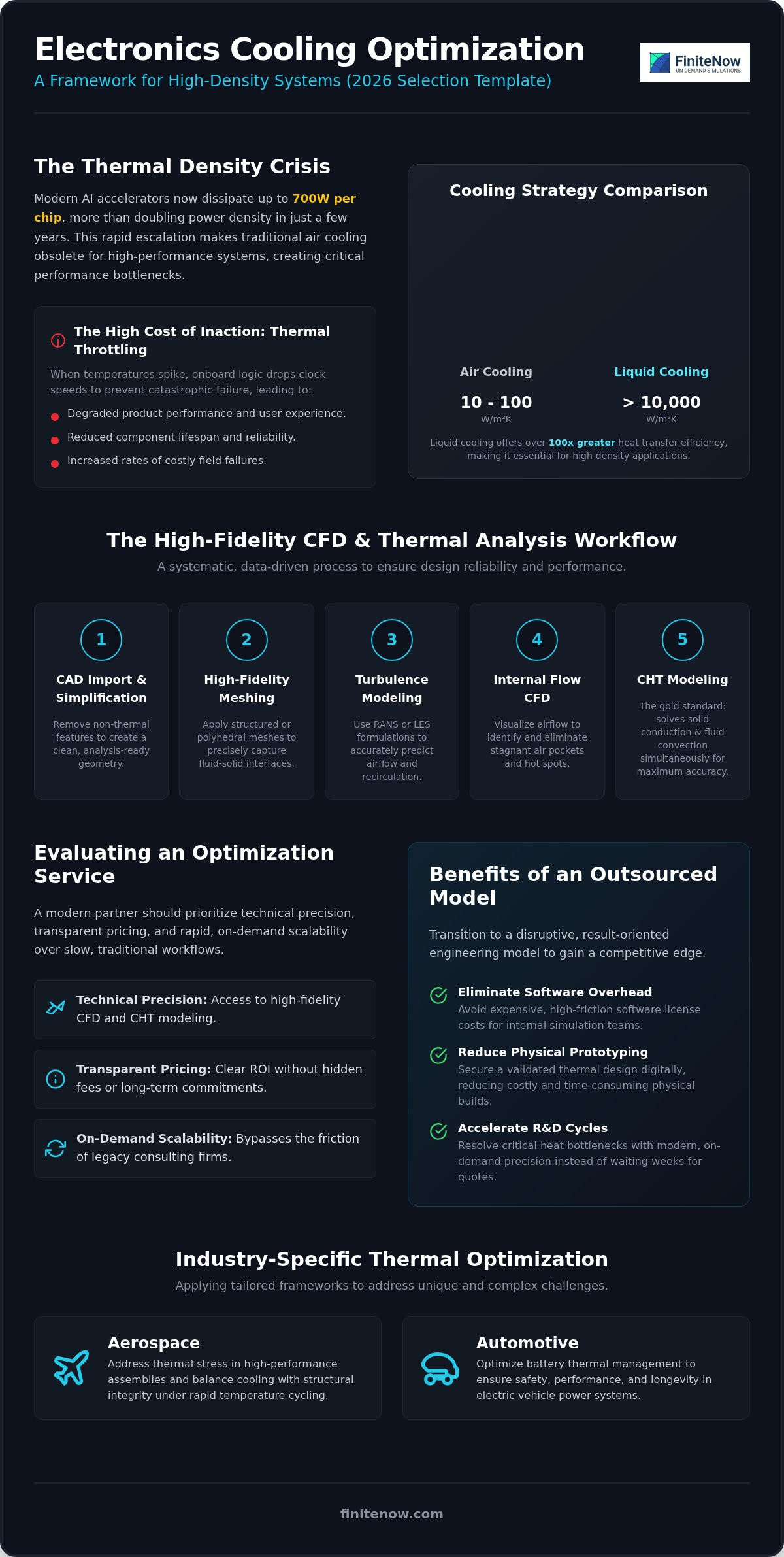
Modern AI accelerators now dissipate up to 700W per chip, more than double the power density of processors from just a few years ago. This thermal density crisis makes legacy air cooling obsolete for high-performance systems. You need a specialized electronics cooling optimization service that bypasses the friction of traditional engineering firms to maintain your competitive edge.
It’s frustrating when thermal throttling degrades your product’s performance while you’re stuck waiting weeks for legacy consultancies to return a quote. High software license costs and long lead times for physical prototypes shouldn’t be the baseline for your R&D department. You deserve a streamlined approach that prioritizes data-driven validation over slow, traditional workflows.
This 2026 selection template provides the framework to evaluate and select the right thermal management partner for your high-density systems. We’ll show you how to secure a validated thermal design, reduce physical prototyping costs, and ensure a clear ROI from outsourced engineering. You’ll gain the insights needed to resolve critical heat bottlenecks with modern, on-demand precision.
Key Takeaways
- Identify why traditional air cooling fails in high-density AI systems and how systematic optimization resolves critical thermal bottlenecks.
- Master the professional CFD workflow to ensure your simulations accurately predict airflow and temperature distributions using high-fidelity turbulence modeling.
- Evaluate an electronics cooling optimization service using a framework that prioritizes technical precision, transparent pricing, and rapid on-demand scalability.
- Apply industry-specific frameworks to address complex challenges such as battery thermal management in automotive or thermal stress in aerospace assemblies.
- Eliminate the overhead of expensive software licenses and physical prototypes by transitioning to a disruptive, result-oriented outsourced engineering model.
Scaling Thermal Management: Addressing the Electronics Cooling Bottleneck
Electronics cooling optimization is the systematic improvement of heat dissipation across electronic assemblies. It goes beyond simply adding larger fans or heat sinks. It requires an architectural refinement of the entire thermal path. As AI accelerators now hit 700W per chip, traditional air cooling is hitting a physical wall. The delta between ambient air and junction temperature has become impossible to bridge with forced convection alone. Utilizing a professional electronics cooling optimization service ensures you don’t compromise performance for safety in these high-density environments.
Thermal throttling is a silent killer of product reputation. When temperatures spike, onboard logic drops clock speeds to prevent catastrophic failure. This results in degraded user experiences, reduced product lifespans, and increased field failure rates. The real bottleneck in modern R&D isn’t just the heat itself. It’s the gap between these complex thermal requirements and the high cost of internal simulation licenses. Many teams find themselves stuck between expensive software overhead and the months-long lead times of legacy engineering consultancies.
The Shift from Air to Liquid Cooling
Heat transfer coefficients (h) define the efficiency of your cooling strategy. Air typically offers a coefficient between 10 and 100 W/m²K. In contrast, liquid cooling can exceed 10,000 W/m²K. This massive disparity is why liquid-cooled busbars and direct-to-chip architectures are becoming the baseline for high-performance computing. These systems rely on Conjugate Heat Transfer (CHT) as the primary mechanism for modern electronics cooling, where heat conduction through solid components is solved simultaneously with the convective flow of the coolant. This integrated approach allows for far more precise temperature predictions than simplified empirical models.
Thermal Management in High-Density Systems
Compact enclosures create unique challenges like stagnant air pockets and localized hot spots. Effective thermal management of electronics in these spaces requires a granular look at the thermal stack. High-performance Thermal Interface Materials (TIMs) are essential to reduce contact resistance between the silicon die and the heat spreader. Without an electronics cooling optimization service to validate these choices, even the most expensive cooling hardware will underperform due to interface losses.
These thermal decisions often carry structural consequences. Rapid temperature cycling causes differential expansion between PCBs and enclosures, leading to solder joint fatigue or housing warpage. You must evaluate these risks early in the design phase. For a deeper look at predicting these mechanical failures, see our guide on Structural FEA: The Modern Engineer’s Guide to Stress and Failure Prediction. Balancing thermal efficiency with structural integrity is the only way to ensure long-term reliability in mission-critical hardware.
High-Fidelity CFD and Thermal Analysis for Electronic Systems
A professional electronics cooling optimization service follows a rigorous digital workflow to ensure design reliability. It begins with high-fidelity CAD import and geometry simplification to remove non-thermal features like decorative fillets or small fasteners. We then apply structured or polyhedral meshing to capture complex fluid-solid interfaces with precision. Turbulence modeling, specifically using RANS or LES formulations, is non-negotiable for predicting airflow within tight enclosures. Without accurate turbulence data, you risk missing the recirculating flow patterns that cause localized overheating.
Internal flow CFD serves as a diagnostic tool for your enclosure design. It identifies stagnant air pockets where heat accumulates despite active fan cooling. By visualizing these “hot spots,” engineers can reposition components or redesign baffles to optimize pressure drop and flow distribution. For power electronics, steady-state thermal analysis service provides the foundational thermal equilibrium data needed before transient simulation. We utilize transient thermal simulation to model dynamic load cycles, ensuring that peak power bursts don’t push junction temperatures beyond safe limits.
Conjugate Heat Transfer (CHT) Modeling
CHT modeling is the gold standard for thermal accuracy. It solves for heat transfer in solids and fluids simultaneously, accounting for the complex thermal coupling at every interface. This is critical for predicting component temperatures within a narrow margin of physical reality. Beyond temperature, this data feeds directly into thermo-mechanical analysis services to predict structural integrity. Understanding how thermal gradients induce mechanical stress prevents board warpage and solder joint cracking before you ever build a prototype.
Battery Cooling and Power Electronics
High-voltage battery packs require specialized cooling architectures to maintain cell uniformity and prevent degradation. We optimize cold plate designs and evaluate phase-change materials to buffer thermal spikes during rapid discharge cycles. Simulation is the only safe way to model thermal runaway prevention, testing failure scenarios without the risk of laboratory fires. As researchers explore advanced cooling solutions like two-phase evaporative systems, high-fidelity CFD becomes the primary validation tool. You can leverage an electronics cooling optimization service to ensure these complex systems remain stable under extreme conditions while maintaining high energy density.
Industry-Specific Thermal Optimization Frameworks
Thermal management isn’t a monolithic discipline. Each vertical presents unique environmental stressors that dictate the simulation strategy. A high-performance electronics cooling optimization service must adapt its boundary conditions based on whether the target is a subsea sensor or a satellite avionics suite. The physics remain the same, but the failure modes shift from moisture ingress to radiative heat transfer in a vacuum. Effective engineering requires a framework tailored to these specific operational realities.
In the automotive sector, the focus has shifted toward battery thermal management for high-voltage packs. We prioritize under-hood flow and cabin HVAC optimization to balance passenger comfort with powertrain efficiency. Industrial machinery, however, demands a focus on vibration-induced thermal issues. Constant mechanical oscillation can loosen thermal interfaces, leading to rapid component degradation. We use flow-induced cooling analysis to ensure that even in dusty or high-vibration factory environments, your control electronics remain within safe operating limits. Teams working in this space should also understand how thermal stress analysis for machinery can expose costly design assumptions that standard safety factors routinely miss.
Aerospace and Defense Cooling Requirements
Aerospace systems face the dual challenge of varying atmospheric pressures and high G-loads. As an aircraft climbs, the thinning air significantly reduces convective cooling efficiency. We evaluate cooling performance across the entire flight envelope, ensuring that avionics don’t overheat during high-altitude cruise or rapid ascent. High G-loads also threaten the integrity of liquid cooling loops, potentially causing pump cavitation or seal failure. By utilizing CFD simulation for external aerodynamics and internal thermal paths, we validate that your cooling architecture can withstand the rigors of flight without adding unnecessary weight.
Medical Device Thermal Validation
Medical device engineering requires extreme precision, especially for implantable or wearable electronics where skin contact temperatures are strictly regulated. High-fidelity thermal modeling is the only way to ensure compliance with ISO and FDA safety standards without exhaustive physical testing. Academic research into CFD analysis of cooling techniques confirms that numerical methods provide the resolution needed to identify micro-scale hot spots in these compact devices. We often employ Fluid-Structure Interaction (FSI) to model how thermal expansion affects delicate biomechanical interfaces. This level of detail is essential for an electronics cooling optimization service to provide the validation data required for regulatory submission and patient safety.
Evaluating Electronics Cooling Optimization Service Providers
Traditional engineering consultancies often operate on a billable-hours model that incentivizes slow progress. For high-stakes projects, this creates a conflict between your R&D deadlines and their revenue goals. Modern on-demand simulation platforms disrupt this by offering fixed-price, project-based outcomes. When selecting an electronics cooling optimization service, you must prioritize providers that eliminate the overhead of simulation software licensing. This “license-free” approach allows you to scale your engineering capacity without committing to six-figure annual software contracts or specialized training for internal staff.
Expertise is the primary differentiator. A German-based engineering team provides a level of technical rigor and precision that is essential for complex thermal management in aerospace or automotive sectors. You should evaluate potential partners based on their ability to deliver high-fidelity results within days, not months. This speed is only possible through a streamlined engagement process that removes the friction typical of legacy industry standards. Reliability and technological mastery should be your baseline requirements, ensuring that complex thermal problems are handled with clinical precision.
Transparency and Instant Quoting
Procurement friction is a major barrier to engineering agility. Automated quoting systems replace the “black box” pricing models of traditional firms with immediate, transparent project fees. This transparency allows managers to secure budget approvals and initiate critical thermal simulations in minutes. Rapid bidding is essential for time-sensitive projects where a delay in validation could push back a product launch by an entire quarter. You don’t have time for multiple sales calls; you need a partner that values your intellectual rigor and your schedule.
Expertise and Validation Standards
Trust in simulation results comes from a pre-qualified engineering network and standardized validation processes. Your service provider must deliver professional reporting that details mesh quality, convergence criteria, and physical assumptions. This level of transparency removes the traditional barriers to high-end engineering expertise, giving mid-sized R&D teams the same technological mastery as industry giants. You can get an instant quote for your thermal analysis today to see how a modern, data-driven workflow can accelerate your development cycle. Professional validation ensures your design meets the necessary safety and performance standards without the need for redundant physical prototypes.
Transitioning to On-Demand Thermal Engineering with FiniteNow
FiniteNow disrupts the traditional engineering consultancy model by focusing on outcomes rather than billable hours. Many R&D departments are weighed down by the toolchain trap, where high-cost software licenses and specialized training create significant friction. By choosing an electronics cooling optimization service that operates on an on-demand basis, you shift your focus from managing simulation software to managing product performance. This is the strategic move toward engineering simulation without software licenses, allowing your team to remain agile while maintaining access to high-end technical mastery. We provide the results you need without the long-term contracts or overhead typical of legacy industry standards.
The FiniteNow Engagement Process
Our engagement process is fast-paced and highly structured to respect your intellectual rigor and your schedule. It moves logically from your initial requirements to a validated thermal design in three distinct steps.
- Step 1: Upload CAD and Requirements. Use our instant quoting platform to submit your assembly geometry and thermal boundary conditions. You’ll receive a transparent, project-based fee immediately, removing the procurement friction of traditional bidding.
- Step 2: Expert Collaboration. You’ll collaborate directly with our German-based engineering team. We use structured video calls to refine the cooling strategy, ensuring that complex turbulence models and conjugate heat transfer assumptions align with your physical constraints.
- Step 3: High-Fidelity Reporting. Receive a comprehensive simulation report that includes mesh validation, temperature distribution maps, and optimized design recommendations. These are actionable insights, not just raw data.
Why On-Demand Simulation Wins in 2026
The engineering landscape in 2026 is defined by the shift toward agile R&D and digital twins. Traditional, slow-moving consultancies can’t keep pace with the rapid development cycles required for AI accelerators or high-density power electronics. Our pay-per-project model empowers SMEs and startups by providing access to specialized electronics cooling optimization service capabilities without a massive capital investment. It’s a methodical yet rapid progression that mirrors a modern technology firm. We remain committed to data-driven, validated engineering results that reduce your physical prototyping costs and improve your speed to market. By leveraging our pre-qualified network, you ensure that your thermal management strategy is grounded in technological mastery and clinical precision.
Accelerating Your Thermal Design Workflow
The transition toward high-density AI accelerators and compact power electronics has made legacy cooling methods obsolete. You’ve seen how high-fidelity CHT modeling and industry-specific frameworks provide the validation needed to bypass expensive physical prototyping. Selecting a modern electronics cooling optimization service is no longer about just outsourcing a task; it’s about securing a strategic advantage in a market that demands rapid iteration and clinical precision.
FiniteNow removes the traditional barriers to high-end engineering. You don’t need to manage complex software licenses or wait weeks for a quote. Our German-based engineering team delivers results with a focus on data-driven transparency and immediate scalability. This results-oriented approach ensures your R&D department remains agile and your products remain reliable under the most demanding thermal loads.
Take the first step toward a more efficient development cycle today. Get an Instant Quote for Your Electronics Cooling Project and experience transparent project pricing without the overhead. It’s time to resolve your heat bottlenecks with streamlined precision.
Frequently Asked Questions
What is an electronics cooling optimization service?
It’s a specialized engineering service that uses CFD and thermal analysis to improve heat dissipation in electronic assemblies. The service identifies thermal bottlenecks and validates cooling architectures like liquid cold plates or advanced air cooling. By utilizing an electronics cooling optimization service, you ensure that high-density components operate within safe junction temperatures. This process reduces the need for expensive physical prototyping and prevents performance-degrading thermal throttling.
How much does thermal simulation for electronics cost?
Pricing for thermal simulation is project-dependent and varies based on CAD complexity. We avoid the “black box” pricing of traditional consultancies by using an instant quoting platform. This provides transparent, fixed-price project fees rather than billable hours. This model allows procurement managers to secure budget approvals immediately. It eliminates the unpredictability of traditional engineering bids and ensures you only pay for the specific validation you need.
Can CFD simulation predict battery thermal runaway?
High-fidelity CFD simulation identifies the conditions that lead to thermal runaway by modeling heat generation and propagation between cells. We simulate failure scenarios, such as internal short circuits, to test the effectiveness of your thermal management system. This includes validating the performance of cold plates and phase-change materials under extreme stress. Numerical modeling is the only safe way to verify safety margins without risking laboratory fires during physical testing.
Do I need my own simulation software licenses to use FiniteNow?
You don’t need to maintain internal software licenses to leverage our engineering capabilities. We provide a “license-free” model where all simulation overhead is handled by our German-based engineering team. This approach removes the R&D burden of expensive annual subscriptions and specialized staff training. You receive high-fidelity results and optimized design recommendations through an on-demand service. This allows your team to focus on product development rather than software management.
How accurate are the results from an outsourced thermal analysis?
Results are highly accurate when based on high-fidelity Conjugate Heat Transfer (CHT) modeling and validated turbulence formulations. We use structured polyhedral meshing to capture the precise interaction between fluids and solids. Accuracy is ensured through rigorous convergence criteria and mesh independence studies. Our German-based engineers follow standardized validation protocols to ensure that numerical results mirror physical reality. This level of precision is essential for meeting strict ISO and FDA thermal safety standards.
What industries benefit most from electronics cooling optimization?
Aerospace, automotive, medical device, and industrial machinery sectors benefit most from an electronics cooling optimization service. In aerospace, we focus on thermal stress under varying atmospheric pressures. Automotive projects often prioritize battery thermal management and power electronics cooling. Medical device validation ensures that implantable or wearable electronics meet strict skin-contact temperature regulations. Each industry requires a tailored framework to address its specific environmental stressors and regulatory compliance needs. Engineering teams in manufacturing and heavy industry should also review how thermal stress analysis for machinery debunks the most costly assumptions that lead to premature component failure.
What is the typical turnaround time for a thermal analysis project?
Turnaround times are significantly faster than traditional consultancies due to our streamlined digital workflow and pre-qualified engineering network. While specific durations depend on project scope, our instant quote platform allows you to bypass the weeks of negotiation typical of legacy firms. We prioritize rapid iteration to align with agile R&D cycles. This speed ensures that your thermal validation happens in parallel with your design phases, preventing bottlenecks in your product development timeline.
Does FiniteNow provide professional engineering reports for validation?
Every project concludes with a comprehensive professional engineering report designed for technical validation and regulatory submission. These reports detail the simulation methodology, including mesh quality, boundary conditions, and material properties. We provide clear visualizations of temperature distributions, pressure drops, and airflow patterns. These actionable insights serve as a verified record of your design’s thermal performance. They’re essential for internal design reviews and external compliance audits.
Simulation Work Reinvented