

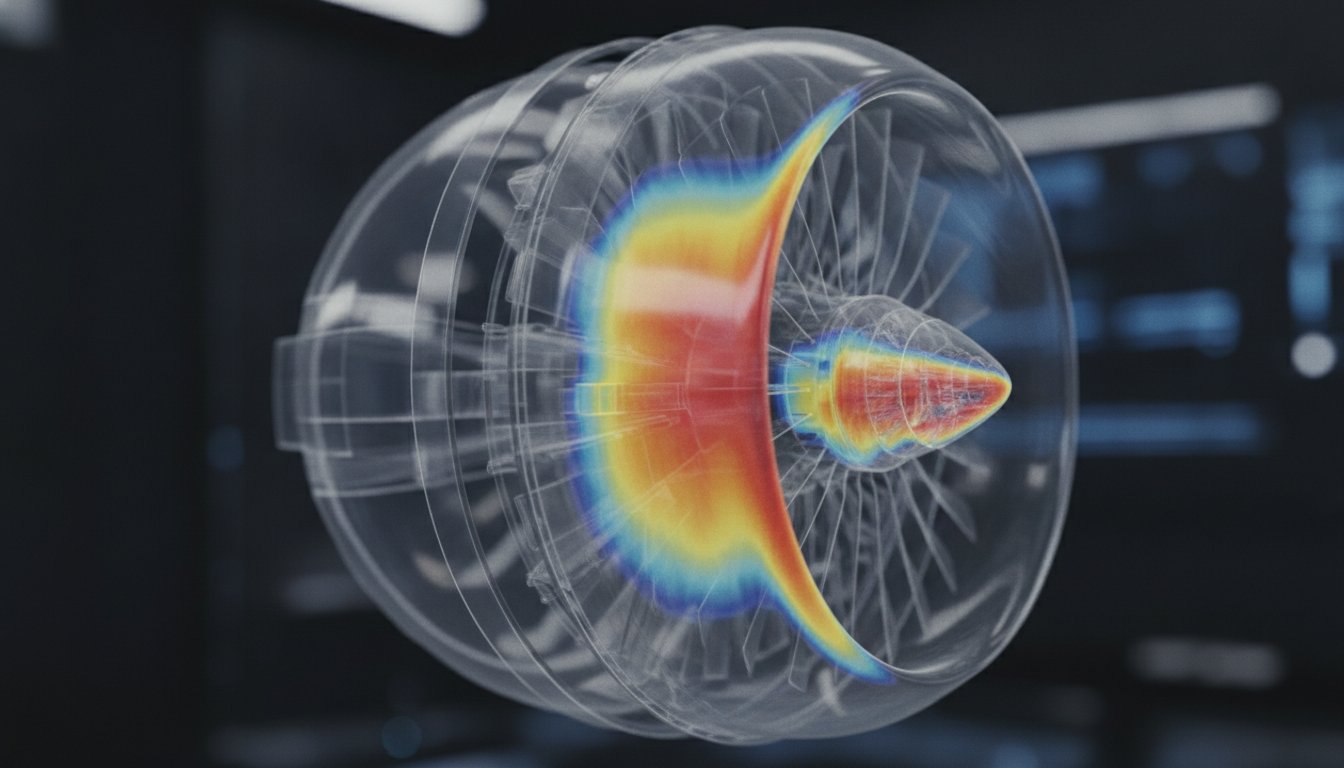
Relying on physical prototypes to detect thermal expansion mismatch is a gamble that modern engineering timelines can’t afford. Every unexpected failure during high-temperature testing doesn’t just represent a broken part; it’s a setback that burns through your R&D budget and delays market entry. You’re likely familiar with the friction of trying to couple thermal and structural data in-house, only to find that current tools or internal bandwidth can’t keep pace with complex assembly requirements.
Leveraging professional thermo-mechanical analysis services allows you to move away from reactive troubleshooting and toward a predictive, simulation-first workflow. You’ll learn how high-fidelity modeling identifies thermal stress hotspots before a single gram of material is cast or machined. We will examine the methods for validating material selection in high-heat environments and show you how to streamline your path to validation by cutting the number of physical prototypes needed. This guide breaks down how to replace traditional testing obstacles with data-driven precision to ensure structural integrity under the most demanding thermal loads.
Key Takeaways
- Understand how coupling heat transfer and structural mechanics identifies failure points like thermal expansion mismatch early in the design phase.
- Identify the optimal coupling method for your project by distinguishing between one-way and fully coupled two-way analysis workflows.
- Compare the efficiency of digital validation against physical testing to reduce R&D costs and accelerate your time-to-market.
- Learn how specialized thermo-mechanical analysis services eliminate the need for long-term contracts while providing high-fidelity results for complex assemblies.
- Validate material performance in extreme environments across aerospace, automotive, and industrial sectors using simulation-driven data.
What is Thermo-Mechanical Analysis in Modern Engineering?
Traditional engineering often views What is Thermo-Mechanical Analysis as a simple laboratory measurement of dimensional change. While physical lab testing provides baseline material data, modern engineering requires a more comprehensive approach. True thermo-mechanical analysis (TMA) examines how materials and complex assemblies behave under the simultaneous application of thermal and mechanical loads. It isn’t just about measuring a sample; it’s about predicting performance.
High-performance assemblies operate in environments where temperature isn’t constant. Thermal stress has become a primary failure mode as designs push the limits of power density and weight reduction. Utilizing professional thermo-mechanical analysis services allows teams to move beyond measuring physical samples in a furnace. Instead, you validate digital twins. This shift enables you to visualize stress fields and deformation patterns that physical probes simply cannot reach.
The Interplay of Temperature and Mechanical Stress
Temperature gradients are rarely uniform. When one part of a structure heats faster than another, the resulting temperature gradient induces internal strain. This is governed by the Coefficient of Thermal Expansion (CTE). In a structural context, CTE describes how much a part grows per degree of temperature change. If that growth is constrained by a housing or a different material, stress levels can quickly exceed yield strength.
Material anisotropy adds another layer of complexity. Many modern materials, like carbon fiber composites or additive manufactured metals, don’t expand equally in all directions. Predicting these directional responses requires high-fidelity simulation. It ensures that your design accounts for non-uniform expansion before you commit to a manufacturing run.
Why Simulation-Based TMA is Essential for R&D
Most structural failures in high-temperature environments stem from CTE mismatch. When you join materials with different expansion rates, the interface becomes a high-risk zone for delamination or cracking. Simulation-based thermo-mechanical analysis services allow you to test these multi-material interfaces digitally. You can evaluate transient thermal loads, such as rapid startup cycles in turbines or battery discharge cycles, which are notoriously difficult to replicate accurately in a lab.
Digital validation eliminates the “build and break” cycle. You reduce reliance on destructive physical testing by identifying hotspots early. This proactive approach saves significant R&D costs and shortens the development timeline. By leveraging on-demand expertise, you gain the clarity needed to make informed material and design decisions without the overhead of physical prototyping.
The Mechanics of Thermo-Mechanical Simulation: Coupling Heat and Stress
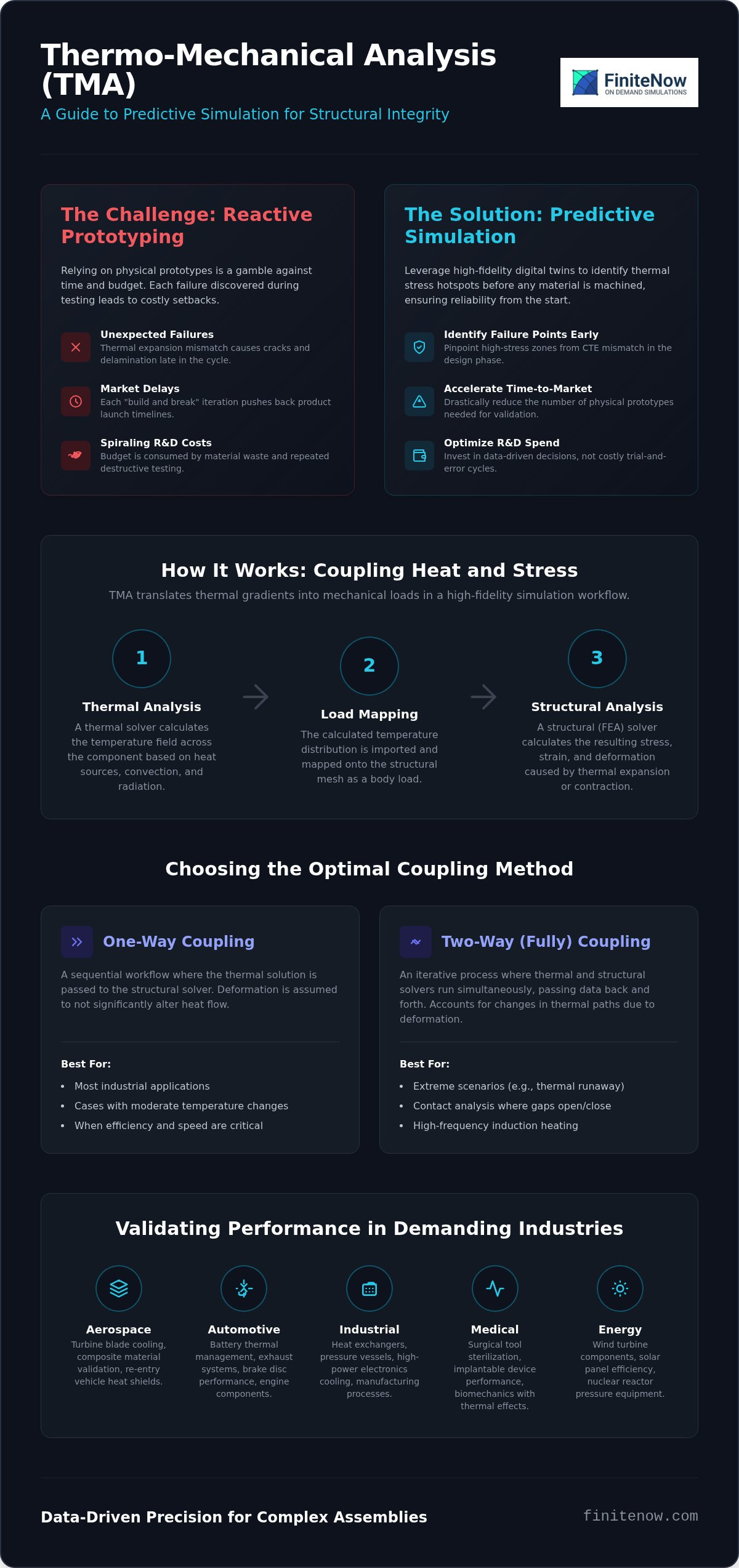
Predicting how a part deforms under heat requires more than a simple temperature map. It demands a workflow that translates thermal gradients into mechanical loads. This transition from heat transfer to structural Finite Element Analysis (FEA) is the core of The Mechanics of Thermo-Mechanical Simulation. Professional thermo-mechanical analysis services bridge this gap by mapping temperature distributions onto a structural mesh to calculate resultant strain and stress.
Success starts with high-fidelity data inputs. You need clean CAD geometry, detailed thermal boundary conditions like convection coefficients, and precise heat flux values. Mesh density is equally critical. Low-resolution meshes fail to capture steep temperature gradients, leading to inaccurate stress concentrations. A refined mesh ensures that the simulation accurately reflects the physical reality of thermal expansion and contraction.
One-Way vs. Fully Coupled Thermal-Structural Analysis
Most industrial applications utilize one-way coupling. In this sequential workflow, the thermal solver calculates the temperature field, which is then imported as a load into the structural solver. It’s efficient and accurate for cases where deformation doesn’t significantly alter the heat flow. If you’re looking to optimize your design process, our structural FEA experts can help you determine the most cost-effective coupling strategy for your specific assembly.
Fully coupled analysis is reserved for extreme scenarios. If a component’s mechanical deformation or contact changes the thermal paths, both solvers must run simultaneously. While this increases computational costs, it’s essential for high-precision validation in aerospace or battery thermal management. Choosing the right method balances the need for accuracy with the reality of project timelines. For projects where multiple interacting physics fields demand simultaneous resolution, coupled-field analysis services provide the multiphysics simulation framework needed to capture these complex interdependencies accurately.
Critical Material Properties for Accurate Modeling
Static material values don’t hold up at 500°C. Accurate modeling requires temperature-dependent material properties. Young’s Modulus and Yield Strength often drop significantly as temperatures rise, making it easier for components to deform or fail under identical mechanical loads. You can’t ignore these non-linearities if you want a reliable digital twin.
Mapping specific heat and thermal conductivity across the expected temperature range is non-negotiable. If these values are off, your transient analysis will fail to predict the correct timing of thermal spikes. High-fidelity thermo-mechanical analysis services ensure these properties are mapped correctly, providing a foundation for data-driven design decisions that prevent unexpected field failures. Establishing a reliable thermal equilibrium baseline through a dedicated steady-state thermal analysis service is often the critical first step before advancing to fully coupled thermo-mechanical simulations.
Simulation vs. Physical TMA: Why Digital Validation Wins
Traditional lab-based TMA is reactive. You ship a sample, wait for an available slot, and receive data on a single material specimen. This process is inherently slow and geographically localized. Professional thermo-mechanical analysis services flip this script. Instead of measuring a physical coupon, you iterate on complex assemblies in a virtual environment. You don’t have to wait for material shipping or lab technicians to clear their queue. You can run fifty design variants in the time it takes to prep one physical sample.
Simulation excels at “what-if” scenarios that are nearly impossible to replicate in a lab. What happens if the ambient temperature drops by 40 degrees in seconds? What if your material supplier changes the alloy composition? Physical labs struggle with these environmental shifts because they require specialized rigs and controlled atmospheres. Digital validation handles these extremes with a few parameter changes. This gives you a wider safety margin and deeper insight into edge-case failures before they happen in the field.
Visualizing Stress Hotspots and Deformation
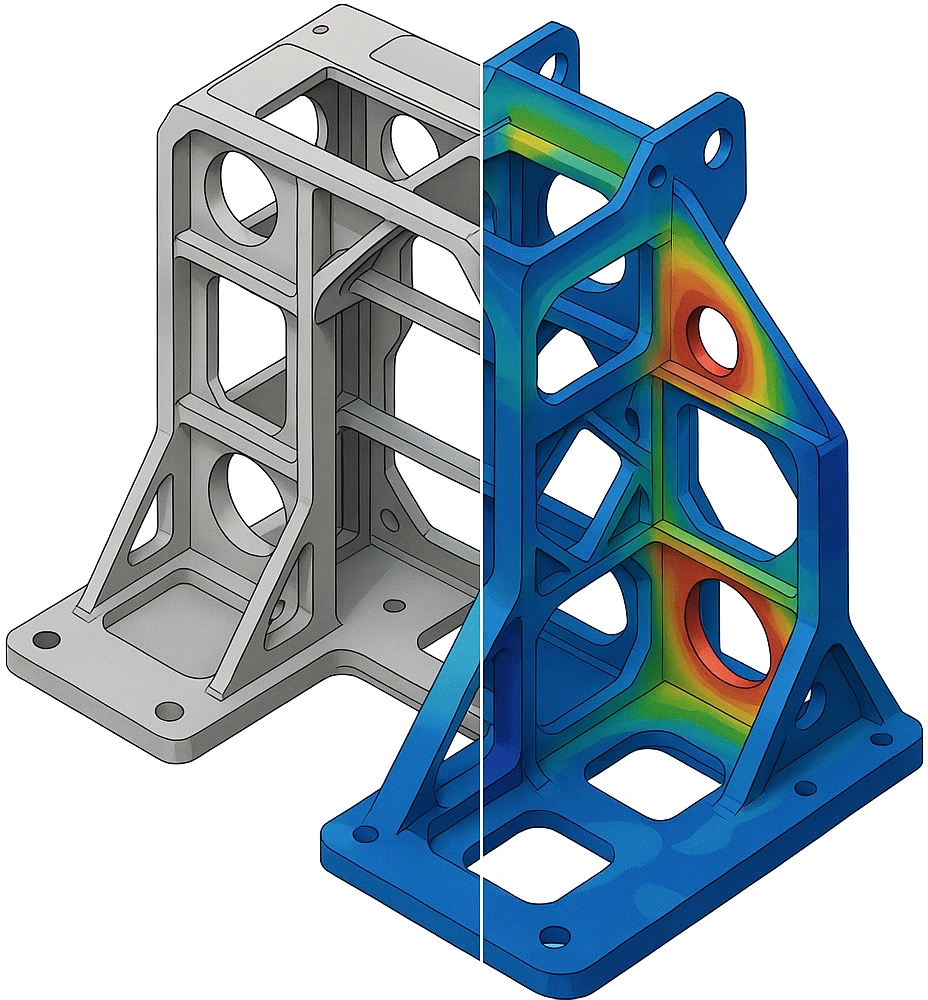
Physical probes only measure the surface or specific points. They’re blind to internal structural risks. Simulation uses contour plots to reveal exactly where strain is accumulating inside a bond-line or within a multi-material joint. This transparency is critical for predicting buckling in thin-walled structures or warping in complex housings. You can use digital cross-sectioning to inspect bond-line integrity without destroying a single part. It’s a level of detail that traditional testing simply can’t match.
Cost and Time Efficiency in the Design Cycle
Integrating TMA into the early-stage CAD process stops design flaws before they become expensive. You aren’t just reducing the number of physical prototypes; you’re eliminating the logistics of material sample shipping and the risk of late-stage failure. Our German-based engineering team provides high-fidelity results that allow you to move toward certification with confidence. By validating digitally, you keep your R&D agile and focused on innovation rather than troubleshooting broken hardware. It’s about moving faster without sacrificing the technical rigor your project demands.
Industry Applications for Thermo-Mechanical Analysis Services
Complex assemblies across diverse sectors share a common enemy: unmanaged thermal load. Professional thermo-mechanical analysis services provide the high-fidelity data needed to ensure reliability where failure isn’t an option. From the vacuum of space to the internal chemistry of a lithium-ion battery, understanding the coupling of heat and stress is essential for modern validation. We move beyond generic checks to address the specific failure modes of your industry vertical.
Aerospace and Defense: High-Stakes Thermal Integrity
High-altitude missions subject airframes to rapid temperature swings that can compromise structural integrity. Composites are particularly vulnerable to buckling and delamination when resin and fiber expansion rates differ during these transitions. We analyze turbine blades and heat shields to ensure they maintain their geometry and strength under extreme heat flux. To understand how these loads affect your overall design, explore our modern engineer’s guide to stress and failure prediction.
Electronics and Power: Managing Miniaturization
Miniaturization creates massive heat density in confined spaces. PCB durability often hinges on predicting solder joint fatigue caused by repeated power cycling. By coupling electronics cooling with mechanical stress analysis, you can optimize heat sink performance and extend component life. For high-density systems where thermal throttling is a critical concern, a dedicated electronics cooling optimization service provides the specialized thermal management validation your designs require. Our expertise in optimizing fluid and gas dynamics ensures your thermal management strategy is grounded in physics, preventing localized hotspots from causing system-wide failures.
Industrial Machinery and Energy
Industrial machinery must withstand thermal transients in pressure equipment and piping systems. Rotating machinery, such as pumps and turbines, faces vibration issues exacerbated by thermal expansion. Even in additive manufacturing workflows, managing the thermal history of a part is the only way to ensure process stability and avoid internal cracking. We provide the technical depth required to validate these systems under fluctuating operating temperatures.
Automotive engineers utilize our thermo-mechanical analysis services for battery thermal management and exhaust system durability. In the medical field, we address structural biomechanics and validate devices that must survive the intense thermal stress of repeated sterilization cycles. If you’re ready to validate your assembly’s performance with precision, get an instant quote from our German-based engineering team today.
Scaling Your Capacity with On-Demand Thermo-Mechanical Analysis
Traditional engineering consulting often involves long lead times and opaque pricing models. FiniteNow disrupts this by offering thermo-mechanical analysis services through a “Simulation-as-a-Service” framework. This model prioritizes project-based execution over the heavy overhead of annual software maintenance. You gain access to a pre-qualified network of specialists without the friction of long-term contracts. It’s a faster, more transparent alternative to legacy industry standards that values your time and project deadlines.
The Digital Workflow: From CAD to Expert Report
Efficiency starts at the procurement phase. Our instant quoting system removes the days of back-and-forth communication typical of traditional firms. Once you upload your CAD geometry, the process moves logically toward validation. You collaborate with a German-based engineering team that understands the technical nuances of high-fidelity FEA and thermal stress. This structured interaction ensures that your project moves at the speed of a digital workflow. You receive a comprehensive validation report, ready for design sign-off, containing actionable insights:
- Detailed stress and strain contour plots across critical interfaces
- Transient temperature distribution maps for thermal cycle analysis
- Safety factor calculations for high-heat zones and material limits
- Validation data for material selection in extreme environments
Eliminating Barriers to High-Fidelity Simulation
High-fidelity simulation was once the exclusive domain of global OEMs with massive R&D budgets. Today, SMEs can access the same level of technological mastery. This is a strategic shift to Engineering Simulation Without Software Licenses, where you pay for results rather than the tools. Scaling your capacity on-demand allows you to handle complex thermal validation during peak development cycles without increasing your permanent headcount. This approach levels the playing field, allowing smaller firms to validate designs with the same rigor as industry leaders.
Maintaining agility in R&D requires a partner who values your intellectual rigor. By removing traditional barriers like software training and hardware maintenance, you focus on what matters most: product innovation. Our platform provides the scalability needed to validate complex assemblies with streamlined precision. Whether you’re a startup or an established manufacturer, our thermo-mechanical analysis services ensure your structural integrity is backed by data, not guesswork. It’s engineering expertise delivered with modern efficiency.
Secure Structural Integrity with Predictive Validation
Transitioning to simulation-driven design eliminates the risk of late-stage structural failure and the high costs of redundant testing. You’ve seen how coupling thermal and mechanical data identifies stress hotspots early, allowing you to validate material selection for high-temperature environments with total precision. Professional thermo-mechanical analysis services provide the technical clarity needed to reduce physical prototypes while significantly accelerating your R&D timeline. It’s about replacing guesswork with high-fidelity validation that stands up to the most demanding industrial requirements.
FiniteNow offers a streamlined path to these results. Our secure online collaboration platform connects you with a German-based engineering team, delivering expert reports through a transparent, project-based pricing model. You don’t need long-term contracts or expensive software licenses to access world-class simulation expertise. Get an Instant Quote for Your Thermo-Mechanical Analysis Project today and build confidence in your assembly’s performance. Your next engineering breakthrough starts with data-driven validation and a partner who values your project’s momentum.
Frequently Asked Questions
What is the difference between thermal analysis and thermo-mechanical analysis?
Thermal analysis focuses solely on heat transfer and temperature distribution within a part. Thermo-mechanical analysis goes further by calculating how those temperature changes induce mechanical stress and deformation. While thermal analysis tells you how hot a component gets, the coupled approach predicts if that heat will cause the structure to crack, warp, or fail. It effectively bridges the gap between heat flux and structural integrity.
Can simulation replace physical TMA testing entirely?
Simulation reduces the need for physical testing by up to 80% during the design phase but rarely replaces final certification testing. It allows you to eliminate dozens of flawed design variants digitally before building a single prototype. This targeted approach ensures that your physical test becomes a validation of a mature design rather than a costly troubleshooting exercise. Use simulation to find failure limits that physical probes cannot detect.
Which industries benefit most from thermo-mechanical analysis services?
High-stakes sectors like aerospace, automotive, electronics, and energy benefit most from professional thermo-mechanical analysis services. These industries deal with extreme temperature gradients and complex material interfaces where failure is catastrophic. Aerospace engineers use it for turbine blades; automotive teams apply it to battery cooling systems; and electronics manufacturers rely on it to prevent solder joint fatigue in high-power PCBs. Any sector using multi-material assemblies under heat requires this level of validation.
What data is required to start a thermo-mechanical simulation project?
You need three primary inputs: clean CAD geometry, temperature-dependent material properties, and thermal boundary conditions. The CAD should represent the final assembly state. Material data must include the Coefficient of Thermal Expansion (CTE), thermal conductivity, and specific heat. Boundary conditions include heat flux, convection coefficients, or fixed temperature points. Providing detailed operational cycles ensures the transient analysis accurately reflects real-world thermal loads and mechanical constraints.
How accurate are the results of a thermo-mechanical FEA?
Accuracy depends on the quality of material data and mesh refinement. When using high-fidelity material properties and a sufficiently dense mesh, simulation results typically correlate within 5% to 10% of physical test data. Our German-based engineering team employs advanced solvers to ensure that complex non-linearities, such as temperature-dependent yield strength, are captured precisely. This high level of correlation makes digital validation a reliable foundation for critical design sign-off.
How much do thermo-mechanical analysis services typically cost?
Costs vary based on assembly complexity, the number of load cases, and whether the analysis is one-way or fully coupled. We offer transparent, project-based pricing that eliminates the hidden fees found in traditional consulting. Instead of paying for software licenses or long-term retainers, you pay only for the specific validation your project requires. Our instant quoting system provides a clear cost breakdown once you upload your CAD files and project specifications.
What is the turnaround time for a professional thermo-mechanical report?
Turnaround times are significantly faster than traditional lab testing. Simple components might take only a few business days, while complex assemblies with transient thermal loads may require one to two weeks. Our streamlined digital workflow and pre-qualified expert network are designed to match the speed of modern R&D cycles. You receive a high-fidelity report ready for design review without the logistics of shipping physical samples to a lab.
Does FiniteNow support non-linear thermo-mechanical analysis?
Yes, we specialize in non-linear thermo-mechanical analysis services for complex engineering challenges. This includes modeling materials with temperature-dependent properties, non-linear contact behavior, and large deformations. Many high-temperature applications push materials beyond their elastic limits, requiring plastic strain calculations to predict fatigue and failure accurately. Our team handles these complexities using advanced FEA solvers to ensure your digital twin reflects the true physics of extreme thermal environments.
Simulation Work Reinvented