

Designing a high-performance component using isolated structural and thermal simulations isn’t just inefficient; it’s a gamble with your product’s reliability. When physics interact in the real world, an uncoupled approach often yields results that fail to predict actual stress points or thermal fatigue. You’ve likely felt the frustration of a prototype failing a test that your simulation said it would pass. Utilizing professional coupled-field analysis services is the only way to capture the nuanced reality of interacting physical phenomena and avoid these costly inaccuracies.
We understand that the barrier to high-fidelity modeling is often the steep cost of multiphysics software licenses or a lack of specialized internal expertise. This guide shows you how to bridge that gap. You’ll learn to master complex interactions and custom simulation workflows to create accurate digital twins without the overhead of legacy industry standards. We’ll explore how these advanced methodologies replace guesswork with data-driven precision, ensuring your product performs under real-world loads while significantly reducing your physical prototyping cycles and overall time-to-market.
Key Takeaways
- Utilize coupled-field analysis services to solve interacting physical phenomena simultaneously, ensuring your digital twins reflect real-world performance.
- Determine when to deploy one-way versus two-way coupling by evaluating the feedback loop intensity between different physical domains.
- Identify critical multiphysics applications across high-stakes sectors, including fluid-structure interaction for medical devices and thermal-structural analysis for aerospace components.
- Build custom simulation workflows that utilize robust data exchange interfaces to handle unique or non-linear engineering challenges.
- Access specialized German-based engineering expertise through an on-demand model that eliminates the need for costly software licenses and long-term contracts.
What is Coupled-Field Analysis? Defining Multiphysics Precision
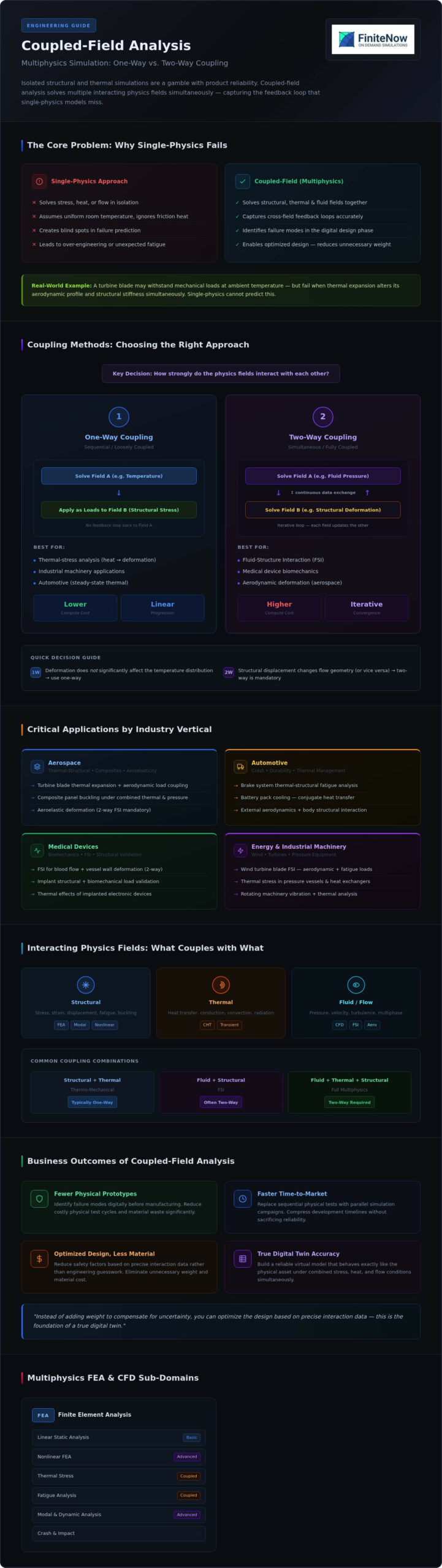
Coupled-field analysis is the simultaneous solution of multiple interacting physics fields within a single computational framework. While legacy engineering methods often solve for stress, heat, or fluid flow in isolation, this integrated approach treats them as a unified system. This is why “multiphysics” has become the industry-standard term. It reflects the reality that physical forces don’t exist in vacuums. Professional coupled-field analysis services provide the mathematical rigor needed to capture the feedback loop between these forces, ensuring that a change in one field correctly influences all others.
Traditional Structural FEA typically ignores these interactions to save on computational time. It might assume a component operates at a uniform room temperature while ignoring the localized heat generated by friction or electrical resistance. This simplification leads to blind spots. Coupled analysis eliminates these gaps by solving the equations of different physical domains together, creating a more accurate representation of operational reality.
The Shift from Single-Physics to Multiphysics
Linear static analysis serves its purpose for basic load cases, but it’s insufficient for complex environments. Real-world conditions rarely involve a single isolated force; they involve a chaotic mix of vibration, heat transfer, and pressure. Relying on single-physics models often results in components that are either over-engineered or prone to unexpected fatigue. Multiphysics is the convergence of structural, thermal, and fluid solvers into a singular, high-fidelity model. This shift allows engineers to move beyond “best guesses” and toward validated performance based on how parts actually behave when multiple loads hit at once.
Why High-Fidelity Simulation Requires Coupling
Ignoring cross-field interactions creates a significant risk of design failure. For example, a turbine blade might withstand mechanical loads at ambient temperatures but fail when thermal expansion alters its aerodynamic profile and structural stiffness. By utilizing expert coupled-field analysis services, you can identify these failure modes during the digital design phase long before a physical prototype is built.
This precision allows you to reduce the “factor of safety” without increasing operational risk. Instead of adding weight to compensate for uncertainty, you can optimize the design based on precise interaction data. This level of fidelity is the foundation of a true digital twin. It provides a reliable virtual representation that behaves exactly like the physical asset under stress, heat, and flow, giving you the confidence to push performance boundaries.
Mapping Interaction Dynamics: One-Way vs. Two-Way Coupling
Choosing the right coupling method is a technical decision that determines the success of your multiphysics project. It isn’t just about software settings. It’s about understanding the underlying physics. The choice hinges on the strength of the interaction between your physical domains. If one field influences another without a significant return effect, a sequential approach is usually the most efficient path. However, when forces are deeply intertwined, simultaneous solutions are mandatory. Expert coupled-field analysis services help you navigate this trade-off to ensure your simulation remains both high-fidelity and cost-effective.
One-Way (Sequential) Coupling Explained
In a one-way or sequential workflow, the simulation solves field A and then maps those results as boundary conditions or loads for field B. The classic example is a thermal-stress analysis. Here, a temperature distribution is calculated first. These thermal results then act as loads to determine structural strain and stress. Since the structural deformation usually doesn’t significantly change the heat distribution, this linear progression is effective. Utilizing Thermo-Mechanical Analysis Services in this way reduces computation time compared to more complex methods while maintaining precision for most industrial machinery and automotive applications.
Two-Way (Simultaneous) Coupling and Feedback Loops
Two-way coupling is necessary when both physical fields influence each other in a continuous loop. This iterative process requires solvers to exchange data back and forth until the solution converges. Fluid-Structure Interaction (FSI) is a prime example. Fluid pressure deforms a structure, and that deformation, in turn, changes the fluid’s flow path. Piezoelectric analysis also requires this simultaneous approach, as the electrical field and mechanical strain are fundamentally coupled. These simulations are computationally intense. They require strict convergence criteria to ensure numerical stability. If you’re dealing with these complex feedback loops, you can request a custom simulation quote to see how a streamlined multiphysics workflow handles these demands without the overhead of traditional consultancies.
The technical distinction between these methods is a matter of operational efficiency. One-way coupling is faster and easier to validate. It’s ideal for standard design checks. Two-way coupling is the only way to capture the non-linear behaviors that cause unexpected failures in high-performance systems. Professional coupled-field analysis services provide the expertise to distinguish between these needs. This prevents you from over-paying for unnecessary complexity or under-simulating critical risks.
Critical Applications Across High-Stakes Industry Verticals
High-stakes engineering environments demand more than generic validation. Each industry faces unique physical interactions that require specialized coupled-field analysis services to ensure long-term reliability. Whether you’re navigating high-velocity airflow or the subtle biomechanics of a medical implant, the goal remains the same. You must capture the exact relationship between interacting forces to predict performance with clinical precision. This targeted approach moves beyond basic safety factors, allowing for lean, high-performance designs that meet rigorous operational standards.
Aerospace and Automotive: High-Speed Interactions
In Aerospace, aeroelasticity represents a critical multiphysics challenge where aerodynamic loads and structural stiffness interact dynamically. Capturing this requires CFD Simulation integrated with structural solvers to predict buckling and flutter in thin-walled composite structures. Automotive engineering faces similar complexities in thermal management, specifically for electric vehicle battery cooling systems. Simultaneous thermal-fluid simulations ensure durability and safety during rapid discharge cycles or high-ambient heat conditions. These simulations effectively replace expensive wind tunnel sessions and physical crash testing. They provide granular data on deformation and heat dissipation that physical sensors often miss.
Medical Devices and Industrial Machinery
Medical device development operates under strict regulatory frameworks that mandate rigorous validation. Biomechanics and stent fatigue life are primary focuses, where Fluid-Structure Interaction (FSI) models blood flow through flexible arterial walls to predict vessel wall stress. Applying FEA for medical implants within this coupled-field framework provides the high-fidelity data required for clinical certification and risk mitigation. In the Industrial Machinery sector, the emphasis shifts to vibration and modal analysis. Engineers use coupled-field analysis services to evaluate rotating machinery, focusing on pressure drops and flow-induced vibrations that lead to premature fatigue. Identifying these resonance points early prevents catastrophic field failures. It also optimizes the operational efficiency of pumps, turbines, and heavy manufacturing equipment by balancing flow dynamics with structural integrity. For assemblies with moving parts, a dedicated mechanism design simulation service can complement coupled-field analysis by capturing the high-speed dynamic loads and friction effects that static models miss.
Developing Custom Engineering Simulation Workflows
Standard solver defaults often fail when faced with unique physical interactions. Relying on “out-of-the-box” settings for complex problems leads to convergence errors or, worse, plausible-looking but incorrect results. Custom workflows are optimized sequences that prioritize accuracy over generic solver defaults. By building a tailored simulation pipeline, you ensure that the mathematical models align perfectly with your specific engineering constraints. Professional coupled-field analysis services specialize in architecting these pipelines, moving beyond basic templates to deliver high-fidelity data that reflects your product’s actual operational environment.
The efficiency of a custom workflow depends heavily on robust data exchange interfaces between different solvers. In a multiphysics environment, the structural, thermal, and fluid solvers must communicate without data loss or interpolation errors. A well-designed interface manages the mapping of nodal forces and temperatures across dissimilar meshes. This technical precision streamlines the project kickoff, especially when integrated with an instant automated quoting system that allows you to bypass the weeks of negotiation typical of legacy consultancies.
The Architecture of a Custom Multiphysics Setup
A successful setup begins with geometry preparation and physics-aware meshing strategies. You can’t use a generic mesh for a coupled-field problem. The mesh density must account for high gradients in both the fluid boundary layer and the structural stress concentrations. Selecting appropriate turbulence models and material laws for each field is equally critical. For example, a custom workflow might utilize a non-linear hyperelastic material law in the structural solver while simultaneously employing a specific k-omega SST model in the CFD solver. Defining the load-transfer frequency and strict convergence criteria ensures that the iterations between these fields remain stable and physically accurate. When your assembly includes linkages or kinematic mechanisms, integrating a multibody dynamics-based mechanism design simulation service into the workflow provides the force and displacement data needed to define accurate boundary conditions for the coupled-field solver.
Validation and Reporting in Custom Workflows
Validation is the cornerstone of any custom engineering simulation. These workflows incorporate mesh sensitivity studies specifically designed for coupled fields. This process verifies that the interaction results remain consistent regardless of mesh refinement. Once the simulation is complete, the findings must be documented through professional FEA reports. These documents provide more than just colorful plots. They offer a deep dive into the methodology, boundary conditions, and validation steps. This level of documentation ensures full traceability from your initial CAD input to the final simulation output, providing the technical evidence needed for internal design reviews or regulatory submissions. If you need to validate a complex interaction, get an instant quote for custom simulations to accelerate your development cycle.
Scaling Multiphysics with On-Demand Engineering Expertise
Traditional engineering consultancies often struggle with the pace of modern product development. They rely on rigid contracts and opaque pricing models that slow down innovation. FiniteNow disrupts this legacy approach by offering on-demand coupled-field analysis services that prioritize speed and technical transparency. By shifting from a fixed-overhead model to a scalable, pay-per-project framework, you gain the ability to handle complex multiphysics simulations without the burden of long-term commitments. This flexibility is critical for teams that need high-fidelity validation but don’t require a full-time internal simulation department to manage their coupled-field analysis services.
Removing the Barriers of Software Licensing
Accessing high-fidelity solvers usually requires a massive capital investment. The annual fees for advanced multiphysics modules can be prohibitive for SMEs and startups. Shifting to Engineering Simulation Without Software Licenses allows your team to redirect those funds toward R&D and physical prototyping. You get access to the latest solver technologies and high-performance computing (HPC) clusters without managing the underlying infrastructure. Our instant quote system provides immediate cost transparency. It eliminates the back-and-forth negotiation cycles, allowing procurement managers to plan budgets with certainty rather than waiting weeks for a traditional bid.
Leveraging Global Expertise for Specialized Domains
Reliability in simulation comes from the expertise behind the mesh. Our German-based engineering team brings a methodical, precision-oriented mindset to every project. This ensures that your custom simulations are validated against rigorous standards and logical processes. We maintain a pre-qualified supplier network that allows us to scale rapidly, providing specialized support for niche domains like biomechanics or battery thermal management. The process is designed for maximum momentum.
You submit your project requirements, receive an automated quote, and engage directly with experts through video calls to refine the technical scope. This collaborative approach ensures that the simulation output is actionable and aligned with your design goals. It’s a faster, more flexible way to integrate high-level expertise into your engineering workflow without the friction of traditional staffing or licensing barriers. This model empowers you to solve complex interactions with clinical precision while maintaining total control over your project timelines and costs.
Transitioning to High-Fidelity Multiphysics Precision
Mastering the feedback loop between physical domains is no longer a luxury reserved for specialized labs. It’s a technical requirement for high-performance engineering. We’ve explored how identifying the correct coupling method, whether sequential or simultaneous, ensures your digital twins provide actionable data. By building custom workflows that prioritize accuracy over generic solver defaults, you eliminate the risks associated with uncoupled, simplified models.
FiniteNow provides access to this advanced methodology through a German-based engineering team. Our pay-per-project model removes the traditional barriers of expensive software licenses and long-term contracts. Whether you’re validating a medical implant, an automotive cooling system, or an aerospace composite, our coupled-field analysis services deliver the high-fidelity results your project demands. It’s time to replace guesswork with data-driven precision.
Get an instant quote for your coupled-field analysis project and accelerate your development cycle with streamlined, expert-led simulation. Take control of your design validation today.
Frequently Asked Questions
What is the difference between coupled-field and multiphysics analysis?
Coupled-field and multiphysics analysis are often used interchangeably, but there’s a technical distinction in implementation. Coupled-field analysis specifically refers to the simultaneous solution of multiple physical degrees of freedom within a single solver framework. Multiphysics is the broader industry term. Both approaches are central to our coupled-field analysis services, capturing the interactions that single-physics solvers ignore to provide a comprehensive view of product performance.
When is it necessary to use two-way coupling instead of one-way?
You should use two-way coupling when physical forces influence each other iteratively. If the deformation of a structure significantly alters the fluid flow path or if a temperature change fundamentally shifts the material’s structural response, a one-way approach won’t be accurate. This simultaneous data exchange is mandatory for complex interactions like Fluid-Structure Interaction (FSI) in flexible components. If the interaction is linear, one-way coupling is a more efficient choice.
How much does a coupled-field analysis service typically cost?
The cost of coupled-field analysis services depends on several factors, including the number of interacting physical domains, the complexity of the geometry, and the convergence requirements of the solvers. Instead of the high overhead associated with traditional consultancies, our pay-per-project model ensures you only pay for the specific expertise needed for your simulation. You can use our automated system to receive a transparent quote based on your unique project parameters.
What types of CAD files are required for a custom simulation workflow?
We typically require neutral CAD formats to ensure compatibility across different simulation environments. STEP (.stp, .step) and Parasolid (.x_t) files are preferred because they preserve the integrity of the geometry during the meshing process. For complex multiphysics setups, providing a clean, de-featured version of your assembly helps reduce computational time without sacrificing the accuracy of the interaction results. Our engineering team can guide you on geometry preparation during project kickoff.
Can coupled analysis simulate fluid-structure interaction (FSI) in medical devices?
Yes, coupled analysis is the standard method for simulating FSI in medical devices. It’s particularly effective for modeling how blood flow interacts with flexible arterial walls or prosthetic heart valves. These simulations capture the dynamic deformation of the device under physiological pressure loads, which is essential for fatigue life prediction and regulatory validation. By integrating structural and fluid solvers, we provide the high-fidelity data required to ensure patient safety and reliability. For a deeper understanding of biomechanical validation methodologies, our guide on FEA for medical implants covers the full spectrum of simulation techniques used in device certification.
How do I validate the results of a coupled-field simulation?
Validating a multiphysics simulation involves a multi-step verification process. We start with mesh sensitivity studies to ensure the results aren’t dependent on the grid density of either physical field. We then compare the simulation output against known analytical solutions for simplified cases or existing experimental data where available. This rigorous approach confirms that the interaction dynamics are physically plausible and that the solver has reached a stable, converged solution within the defined tolerances.
What are the typical lead times for a complex multiphysics project?
Lead times vary based on the technical complexity of the interaction and the mesh requirements. A standard sequential thermal-structural analysis usually moves faster than a fully coupled, non-linear FSI project. Our on-demand model is designed to be faster than traditional consultancies by eliminating the lengthy negotiation and software setup phases. Once you submit your project through our platform, our team begins execution immediately, ensuring a streamlined progression from CAD input to final report.
Simulation Work Reinvented