

Relying on physical prototypes to validate thermal equilibrium is an expensive relic of legacy engineering that your timeline simply can’t afford. You’ve likely felt the pressure of identifying critical hot spots only after a build is complete, which triggers a cycle of costly redesigns and missed delivery dates. Traditional engineering consultancies often compound these pains with long lead times and opaque pricing structures, making internal thermal modeling feel like a project bottleneck rather than a strategic advantage. It’s time to move past these outdated obstacles and adopt a more efficient validation path.
By leveraging a specialized steady-state thermal analysis service, you’ll secure the foundational data required to optimize heat management and ensure structural integrity in high-performance applications. This approach transforms thermal validation from a late-stage hurdle into a front-end design tool that informs every iteration. This article explores how modern simulation workflows identify thermal risks early, significantly reduce the number of physical test cycles, and provide the professional documentation necessary for rigorous design verification across the Aerospace, Automotive, and Energy sectors. You’ll learn to replace guesswork with precision, obtaining the validated reports your procurement and engineering managers demand for project sign-off.
Key Takeaways
- Define thermal equilibrium as the essential baseline for high-performance engineering to ensure heat input perfectly matches dissipation.
- Master the governing physics of conduction, convection, and radiation to accurately predict material behavior and structural integrity under constant thermal loads.
- Utilize a professional steady-state thermal analysis service to eliminate software licensing overhead and obtain design-ready validation reports with streamlined precision.
- Identify why steady-state models offer the most efficient path for “worst-case” data, enabling faster design iterations than computationally intensive transient simulations.
- Detect critical thermal hot spots early in Aerospace and Automotive projects to reduce physical test cycles and prevent expensive late-stage prototyping failures.
Fundamentals of Steady-State Thermal Analysis in Engineering
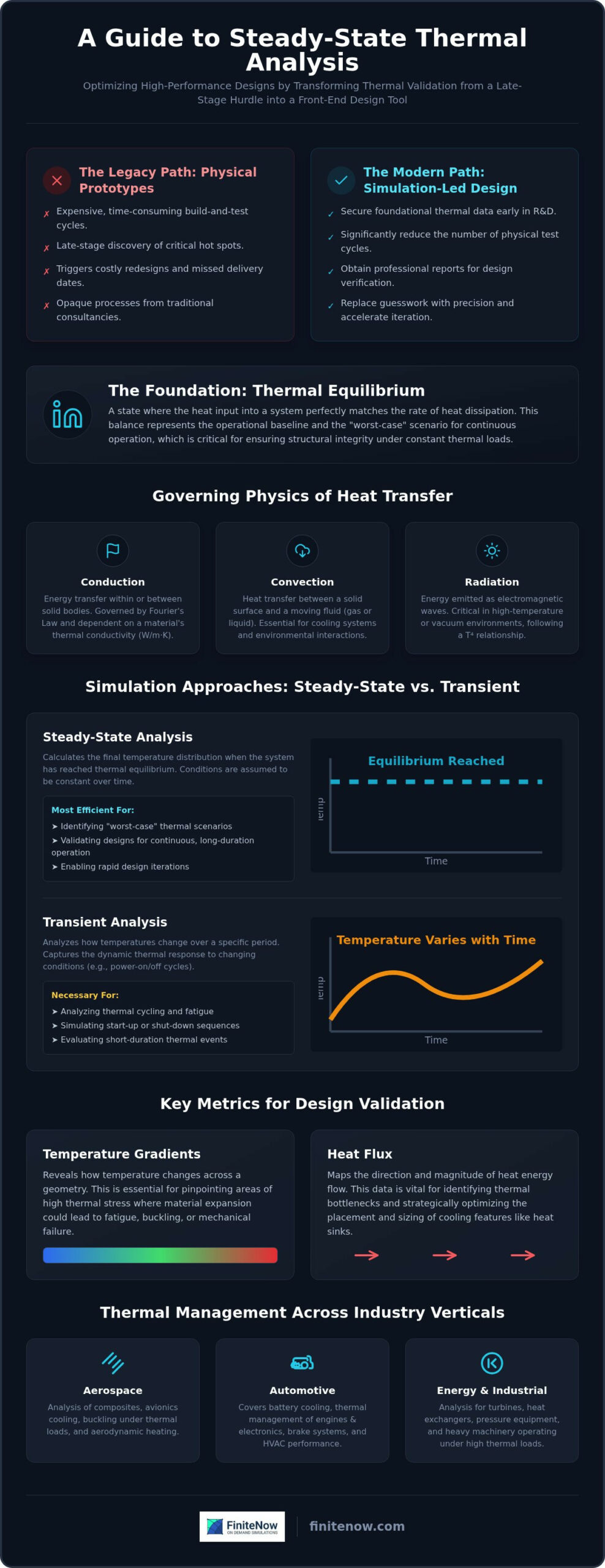
Thermal equilibrium isn’t a suggestion; it’s a requirement for operational stability. This state occurs when the heat input into a system perfectly matches the rate of heat dissipation. In high-performance engineering, this balance represents the “worst-case” scenario for continuous operation. If your design cannot maintain structural integrity at equilibrium, it will certainly fail during transient fluctuations. Engaging a steady-state thermal analysis service allows you to secure this baseline data early in the R&D cycle. This avoids the high costs associated with discovering thermal bottlenecks during physical prototyping phases.
Engineers must master the Fundamentals of Thermal Analysis to set accurate boundary conditions, which include fixed temperatures, heat loads, and convection coefficients. These inputs are the backbone of a reliable thermal model. Without precise boundary definitions, the simulation results remain theoretical rather than actionable. By focusing on steady-state behavior first, you establish a streamlined workflow that prioritizes rapid iteration and design validation over computationally expensive time-domain modeling.
Linear vs. Non-Linear Thermal Systems
Linear thermal analysis assumes that material properties, such as thermal conductivity, remain constant regardless of temperature changes. This simplification allows for extremely fast computation and is often sufficient for standard structural components operating within narrow temperature ranges. However, complex assemblies in Aerospace or Energy sectors frequently exhibit non-linear behavior. You must account for temperature-dependent conductivity where materials lose efficiency as they heat up. Non-linearity also enters the model through radiation effects, which follow a T to the fourth power relationship, and natural convection, where fluid buoyancy depends on the temperature delta. A professional steady-state thermal analysis service utilizes iterative solvers to converge on an accurate solution for these complex, interlinked variables.
Key Metrics: Temperature Gradients and Heat Flux
You need more than just a peak temperature reading to validate a design. Analyzing temperature gradients allows you to pinpoint areas of high thermal stress where expansion could lead to fatigue or buckling. These gradients show exactly how heat moves through your geometry. Heat flux vectors are equally vital; they map the physical path of energy flow through your assembly. This mapping identifies thermal bottlenecks where heat is trapped, allowing you to optimize heat sink placement or adjust material thickness. For electronics cooling, quantifying total heat dissipation ensures your thermal interface materials are sized correctly for the expected load. These metrics transform raw simulation data into a professional report for design verification.
Governing Physics: Conduction, Convection, and Radiation
High-fidelity thermal modeling requires a rigorous approach to multi-mode heat transfer. While some legacy models treat these as isolated events, true engineering precision demands an integrated view of conduction, convection, and radiation. A professional steady-state thermal analysis service solves these governing equations simultaneously to ensure the resulting equilibrium state reflects real-world conditions. This integrated approach, often termed Conjugate Heat Transfer (CHT), is critical when fluid flow and solid-state heat transfer are inextricably linked, such as in high-performance cooling jackets or heat exchangers. By solving the full energy equation, you eliminate the inaccuracies inherent in decoupled simulations.
Modeling Conduction in Multi-Material Assemblies
Conduction modeling relies on Fourier’s Law to calculate energy transfer within solid bodies. Real-world assemblies aren’t monolithic; they’re collections of parts with varying thermal impedances. You must account for thermal contact resistance at every interface, where microscopic air gaps create significant temperature drops. Thermal conductivity is the material’s ability to conduct heat, measured in W/(m·K). Referencing a NAFEMS benchmark for conductive heat transfer ensures your simulation setup aligns with industry-standard accuracy.
Convection and Fluid-Structure Interaction (FSI)
Convection analysis manages the interaction between solid surfaces and surrounding fluids. The accuracy of your convection coefficient hinges on the Nusselt number, which characterizes the ratio of convective to conductive heat transfer across the boundary layer. Advanced CFD simulation provides the high-fidelity boundary conditions needed to model these fluid-surface interactions accurately. It replaces generic “rule of thumb” coefficients with data-driven insights tailored to your specific geometry.
Distinguishing between internal flow, such as coolant channels in an engine block, and external aerodynamics, like airflow over an avionics bay, is essential. Internal flow requires precise pressure drop calculations to ensure pump capacity, while external flow focuses on heat dissipation into the ambient environment. If you’re struggling with complex boundary layer transitions, accessing a steady-state thermal analysis service can streamline your R&D timeline. Radiation modeling completes the thermal picture by accounting for surface-to-surface and surface-to-ambient exchange. This becomes the dominant heat transfer mode at high temperatures or in vacuum environments common in aerospace. Accounting for emissivity and view factors ensures your thermal model doesn’t underestimate the heat load on sensitive components. If you need immediate validation, get an instant quote for thermal analysis to keep your project moving.
Steady-State vs. Transient Thermal Simulation
Choosing between steady-state and transient simulation isn’t about which is “better”; it’s about which is appropriate for your current R&D stage. A steady-state thermal analysis service focuses on the equilibrium point where temperatures have stabilized. It’s the “worst-case” scenario for equipment designed for continuous operation. In contrast, transient analysis tracks temperature changes over a specific duration. While transient models offer a granular look at the journey to equilibrium, they require significantly more computational power and time-stepping data. For most engineering workflows, steady-state is the high-efficiency baseline that identifies critical hot spots before you invest in complex dynamic modeling.
Computational cost is the primary differentiator. Steady-state solvers ignore the time variable, allowing for rapid iteration and faster design cycles. You don’t need to define initial temperatures or specific heat capacities because the model assumes the system has already reached its final thermal state. This simplicity makes it the ideal tool for pruning the design space. Transient models, however, are governed by thermal inertia. They require accurate mass and heat capacity data to predict how fast a component heats up or cools down. If your goal is to validate long-term structural integrity under constant load, steady-state provides the necessary data without the overhead of time-domain calculations.
When to Choose Steady-State Analysis
Opt for steady-state when your system operates at a constant duty cycle for extended periods. Servers, industrial furnaces, and chemical reactors are classic examples where the equilibrium state is the only state that matters for long-term reliability. This approach is also essential for initial design screening and topology optimization. By running multiple steady-state iterations, you can quickly identify which geometry dissipates heat most effectively. It also serves as the critical baseline for thermo-mechanical analysis services, providing the temperature distribution maps required to calculate thermal expansion and structural stress.
Transitioning to Transient Thermal Models
You should transition to transient models when the “peak” load occurs during a change in state rather than at equilibrium. Analyze startup and shutdown cycles to ensure that rapid temperature ramps don’t cause immediate structural failure. Transient simulation is also vital for evaluating thermal fatigue in components subject to cyclic heating, such as engine pistons or power electronics. In safety-critical scenarios like battery thermal runaway or rapid electronics cooling events, the speed of heat propagation is just as important as the final temperature. Use these dynamic models only after steady-state analysis has cleared the foundational design for structural viability. For components where cyclic thermal loading may initiate crack growth, complementing your thermal results with a fracture mechanics simulation service provides the fatigue life predictions needed to fully validate structural integrity.
Thermal Management Across Industry Verticals
Generic thermal assumptions are a liability your project can’t afford. Every industry faces unique thermodynamic constraints that require specialized modeling parameters. A professional steady-state thermal analysis service provides the vertical-specific precision needed to validate complex systems before they reach the production floor. This proactive approach isn’t just about safety; it’s about optimizing performance within strict environmental and regulatory boundaries. It’s a faster, more transparent alternative to the “build-and-break” cycles of legacy engineering.
In Aerospace, you’re managing the interplay between aerodynamic heating and high-altitude radiation. Steady-state models identify potential buckling in airframe components and ensure avionics stay within operational limits. Automotive engineers utilize these simulations for under-hood thermal management and high-efficiency battery cooling systems in electric vehicles. Industrial machinery designers focus on the thermal expansion of rotating shafts and gearboxes to prevent premature fatigue. Even the Medical sector relies on this data; you must validate that biomechanical implants and surgical tools maintain structural integrity under intense sterilization loads or while operating inside the human body.
Electronics Cooling and Battery Management
Optimizing heat sink geometry is a critical step in preventing thermal throttling. It’s not just about adding more fins; it’s about managing fluid-surface interactions to maximize dissipation. Using an electronics cooling optimization service allows you to refine PCB layouts and enclosure designs with streamlined precision. This ensures that high-density components maintain longevity and performance, even under 100% duty cycles. German-engineered simulations provide the granular heat flux data needed to eliminate hot spots that generic models often miss.
Thermal Stress and Structural Integrity
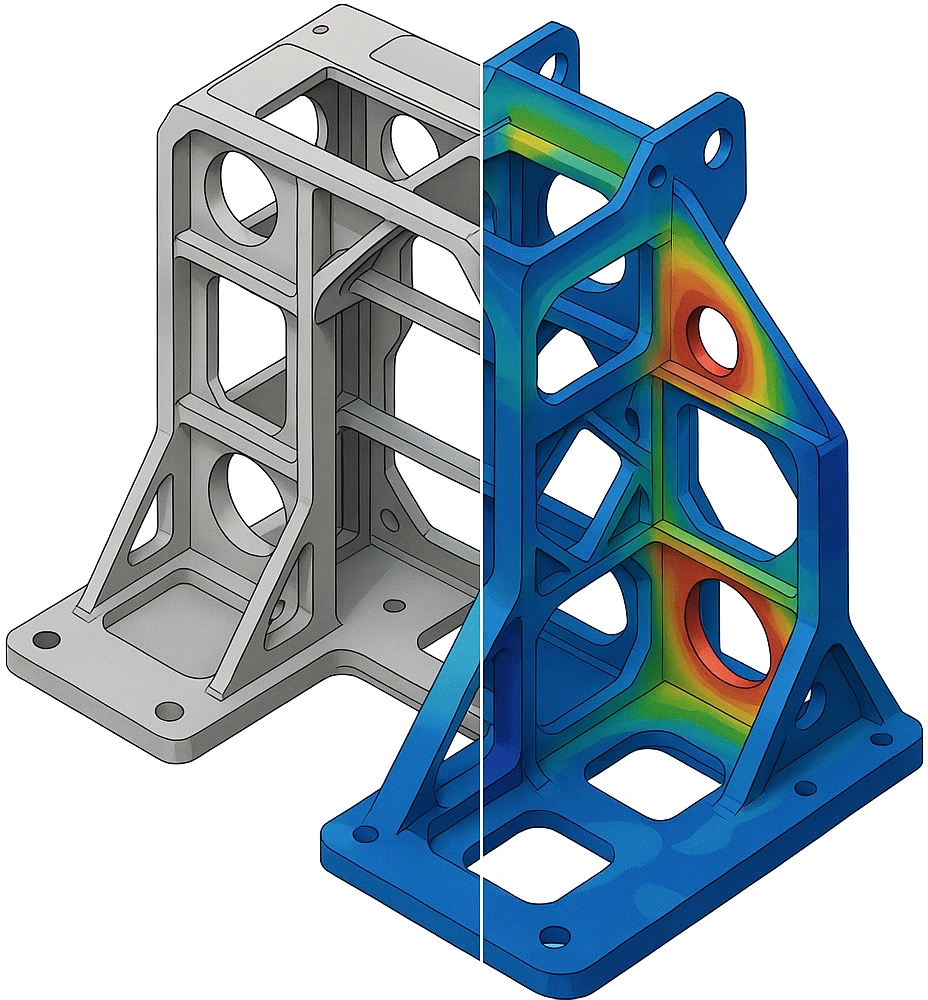
You can’t evaluate structural health without accurate thermal data. Mapping temperature distributions directly to Structural FEA models is the industry standard for predicting thermally induced strains. These strains frequently lead to stress concentrations that cause catastrophic failure in pressure equipment and turbines. High-fidelity simulation mitigates this risk by identifying these zones during the initial design phase. It replaces guesswork with validated data, providing the professional reports required for design verification. Industrial machinery designers who rely on standard safety factors alone risk unexplained fatigue cracks; understanding the full scope of thermal stress analysis for machinery is essential to avoid the costly assumptions that drive up scrap rates and manufacturing overhead. To secure your design validation and eliminate software licensing barriers, obtain an instant quote for thermal analysis and move your project into the next phase today.
Scaling R&D with On-Demand Thermal Simulation Services
Traditional engineering departments often waste capital on idle software licenses and underutilized high-performance computing hardware. This legacy model creates a fixed-cost burden that slows down innovation and restricts your ability to pivot. Transitioning to a project-based steady-state thermal analysis service allows you to scale your R&D efforts without the overhead of perpetual licensing. This approach provides the distinct advantage of engineering simulation without software licenses, enabling SMEs and agile teams to access elite technical capabilities on demand. You pay for the specific insights you need to move a design forward, not for the maintenance of complex software environments.
Accessing a pre-qualified network of engineering experts instantly removes the recruitment bottleneck. Instead of searching for specialized thermal analysts, you tap into a German-based engineering team that’s ready to execute. This shift from “ownership” to “access” ensures that your thermal models are built on the latest best practices and solver technologies. You receive professional, validation-ready reports that satisfy the rigorous documentation requirements of both procurement and regulatory compliance bodies. It’s a faster, more transparent alternative to the opaque processes of traditional consultancies.
The FiniteNow Workflow: From Quote to Results
Speed is your most valuable asset in a competitive market. FiniteNow utilizes an automated instant quoting system to accelerate project kick-off, eliminating the weeks of back-and-forth typical of legacy firms. You collaborate with expert engineers through a streamlined digital platform designed for modern efficiency. This workflow ensures that data security and IP protection are baked into every interaction. Your technical data remains confidential while the communication remains fast-paced and results-oriented. It’s a methodical progression that mirrors a well-oiled digital workflow, delivering actionable insights with momentum.
Reducing Physical Prototyping Costs
Virtual validation is the cornerstone of a modern “zero-prototype” strategy. High-fidelity simulation allows you to identify potential failures and thermal bottlenecks before you commit to expensive manufacturing runs. By validating designs virtually, you significantly reduce the number of physical test cycles required for sign-off. This data-driven analysis doesn’t just find flaws; it optimizes material selection and energy efficiency. You can test multiple configurations in a fraction of the time it takes to build a single physical unit. This precision ensures that when you finally move to production, your design is already validated for the required thermal equilibrium.
Accelerating Thermal Validation with Precision Simulation
Steady-state thermal analysis is more than a technical check; it’s a strategic baseline for high-performance design. You’ve seen how identifying thermal equilibrium points early prevents the catastrophic failures and costly redesigns typical of legacy engineering workflows. By mastering the governing physics of conduction, convection, and radiation, you secure the data needed to optimize everything from electronics cooling to airframe integrity.
Transitioning to a professional steady-state thermal analysis service removes the friction of high software costs and recruitment delays. You gain immediate access to German-based engineering expertise through a transparent, project-based model with no long-term contracts. FiniteNow delivers professional FEA and CFD reports that are validation-ready for procurement and compliance. Stop waiting on traditional consultancies and start validating your designs with streamlined precision.
Get an Instant Quote for Thermal Analysis Services today and move your project from simulation to production with confidence.
Frequently Asked Questions
What is the primary difference between steady-state and transient thermal analysis?
Steady-state analysis evaluates the system at equilibrium where temperatures no longer change over time. Transient analysis tracks temperature fluctuations during a specific duration. Steady-state is the more efficient choice for validating continuous operation and identifying “worst-case” thermal loads. It ignores heat capacity and time-stepping, which significantly reduces computational overhead. Transient models are reserved for analyzing startup cycles, shutdown phases, or rapid thermal runaway events where time-dependent behavior is critical.
How accurate are steady-state thermal analysis services compared to physical testing?
Simulations achieve high accuracy when benchmarked against material standards like ISO 11357 or ASTM E1131. While physical testing provides empirical validation, a steady-state thermal analysis service identifies hot spots and gradient issues that sensors might miss due to limited placement. Modern solvers provide high-fidelity results that correlate closely with real-world performance, allowing you to refine designs before committing to expensive physical prototypes. It’s a faster, data-driven alternative to traditional trial-and-error testing.
What inputs are required to start a steady-state thermal simulation?
You must provide the CAD geometry, material properties, and specific boundary conditions. Essential material data includes thermal conductivity, measured in W/(m·K), and emissivity for radiation modeling. Boundary conditions must define heat loads, such as power dissipation in Watts, and ambient convection coefficients. If your assembly involves fluid interaction, specifying the flow rate and fluid type is necessary for accurate conjugate heat transfer. High-quality inputs ensure the resulting professional report is ready for design verification.
Can steady-state analysis predict thermal stress and fatigue?
Yes, steady-state results serve as the primary input for thermo-mechanical analysis. By mapping the temperature distribution onto a structural mesh, engineers calculate thermally induced expansion and resulting stress concentrations. This process identifies areas prone to buckling or fatigue failure caused by uneven heating. While steady-state predicts static thermal stress, it provides the foundational baseline needed to evaluate long-term structural integrity in pressure equipment, turbines, and aerospace components. When thermally induced stress concentrations are identified, pairing this data with a fracture mechanics simulation service enables accurate crack propagation and fatigue life predictions for safety-critical designs.
Is steady-state thermal analysis suitable for electronics cooling?
Steady-state analysis is the industry standard for optimizing heat sink geometry and PCB layouts. It ensures that components operating at 100% duty cycle stay within safe temperature limits to prevent thermal throttling. By simulating heat flux and temperature gradients, you can position thermal interface materials and cooling fans with precision. This proactive approach ensures component longevity and system reliability in high-density electronics environments, from server racks to automotive control units.
How long does a typical thermal analysis project take with FiniteNow?
Turnaround times depend on model complexity and the specific scope of the thermal report. FiniteNow utilizes an automated quoting system to eliminate the long lead times associated with traditional engineering consultancies. Once you accept the project-based fee, our German-based engineering team begins the simulation immediately. Most standard thermal validation projects are completed within a few business days, providing you with a professional, data-backed report that keeps your R&D timeline moving forward.
Do I need to own simulation software to use your thermal analysis service?
No, you don’t need to own or maintain any software licenses to use our steady-state thermal analysis service. We provide a project-based engagement model that removes the high upfront costs of platforms like Ansys or Abaqus. You simply upload your design files and receive the validated results. This on-demand expertise allows your team to focus on core engineering tasks while we handle the heavy computational lifting and expert-level solver configuration.
How does steady-state analysis help in reducing R&D costs?
Simulation reduces costs by moving validation from the physical workshop to the digital environment. You identify design flaws and thermal bottlenecks virtually, which significantly decreases the number of expensive physical prototypes required. By optimizing material selection and energy efficiency before manufacturing begins, you avoid late-stage redesigns that often derail budgets. It’s a scalable solution that provides SMEs with the same high-level professional confidence as large-scale aerospace or automotive firms.
Simulation Work Reinvented