

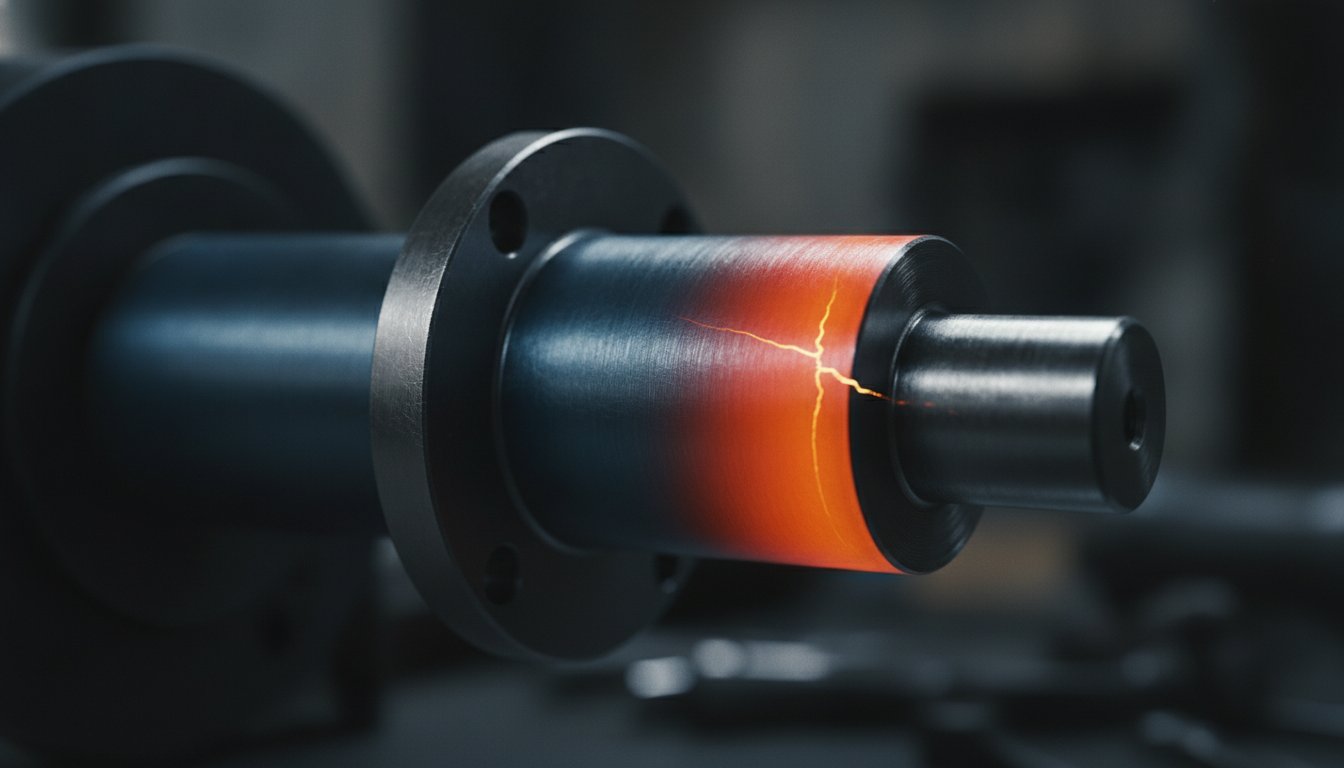
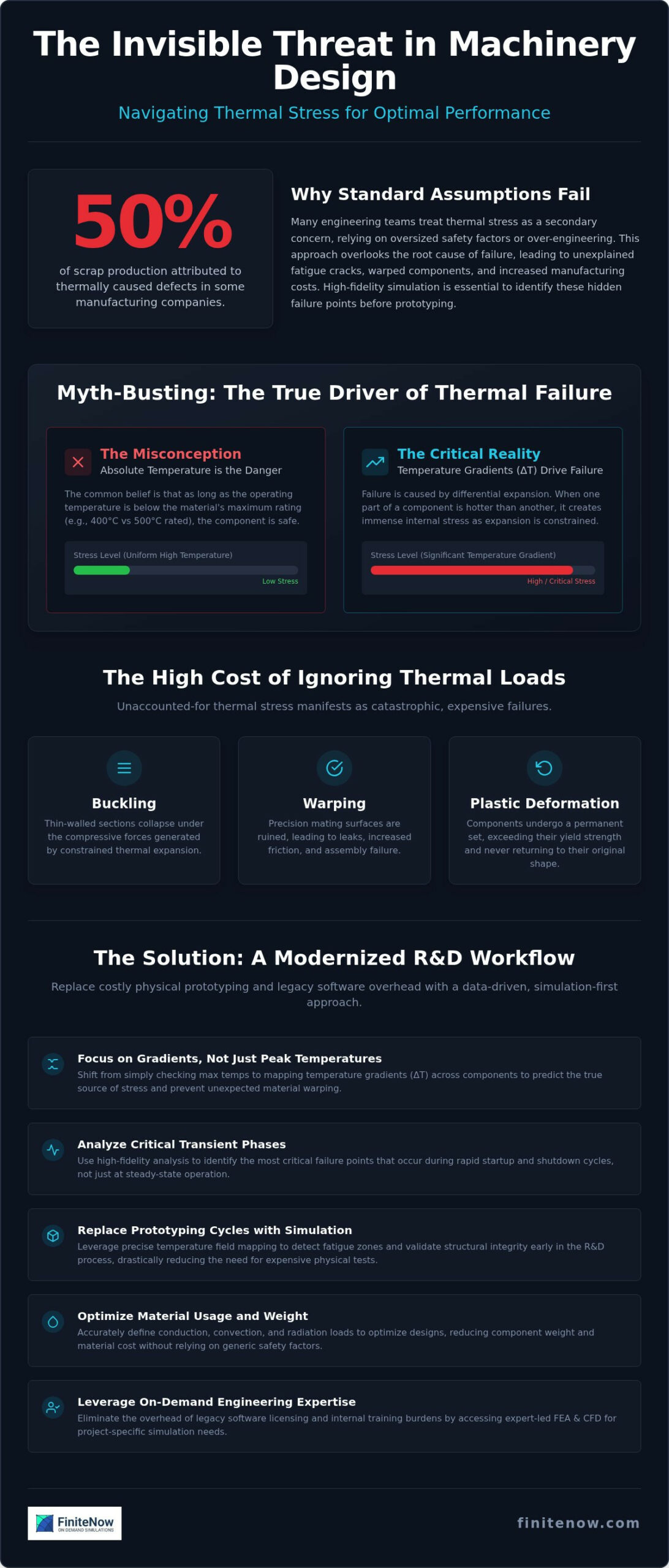
Did you know that production companies attribute up to 50% of their scrap production to thermally caused defects? It’s a staggering figure that highlights a critical gap in traditional design workflows. Many engineering teams treat thermal stress analysis for machinery as a secondary concern. They assume that standard safety factors or over-engineering a component will prevent failure. In reality, these assumptions lead to unexplained fatigue cracks in high-temp zones or unnecessarily heavy parts that drive up manufacturing costs.
You’ve likely felt the frustration of a prototype failing because of a thermal gradient you didn’t see coming. It’s expensive and puts your product launch at risk. This article will show you why traditional assumptions fail and how high-fidelity simulation identifies failure points before prototyping. We’ll dismantle five costly engineering myths and introduce a scalable way to access expert FEA. You’ll learn to optimize material usage without the burden of long-term software licenses or the risk of unplanned downtime.
Key Takeaways
- Shift your focus from peak operating temperatures to temperature gradients to prevent unexpected material warping and structural failure.
- Identify why transient phases like startup and shutdown are the most critical failure points using high-fidelity thermal stress analysis for machinery.
- Replace expensive physical prototyping cycles with precise temperature field mapping to detect fatigue zones early in the R&D process.
- Optimize material usage and reduce component weight by accurately defining conduction, convection, and radiation loads instead of relying on generic safety factors.
- Eliminate the overhead of legacy software licensing by leveraging on-demand engineering expertise for project-specific simulation needs.
The Invisible Threat: Why Thermal Stress Analysis for Machinery is Non-Negotiable
Heat changes everything in mechanical design. When a component heats up, it naturally wants to expand. If that part is free to move, it simply gets larger. However, in modern high-performance systems, components are rarely free. They are constrained by bolts, housings, or adjacent parts made of different materials. This constraint transforms simple expansion into Thermal Stress. It’s the internal force generated when a material’s natural desire to expand is blocked. Expansion is a change in geometry; stress is a change in internal pressure that can tear a material apart from the inside.
Modern engineering demands tighter tolerances and the use of diverse materials with varying coefficients of thermal expansion. This complexity makes thermal stress analysis for machinery a non-negotiable step in the design process. Without it, you aren’t just guessing about clearances; you’re ignoring internal pressures that can exceed the material’s yield strength. Integrating this into your broader Structural FEA workflow allows you to see these invisible forces before they manifest as physical damage.
The High Cost of Ignoring Thermal Loads
Ignoring thermal loads leads to expensive, often catastrophic outcomes. When you fail to account for internal pressures, the machinery doesn’t just underperform; it breaks. Common failure modes include:
- Buckling: Occurs when thin-walled sections can’t handle the compressive forces of expansion.
- Warping: Ruins precision mating surfaces, leading to leaks or increased friction.
- Plastic Deformation: Parts undergo a permanent set and never return to their original shape.
Rotating machinery is particularly vulnerable. Even a slight thermal gradient can cause shaft misalignment, leading to premature bearing failure and high-vibration states. Thermal fatigue is the result of repeated heating and cooling cycles. When thermally induced cracks begin to propagate, a dedicated fracture mechanics simulation service becomes essential for predicting crack growth rates and validating the remaining fatigue life of affected components.
From CAD to Reality: The Gap in Traditional Design
Standard CAD-integrated simulation tools often provide a false sense of security. These lite versions usually simplify thermal environments, ignoring complex conduction paths or radiation effects. They fail to capture the sharp thermal gradients that occur during rapid startups or load spikes. This gap between CAD and reality is where most R&D delays begin. High-fidelity simulation doesn’t just find problems; it validates the structural integrity of your entire assembly under peak thermal loads.
Validating designs with high-fidelity simulation early in the cycle prevents these surprises. You need to bridge the gap between a digital model and real-world durability. Professional thermal stress analysis for machinery via expert thermo-mechanical analysis services provides the depth required to map these gradients accurately. Don’t wait for a prototype to fail in the test cell to realize your thermal assumptions were wrong.
Myth-Busting: “Absolute Temperature is the Primary Danger”
A common misconception in industrial design is that high-temperature resilience equals safety. If your alloy is rated for 500°C and your process hits 400°C, you might feel secure. You shouldn’t. The absolute temperature of a component is rarely what causes it to fail. Instead, the primary driver of failure is the temperature gradient, often referred to as delta-T. When one part of a machine is significantly hotter than another, the resulting differential expansion creates massive internal forces.
Every material has a specific Coefficient of Thermal Expansion (CTE). In complex assemblies, different materials expand at different rates. This creates an internal tug-of-war. Bolted joints, welds, and rigid supports act as constraints that prevent these parts from moving freely. When expansion is blocked, it transforms instantly into stress. This is why thermal stress analysis for machinery is critical; it identifies these hidden pressures that simple temperature checks miss.
The Gradient Factor in Industrial Machinery
Consider a large machine frame where one side is positioned near a heat source while the other remains at ambient temperature. The temperature might stay well below the material’s melting point. However, the hot side tries to grow while the cold side remains rigid. This mismatch creates localized hot spots and stress concentrations. These areas can easily exceed the material’s yield strength, leading to permanent warping or cracks. Mapping these gradients requires a steady-state thermal analysis service to visualize how heat distributes through the structure at equilibrium.
Material Selection vs. Structural Constraint
Engineers often try to solve thermal failure by upgrading to “better” materials. This can be a costly mistake. For instance, switching from carbon steel to certain stainless steel alloys can actually worsen thermal stress because stainless often has a higher CTE. You might be making the part more heat-resistant but also increasing the forces it exerts on the rest of the assembly. Effective thermal stress analysis for machinery evaluates the “stiffness” of the entire system. It helps you decide whether to change the material or modify the structural constraints. Often, the most efficient solution is adding “breathing room” through slotted holes or flexible mounts rather than buying expensive alloys. Our team provides the precision needed to identify these hotspots quickly. You can get an instant quote to see how simulation can streamline your current R&D cycle.
Transient vs. Steady-State: When “Good Enough” Leads to Failure
Steady-state analysis assumes your machinery has reached thermal equilibrium. It’s a snapshot of a machine running at a constant operating temperature for hours. While useful for checking long-term clearances, it ignores the most violent moments in a machine’s life. Transient analysis, by contrast, tracks temperature changes over time. It captures the frantic thermal evolution during startup, shutdown, and sudden load spikes. Most catastrophic failures don’t happen when a machine is running smoothly; they happen during the ramp-up phase. This is when temperature gradients are most extreme and internal pressures peak.
Using thermal stress analysis for machinery to simulate these transient events acts as a vital risk mitigation tool. It allows you to see the lag between surface heating and core temperature, revealing stresses that equilibrium models simply hide. If you only design for the steady state, you’re missing the peaks that actually cause the cracks.
The Danger of Startup and Shutdown Cycles
Thermal shock is a transient phenomenon. It occurs when a rapid temperature change creates a massive gradient across a component’s thickness. Thick-walled parts, such as turbine casings or heavy industrial frames, are particularly susceptible. The exterior might expand rapidly while the interior remains cold and rigid. This mismatch generates stresses that can exceed the material’s elastic limit in seconds. Transient analysis is essential for predicting the fatigue life of components subject to duty cycles. Without it, you’re blind to the cumulative damage caused by every power cycle your equipment undergoes. Complementing this with a professional fracture mechanics simulation service allows you to quantify crack propagation risks that accumulate over thousands of these thermal cycles.
Coupling CFD and FEA for Accurate Results
Getting transient results right requires accurate boundary conditions. Many designers make the dangerous mistake of assuming a uniform heat transfer coefficient (h) across a surface. In reality, fluid flow is rarely uniform. High-velocity jets or stagnant zones create localized cooling or heating that a single number can’t represent. Assuming a uniform h-value is a dangerous simplification that leads to under-designed components.
This is where Conjugate Heat Transfer (CHT) within a CFD simulation becomes critical. CHT models the heat transfer between the fluid and the solid simultaneously. The resulting temperature map provides the exact boundary conditions needed for an FEA model. This high-fidelity thermal stress analysis for machinery eliminates the guesswork of manual entry. Multiphysics consulting provides the only reliable way to capture these complex interactions, ensuring your simulation matches the physical reality of the factory floor.
A Professional Workflow for Thermal Stress Validation
High-fidelity thermal stress analysis for machinery requires a structured approach that moves beyond basic software clicks. The goal is to replicate the physical reality of the factory floor within a digital environment. This process begins by defining the thermal environment. You must account for conduction through the machinery frame, convection to the surrounding air, and radiation if operating temperatures are high. Once these parameters are set, map the temperature field using either steady-state or transient analysis. As established in previous sections, the choice depends on whether your machinery operates at a constant load or undergoes frequent duty cycles.
The next phase bridges the gap between heat and structural integrity. You import the resulting temperature field into your structural FEA model as a thermal load. It’s critical to apply mechanical constraints and external loads simultaneously. Gravity, internal pressures, and operating torques must all be present. A component doesn’t expand in a vacuum; it expands while under load. Finally, evaluate the combined von Mises stress. Comparing these results against material yield and fatigue limits determines if your design will survive the real world or fail in the field.
Critical Input Requirements
Precision in simulation depends entirely on the quality of your input data. You must use temperature-dependent material properties. A material’s Modulus of Elasticity and Coefficient of Thermal Expansion (CTE) are not static; they change as the component heats up. Using room-temperature values for a part operating at 300°C leads to significant errors in stress prediction. Additionally, bolted joints and contact interfaces require sophisticated modeling. Heat doesn’t flow perfectly across a joint; contact resistance must be accounted for to prevent artificial hot spots.
Identifying accurate convection coefficients is equally vital. For machinery with high-heat density zones or integrated control units, referencing specialized templates like our electronics cooling optimization service can help define these boundary conditions. Modern standards, such as the 2025 ASME Boiler and Pressure Vessel Code (BPVC), emphasize this level of detail for validated safety. Ready to validate your machinery design? Request an instant quote to start your project with our German-based engineering team.
Interpreting the Results: Stress vs. Strain
When reviewing results, don’t focus solely on total displacement. While seeing a frame warp by 2mm is a helpful visual, the equivalent stress (von Mises) tells the real story of structural health. You must distinguish between elastic strain and plastic strain. Elastic strain is temporary; the part returns to its original shape. Plastic strain indicates permanent deformation and imminent failure. High-fidelity thermal stress analysis for machinery provides the data needed to justify design changes to stakeholders. It moves the conversation from “I think this might fail” to “The simulation proves this exceeds yield limits.”
Modernizing R&D: Why Legacy Licensing is the Final Myth
Traditional engineering sectors often cling to the idea that high-fidelity thermal stress analysis for machinery is an exclusive luxury. They believe it requires a £50k annual software license and a dedicated PhD on staff to operate. This is the final myth holding back your R&D cycle. That legacy mindset forces companies to either over-engineer their products or accept the risk of unexplained fatigue cracks. The reality is that modern simulation has moved beyond the ownership model. On-demand simulation allows for project-based execution, delivering expert results in days rather than months without the burden of long-term contracts.
FiniteNow disrupts this legacy standard by providing a German-based engineering team and an instant quote system. You don’t need to manage complex software environments or maintain expensive internal infrastructure. Instead, you access technological mastery exactly when your project demands it. This model empowers SMEs to compete directly with global manufacturers. It removes the heavy capital expenditure of simulation and replaces it with a scalable, transparent service. You get the same level of precision as a multinational firm but with the agility of a modern technology startup.
Removing the Barriers to Entry
The strategic shift toward engineering simulation without software licenses is now a competitive necessity. Legacy firms often treat their fees as a “black box,” leaving you in the dark about the true cost of your analysis until weeks into a consultation. Our instant quoting system removes this ambiguity. It provides immediate transparency, allowing you to budget your R&D with precision and confidence. We leverage a network of pre-qualified suppliers to ensure your thermal stress analysis for machinery is handled by specialists who understand your specific industrial constraints.
Speed as a Competitive Advantage
In the machinery sector, speed is your greatest asset. Waiting four weeks just to receive a quote from a legacy firm kills your R&D momentum. It stalls prototyping and delays market entry, costing far more than the simulation itself. A digital-first workflow replaces these traditional obstacles with streamlined precision. Our German engineering expertise ensures that complex problems, like thermal-mechanical coupling, are handled with methodical speed. We move from high-level value propositions to technical execution in a rapid progression that mirrors a well-oiled digital workflow. Don’t let outdated licensing models or slow procurement cycles stall your innovation. Get an instant quote for your thermal stress analysis project today.
Secure Your Machinery’s Future with High-Fidelity Validation
Engineering machinery for high-heat environments requires moving beyond static assumptions. You’ve seen how temperature gradients and transient phases like startup cause more damage than absolute heat alone. By adopting a professional validation workflow, you identify these failure points long before they reach the physical test cell. This proactive approach prevents the staggering costs associated with unplanned downtime and scrap production.
You don’t need to be burdened by legacy software licensing to access specialized expertise. FiniteNow offers a streamlined path to high-fidelity thermal stress analysis for machinery. Our German-based engineering team delivers precise results in days, not weeks. We remove the traditional barriers of entry, allowing you to focus on innovation instead of administrative overhead. It’s time to modernize your R&D process with a partner that values your speed and intellectual rigor. Upload your CAD and get an instant quote for thermal stress analysis to validate your next design with confidence.
Frequently Asked Questions
What is the difference between thermal expansion and thermal stress?
Thermal expansion is the physical change in volume or length as a material heats up. Thermal stress occurs only when that expansion is restricted by external constraints or internal temperature gradients. In machinery, components are often bolted or welded, preventing free movement. This constraint converts the expansion into internal forces. Understanding this distinction is vital because a part can expand significantly without failing if it’s designed to move freely.
Can I perform thermal stress analysis with standard FEA software?
Most standard FEA packages include basic thermal modules, but they often lack the multiphysics coupling required for high-fidelity thermal stress analysis for machinery. Basic tools might simplify boundary conditions or ignore radiation and complex contact resistance. For industrial machinery with tight tolerances, you need advanced solvers like Ansys 2026 R1 or Abaqus 2026. These professional tools capture the non-linear material behavior and sharp gradients that basic CAD-integrated tools often miss.
When should I use transient thermal analysis instead of steady-state?
Use transient analysis when your machinery undergoes rapid temperature changes, such as during startup, shutdown, or load cycling. Steady-state analysis is only suitable for equipment running at a constant temperature for long durations. Since 70-85% of industrial machinery failures are non-age-related, many are triggered by the extreme gradients found during these transient phases. Transient simulation identifies peak stresses that occur before the system reaches thermal equilibrium.
How do I determine the heat transfer coefficients for my machinery?
Determining accurate heat transfer coefficients (h) requires Conjugate Heat Transfer (CHT) within a CFD simulation. Relying on textbook values or empirical correlations often leads to significant errors in machinery validation. CHT models the interaction between fluid flow and solid surfaces simultaneously, providing a precise map of convection across the entire assembly. This high-fidelity data ensures your FEA model reflects the actual cooling or heating rates found in the physical environment.
Is thermal stress analysis necessary if my machinery operates at low temperatures?
Yes, thermal stress is a risk even in low-temperature applications if significant gradients exist. Cryogenic systems or machines moving from refrigerated to ambient zones experience differential contraction. If the cooling is non-uniform, the resulting internal forces can cause brittle fracture or warping. Performing thermal stress analysis for machinery in these scenarios ensures that material selection and joint design account for contraction-induced loads, which are just as destructive as expansion-induced ones.
How much does an outsourced thermal stress analysis cost?
The cost of outsourced analysis depends on the complexity of the assembly and the required fidelity. Traditional consultancies often use opaque pricing models with long lead times. FiniteNow disrupts this by offering an instant quote system based on your specific CAD and requirements. This model removes the overhead of legacy software licensing and internal staffing. You pay only for the expert results you need, making high-level simulation accessible for project-based R&D.
What material properties are required for an accurate thermal FEA?
Accurate thermal FEA requires temperature-dependent values for the Coefficient of Thermal Expansion (CTE), Thermal Conductivity, and Specific Heat. You also need the Modulus of Elasticity and Poisson’s Ratio mapped across the expected temperature range. Since material properties shift as temperatures rise or fall, using static room-temperature data will lead to inaccurate stress predictions. Professional analysis uses validated material databases to ensure every simulation reflects real-world physics.
Can thermal stress cause vibration issues in industrial machinery?
Thermal stress can definitely cause vibration issues by altering the stiffness and alignment of machinery components. As parts warp or expand, they can shift the center of gravity of rotating shafts or change the tension in supports. This often leads to resonance shifts or increased mechanical play. Simulation helps you identify these thermal-mechanical interactions early, ensuring that thermal expansion doesn’t push your system into a high-vibration state that causes premature bearing failure.
Simulation Work Reinvented