

Owning an enterprise CAE license in 2026 is increasingly becoming a strategic liability for lean R&D teams. While traditional firms still sink five-figure sums into perpetual software seats and high-performance hardware, agile innovators treat simulation as a precision utility rather than a capital asset. You’ve likely felt the friction of opaque consultancy pricing or the sting of a specialized software license sitting idle between critical design phases. It’s a bottleneck that delays milestones and forces compromise when you need data-driven validation most.
This guide demonstrates how to bypass these legacy hurdles through pay-per-project engineering simulation. We’ll show you how to procure high-fidelity FEA and CFD results with the speed and transparency of a modern digital workflow. You don’t need a year-long retainer or a dedicated internal team to access German engineering standards. We’ll break down the transition to on-demand results for aerospace, automotive, and medical device projects, ensuring your R&D remains agile and your technical decisions remain backed by rigorous data and expert-level validation.
Key Takeaways
- Shift your R&D budget from rigid software licensing to agile, results-based expenditures that align directly with your actual design cycles.
- Discover how pay-per-project engineering simulation provides access to specialized Structural FEA and CFD expertise without the burden of long-term consulting retainers.
- Compare the operational efficiency of instant automated quoting against traditional procurement timelines to significantly accelerate your product development milestones.
- Identify the critical preparation steps, such as CAD simplification and load case definition, required to ensure high-fidelity results from the very first iteration.
- Utilize German engineering standards to validate complex designs in Aerospace, Automotive, or Medical Device sectors with clinical precision and reliability.
The Economic Shift Toward Pay-Per-Project Engineering Simulation
The engineering landscape has reached a structural inflection point. Historically, Computer-Aided Engineering (CAE) required a “Heavy License” model. This involved massive upfront capital expenditure for software seats, high-performance computing clusters, and specialized personnel. Pay-per-project engineering simulation disrupts this legacy approach by prioritizing the deliverable over the tool. It’s a results-first methodology. You procure the validated report, the optimized geometry, or the safety certification. You don’t pay for idle software hours or depreciating hardware.
By 2026, the transition from perpetual licenses to agile procurement has accelerated. Modern R&D environments can’t afford the lag of traditional consultancy negotiations or the cost of underutilized software. The industry is moving toward a utility model. This shift allows teams to integrate advanced simulations, such as those involving new GPU-based structural solvers, without the burden of long-term ownership. It turns simulation into a high-precision tool that scales with your specific project milestones rather than your annual budget constraints.
From CAPEX to OPEX: The CFO’s View on Simulation
Traditional CAE software licenses often lead to “shelfware.” This occurs when expensive seats sit unused between design iterations. CFOs are increasingly rejecting these fixed costs. By shifting simulation to an operating expense, firms gain immediate balance sheet flexibility. You eliminate the hidden overhead of maintenance contracts, specialized IT infrastructure, and continuous staff training. In 2026, with the global simulation market estimated at up to $30.1 billion, the most successful firms are those that minimize fixed assets in favor of on-demand precision. This model ensures that every dollar spent correlates directly to a tangible project outcome.
Scalable Engineering Simulation for Modern R&D
R&D cycles are rarely linear. One month requires basic linear static analysis. The next demands complex Fluid-Structure Interaction or nonlinear crash simulations for automotive safety. Hiring a full-time expert for every niche physics domain is unsustainable. Implementing a scalable engineering simulation strategy allows you to handle peak workloads without increasing permanent headcount. You access specialized expertise for buckling, fatigue, or electronics cooling only when the project dictates it. This agility supports the deployment of digital twins; these virtual models drastically reduce physical prototyping costs by validating performance before the first part is ever manufactured. Using pay-per-project engineering simulation ensures you only pay for the high-level expertise required at that specific moment.
Evaluating Technical Depth: What You Should Expect
Procurement speed shouldn’t compromise technical rigor. When engaging in pay-per-project engineering simulation, high-fidelity results depend on the depth of the solver setup and the engineer’s experience. It’s not enough to run a simple linear static check. You need a partner who understands the underlying physics of your specific industry vertical, whether it’s aerospace buckling or medical device biomechanics. High-fidelity results require a methodical approach to mesh density and solver convergence that generic automated tools often miss.
Don’t confuse an “Instant Quote” with fully automated, black-box processing. While automation handles the administrative friction, a German-based expert team must oversee the mesh generation and boundary condition setup. This human oversight ensures the results aren’t just fast; they’re validated against real-world physics. Expert-led validation is the primary differentiator between a generic CFD consulting service and a high-performance partner. It’s the human factor that transforms raw data into actionable engineering intelligence. Learn how German engineering simulation services combine traditional mechanical rigor with a digital-first approach to deliver this level of validated precision.
Core Competencies in Structural FEA
High-fidelity FEA services must tackle nonlinear structural analysis when components undergo large deformations or material yielding. This is vital for automotive crash simulations and medical device structural integrity. Fatigue life prediction goes beyond basic stress plots; it identifies cycles to failure, which is critical for industrial machinery and aerospace durability. Additionally, vibration and modal analysis help you identify resonance issues before they lead to catastrophic failure during physical testing. These specialized analyses ensure your product survives real-world operating conditions.
Advanced CFD and Thermal Management
Effective thermal management requires precise turbulence modeling and internal flow analysis. In high-power assemblies, electronics cooling optimization is the difference between a reliable product and a thermal shutdown. For more complex challenges, Fluid-Structure Interaction (FSI) analyzes how fluid pressure affects structural components. This multiphysics approach is essential for wind turbines and flexible medical implants where the flow and the structure are inextricably linked. Solving these challenges requires a sophisticated mix of technical terminology and practical application. Explore how our Structural FEA services provide the technical depth your R&D team needs to move forward with confidence.
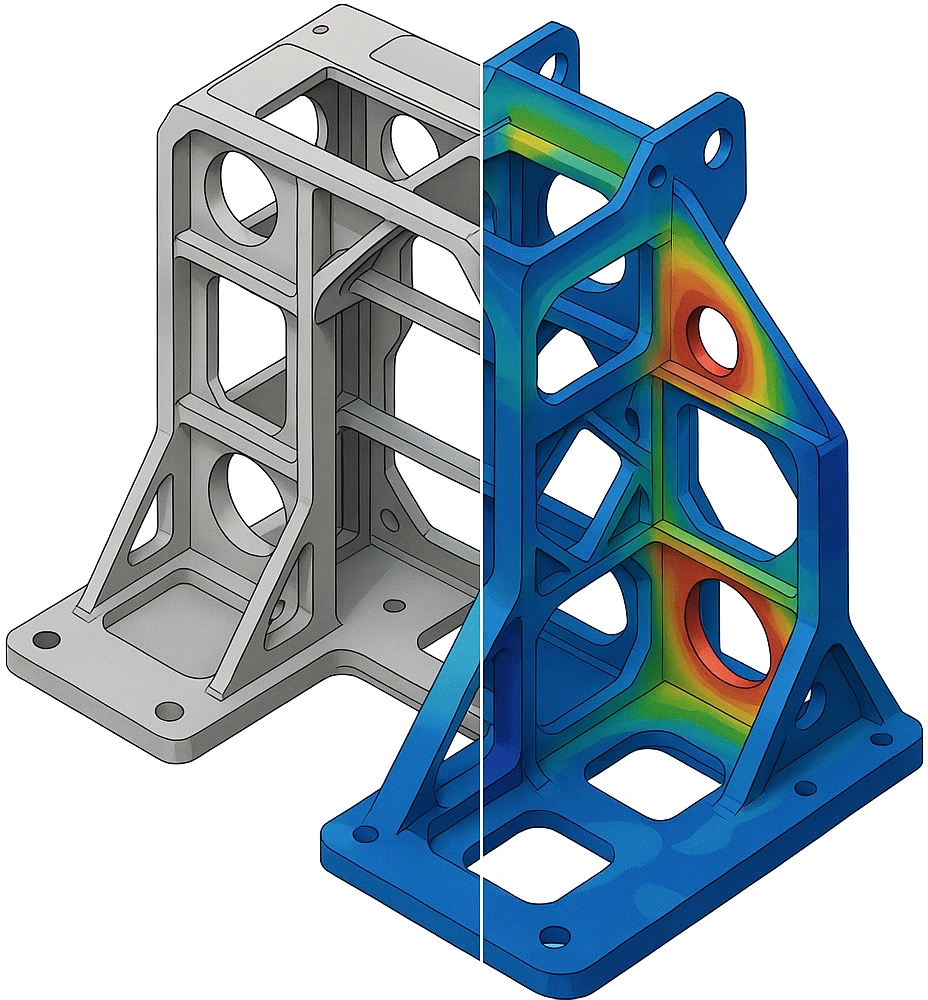
A professional FEA or CFD report isn’t just a collection of colorful contour plots. It must include mesh sensitivity studies, clear documentation of material models, and actionable design recommendations. It’s a technical document that serves as a foundation for your engineering decisions. If your simulation provider doesn’t offer this level of detail, you’re buying a picture, not a validated engineering solution. Every report should provide the intellectual rigor required to pass procurement audits and technical reviews.
Procurement Comparison: In-House vs. Consulting vs. Pay-Per-Project
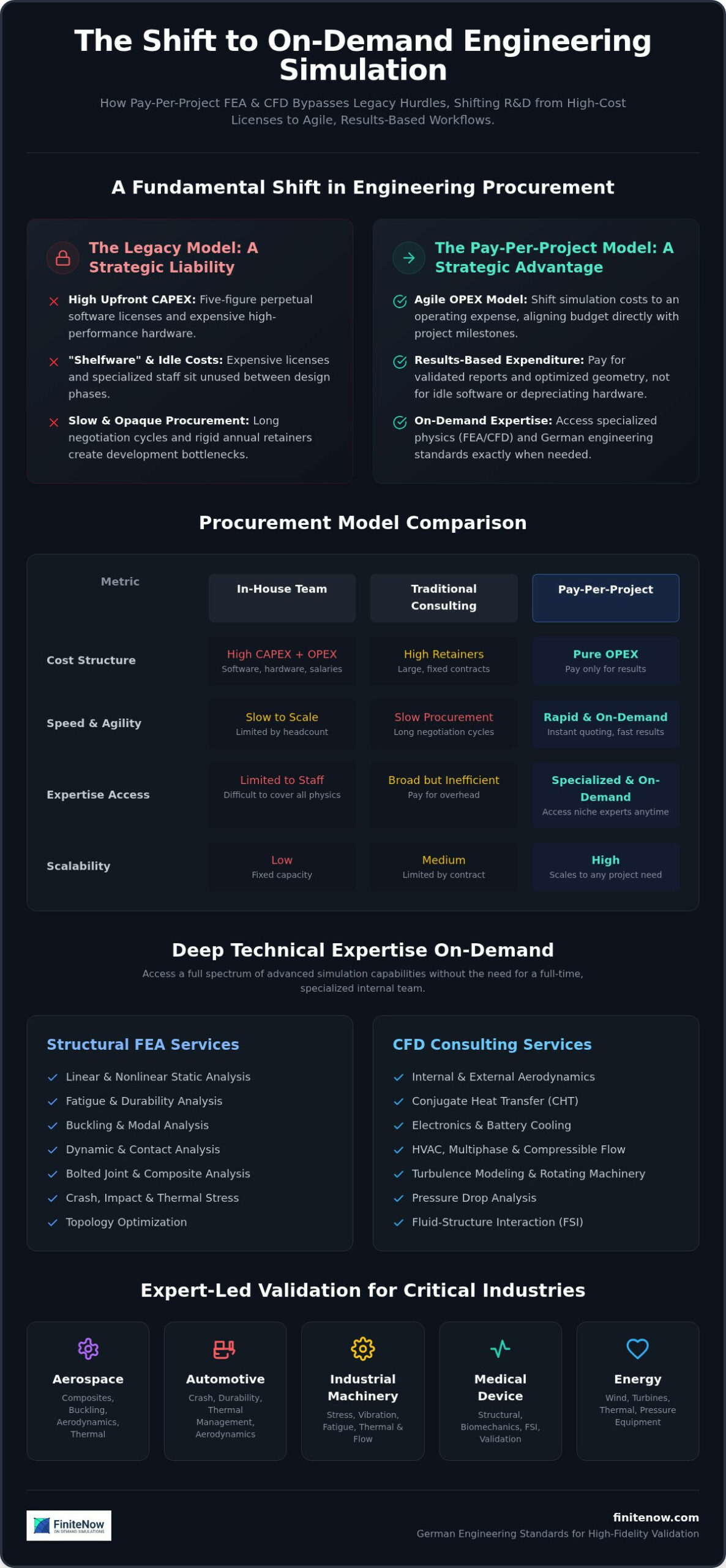
Choosing the right procurement model for CAE results determines your R&D velocity. Most firms default to three paths: building an internal department, hiring traditional consultancies, or utilizing pay-per-project engineering simulation. The differences aren’t just financial; they’re operational. Traditional procurement is slow. It relies on manual quoting and long-term commitments. Modern on-demand models prioritize speed and transparency. They remove the administrative friction that often stalls critical design iterations.
The TCO of In-House Simulation Seats
The Total Cost of Ownership (TCO) for an in-house simulation seat is often misunderstood. A $40,000 annual license is only the entry price. You must also account for high-performance computing hardware, annual maintenance, and continuous staff training. Then there’s the “Expertise Gap.” You’re paying a senior engineer’s salary even when the software sits idle. Transitioning to engineering simulation without software licenses eliminates these sunk costs. You convert a massive fixed overhead into a scalable variable expense. This allows SMEs to access the same high-fidelity tools as enterprise firms without the capital risk.
Traditional Consulting vs. On-Demand Services
Traditional engineering consultancies often struggle with the agility required for R&D milestones. Negotiating a Statement of Work can take weeks. This “Consulting Black Box” usually hides opaque pricing structures and variable lead times. In contrast, on-demand services use an instant quoting system to provide immediate cost certainty. You don’t wait for a partner to find time in their schedule; the workflow is built for speed from the start.
Reliability is another major differentiator. While unverified freelancers might offer lower rates, they lack the rigorous validation processes of established firms. A pay-per-project engineering simulation model backed by German engineering standards provides a pre-qualified supplier network. This ensures that specialized physics, like nonlinear FEA or multiphase CFD, are handled by vetted experts. You get fixed project pricing and fast turnaround without the risk of unverified data. This structured approach ensures that every simulation result is audit-ready and technically sound.
The Buyer’s Checklist: Preparing for an On-Demand Simulation
Procuring results through a pay-per-project engineering simulation model requires a shift in how you package technical data. High-fidelity results are a direct function of input quality. To ensure your project moves from quote to validation without technical debt, you must follow a structured preparation sequence. This checklist streamlines the interaction between your internal R&D and the expert team. It ensures that the “human factor” mentioned earlier has the best possible foundation for high-performance analysis.
CAD Preparation for FEA and CFD
Efficient meshing starts with the removal of “Simulation Noise.” This includes small fillets, cosmetic fasteners, and non-structural details that don’t influence the primary load path or flow field. These features exponentially increase mesh density and solver time without adding value to the final result. Simplification isn’t about losing accuracy. It’s about focusing solver resources on critical stress concentrations or turbulence zones. Use STEP or Parasolid formats to ensure the most stable geometry for high-fidelity meshing.
Protecting your Intellectual Property is equally critical. Sanitize your CAD by removing proprietary internal components that aren’t relevant to the specific FEA or CFD scope. This ensures a secure and efficient transfer of engineering intent. By delivering “clean” geometry, you reduce the time needed for pre-processing and accelerate your overall project timeline.
Defining the Engineering Problem Statement
A simulation is only as useful as the problem it solves. You must clearly identify the failure mode you intend to predict. Are you checking for plastic deformation, fatigue life, or thermal throttling? Defining these goals upfront allows the engineer to select the appropriate material models. For example, high-strain applications require nonlinear material data, while basic structural checks might only need linear elastic properties. Ensure your load cases reflect real-world operating environments, including static loads, thermal gradients, and dynamic vibrations.
If you’re unsure about the boundary conditions, a brief video call with a specialist can refine these requirements. This human-led refinement prevents “garbage-in, garbage-out” scenarios and ensures the final report meets your internal validation standards. Finally, set clear acceptance criteria. Specify whether you need a safety factor validation, a specific pressure drop target, or a fatigue life milestone. This methodical preparation ensures that your pay-per-project engineering simulation delivers maximum ROI with minimal turnaround time. You can get an instant quote for your simulation to begin the validation process today.
FiniteNow: Streamlining the Path to Validated Results
FiniteNow represents the operational peak of pay-per-project engineering simulation. We’ve eliminated the friction inherent in traditional procurement by replacing manual negotiation with an automated, data-driven workflow. This approach ensures that technical precision remains the priority while the administrative burden is minimized. Our model connects your R&D requirements directly to a German-based expert team and a network of pre-qualified specialists. By prioritizing clinical precision over legacy consulting structures, we provide a faster, more transparent alternative that aligns with the speed of modern innovation.
The Instant Quote Experience
The process begins with our instant automated quoting system. You submit your CAD geometry and project parameters; our engine performs an automated assessment of project complexity in real time. Within seconds, you receive a transparent, fixed-fee quote. This removes the “Consulting Black Box” and allows for immediate budget approval without the need for multiple procurement meetings. Once you accept the quote, the transition to the kick-off phase is seamless. Our digital workflow ensures that your data is securely transferred to the appropriate specialist, allowing the technical analysis to begin without the lag typical of traditional firms.
Industry-Specific Validation Frameworks
We apply a rigorous validation framework tailored to your specific industry vertical. Our engineers don’t just run software; they apply deep domain expertise to interpret results and ensure they meet stringent safety and performance standards. This high-performance partnership values your time and intellectual rigor, providing data that’s ready for technical review or regulatory audit.
- Aerospace: We focus on buckling analysis, composite structural integrity, and aerodynamic performance optimization to meet strict weight and safety targets.
- Medical Devices: Our specialists handle stent fatigue life, biomechanics simulation, and Fluid-Structure Interaction (FSI) for complex implants.
- Automotive: We provide verification for crash and impact safety, durability assessments, and thermal management for high-power battery systems.
- Industrial Machinery: Our team delivers stress, vibration, and fatigue analysis to ensure long-term operational reliability for heavy equipment.
By leveraging pay-per-project engineering simulation, you gain access to high-fidelity results that adhere to the “German Engineering” quality standard. We don’t just provide raw data; we provide validated engineering intelligence that moves your product closer to market milestones. This model allows you to scale your simulation capabilities dynamically, ensuring your R&D budget is spent on results rather than software maintenance or consulting overhead. Teams that adopt this approach also find it significantly easier to reduce physical prototyping costs by catching design flaws in the digital environment before committing to expensive material builds. It’s a methodical yet rapid progression that mirrors a well-oiled digital workflow, designed for specialists who value precision and momentum.
Accelerate Your R&D with Agile Engineering Simulation
The transition toward results-oriented CAE is no longer a future projection. It’s a current operational necessity for firms in aerospace, automotive, and medical device sectors. By adopting pay-per-project engineering simulation, you eliminate the friction of software licensing and the financial burden of underutilized specialists. You move from weeks of negotiation to instant cost certainty, ensuring your budget aligns directly with your project milestones.
Rely on our German-based engineering team to handle your most complex structural and fluid challenges with clinical precision. Our workflow bypasses the traditional consulting black box by using an instant automated quoting system. You don’t need to manage software seats or long-term retainers to secure high-fidelity validation for your next innovation. It’s time to stop paying for idle tools and start investing in validated data that moves your design forward.
Get an Instant Quote for Your Simulation Project and experience the speed of modern on-demand engineering. Your path to validated results is just a few clicks away.
Frequently Asked Questions
What is the typical turnaround time for a pay-per-project simulation?
Turnaround times vary based on the technical scope, but standard reports are typically delivered within five to ten business days. Our instant automated quoting system eliminates the initial weeks of negotiation found in traditional models. This allows the technical team to begin work immediately after CAD submission. For urgent R&D milestones, this streamlined workflow ensures you receive validated results faster than conventional procurement paths.
Is pay-per-project simulation more expensive than buying a software license?
Project-based fees are significantly more cost-effective when you account for the total cost of ownership of in-house software. A single CAE license often costs tens of thousands annually, excluding hardware and specialized personnel. Utilizing pay-per-project engineering simulation allows you to pay only for the results you use. This model converts high fixed costs into scalable operational expenses, which is especially beneficial for SMEs with irregular simulation needs.
How do you ensure the accuracy of the simulation results?
Accuracy is maintained through a rigorous validation framework led by our German-based engineering team. Every project includes mesh sensitivity studies and convergence checks to ensure the mathematical model reflects physical reality. We apply domain-specific physics, such as nonlinear material models or advanced turbulence modeling, to match your real-world operating conditions. This methodical approach provides the intellectual rigor required for critical engineering decisions and technical reviews.
What industries benefit most from on-demand FEA and CFD?
High-stakes industries such as Aerospace, Automotive, and Medical Device manufacturing see the highest ROI from on-demand services. These sectors require specialized physics like buckling analysis, crash verification, or biomechanics validation without the overhead of permanent staffing. Industrial machinery and energy sectors also utilize these services for fatigue life prediction and thermal management. Our network of pre-qualified suppliers ensures that your specific vertical receives the appropriate technical focus and expertise.
Can I speak with an engineer before the project starts?
Technical consultation is a core component of our workflow to ensure project requirements are clearly defined. Once you receive an instant quote, you can schedule a call with a specialist to refine boundary conditions or discuss specific failure modes. This human-led interaction prevents technical errors and ensures the simulation setup aligns with your R&D goals. It’s a collaborative process that combines our technological precision with your deep product knowledge.
How is my proprietary data and CAD geometry protected?
We prioritize intellectual property protection through secure digital workflows and non-disclosure agreements. We recommend sanitizing CAD data by removing non-essential proprietary features before submission. This reduces the data footprint while maintaining the structural or fluid intent required for analysis. Our German-based team adheres to strict data handling protocols, ensuring your sensitive engineering designs remain confidential throughout the entire simulation and reporting process.
What software do you use for structural and fluid simulations?
Our network utilizes industry-standard enterprise suites including Ansys, Abaqus, Simcenter, and Altair HyperWorks. These tools provide the robust solvers needed for complex analyses like Nonlinear FEA, Fluid-Structure Interaction, and Multiphase Flow. By accessing these high-fidelity packages through a project-based model, you benefit from the latest software updates and GPU-based solvers without the burden of licensing fees. This ensures your results are compatible with global engineering standards.
Do you provide a formal report for regulatory or certification use?
Every project concludes with a comprehensive technical report designed for regulatory submission or internal certification. These documents include detailed methodology, mesh validation, material property definitions, and actionable design recommendations. Whether you are validating a medical implant for biomechanics or an aerospace component for buckling, our reports provide the data-driven proof points required by auditors. This level of documentation ensures your pay-per-project engineering simulation is audit-ready and technically defensible.
Simulation Work Reinvented