

Scaling your R&D throughput shouldn’t require an exponential increase in your software licensing budget or a permanent expansion of your internal headcount. While traditional models suggest that scalable engineering simulation requires more seats of Ansys 2026 R1 or SIMULIA R2026x, that’s a legacy mindset that ties your innovation to fixed overhead. You’ve likely felt the friction of peak R&D cycles where hardware bottlenecks and the scarcity of niche CFD or nonlinear FEA specialists stall your momentum.
We agree that the traditional model of purchasing annual CAE licenses is too rigid for the modern pace of product development. This guide provides a strategic framework for scaling your capabilities by decoupling specialized expertise from restrictive software and hardware constraints to reduce physical prototyping costs and accelerate time-to-market. We’ll examine how to leverage a pre-qualified expert network and automated quoting to transform simulation from a cost center into a fluid, parallelized asset.
Key Takeaways
- Define scalable engineering simulation as the ability to adjust R&D throughput without proportional increases in fixed software licensing or headcount costs.
- Identify and bridge the “Expertise Gap” by prioritizing high-fidelity engineering intelligence over mere hardware capacity.
- Transition from Capex-heavy legacy models to Opex-based project workflows that front-load design validation and accelerate time-to-market.
- Apply sector-specific technical frameworks for Aerospace, Automotive, and Medical devices to ensure simulation accuracy across complex multiphysics requirements.
- Audit internal workflows to strategically deploy on-demand resources during peak R&D cycles and high-complexity project phases.
What is Scalable Engineering Simulation in Modern R&D?
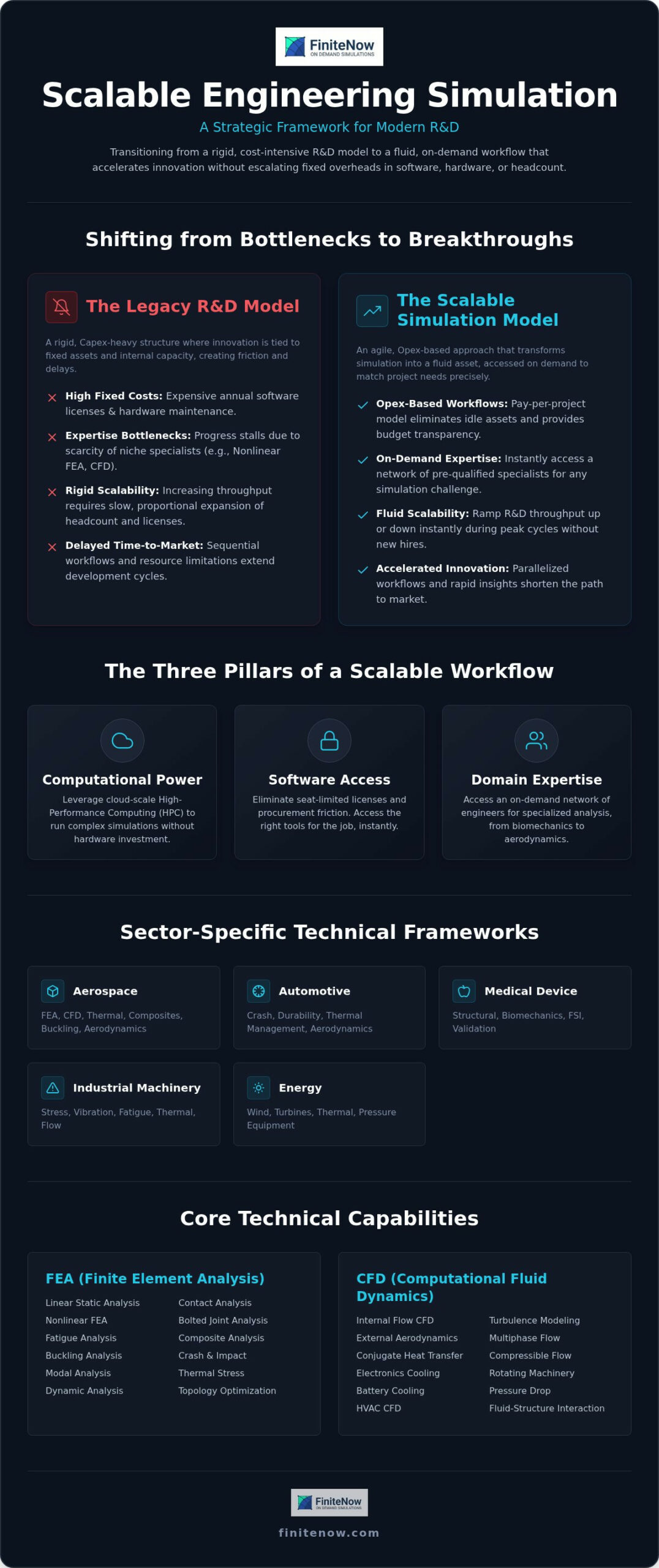
At its core, scalable engineering simulation represents the decoupling of simulation throughput from fixed operational costs. In a traditional R&D environment, increasing your simulation capacity usually requires a proportional investment in high-end workstations, annual software licenses, and full-time specialized staff. This legacy model creates a rigid overhead structure that doesn’t account for the “spiky” nature of engineering projects. Scalability allows your team to ramp up during critical validation phases and scale back during initial design stages without carrying the weight of idle assets.
Understanding the foundational principles of What is Modeling and Simulation is essential here, as it highlights the shift from physical trial-and-error to digital-first validation. The “one-engineer-one-license” approach is failing. Innovation cycles have shrunk to the point where waiting weeks for license procurement or months for recruitment isn’t viable. High-fidelity results from expert-led workflows are now the primary driver for reducing project risk and ensuring that your engineering intelligence is distributed rather than siloed on local workstations.
The Components of a Scalable Workflow
Scalability relies on three pillars: computational power, software access, and domain expertise. Moving beyond local hardware to cloud-scale High-Performance Computing (HPC) is the first step. Specialized GPU cloud providers now offer NVIDIA H100 hardware for as low as $2.00 per hour, providing a cost-effective alternative to traditional hyperscale platforms. Software access is the second hurdle. Eliminating seat-limited licenses removes the friction that often stalls parallel workflows. Finally, accessing on-demand domain expertise in areas like Biomechanics or Aerodynamics ensures that your simulation setup is scientifically sound without needing a permanent niche specialist on the payroll. Having the software isn’t the same as having the solution; if your team lacks a specialist in nonlinear FEA or complex CFD, the most expensive license won’t prevent a project delay.
Digital Twins and Virtual Testing
A robust strategy for scalable engineering simulation serves as the backbone for functional Digital Twins. Rather than using simulation as a final “check-box” before production, modern R&D teams use it for continuous, iterative design validation. This shift allows for a more granular understanding of product performance under various stress conditions. Virtual testing replaces physical trials by enabling a parallelized validation workflow that reduces physical prototyping costs and significantly shortens the path to market.
Overcoming the Infrastructure vs. Intelligence Bottleneck
R&D leaders often treat scalable engineering simulation as a procurement task. They buy more licenses or add server racks. But scaling infrastructure without scaling intelligence leads to a bottleneck. Internal expansion hides massive costs in recruitment, training, and software maintenance. Finding a specialist in Nonlinear FEA or external aerodynamics can take months. Even then, the annual maintenance fees for high-end CAE software continue regardless of project volume.
The “Expertise Gap” is the real constraint. Owning a license for Ansys or Abaqus doesn’t solve the physics problem; it only provides the environment. True scalable engineering simulation requires a shift from owning tools to accessing outcomes. Traditional CAE consulting often feels like a legacy bottleneck itself, with slow turnaround times and opaque pricing. Modern on-demand simulation services disrupt this by providing immediate access to a German-led engineering team. This model delivers high-fidelity results without the overhead of on-site staffing or long-term commitments.
Decoupling Expertise from Licensing
The primary friction in R&D is the link between software seats and engineering output. Choosing engineering simulation without software licenses allows teams to bypass procurement cycles. You don’t need to wait for budget approval for a new license seat to start a project. Project-based fees provide absolute budget transparency for procurement teams. This approach reduces the “Time-to-Insight” significantly, allowing your core team to focus on design while external specialists handle the heavy compute and setup.
Ensuring Accuracy in Scalable Environments
Scalability shouldn’t compromise precision. High-fidelity standards are maintained through rigorous Verification and Validation (V&V) protocols. Leveraging a pre-qualified supplier network ensures that every project meets specific industry requirements, whether it’s for medical device validation or automotive crash testing. Collaborative tools such as instant automated quoting and direct video calls with technical leads maintain project momentum. This infrastructure ensures that external intelligence feels like a seamless extension of your internal R&D department.
Industry-Specific Scalability: Technical Requirements
Generic cloud platforms provide raw compute, but they often lack the domain-specific logic required for regulated industries. True scalable engineering simulation must be tailored to the unique physics of your vertical. A “one-size-fits-all” approach fails when complex multiphysics requirements, such as Fluid-Structure Interaction (FSI) or conjugate heat transfer, demand specialized solver configurations. Transitioning from generic workflows to custom engineering simulation pipelines ensures that your data remains accurate and validation-ready, especially when integrated into existing PLM systems to maintain a single source of truth.
Aerospace and Automotive Performance
Aerospace R&D requires high-fidelity analysis across FEA, CFD, and thermal domains to optimize fuel efficiency and ensure structural integrity. Scalability in this sector involves managing massive models for buckling and composite analysis. For automotive teams, scalable engineering simulation is critical for accelerating durability testing and thermal management for EV batteries. You can’t wait for physical test rigs when developing complex cooling systems. Scaling nonlinear structural analysis for crash and impact scenarios allows for rapid iteration of safety features without the cost of destroying physical prototypes. This parallelized approach ensures that aerodynamics and crashworthiness are validated simultaneously, rather than sequentially.
Medical Devices and Industrial Machinery
Medical device R&D relies on precision. Scaling biomechanics and FSI simulations is necessary for modeling stent fatigue life or heart valve performance. These regulated environments demand rigorous domain-specific validation that generic platforms can’t provide. In the industrial machinery sector, Structural FEA serves as the cornerstone for predicting stress, vibration, and fatigue in heavy equipment. By scaling these simulations on demand, you’ll identify potential failure points in complex assemblies before the first metal is cut. This proactive validation reduces project risk and ensures that heavy machinery meets flow and vibration standards under peak loads.
Energy and Power Generation
Optimizing renewable energy infrastructure, such as wind turbines, requires massive CFD studies for external aerodynamics and structural modal analysis. Scalable resources allow you to simulate entire wind farm arrays to predict wake interference and power output. In traditional power generation, managing heat transfer in thermal and pressure equipment is a constant challenge. Scaling your simulation capacity during the design of power plant components ensures that thermal stresses are managed efficiently. This approach allows R&D teams to handle the massive data requirements of energy projects while maintaining the high-fidelity standards required for long-term operational safety.
The Economics of Scalable Engineering Simulation
The financial architecture of R&D is shifting. Traditional simulation models rely on heavy Capital Expenditure (Capex) for software seats and high-performance computing (HPC) clusters. This creates a high barrier to entry and a fixed cost that doesn’t disappear when projects end. Implementing scalable engineering simulation allows you to transition to an Operational Expenditure (Opex) model. You pay for projects, not potential. This shift improves ROI by front-loading design validation, catching failure points before they reach the manufacturing floor.
The cost of “Failure to Simulate” is often catastrophic. Late-stage design changes or product recalls can derail a company’s financial year. By integrating simulation earlier in the cycle, you reduce physical prototyping costs and warranty claims while ensuring that your first physical prototype is already optimized. Transparency in this process is vital. Instant automated quoting provides procurement teams with immediate budget clarity, removing the guesswork from engineering estimates and allowing for more precise resource allocation.
Pay-Per-Project vs. Annual Licensing
CAE software utilization rates in typical SMEs are surprisingly low. Many firms maintain expensive annual licenses that sit idle during the early conceptual or late documentation phases of a project. A pay-per-project engineering simulation model eliminates this inefficiency by ensuring you only pay for the physics you actually solve. You also bypass the hidden costs of hardware depreciation and IT maintenance. While local hardware can be 3.5 to 6.5 times cheaper for continuous 24/7 workloads over a three-year period, most R&D cycles are intermittent. For these “spiky” requirements, on-demand scaling is the more economical choice.
Quantifying the Value of Speed
Speed is a competitive differentiator. Tier 1 and Tier 2 suppliers often lose bids because their simulation turnaround is too slow. An “Instant Quote” system allows these teams to factor simulation costs into their proposals within minutes, not days. Increased simulation throughput correlates directly with faster time-to-market. Utilizing on-demand CFD simulation typically reduces project lead times from weeks to days by bypassing the internal queue for local cluster resources. This agility allows your team to iterate faster and secure market share before competitors. To see how this model fits your current project, you can get an instant quote today.
Implementing a Scalable Simulation Strategy
Transitioning to scalable engineering simulation requires more than a budget reallocation; it demands a fundamental shift in how your R&D team views its operational boundaries. Start by auditing your current project pipeline. Segment your needs into baseline tasks that your internal team handles daily and peak or specialized tasks that require niche expertise or massive compute power. This audit reveals the expertise gap, allowing you to deploy external intelligence precisely where it adds the most value without the friction of new software procurement.
Integrating on-demand experts into your existing structure works best when you treat them as a technical extension of your department. You aren’t just offloading a task; you’re accessing a German-led expert network that operates with the same rigor as your internal staff. This collaborative approach ensures that the high-fidelity results generated externally translate directly into actionable design changes. Transparency throughout this process is the key to maintaining project momentum and ensuring that your internal engineers stay focused on core product innovation.
Identifying High-Impact Simulation Projects
Focus your initial scaling efforts on projects with high physical prototyping costs or long lead times for test rigs. These are the areas where virtual validation offers the highest ROI. Use an instant automated quoting system as your entry point to scalability. It allows you to test the feasibility of a simulation-led approach for specific iterations without committing to long-term contracts. When selecting a partner, look beyond raw compute capacity. Priority should be given to networks that provide pre-qualified expertise in specific verticals, such as Medical Device validation or Aerospace aerodynamics, ensuring that the results meet stringent industry standards.
Managing Data and Collaboration
IP security is non-negotiable in engineering R&D. Implementing a strategy for scalable engineering simulation requires secure data transfer protocols that protect your sensitive designs while allowing for rapid iteration. Transparency in the workflow is what differentiates a high-performance partnership from a standard vendor relationship. Use direct video calls to review complex CFD or FEA results with technical leads. This bridges the gap between raw data and design decisions, ensuring that your team understands the logic behind the results. Over time, this evolves into a partnership model that provides your R&D department with a permanent, elastic capability that scales instantly with your innovation goals.
Future-Proofing Your R&D Through Elastic Simulation
Legacy R&D models that tie innovation to fixed software licenses and hardware bottlenecks are no longer competitive. Adopting scalable engineering simulation allows your team to ramp up throughput during critical validation phases without increasing permanent overhead. This transition ensures that your technical intelligence remains as fluid as your design cycle, enabling parallel workflows that catch potential failure points early in the development process.
We provide a faster, more transparent alternative to traditional industry standards. You gain access to German-led engineering expertise without the burden of annual software licenses or restrictive long-term contracts. Our model prioritizes precision and speed, offering on-demand pricing that fits your specific project requirements while eliminating the hidden costs of hardware maintenance and IT infrastructure.
Get an instant quote for your engineering simulation project today to transform your simulation workflow into a high-performance asset. Start validating your designs with expert-led precision and move your product to market faster than ever. Your next breakthrough doesn’t have to wait for a license renewal.
Frequently Asked Questions
How does scalable engineering simulation differ from traditional CAE software?
Traditional CAE software requires annual licenses and fixed internal hardware. Scalable engineering simulation focuses on on-demand access to technical expertise and compute power. Instead of managing software seats, you pay for specific project outcomes. This model removes the overhead of idle licenses during slow R&D phases, allowing you to ramp up capacity only when the physics requirements demand it.
Can I use on-demand simulation instead of buying expensive software licenses?
You can replace or supplement internal licenses with on-demand simulation services. This strategy eliminates the need for high upfront Capex and annual maintenance fees. It’s particularly effective for SMEs that don’t have constant, 24/7 simulation workloads. You bypass the procurement cycle and gain immediate access to the necessary solvers and hardware without the burden of long-term software contracts.
Is outsourced engineering simulation as accurate as in-house analysis?
Accuracy depends on the expertise of the engineer and the rigor of the Verification and Validation (V&V) process. Our German-led engineering team applies the same high-fidelity standards as top-tier internal departments. We use industry-standard solvers and pre-qualified experts to ensure results are reliable. Because our specialists often have deeper experience in niche domains like nonlinear FEA or complex CFD, the accuracy frequently exceeds generalist in-house capabilities.
How do instant quotes for engineering simulation work?
Our automated system processes your project parameters to provide immediate cost transparency. You input specific technical requirements, such as the type of physics (FEA, CFD, or Thermal) and model complexity. The system generates a quote based on the engineering effort and compute resources needed. This eliminates the traditional weeks-long bidding cycle, allowing procurement and R&D managers to make decisions and start projects without delay.
What industries benefit most from scalable simulation services?
Industries with complex physics and strict regulatory standards see the highest ROI. This includes Aerospace, where buckling and composite analysis are critical, and Automotive, which requires crash and battery thermal management simulations. Medical device firms benefit from specialized biomechanics and FSI validation. Energy companies and industrial machinery manufacturers also use scalable engineering simulation to optimize heavy equipment performance and reduce project risk during peak innovation cycles.
How does FiniteNow ensure the quality of results from its expert network?
Quality is maintained through a pre-qualified network of specialists led by a German engineering core. Every project undergoes a structured review process to validate mesh quality, boundary conditions, and solver convergence. We don’t just deliver data; we provide expert-backed insights. This methodical approach ensures that every simulation meets the high-fidelity requirements necessary for safety-critical applications in sectors like aerospace and medical technology.
What is the typical turnaround time for a scalable FEA or CFD project?
Project timelines vary based on complexity, but the on-demand model is significantly faster than traditional consulting. By bypassing the internal queue for local hardware and software seats, we often deliver results in days rather than weeks. The instant quote system acts as the entry point, allowing work to commence immediately. Our distributed expert network ensures that your project isn’t stalled by local resource bottlenecks or staffing shortages.
Can scalable simulation help reduce my physical prototyping costs?
Strategic scalable engineering simulation reduces physical prototyping by identifying design flaws in the virtual environment. You can iterate through dozens of design variations digitally for a fraction of the cost of one physical test rig. This front-loads validation, ensuring that your first physical prototype is already optimized. By reducing the number of failed physical trials, you shorten your time-to-market and lower the overall R&D budget.
Simulation Work Reinvented