

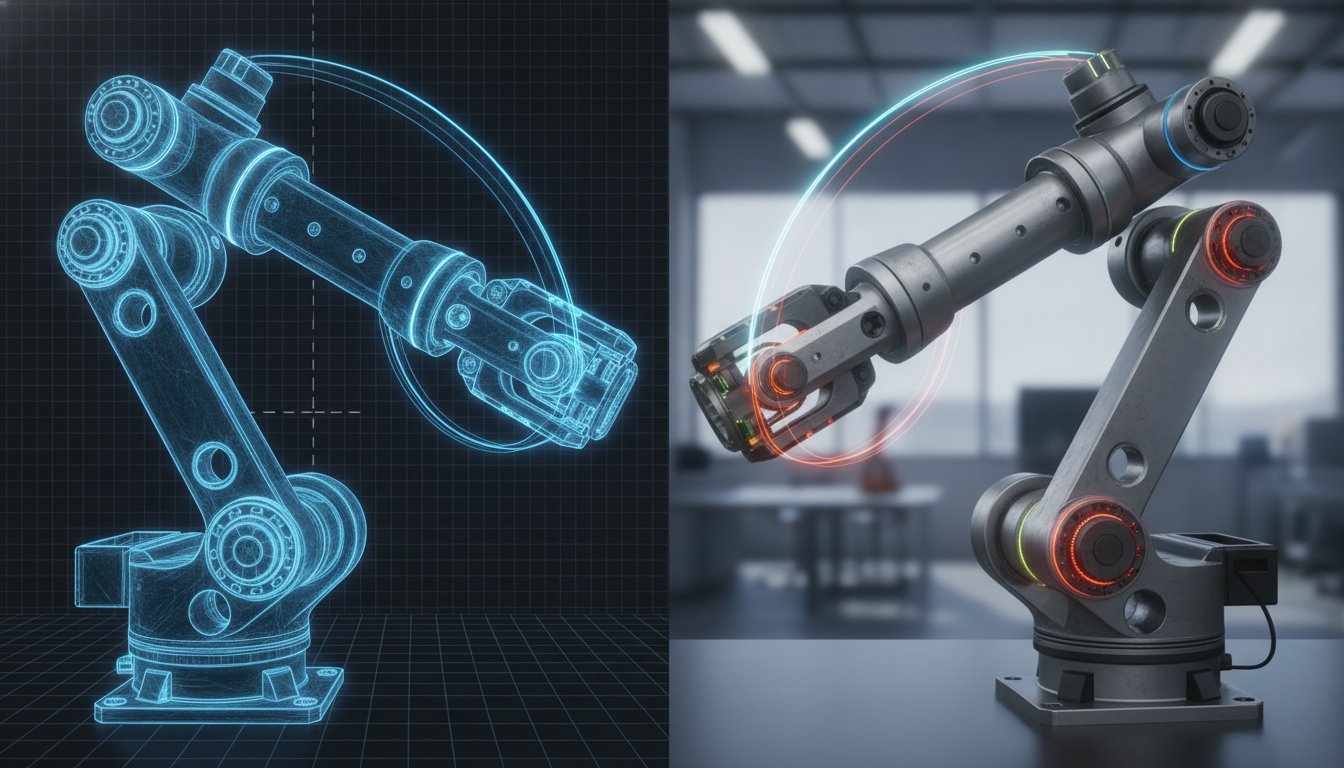
Your kinematic “motion sketch” is a dangerous place to stop. It assumes ideal conditions that disappear the moment high-speed dynamic loads and friction enter the equation. Many engineers hesitate to move beyond basic geometry because the high cost of MBD software and the steep learning curve of legacy tools create massive operational barriers. Utilizing a professional mechanism design simulation service shouldn’t be an inaccessible luxury or a drain on your project timeline. You need reliable data to ensure your design won’t fail under stress; you don’t need the overhead of a permanent software license.
We recognize that the transition from CAD to a functional dynamic simulation is where most projects stall. This article provides a streamlined path to bridge that gap. You’ll learn the exact technical workflow required to move from initial sketches to high-fidelity simulations that provide actionable force and displacement data. We’ll explore how to validate mechanism durability before you ever cut metal, ensuring your path from CAD to results is fast, transparent, and technically rigorous.
Key Takeaways
- Shift from kinematic “motion sketches” to dynamic models that capture inertia, friction, and transient loads to prevent real-world mechanical failure.
- Access specialized expertise through an on-demand mechanism design simulation service to eliminate the overhead of expensive software licenses and internal training cycles.
- Streamline the simulation workflow by simplifying CAD geometry and precisely mapping the kinematic chain with revolute, translational, and spherical joints.
- Utilize dynamic force and displacement data to optimize actuator sizing and provide accurate load inputs for subsequent structural analysis.
Beyond Linkage Sketches: Why Mechanism Design Requires Dynamic Simulation
Starting with a 2D linkage sketch is standard practice, but it’s often the point where engineering rigor ends and guesswork begins. Mechanism design simulation is the process of predicting how a system of interconnected parts moves and reacts under real-world physical constraints. It goes beyond checking for interference or simple range of motion. It provides a deep dive into the forces, torques, and accelerations that define mechanical performance.
Relying on a professional mechanism design simulation service allows you to move beyond simple geometry and into true physics-based validation. A Multibody system analysis accounts for the complex interactions between rigid and flexible bodies. This is the professional standard for ensuring a design won’t just move, but will survive the rigors of its operating environment. Skipping this step invites risks like excessive wear, resonance-induced vibration, or catastrophic structural failure during high-speed operation.
The Limitations of Static and Kinematic Analysis
Static analysis is blind to the effects of motion. It assumes loads are constant, which is rarely true for moving machinery. Kinematic sketches are equally limited; they only track geometry and paths. They won’t tell you the peak torque required for an actuator or how inertia will spike joint loads during a sudden stop. High-speed mechanisms require transient dynamic analysis to capture these energy exchanges. Without it, you’re guessing at motor sizes and bearing life. This lack of data often leads to over-engineering, which adds unnecessary weight and cost, or under-engineering, which leads to field failures.
Industry-Specific Mechanism Challenges
Different sectors face unique hurdles that require specialized simulation approaches. In medical devices, engineers must simulate biomechanical joints and prosthetic movements to ensure compatibility with human kinematics. For implantable devices specifically, FEA for medical implants has become a baseline requirement for regulatory validation, replacing costly physical bench testing with high-fidelity in silico evidence. Industrial machinery focuses on validating high-cycle fatigue in automated assembly arms, where even minor vibrations can ruin precision. In aerospace, the stakes are higher. Analyzing deployment mechanisms for landing gear or solar arrays requires accounting for extreme conditions where a single failure is unacceptable. These complex scenarios demand more than a “best guess” approach. They require the high-fidelity force data that only a professional mechanism design simulation service can provide, often serving as the critical input for subsequent structural FEA to predict failure points.
Multibody Dynamics (MBD) Explained: Kinematics vs. Dynamics
Understanding the distinction between kinematics and dynamics is the difference between a visual mockup and a validated engineering system. A multibody model consists of three core components: bodies, joints, and forces. In a standard kinematic analysis, you’re tracking position and velocity. You’re checking if the parts clear each other. However, a mechanism design simulation service focuses on dynamic analysis, which accounts for mass, inertia, torque, and energy. This is essential for calculating the real-world loads that determine component life.
Constraints and Degrees of Freedom (DoF) dictate how these components interact. Each joint in an assembly removes specific DoF, restricting motion to intended paths. Managing these constraints is vital in complex assemblies where over-constrained systems can lead to mathematical errors or physical binding. For a deeper look at how these systems are modeled in professional environments, Multibody Dynamics Simulation provides a framework for connecting theoretical equations to practical solver applications.
MBD serves as the front end for high-fidelity structural validation. While MBD identifies the global reaction forces at the joints, it doesn’t calculate internal stress. By exporting these dynamic load cases into Structural FEA, engineers can perform stress-at-point analysis. This integrated workflow ensures that your components aren’t just moving correctly; they’re strong enough to survive the peak forces identified during the simulation. If you need to validate these complex interactions quickly, our on-demand simulation platform can accelerate your development cycle.
Rigid vs. Flexible Multibody Dynamics
Rigid body MBD assumes parts don’t deform. It’s incredibly fast and perfect for calculating global motion and reaction forces in the early design stages. You transition to flexible body MBD when component deformation significantly impacts the mechanism’s accuracy or timing. For example, a high-speed robotic arm might flex under its own inertia, shifting the end-effector’s position. Flexible MBD captures these transient vibrations, providing the precision required for high-performance applications.
The Role of Contact and Friction
Real-world mechanisms rely on intermittent contact between gears, cams, and followers. Modeling these interactions requires sophisticated contact algorithms that account for stiffness and damping at the interface. Friction coefficients also play a critical role, directly impacting efficiency and heat generation. Contact analysis is the study of interaction between moving boundaries. Without accurate friction and contact modeling, your simulation will underestimate the power requirements and thermal loads of the system.
Mechanism Design Simulation: Professional Service vs. DIY Software
Owning a license is not the same as owning an answer. Traditional engineering departments often sink significant capital into complex MBD software, only to realize the tool requires a dedicated specialist to operate effectively. Utilizing a mechanism design simulation service shifts the focus from managing tools to validating designs. It replaces the burden of software maintenance with the speed of expert-led results. This model allows your team to stay lean while accessing high-fidelity data that was previously reserved for firms with massive R&D budgets.
The decision between in-house simulation and on-demand expertise usually comes down to the Total Cost of Ownership (TCO). For many organizations, the recurring costs of enterprise-grade tools don’t align with the frequency of their simulation needs. A professional mechanism design simulation service provides a scalable alternative, ensuring you only pay for the validation you use. This approach is particularly effective for SMEs and startups that need to move from concept to prototype without the lag of a steep learning curve.
Evaluating Software Licensing Barriers
MBD modules are rarely included in base CAD packages; they are expensive add-ons. You face high upfront costs and recurring maintenance fees that persist even when projects are dormant. There’s also the persistent risk of “shelfware.” This occurs when your team rarely uses the specialized features you’re paying for because the tools are too complex for casual users. Large-scale dynamic assemblies also demand high-performance computing (HPC) hardware, adding another layer of infrastructure cost that many firms find difficult to justify.
The Advantage of On-Demand Engineering Expertise
Our model replaces fixed overhead with scalable precision. You gain access to a German-based engineering team without the headcount cost or the training lag. We provide transparency through an instant quoting system and fixed-project fees. This eliminates the “black box” pricing typical of legacy consultancies. By leveraging a pre-qualified supplier network, we ensure faster turnaround times from CAD upload to final report. You get the results you need without the administrative friction of traditional software procurement.
This represents a strategic shift toward engineering simulation without software licenses. It allows your engineers to focus on design innovation while we handle the heavy lifting of dynamic validation. Efficiency is the new standard in modern product development; don’t let legacy licensing models slow your momentum.
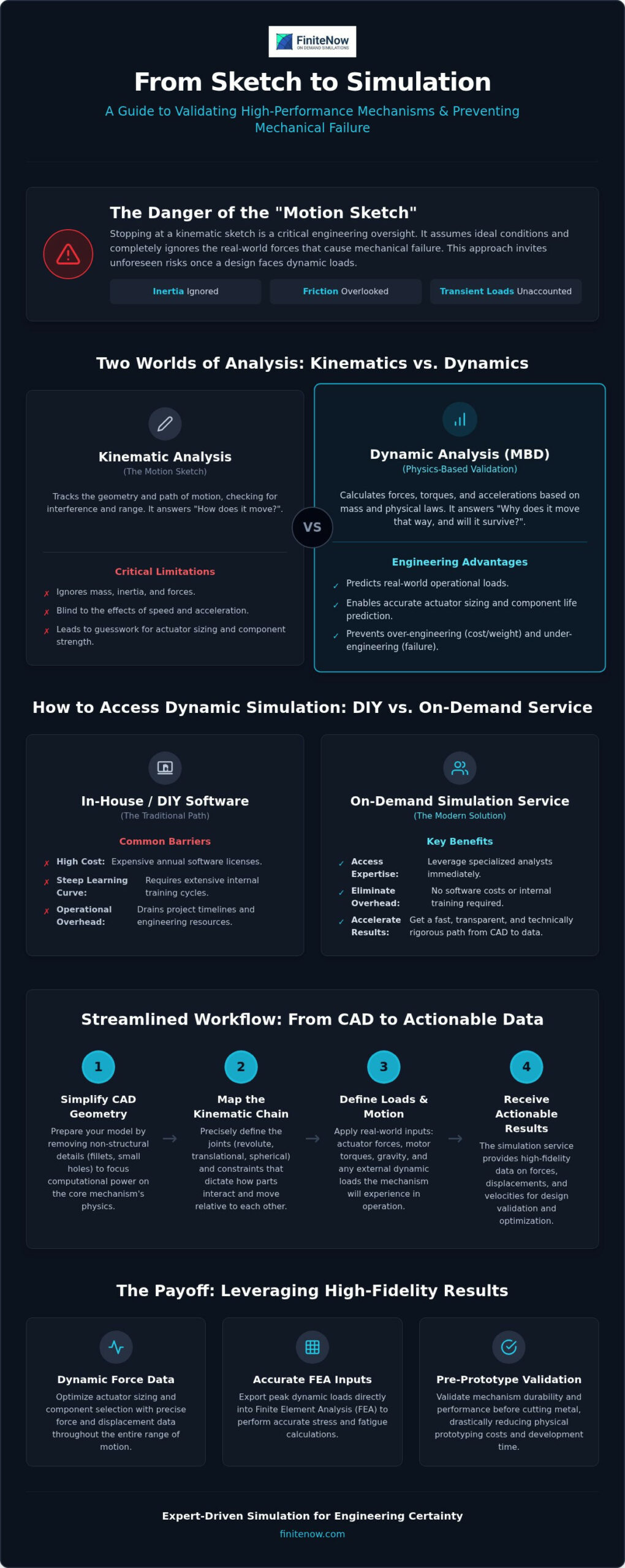
How to Prepare Your CAD for Professional Mechanism Simulation
Transitioning from a static assembly to a dynamic model requires a methodical approach to data preparation. High-fidelity results depend on the quality of the input. When engaging a mechanism design simulation service, your CAD model shouldn’t be a raw production file. It needs to be a simplified representation of the physics involved. Follow these five steps to ensure your model is simulation-ready.
- Step 1: Simplify geometry. Remove non-structural features like fillets, rounds, and engraved logos. These details don’t impact global dynamics but significantly increase computation time.
- Step 2: Define the kinematic chain. Map out how parts move relative to one another. Identify joint types such as revolute for rotation, translational for sliding, and spherical for ball joints.
- Step 3: Specify material properties. Ensure each component has an assigned material. The solver needs accurate mass and moments of inertia to calculate acceleration and reaction forces.
- Step 4: Establish load cases. Include all external influences. This covers gravity, spring rates, damping coefficients, and the force profiles of external actuators.
- Step 5: Define time-step and duration. Determine the length of the event and the frequency of data capture. Transient events like impacts require much finer time-steps than steady-state cycles.
CAD Clean-up and Assembly Constraints
A “watertight” CAD model is the foundation of accurate mass property calculation. Gaps or overlapping volumes in your assembly lead to incorrect inertia data, which compromises the entire simulation. Translating assembly mates into simulation joints is a critical step. Mates in CAD are often redundant; simulation joints must be mathematically precise. Identifying and resolving redundant constraints prevents the solver from becoming over-constrained, which can lead to artificial stiffness or convergence failure. If you’re unsure about your model’s readiness, you can get an instant quote for a mechanism design simulation service to have our experts review your assembly.
Defining Realistic Boundary Conditions
Simulations don’t happen in a vacuum. You must account for real-world environmental factors like gravity and air resistance where applicable. Modeling motor curves and actuator profiles is equally important. Instead of a constant velocity, use a realistic ramp-up or torque curve to capture the true behavior of the system. Always perform a validation check. Compare the initial simulation motion against conceptual hand calculations to ensure the results align with basic physics principles before diving into deep data analysis.
Leveraging High-Fidelity Results for Product Development
High-fidelity simulation data serves as a roadmap for the entire product lifecycle. It isn’t enough to know that a mechanism moves; you need to know how it behaves under peak operating conditions. A professional mechanism design simulation service extracts precise torque and load data that directly informs your hardware choices. You can optimize actuator sizing to reduce energy consumption and weight, avoiding the common trap of over-specifying motors due to uncertainty. This precision ensures that your final bill of materials is as lean as possible without sacrificing reliability.
These results act as the primary input for detailed structural validation. While MBD tracks the motion of the assembly, it identifies the exact peak force locations that require Structural FEA. This hand-off ensures that your components aren’t just kinematically sound but are also fatigue-resistant. Validating durability through fatigue life prediction allows you to identify failure points thousands of cycles before they occur in the field. For systems where motion generates heat or involves electromagnetic forces, integrating MBD with coupled-field analysis services provides a complete multiphysics overview.
From Simulation to Physical Validation
Virtual stress testing drastically reduces the number of physical prototyping cycles. Instead of building five versions of a prosthetic joint or an assembly arm, you build one that has already been validated in a digital environment. Digital twin data allows you to guide physical test bench setups, focusing your sensors on the high-stress areas identified during simulation. In highly regulated sectors like medical devices and aerospace, these professional reports provide the necessary documentation for regulatory compliance. They prove that your design meets safety margins before a single part is manufactured, streamlining the certification process. For medical device engineers, combining MBD results with biomechanics simulation for medical implants creates a complete validation chain that satisfies FDA in silico evidence requirements.
Scaling with FiniteNow’s Mechanism Simulation Service
We’ve optimized the path from CAD to actionable data. Our mechanism design simulation service is built on a foundation of speed and technical mastery. You can use our instant quote platform to get transparent pricing for your MBD projects without waiting days for a proposal. Our German-based engineers are available for video calls to refine mechanism constraints and ensure the simulation reflects your real-world requirements. We handle the technical complexity so your team can focus on innovation. Submit your CAD for an instant mechanism simulation quote. and accelerate your development timeline today.
Accelerate Your Design Validation with Dynamic Precision
Transitioning from simple motion sketches to high-fidelity multibody dynamics is the only way to ensure mechanical reliability under transient loads. You’ve seen how precise CAD preparation and joint definition eliminate the uncertainty of peak force locations. By leveraging professional expertise, you bypass the steep learning curve and high licensing costs associated with legacy MBD tools. This strategic shift allows your engineering team to focus on innovation while we handle the technical heavy lifting of complex multibody systems.
Our mechanism design simulation service provides the specialized data you need to optimize actuator sizing, reduce energy consumption, and predict fatigue life. We combine German-based engineering mastery with a transparent, project-based pricing model. This approach ensures your team gets high-fidelity results for Aerospace, Automotive, or Medical projects without the burden of software overhead or long-term contracts. The same simulation-first philosophy that eliminates guesswork in mechanism design also applies to product reliability; teams developing hardware enclosures and compact assemblies can apply FEA for consumer electronics to predict solder joint fatigue and thermal failure before a single prototype is built. It’s time to move beyond guesswork and secure your design’s durability with data-driven confidence. Get an Instant Quote for Mechanism Design Simulation and take the next step toward a failure-proof prototype.
Frequently Asked Questions
What is the difference between kinematics and multibody dynamics?
Kinematics only tracks the geometry and motion paths of an assembly, focusing on position and velocity without considering the forces involved. Multibody dynamics (MBD) accounts for mass, inertia, and external loads to calculate the actual reaction forces and torques acting on the system. While kinematics tells you if parts clear each other, MBD provides the high-fidelity force data required for structural validation and actuator sizing.
How long does a professional multibody dynamics simulation take?
Project timelines vary based on the number of bodies, joint complexity, and contact interactions. Simple kinematic validations might be completed in a few business days, while complex transient dynamics with flexible bodies take longer. Our mechanism design simulation service uses an instant quote system to provide transparent timelines immediately after you upload your CAD. This eliminates the traditional weeks of back-and-forth negotiation common with legacy engineering consultancies.
Do I need to provide a fully detailed CAD model for mechanism simulation?
No, you should actually provide a simplified version of your production CAD. High-fidelity simulations require watertight geometry for mass property calculation, but non-structural features like cosmetic fillets, logos, and small fasteners should be removed. Simplifying these details reduces computation time without compromising the accuracy of the reaction forces. Our team can guide you on the exact level of simplification needed during our initial technical collaboration.
Can MBD simulation predict the fatigue life of my mechanism?
MBD simulation identifies the peak loads and transient force cycles that cause fatigue over time. While the MBD solver itself calculates the reaction forces at the joints, these loads are then used as inputs for structural FEA to predict fatigue life. This integrated approach allows you to see exactly how many cycles a component will survive before failure, ensuring your design meets durability requirements before you invest in physical prototypes.
Is MBD simulation necessary for slow-moving mechanisms?
Speed isn’t the only factor that necessitates dynamic analysis. Even slow-moving mechanisms can experience significant forces due to high torque requirements, heavy payloads, or intermittent contact. If your design involves precise actuator sizing or needs to withstand high clamping forces, MBD is essential. It provides the energy and torque data that static analysis ignores, helping you avoid over-specifying motors or under-designing critical load-bearing joints.
What industries benefit most from multibody dynamics simulation services?
Any sector with moving assemblies requires dynamic validation.
- Aerospace: Landing gear and deployment mechanisms.
- Automotive: Suspension systems and crash durability.
- Medical Devices: Biomechanics and prosthetic validation.
- Industrial Machinery: High-cycle fatigue in automated arms.
Our mechanism design simulation service provides the specialized technical mastery required to handle these domain-specific challenges with streamlined precision and expert-backed insights.
How does FiniteNow handle intellectual property for mechanism designs?
Your intellectual property is protected by strict confidentiality protocols. All submitted CAD data and generated simulation reports remain your exclusive property. Our German-based engineering team operates with a focus on transparency and security, ensuring that your proprietary designs are never shared outside our network. We don’t use long-term contracts; you retain full control of your IP while leveraging our on-demand expertise to accelerate your product development cycles.
Simulation Work Reinvented