

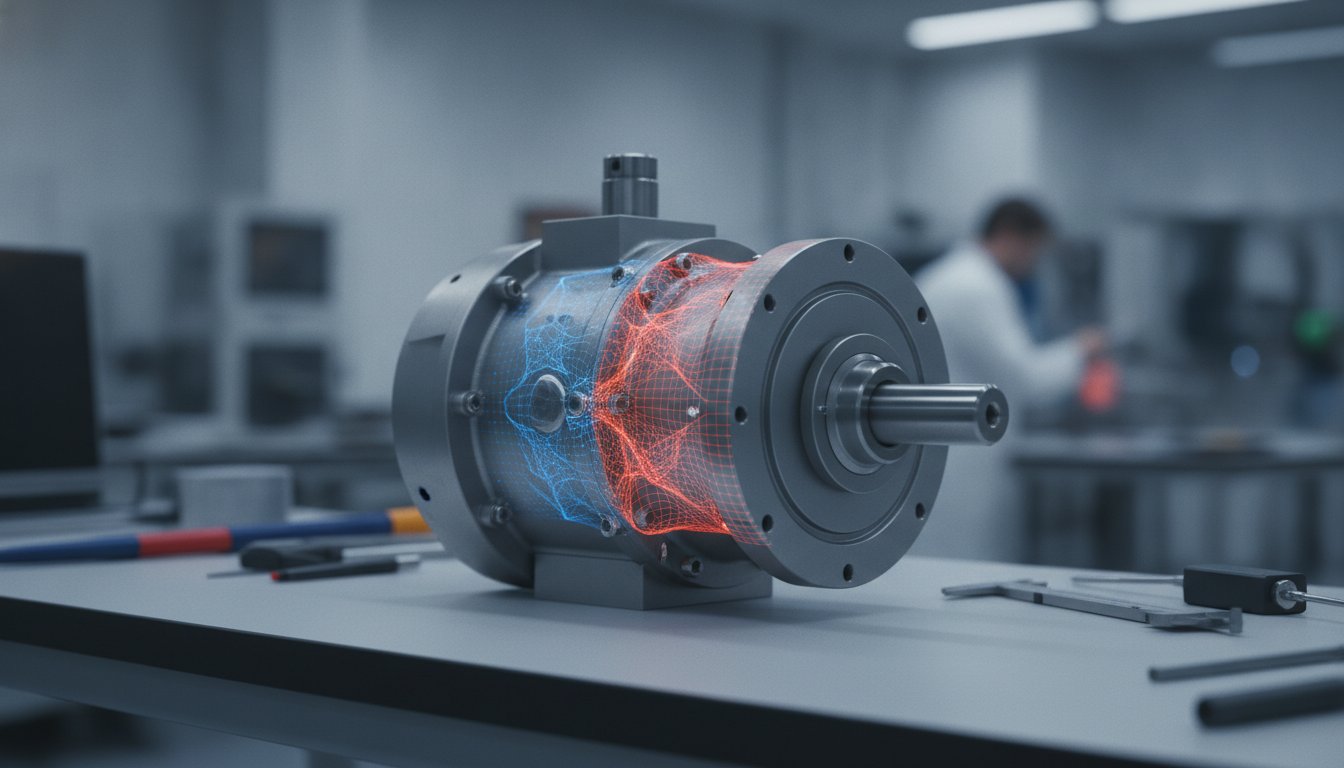
Design failure due to unforeseen resonance isn’t just a technical oversight; it’s a multi-million dollar liability that modern simulation has rendered obsolete. You’ve likely felt the pressure of escalating physical testing costs and the rigid constraints of enterprise software licensing. It’s a common frustration for engineering leads who need to validate structural integrity without draining the project budget or slowing down the innovation cycle.
This strategic guide empowers you to master vibration analysis engineering, allowing you to predict complex structural behavior and mitigate fatigue through high-fidelity simulation. By shifting validation to the front end of your design process, you can significantly reduce R&D timelines while ensuring long-term reliability in demanding sectors like aerospace, automotive, and industrial machinery. We will examine the transition to the ISO 20816 standards, the impact of new IEC 61373:2026 requirements for railway applications, and provide a framework for on-demand dynamic analysis. You’ll learn how to replace traditional trial-and-error methods with a streamlined, data-driven workflow that prioritizes precision and cost-efficiency.
Key Takeaways
- Identify the critical differences between static and oscillatory loads to predict structural responses with precision during the design phase.
- Implement vibration analysis engineering as a standard front-end requirement to prevent resonance and fatigue issues before committing to manufacturing.
- Leverage high-fidelity virtual testing to shorten R&D cycles and eliminate the high costs associated with traditional physical vibration labs.
- Ensure your designs meet rigorous global standards, including the updated ISO 20816 and IEC 61373:2026 specifications for industrial and transport equipment.
- Transition to an on-demand simulation model to access specialized expertise without the burden of long-term software licensing or fixed infrastructure overhead.
Fundamentals of Vibration Analysis in Modern Engineering
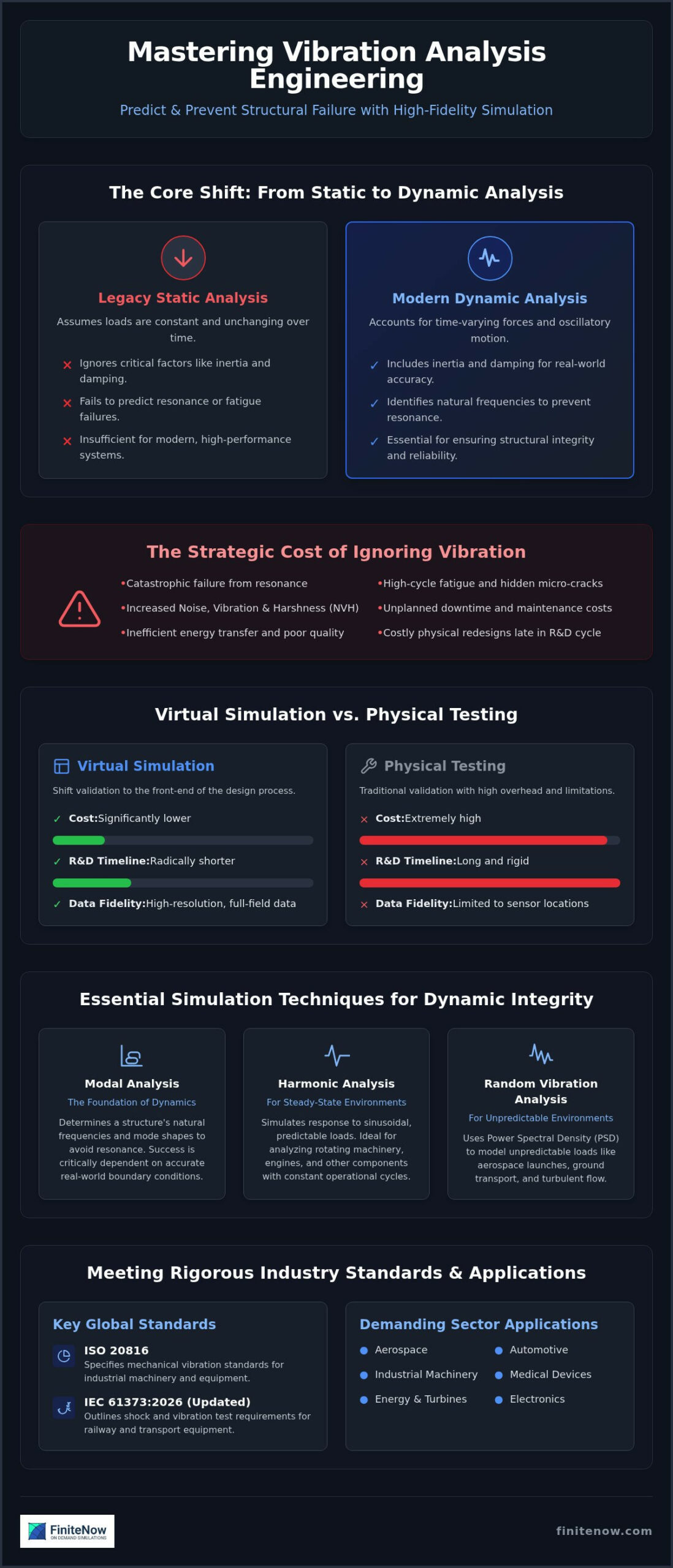
Vibration analysis engineering is the study of oscillatory motion in structures. It’s a departure from legacy static analysis, which assumes loads remain constant over time. In reality, components face time-varying forces that can compromise structural integrity. Dynamic behavior is fundamentally different because it accounts for inertia and damping, factors that static models simply ignore. The primary goal is to identify and prevent mechanical failure caused by these oscillations. Relying on static safety factors is no longer sufficient for high-performance systems.
A critical concept in this field is resonance. Resonance is the frequency where an external excitation matches a structure’s inherent natural frequency. When these frequencies align, the amplitude of vibration increases exponentially, often leading to rapid structural failure. Understanding the Fundamentals of Vibration allows engineers to tune designs away from these dangerous thresholds before a single prototype is built.
Understanding Modal and Dynamic Behavior
Every mechanical system has inherent properties known as natural frequencies and mode shapes. These define how a structure naturally wants to move. Finite Element Analysis (FEA) allows us to visualize these mode shapes, identifying exactly where a structure is most vulnerable. Engineers must differentiate between free vibration, which occurs after an initial impact, and forced vibration, which results from continuous operational loads like rotating machinery or aerodynamic flow. Damping is the third pillar of this behavior. It acts as the internal brake system, dissipating energy and limiting the peak amplitude of oscillations. Without effective damping, even minor forces can escalate into significant structural risks that threaten the entire assembly.
The Engineering Cost of Ignoring Vibration
Dismissing vibration is a strategic error that impacts the bottom line. In sectors like automotive and aerospace, Noise, Vibration, and Harshness (NVH) are essential quality metrics. High NVH levels aren’t just annoying; they indicate inefficient energy transfer and poor build quality. More importantly, vibration is the primary driver of high-cycle fatigue. Microscopic cracks develop under repetitive stress, leading to sudden failures in environments with high operational cycles. In industrial machinery, this translates to unplanned downtime and increased maintenance costs. Prioritizing vibration control during the simulation phase ensures long-term asset reliability and safety. It removes the need for costly physical redesigns late in the R&D cycle, providing a faster path to market with validated results.
Essential Simulation Techniques for Dynamic Integrity
Transitioning from linear static to complex dynamic FEA is a requirement for modern reliability. Static models predict peak stress under constant loads, but they fail to capture the energy accumulation inherent in moving systems. Vibration analysis engineering provides visibility into internal stresses that are invisible to the naked eye. It allows you to identify fatigue zones before they manifest as physical cracks. Achieving this precision requires a high-fidelity mesh. If your mesh is too coarse, it won’t capture the high-frequency modes that often drive failure in precision components. High-resolution discretization ensures that the mathematical model accurately reflects the physical response across the entire frequency spectrum.
Modal Analysis: The Foundation of Dynamics
Modal analysis is the starting point for any dynamic study. It determines the natural frequencies of a structure, helping you avoid critical operational speeds that trigger resonance. Success here depends heavily on boundary conditions. If your constraints don’t mirror real-world mounting, your results will be useless. For a deeper look at how these principles fit into broader design validation, explore our guide on Structural FEA. Correctly identifying mode shapes early prevents the need for heavy, expensive structural reinforcements later in the project.
Harmonic and Random Vibration Modeling
Steady-state environments, such as those found in rotating machinery, require harmonic analysis to simulate sinusoidal excitation. In contrast, unpredictable environments like aerospace launches or off-road transport demand random vibration modeling. We use Power Spectral Density (PSD) as the primary input here. It represents the energy distribution across a frequency range rather than a single peak. This approach is vital for understanding vibration analysis fundamentals in non-deterministic scenarios. It ensures that components can survive the statistical probability of high-energy events without catastrophic failure.
Nonlinear Dynamic and Transient Analysis
When loads vary rapidly over time or structures undergo large deformations, transient analysis becomes necessary. This is critical for non-periodic loading cycles where the response isn’t steady. It’s the standard for simulating extreme events like impact and crash scenarios in the automotive sector. Unlike modal methods, transient analysis solves the equations of motion at discrete time steps, capturing the full history of the event. If your project involves complex interactions or changing contact conditions, custom simulations provide the high-resolution data needed for final validation. This level of detail removes the guesswork from high-stakes engineering decisions.
Virtual Simulation vs. Physical Vibration Testing
Physical vibration testing is a legacy bottleneck that modern engineering can no longer afford. While lab setups require weeks of scheduling, fixture fabrication, and sensor calibration, virtual simulation delivers results in hours. This speed allows for rapid scalability across multiple design variants simultaneously. By leveraging the Digital Twin concept, engineers predict real-world behavior with high accuracy before a single physical component exists. This digital framework facilitates aggressive what-if design iterations at zero material cost. You can test ten different damping strategies or material thicknesses in the time it takes to ship one prototype to a testing facility. The economic contrast is stark: a 24-hour simulation run often provides more comprehensive data than a 2-week lab test, all while avoiding the risk of destroying expensive hardware.
Reducing Prototyping Costs with High-Fidelity FEA
Early-stage design validation through FEA eliminates the need for multiple physical iterations. Traditional workflows often discover resonance issues during final assembly, leading to catastrophic delays and redesign costs. Vibration analysis engineering identifies these failure points when the design is still flexible. By simulating the full operational spectrum, you catch high-cycle fatigue risks that physical tests might miss due to limited sensor placement. This proactive approach is a core pillar of a modern R&D strategy. For a broader look at how these tools integrate into your 2026 roadmap, consult our Engineering Simulation: Strategic Guide for 2026. Catching flaws in the digital phase ensures that your first physical prototype is also your final one.
Validating Results: Bridging CAD and Reality
Digital models must be grounded in physical reality to be effective. We achieve this through a rigorous correlation process between simulation results and established physical benchmarks. Success depends on two critical factors:
- Mesh Convergence: Ensuring that the mathematical discretization is fine enough to capture the true structural response without excessive computational cost.
- Material Property Accuracy: Using validated data for Young’s modulus, Poisson’s ratio, and damping coefficients to mirror real-world performance.
German-engineered precision serves as the benchmark for this validation. It ensures that the transition from a CAD model to a functional simulation isn’t just a visual exercise but a reliable engineering proof. When your virtual data aligns with physical benchmarks, you gain the confidence to bypass redundant testing cycles and move directly to production. This methodical approach transforms simulation from a simple checking tool into a primary driver of engineering certainty.
Industry-Specific Vibration Challenges and Standards
Vibration analysis engineering isn’t a one-size-fits-all discipline. Each industry faces unique physical constraints and regulatory mandates. Engineers must adapt their simulation strategies to account for varying mechanical scales, from the micro-oscillations in medical implants to the massive harmonic loads of wind turbines. Achieving compliance requires a methodical approach to validation that aligns with international standards. Specifically, the transition to the ISO 20816 series defines new thresholds for mechanical vibration in industrial machines. You must follow these rigorous steps: define the operational vibration zones, perform modal analysis to locate natural frequencies, and validate the design against severity zones A through D.
Aerospace and Automotive NVH
Aerospace engineering prioritizes survival under extreme conditions. You must simulate buckling under load and aero-elastic flutter to prevent catastrophic structural failure. Launch-induced random vibration is a primary concern for satellite and rocket components, where energy levels are non-deterministic. For complex interactions between airflow and structural response, integrate CFD Simulation into your workflow. In the automotive sector, focus shifts to Noise, Vibration, and Harshness (NVH). Engineers optimize cabin acoustics and crashworthiness to meet consumer expectations and safety regulations. You need to validate durability over millions of cycles to ensure that road-induced vibration doesn’t lead to premature fatigue failure.
Industrial Machinery and Medical Devices
Industrial machinery revolves around rotating equipment and turbines. Here, managing fatigue is the central challenge. You must identify critical speeds and implement effective damping to protect long-term asset reliability. The updated IEC 61373:2026 standard now mandates more rigorous shock and vibration testing for railway-mounted equipment, including new spectra for urban vehicles. In the medical field, vibration analysis engineering takes a biomechanical turn. Stents and implants must endure high-cycle fatigue within the human body, requiring high-fidelity simulation to predict life expectancy. The energy sector faces its own hurdles. Wind turbines deal with harmonic loads and pressure equipment must maintain stability under fluctuating flow conditions. If your project requires this level of industry-specific precision, access our German-engineered custom simulations to ensure total compliance and structural integrity.
Transitioning to On-Demand Vibration Analysis
The legacy model of engineering consulting is broken. High software licensing fees and rigid, long-term contracts create artificial barriers to innovation. Vibration analysis engineering shouldn’t require a six-figure upfront investment in software seats that sit idle for months. Modern engineering leads are shifting toward on-demand simulation to prioritize results over infrastructure. This strategic transition allows you to access specialized solvers and high-performance computing (HPC) resources only when your project demands them. It’s a faster, more transparent alternative to maintaining a bloated internal simulation department.
Bypassing Software Licenses and Legacy Overhead
Paying per project rather than per seat maximizes your R&D budget and clarifies your ROI. You eliminate the hidden costs of hardware maintenance, IT security updates, and annual subscription renewals that drain resources. This is the core advantage of Engineering Simulation Without Software Licenses. SMEs and agile engineering teams can now leverage high-fidelity dynamic solvers previously reserved for OEMs with massive capital budgets. By removing these financial hurdles, you redirect capital toward physical product development and market expansion. You don’t need to manage software versions or license servers; you simply receive the validated data required for your next design milestone.
Accessing Scalable Engineering Simulation Workflows
Submitting a project for an instant vibration analysis quote removes the friction of traditional procurement cycles. You no longer have to wait weeks for a consulting proposal to clear legal and procurement hurdles. Our streamlined digital workflow connects you directly with a German-based engineering team. These specialists act as a remote extension of your staff, providing technological mastery without the burden of permanent headcount. You can scale your simulation capacity up or down based on your current product roadmap. This agility is vital when facing tight deadlines in the aerospace or automotive sectors. You provide the CAD data and operational parameters; we deliver the high-fidelity vibration analysis engineering results. This methodical progression ensures that your structural validation is grounded in data and expert oversight, allowing your core team to focus on what they do best: designing the next generation of industrial technology.
Mastering Dynamic Reliability through High-Fidelity Simulation
Adopting a modern approach to vibration analysis engineering transforms your R&D from a reactive cost center into a proactive innovation engine. Replacing physical trial and error with high-fidelity dynamic simulation bypasses the chronic bottlenecks of legacy testing labs and expensive software seats. Validating your designs against the latest ISO 20816 and IEC 61373 standards ensures long-term reliability and market compliance across aerospace, automotive, and industrial machinery sectors. This strategic shift isn’t just about technical precision; it’s about reclaiming your project timeline and engineering budget.
Our German-based engineering team provides the technological mastery required to handle complex structural challenges with streamlined precision. We offer transparent, project-based pricing and a total removal of long-term software licensing barriers. This model empowers SMEs and agile teams to scale their engineering capacity without increasing permanent headcount or IT overhead. Get an Instant Quote for Vibration Analysis Simulation and start validating your structural integrity with on-demand expertise. Your next engineering breakthrough is within reach when you choose a partner that values intellectual rigor and operational speed.
Frequently Asked Questions
What is the difference between static and vibration analysis in engineering?
Static analysis assumes loads and responses are independent of time, while vibration analysis engineering accounts for time-varying loads and the influence of inertia and damping. Static models calculate equilibrium states under constant force. Dynamic studies evaluate how a structure oscillates and stores energy over time. This distinction is critical because dynamic loads often trigger resonance or fatigue failures that a standard static safety factor simply can’t predict or prevent.
How does modal analysis help in preventing structural failure?
Modal analysis identifies the natural frequencies and mode shapes inherent to a structure. By knowing these frequencies, engineers tune the design to ensure operational speeds don’t coincide with natural frequencies, avoiding resonance. This preventative step stops the exponential growth of vibration amplitudes that leads to rapid mechanical failure. It provides the mathematical foundation for all subsequent dynamic simulations, ensuring the assembly remains stable and reliable under its intended operational working conditions.
Can vibration analysis predict the fatigue life of a component?
Yes, vibration analysis is essential for calculating fatigue life in high-cycle environments. By simulating repetitive stress cycles, engineers determine when microscopic cracks are likely to initiate and propagate. This is particularly vital for medical devices like stents or industrial turbines that face millions of cycles throughout their lifespan. FiniteNow uses these results to validate structural integrity, helping procurement and engineering managers avoid the high costs of unforeseen field failures.
What information is needed to perform a random vibration simulation?
You must provide the CAD geometry, material properties like modulus and density, and a Power Spectral Density profile. The profile defines the energy distribution across a specific frequency range, representing non-deterministic environments like aerospace launches. Additionally, clear boundary conditions and mounting constraints are required to mirror the real-world installation. This data allows the solver to calculate the statistical probability of the structure surviving the specified vibration environment without sustaining any damage.
Is simulation as accurate as physical vibration testing?
Modern high-fidelity simulation matches the accuracy of physical testing when grounded in validated material data and converged meshes. While physical labs measure responses at specific sensor locations, simulation provides a full-field view of stresses across the entire geometry. This visibility often catches failure points that physical sensors might miss due to placement limitations. While physical benchmarks remain important for final certification, simulation has become the primary tool for rapid, cost-effective design validation.
What are the most common causes of resonance in mechanical systems?
Resonance occurs when an external excitation frequency, such as motor rotation or aerodynamic flow, matches a structure’s natural frequency. Common sources include imbalanced rotating components, reciprocating parts, and fluid-structure interactions. If a machine’s operating speed aligns with its modal response, the resulting energy accumulation causes extreme oscillations. Vibration analysis engineering identifies these overlaps early, allowing for structural stiffening or mass redistribution to shift the natural frequencies away from the excitation source safely.
How long does a typical vibration analysis simulation take to complete?
A typical vibration analysis simulation often takes between 24 and 48 hours, depending on the complexity of the geometry and the study type. Simple modal analyses are faster, while nonlinear transient studies involve more intensive computational steps. Compared to the two-week lead times common in physical testing labs, this digital workflow significantly accelerates R&D cycles. Our German-based team optimizes these processes to deliver validated results with maximum efficiency and precision for your project.
What industries benefit most from vibration analysis engineering?
Aerospace, automotive, industrial machinery, energy, and medical device sectors benefit most from these simulations. Aerospace teams focus on launch-induced random vibration, while automotive engineers prioritize NVH and crashworthiness. Industrial machinery relies on these studies to manage turbine fatigue and rotating equipment reliability. In the medical field, biomechanics simulation validates the long-term fatigue life of implants, ensuring they survive the repetitive stresses of the human body over many years of service.
Simulation Work Reinvented