


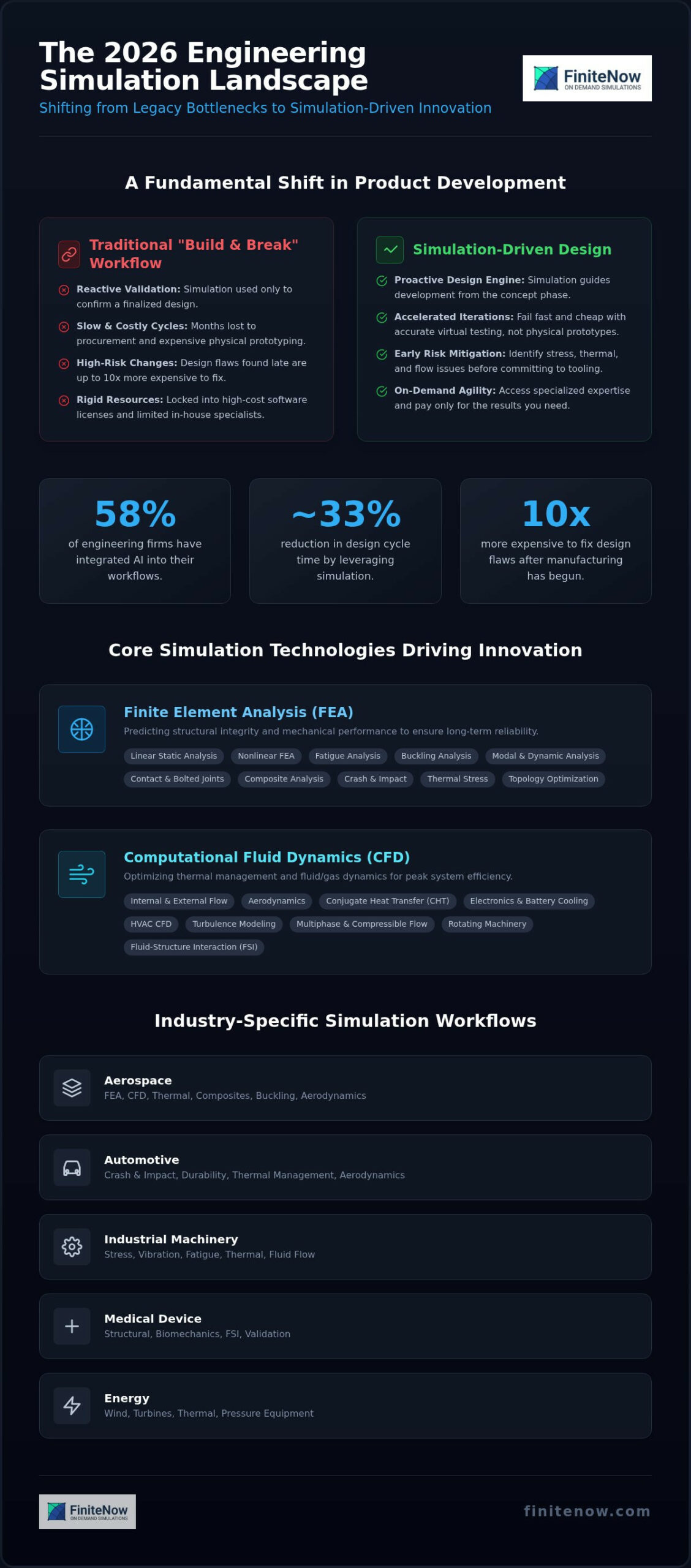
In 2026, the most significant barrier to innovation isn’t a lack of ideas, but the friction of outdated procurement. While over 58% of engineering firms have now integrated AI into their workflows to cut design cycles by nearly a third, many departments still lose months to the traditional bidding process. Integrating high-fidelity engineering simulation for product development has shifted from a luxury validation step to a mandatory strategic requirement. You’ve likely felt the pressure of shrinking R&D timelines while facing a chronic shortage of in-house FEA and CFD specialists.
The industry standard has moved decisively toward usage-based agility, yet many teams remain stuck in legacy workflows. This guide provides a clear roadmap for optimizing the 2026 simulation landscape. You’ll discover how to accelerate design iterations and reduce physical prototyping costs by leveraging simulation-driven design. We preview the shift from heavy licensing to on-demand expertise. This transition ensures you secure faster results and transparent project costs without the overhead of long-term contracts or “shelfware” software seats.
Key Takeaways
- Transition from reactive post-design validation to proactive simulation-driven design to identify critical failure points early in the R&D cycle.
- Leverage high-fidelity engineering simulation for product development to replace expensive physical prototypes with accurate virtual testing and faster design iterations.
- Replace rigid, high-cost software licenses with on-demand technical expertise to ensure you only pay for the specific FEA or CFD results your project requires.
- Adopt vertical-specific workflows for Aerospace, Automotive, and Machinery to address complex technical challenges like composites, buckling, and thermal management.
- Scale your R&D capacity instantly by bypassing traditional bidding bottlenecks through automated, transparent quoting platforms and pre-qualified supplier networks.
The Role of Engineering Simulation in Modern Product Development
Engineering simulation for product development is a method to predict performance before physical prototypes exist. It transforms R&D from a reactive validation exercise into a proactive design engine. In the past, engineers built physical models and tested them to failure. This “build-and-break” cycle is too slow for 2026 market demands. Modern firms treat simulation as the primary source of truth during the design phase, not just a final check before production.
High-fidelity simulation accelerates R&D cycles by identifying design flaws months before tooling begins. When you integrate Core Simulation Technologies early, you reduce the risk of late-stage engineering changes. These changes are often ten times more expensive if discovered after manufacturing has started. Moving to a simulation-driven approach means every design decision is backed by data, ensuring the first physical prototype is already optimized for performance.
From Validation to Simulation-Driven Design
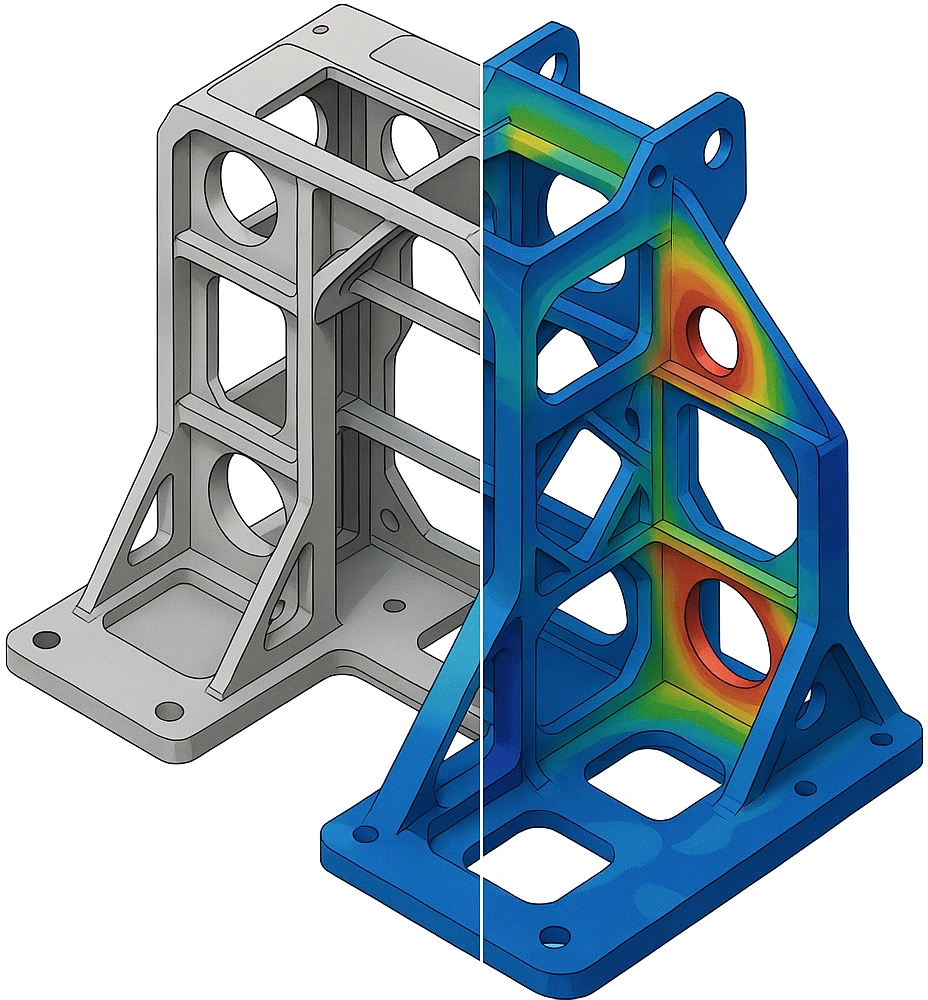
Traditional workflows use simulation to confirm a finished design. Simulation-driven design flips this logic. By embedding Structural FEA and CFD Simulation into the conceptual phase, teams explore hundreds of design variants in a virtual environment. You don’t just find out if a part’s going to break; you discover how to make it lighter, stronger, or more efficient. This iterative process prevents “design lock-in,” where teams are forced to proceed with sub-optimal designs because they’ve already invested in physical assets.
- Detect stress concentrations before cutting metal.
- Optimize thermal management in the CAD phase.
- Validate material choices through virtual stress testing.
Reducing R&D Risk and Prototyping Costs
Physical prototype failures in complex industries like Aerospace or Medical Devices are catastrophic for budgets. A single failed crash test or turbine blade fatigue test can cost hundreds of thousands of euros. Engineering simulation for product development allows you to fail fast and fail virtually. Virtual product testing services enable a wider scope of exploration than physical limits allow, such as testing extreme thermal gradients or complex fluid-structure interactions (FSI) that are difficult to replicate in a lab. This rigorous digital validation also provides a documented audit trail, streamlining the path to certification and regulatory approval.
Core Simulation Technologies Driving Product Innovation
Innovation in 2026 demands more than raw computing power. It requires a strategic application of physics-based solvers to solve multi-domain problems. While some focus solely on cloud infrastructure, the real value lies in how you apply Structural FEA and CFD to refine complex assemblies. Using engineering simulation for product development allows teams to move beyond component-level checks to system-level optimization, ensuring that every part works in harmony under real-world stress.
Structural FEA and Mechanical Design Integrity
Structural integrity is the foundation of any mechanical assembly. Predicting fatigue and buckling under operational loads ensures long-term reliability. Linear static analysis works for simple load cases, but real-world assemblies often require nonlinear FEA to account for large deformations or material plasticity. Validating bolted joints and complex contact mechanics prevents catastrophic failure in industrial machinery. These models must account for friction, pretension, and surface interactions to be truly predictive. For those Implementing a Scalable Simulation Strategy, these high-fidelity models are essential for reducing physical testing overhead and meeting 2026 safety standards.
CFD Simulation for Thermal and Fluid Optimization
Managing fluid and gas dynamics is equally critical for modern R&D. Using CFD simulation allows for precise control over external aerodynamics and internal flow patterns. In electronics, conjugate heat transfer (CHT) is the standard for managing cooling in high-density components, where heat must move from solid conduction to fluid convection. Predicting pressure drops and turbulence helps engineers refine fluid-solid interactions (FSI) and rotating machinery performance before any hardware is built. This level of detail ensures that your engineering simulation for product development results in a more efficient, quieter, and reliable product.
Multibody Dynamics (MBD) takes this further by simulating the motion of complex mechanisms, accounting for joints, springs, and dampers. When you combine these solvers through coupled-field analysis, you can simulate real-world environmental conditions where thermal, fluid, and structural loads interact simultaneously. This holistic view is what separates market leaders from those stuck in traditional silos. If your team lacks the specialized software or in-house expertise to run these complex models, exploring on-demand simulation services can provide the necessary technical depth without the licensing burden.
The Strategic Shift: On-Demand Expertise vs. Software Licensing
Traditional simulation software procurement is a major bottleneck for modern R&D. High upfront costs and recurring annual maintenance fees often result in “shelfware”, expensive software seats that sit idle between projects. In 2026, agile firms are abandoning this ownership model. They prioritize paying for engineering simulation for product development results rather than maintaining complex, underutilized software environments. This shift allows you to scale capacity instantly without the friction of hardware upgrades, IT overhead, or specialized training for in-house staff.
Eliminating the Burden of Heavy Software Licenses
Traditional licensing models demand significant capital expenditure long before a single mesh is generated. Adopting engineering simulation without software licenses transforms these fixed costs into variable, project-based investments. You bypass the cycle of annual maintenance fees and the need for dedicated high-performance computing (HPC) clusters. Instead, you redirect your R&D budget toward expert engineering hours that directly impact product quality. This approach allows startups to execute high-fidelity FEA or CFD studies that would otherwise require six-figure software investments. It ensures your capital is spent on solving complex physics problems, not on managing restrictive vendor contracts.
The Advantage of German Engineering Standards
External simulation support must provide more than just raw data. A German-based engineering team ensures technical rigor, data security, and adherence to ISO-certified workflows. This centralized expertise is supported by a pre-qualified supplier network, allowing you to access specialists for highly specific physics, like composite analysis or multiphase flow. Maintaining transparency in project execution is critical. You receive validated results and comprehensive reporting that meet stringent industry standards. This level of precision ensures that every simulation run is validated against real-world physics, providing a reliable foundation for your design decisions while ensuring your intellectual property remains secure.
Strategic scalability is the competitive advantage for SMEs and startups in 2026. Fixed seat costs are a financial liability during quiet periods and a resource bottleneck during peak design phases. On-demand expertise allows you to adjust simulation capacity in real-time. You gain the technical depth of a full simulation department with the financial flexibility of a modern service model. This approach eliminates the traditional barriers to entry, allowing smaller teams to compete with enterprise-level engineering simulation for product development capabilities.
Industry-Specific Simulation Workflows for Product Teams
Engineering simulation for product development requires deep domain knowledge to be effective. Generalist software models often fail to capture the specific physics of niche verticals. Aerospace teams, for instance, must prioritize buckling analysis and composite material failure modes to ensure structural integrity under extreme flight loads. Automotive engineers focus on high-fidelity crash simulations and long-term durability to meet safety standards, and automotive component simulation workflows provide the data-driven precision needed to validate structural and thermal performance without costly physical iterations. Each industry carries its own set of critical failure points that must be addressed during the virtual prototyping phase to prevent costly redesigns after tooling has already begun.
Medical Device Validation and Biomechanics
Medical device R&D is governed by strict regulatory validation and patient safety requirements. Utilizing a fatigue life prediction service is essential for cardiovascular stents that must withstand millions of cycles without failure. High-fidelity FEA models predict how these implants interact with biological tissues under dynamic loading. Simulating fluid-structure interaction (FSI) allows for precise modeling of blood flow through heart valves or drug-delivery systems. These virtual tests provide the rigorous data needed for FDA or CE marking submissions, reducing the reliance on expensive animal or clinical trials early in the R&D process. It’s a faster, more ethical path to market compliance.
Energy and Industrial Equipment Analysis
The energy sector faces extreme environmental loads that demand rigorous structural and thermal validation. Thermal stress analysis is a requirement for wind turbine components and high-pressure equipment to prevent premature fatigue in the field. In the electric vehicle market, optimizing battery cooling systems via CFD ensures thermal stability and prevents thermal runaway events. Industrial machinery workflows prioritize vibration and modal analysis to avoid resonance-related failures in rotating equipment. Specialized CFD studies for rotating machinery help refine turbine efficiency and pressure drop profiles. These workflows ensure that complex systems operate reliably under fluctuating thermal and mechanical loads without the need for constant maintenance.
Aerospace engineering simulation for product development centers on external aerodynamics and lightweighting through topology optimization of composites. Automotive teams use these same principles for thermal management and cabin HVAC optimization to improve energy efficiency. These industries require a level of technical rigor that standard out-of-the-box simulation tools often lack. Accessing these specialized workflows shouldn’t require an enterprise-sized software budget or a six-month onboarding period for new staff. If your team needs to validate a complex industrial assembly or medical implant, you can leverage dedicated virtual product testing services to access specialized German engineering expertise today.
Implementing a Scalable Simulation Strategy
Success in 2026 requires a shift from sporadic analysis to a continuous, scalable workflow. You don’t need to bloat your internal headcount to achieve this. Instead, follow a structured process that prioritizes speed and data utility. A modern engineering simulation for product development strategy focuses on removing friction at every touchpoint, from the initial CAD review to the final procurement sign-off. Speed is a feature, not just a benefit.
- Step 1: Identify critical failure points in the CAD model. Focus your resources where they matter. Don’t simulate every fastener; target the high-risk zones where stress concentrations or thermal gradients are most likely to occur.
- Step 2: Utilize instant quoting to remove the bidding bottleneck. Traditional procurement kills R&D momentum. Use automated platforms to get project costs immediately.
- Step 3: Collaborate with experts via streamlined digital workflows. Connect your team with specialized German engineering talent without the overhead of long-term contracts.
- Step 4: Integrate simulation reports into the engineering knowledge graph. Convert static results into a searchable database of physics-based intelligence.
Accelerating R&D with Instant Quoting
The manual bidding process is an outdated relic of legacy engineering firms. Waiting weeks for a consultant to review a file and return a quote is unacceptable in a modern design cycle. Adopting instant quote engineering simulation transforms your procurement department into an agile partner. You receive transparent pricing for complex multiphysics tasks in seconds. This allows you to move from project submission to execution without delay. It ensures your engineering simulation for product development stays on schedule, allowing you to hit market windows that competitors will miss due to administrative friction.
Building an Engineering Knowledge Graph
Stop letting your engineering insights die in a PDF archive. A scalable strategy requires moving toward an Engineering Knowledge Graph. This means standardizing your simulation data so it becomes an actionable digital asset for future design iterations. When you centralize the results from FEA and CFD studies, you create a repository of validated performance data. This empowers both procurement and engineering leads to make data-driven decisions based on historical physics results. You aren’t just validating a single part; you’re building a strategic intelligence layer that informs every future product your company develops.
Future-Proofing Your R&D Momentum
Strategic agility in 2026 depends on how quickly your team can validate complex physics without the weight of legacy procurement. Transitioning from heavy software licensing to on-demand expertise eliminates the financial drag of idle seats and annual maintenance fees. Integrating high-fidelity engineering simulation for product development into the early conceptual phase ensures you identify failure modes before incurring tooling costs. It’s about results, not tools. This shift allows you to focus on design innovation rather than software management.
You don’t need to navigate the traditional bidding bottleneck to access specialized technical depth. By leveraging German-based engineering expertise and a pre-qualified supplier network, you secure precise results with pay-per-project flexibility. It’s time to replace “build-and-break” cycles with a streamlined, digital-first workflow. Get an Instant Quote for Your Engineering Simulation Project and start scaling your R&D capacity today. Your path to faster design iterations and lower risk begins with data-driven precision.
Frequently Asked Questions
How does engineering simulation reduce physical prototyping costs?
Simulation identifies design flaws before any material is cut or tooling is built. By using engineering simulation for product development, you eliminate the “build-and-break” cycle that consumes R&D budgets. You can virtually test hundreds of design iterations to find the optimal configuration. This ensures that the first physical prototype you build is already validated for performance, significantly reducing scrap rates and expensive laboratory testing time.
What industries benefit most from outsourced engineering simulation?
Complex sectors with high safety and performance standards gain the most from on-demand expertise. Aerospace firms utilize it for buckling and composite analysis, while Automotive teams focus on crash and durability. Medical Device manufacturers rely on biomechanics and FSI validation. Industrial Machinery and Energy sectors also benefit by addressing vibration, fatigue, and thermal stress challenges without the overhead of maintaining specialized in-house departments for every physics domain.
Is project-based simulation more cost-effective than buying software licenses?
Project-based models eliminate the high upfront capital expenditure and annual maintenance fees associated with enterprise software. You don’t pay for “shelfware” during periods of low activity. Instead, you only invest in specific engineering outcomes. This shift from fixed licensing costs to variable project fees provides better ROI, especially for SMEs and startups that need high-fidelity results without the burden of long-term software contracts or hardware maintenance.
How do you validate the accuracy of simulation results?
Validation involves comparing numerical results against analytical solutions, historical data, or physical test benchmarks. Our German-based team employs mesh independence studies and sensitivity analyses to ensure the solver’s convergence. We also verify material properties and boundary conditions against industry standards. This rigorous approach ensures the digital twin behaves like the physical asset, providing a reliable foundation for critical engineering decisions and reducing the risk of real-world failure.
Can simulation replace physical testing for regulatory compliance?
Simulation often reduces the volume of physical testing required but rarely replaces it entirely for final certification. Regulatory bodies like the FDA or EASA increasingly accept high-fidelity simulation data as supporting evidence for safety and performance. By using engineering simulation for product development, you can narrow down the test matrix to only the most critical cases. This streamlines the path to compliance by ensuring your physical tests are successful on the first attempt.
What technical domains are covered by FiniteNow’s engineering team?
Our team covers a broad spectrum of physics-based analysis. This includes Structural FEA for linear and nonlinear stress, fatigue, and buckling. We provide CFD Simulation for internal flow, aerodynamics, and conjugate heat transfer. Additionally, we handle thermal analysis and multibody dynamics (MBD). These services are delivered by a German-based engineering team and a network of pre-qualified suppliers to ensure technical rigor across specialized domains like composite analysis and electronics cooling.
How long does it take to get a quote for a custom FEA project?
FiniteNow uses an automated instant quoting system that delivers pricing in seconds. Unlike traditional engineering firms that require weeks of manual bidding and back-and-forth communication, our platform processes your project requirements immediately. This removes the procurement bottleneck, allowing you to move from project submission to execution without losing R&D momentum. You get transparent, project-based costs instantly, ensuring your design cycle stays on schedule.
Do I need to provide CAD files for an engineering simulation quote?
Providing a CAD model is the most efficient way to receive an accurate quote. Our platform analyzes the geometry to determine the complexity of the mesh and the physics required. If a CAD model isn’t available yet, you can provide detailed technical specifications to start the conversation. However, uploading your geometry directly to our secure platform is the fastest path to receiving an instant, binding quote for your simulation project.
Simulation Work Reinvented