


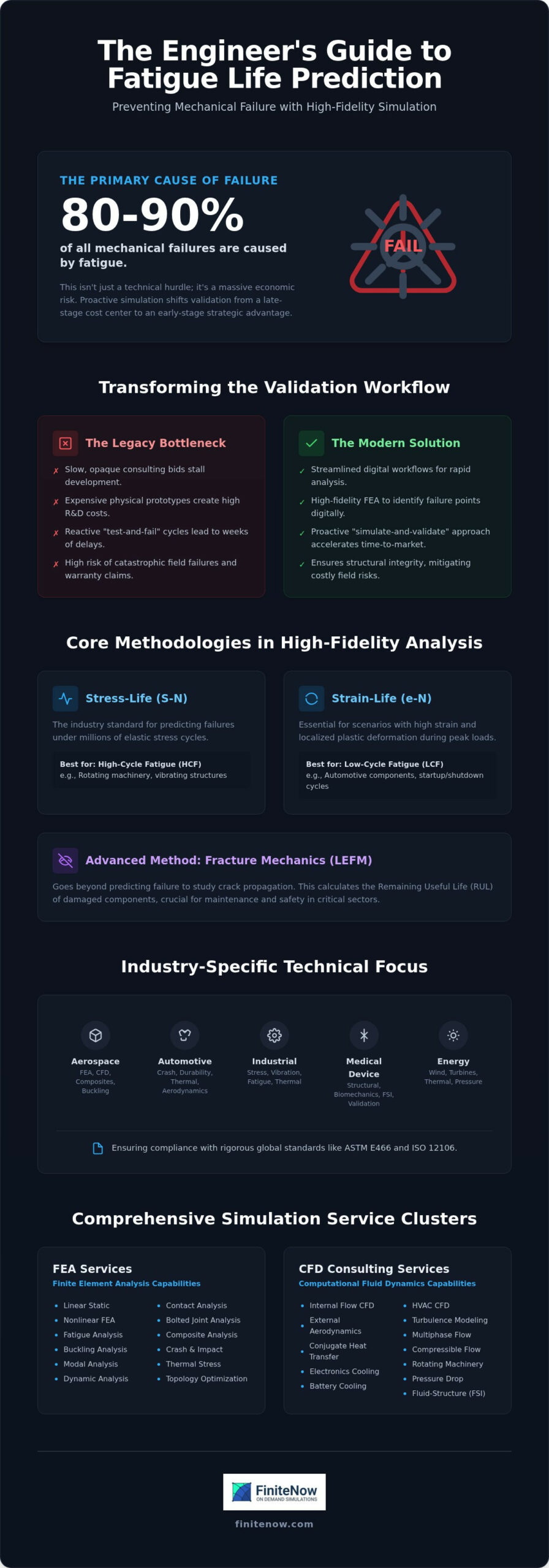
An estimated 80% to 90% of all mechanical failures in engineering are caused by fatigue. It’s a sobering statistic that often leads to catastrophic structural failure and ballooning warranty costs. Traditional validation cycles rely on expensive physical prototypes or slow, opaque consulting bids that stall your development pipeline for weeks. You need a fatigue life prediction service that matches the speed of modern manufacturing. FiniteNow disrupts this legacy model by combining high-fidelity FEA with a streamlined, transparent digital workflow.
We know that nonlinear fatigue simulation is complex and frequently becomes a bottleneck in your product lifecycle. You’re likely frustrated by the high cost of failure and the sluggish turnaround times of traditional firms. This guide promises a better way forward. You’ll discover how professional services utilize advanced simulation to ensure structural integrity while slashing physical testing expenses. We’ll preview the essential technical requirements for durability validation, covering everything from ASTM E466 standards to the application of German engineering expertise. Prepare to transform your validation process into a reliable, cost-effective asset that accelerates your time-to-market.
Key Takeaways
- Understand why 90% of mechanical failures stem from fatigue and how proactive simulation prevents structural disasters before they occur.
- Distinguish between Stress-Life and Strain-Life methodologies to ensure your analysis matches your specific high-cycle or low-cycle loading requirements.
- Leverage a modern fatigue life prediction service to bypass slow bidding processes and obtain professional FEA reports with high-fidelity precision.
- Navigate industry-specific standards like ASTM E466 and ISO 12106 to ensure your durability validation meets rigorous global compliance requirements.
The Strategic Role of Fatigue Life Prediction Services
Durability isn’t an accident. It’s the result of rigorous, proactive engineering. Fatigue life prediction acts as a strategic shield against the most common cause of structural failure. Industry data suggests that 80% to 90% of all mechanical failures are directly attributed to Fatigue (material). This isn’t just a technical hurdle; it’s a massive economic risk. Traditional engineering cycles often rely on late-stage physical testing. This reactive approach is expensive and slow. If a component fails during a physical test, you’re looking at weeks of redesign and remanufacturing. A modern fatigue life prediction service shifts this validation to the digital realm. It allows you to identify failure points before the first piece of metal is cut. By leveraging German engineering expertise, you transition from guessing to knowing.
Identifying Fatigue Mechanisms in Complex Assemblies
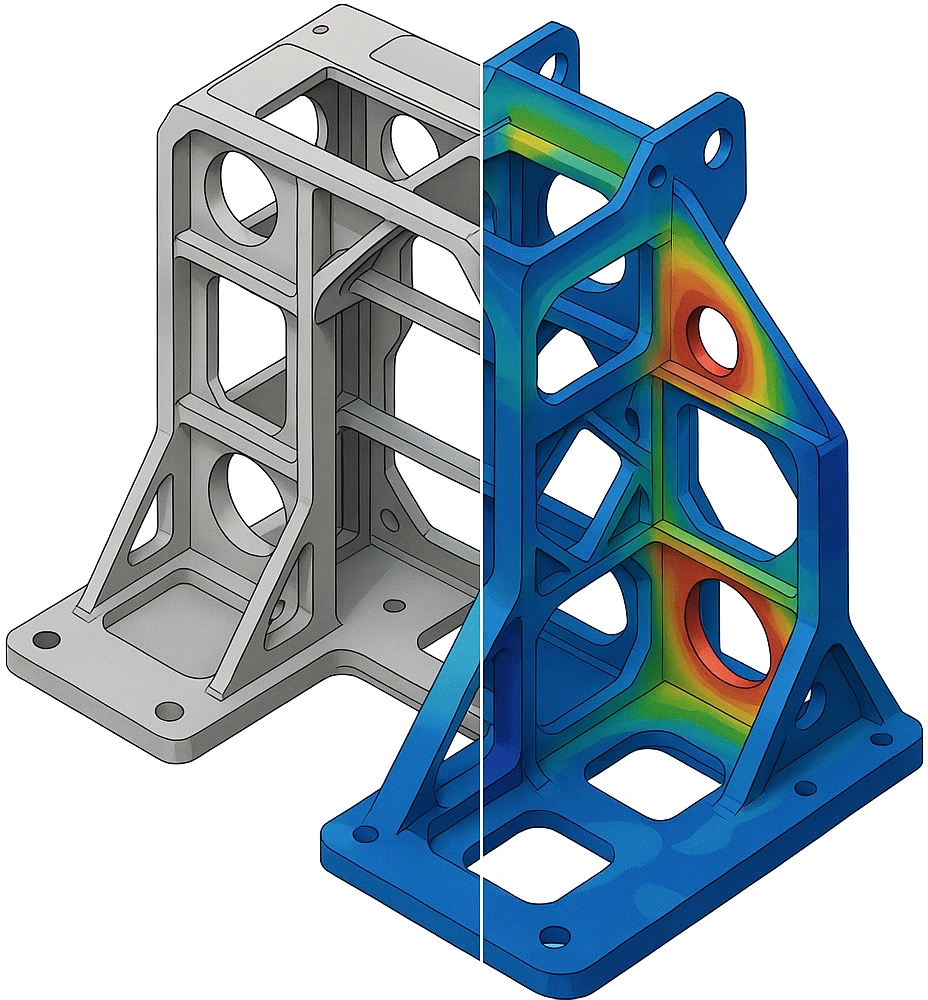
Understanding how a part fails requires more than a simple stress plot. Engineers must distinguish between low-cycle and high-cycle fatigue. Low-cycle fatigue occurs under high-strain conditions where plastic deformation is present. This is common in components subjected to frequent startup and shutdown cycles. High-cycle fatigue involves millions of elastic stress cycles, typical in rotating machinery or vibrating structures. Professional simulation accounts for mean stress effects and environmental variables that degrade material properties over time. High-fidelity FEA pinpoints stress concentrations at geometric transitions, welds, and bolted joints. These are the locations where cracks typically initiate. By simulating these variables early, you ensure the structural integrity of the entire assembly without the guesswork of legacy methods.
Economic Impact of Durability Validation
The financial argument for simulation-driven design is undeniable. Every physical prototype iteration you eliminate saves thousands in material and labor costs. Beyond the immediate R&D savings, accurate prediction mitigates the catastrophic risks of field failures. A single recall can devastate a brand’s reputation and bottom line. Utilizing a professional fatigue life prediction service provides a level of technical rigor that satisfies both engineering requirements and procurement standards. It creates a reliable audit trail of structural validation. This transparency accelerates the approval process and reduces the time-to-market. You aren’t just buying a report; you’re buying the certainty that your product will last its intended service life without expensive warranty claims. It’s about protecting your margin and your reputation simultaneously.
Core Methodologies in High-Fidelity Fatigue Analysis
High-fidelity simulation requires selecting the right mathematical framework. It’s not a one-size-fits-all process. A professional fatigue life prediction service evaluates the loading regime before choosing between stress-based or strain-based models. This technical precision ensures that the results reflect real-world physics rather than generic software outputs. Engineers must match the methodology to the specific failure mode, whether it’s a rapidly vibrating industrial turbine or an automotive chassis subjected to intermittent peak loads.
Stress-Life and Strain-Life Approaches
The Stress-Life (S-N) method remains the standard for high-cycle fatigue in industrial machinery. It relies on the relationship between cyclic stress amplitude and the number of cycles to failure. However, accuracy depends on high-quality material data and surface finish factors like roughness and residual stress. In contrast, automotive components often experience localized plastic deformation during peak loads. Here, the Strain-Life (e-N) method is essential. It accounts for the nonlinear material behavior that S-N curves ignore. Recent research, such as the fatigue life prediction model proposed by the AIAA, highlights how strain energy density provides a more robust estimate for metallic materials under varied loading. This ensures that your fatigue life prediction service delivers results grounded in the latest engineering science.
Fracture Mechanics and Crack Growth Simulation
Predicting when a part will fail isn’t always enough. Sometimes you need to know how long a damaged part can stay in service. Linear Elastic Fracture Mechanics (LEFM) allows engineers to study crack propagation rather than just initiation. Using the Paris Law, we can calculate the Remaining Useful Life (RUL) of components in aerospace or heavy energy sectors. This approach integrates structural integrity verification with maintenance schedules. It’s a shift from “safe-life” to “damage-tolerant” design philosophies. Expert simulation identifies the stress intensity factor (K) at the crack tip, allowing for precise monitoring of structural health over time. This level of detail is critical for aging assets or mission-critical assemblies where total replacement isn’t immediately feasible.
Real-world loads are rarely uniaxial. Complex 3D loading requires multiaxial fatigue analysis to account for rotating principal stress axes. Handling these variables manually is prone to error. Our Structural FEA specialists utilize advanced solver algorithms to process these complex datasets with precision. This level of analysis transforms raw CAD into a definitive roadmap for durability, ensuring your product withstands the rigors of its operational environment without the need for redundant physical testing. You get the speed of a digital workflow without sacrificing the technical depth of traditional engineering.
Evaluating Service Providers: Expertise vs. Accessibility
Selecting a fatigue life prediction service isn’t just about software access. It’s about finding a partner that understands the intersection of physics and business deadlines. Traditional engineering firms often operate on outdated service models that prioritize internal billable hours over your project velocity. You need a provider that combines pre-qualified expert networks with modern digital delivery. This ensures every simulation aligns with real-world physics and industry-standard validation protocols. High-performance engineering requires a shift from slow, opaque consulting to transparent, data-driven partnerships.
The Limitations of Legacy Consulting Models
Legacy consulting models are plagued by the 2-week bidding bottleneck. You submit a request, wait for a sales call, and then wait even longer for a formal proposal. This delay is unacceptable in modern development cycles. Many boutique firms also struggle with scalability. Your project might sit in a queue while they finish other work, stalling your entire R&D pipeline. Hidden costs often lurk in long-term service agreements or minimum engagement fees that don’t reflect the actual work performed. These barriers prevent agile teams from getting the durability insights they need exactly when they need them.
On-Demand Simulation as a Scalable Alternative
On-demand platforms disrupt these barriers. By using instant quote engineering simulation, you can move from CAD to analysis in hours. This approach allows you to access a German-based engineering team without geographic constraints. It also eliminates the overhead of engineering simulation without software licenses. Professional licenses for major FEA software can cost over $20,000. You shouldn’t have to subsidize a consultant’s software stack. On-demand services provide the technical rigor of a traditional firm with the speed and transparency of a modern technology partner.
Validation is the cornerstone of any reliable service. Providers must demonstrate how they ensure simulation-to-reality alignment. In specialized sectors like wind energy, researchers use tools like NREL’s MLife for complex fatigue-life predictions to meet rigorous certification standards. A high-performance fatigue life prediction service doesn’t just run a solver. They apply these specialized methodologies to ensure your component survives its intended lifecycle. Transparency in both timelines and technical assumptions is what separates a vendor from a strategic partner. You deserve a workflow that values your time as much as your intellectual rigor.
Industry-Specific Fatigue Requirements and Standards
General simulation practices provide a foundation, but industry-specific variables dictate the final validation strategy. Each vertical carries unique regulatory burdens and failure modes. A professional fatigue life prediction service must adapt its technical approach to meet these distinct requirements. Whether you’re validating a composite wing spar or a nitinol stent, the simulation must reflect the specific standards of your domain. High-fidelity FEA ensures that these complex assemblies meet safety-critical benchmarks without the need for redundant physical trials. Teams looking to stay ahead of the curve can benefit from understanding how engineering simulation for product development is evolving as a mandatory strategic requirement across all major industries.
Aerospace and Automotive Durability Cycles
Aerospace engineering demands precision across extreme loading spectrums. We focus on high-cycle vibration fatigue, buckling analysis, and the unique failure modes of composite materials. Additive manufacturing introduces new variables; simulation must account for process-induced porosity that can act as a crack initiation site. In the automotive sector, the focus shifts to durability cycles for suspension and powertrain components. These parts must withstand millions of load reversals over a decade of service. We utilize high-fidelity FEA to simulate crash-impact fatigue and thermal-mechanical loading. This ensures that every component meets rigorous safety standards before entering the production phase. Transitioning to a digital-first validation model allows for rapid design iterations that traditional physical testing simply can’t match. Engineering teams that want to eliminate costly prototype failures entirely can explore how virtual product testing services provide a scalable, high-fidelity alternative to physical durability trials across aerospace, automotive, and industrial applications.
Medical Device Validation: Stents and Implants
Medical device R&D is governed by life-critical reliability standards. Stent fatigue life simulation is a specialized domain where components must survive 400 million cycles to meet FDA and CE requirements. This level of analysis requires specialized material models that account for the superelastic behavior of alloys like Nitinol. Beyond stents, orthopedic implants require biomechanics simulation to predict how they interact with bone and tissue over time. These simulations often involve complex interactions between fluid dynamics and structural mechanics. Utilizing coupled-field analysis services allows engineers to account for these multiphysics effects simultaneously. This technical rigor is essential for regulatory compliance and long-term patient safety.
Industrial machinery relies on vibration and modal analysis to ensure long-term operational reliability. We identify resonant frequencies that could lead to accelerated fatigue failure in rotating equipment. By addressing these issues in the design phase, you eliminate the risk of unexpected downtime and expensive field repairs. If you need to validate the durability of your next assembly, get an instant quote for your FEA project. Our German engineering team provides the technical depth required for specialized industry standards, delivering actionable reports that accelerate your procurement and certification cycles. We remove the bidding bottleneck so you can focus on engineering excellence.
Streamlining Your Fatigue Life Workflows with FiniteNow
Traditional engineering consulting is slow. It’s built on a foundation of friction. FiniteNow replaces this legacy model with a streamlined, digital-first fatigue life prediction service. We don’t believe in manual contact forms or two-week bidding cycles. Instead, we provide a transparent platform where you can move from raw CAD data to actionable durability insights in a fraction of the time. Our process is designed for engineers who value precision and speed equally. We’ve optimized every step of the professional interaction to ensure your projects stay on track and your costs remain predictable.
From CAD to Durability Reports: The Process
Submitting projects for Structural FEA is the first step in our optimized workflow. Once your CAD is uploaded, our team works with you to define complex load cases and boundary conditions. This isn’t a hands-off automated process; it’s a collaborative effort supported by integrated video calls. You get direct access to our German-based engineering team to discuss material properties, surface finishes, and life-cycle expectations. We transform raw stress data into clear fatigue life results that guide your design optimization. You receive a professional report that’s ready for procurement or regulatory review, ensuring your structural integrity is validated without the overhead of an in-house team.
Leveraging Instant Quote Technology for Faster R&D
Our instant quote technology removes the most significant barrier in R&D: the bidding bottleneck. The automated system analyzes your project requirements and provides a clear, upfront cost immediately. This allows you to scale your simulation capacity during peak development phases without the burden of long-term contracts or expensive software licensing. You pay for the expertise you need, when you need it. By leveraging our fatigue life prediction service, you gain the technical rigor of German engineering with the agility of a modern technology firm. Stop waiting for proposals and start validating your designs with FiniteNow.
Transparency is our default setting. We provide real-time updates on project progress, ensuring you’re never left wondering about your results. This visibility allows managers to align simulation milestones with broader product launch timelines. We’ve removed the traditional barriers between high-level engineering and rapid execution. Whether you’re a startup or an established manufacturer, our platform provides the scalable capacity needed to handle complex nonlinear fatigue simulations with streamlined precision. You get actionable data, expert validation, and a faster path to market.
Accelerate Your Durability Validation Cycles
Accuracy in fatigue analysis is no longer a luxury reserved for academic research. It’s a fundamental requirement for competitive engineering. By transitioning from reactive physical testing to predictive, high-fidelity simulation, you protect your margins and your reputation. Specific methodologies like Strain-Life and Fracture Mechanics provide the technical rigor necessary for complex assemblies. Now, it’s time to remove the operational barriers that stall your development pipeline.
FiniteNow offers a modern fatigue life prediction service that bypasses the traditional bidding bottleneck. Our platform connects you with a German-based engineering team and provides instant automated quoting without the need for expensive software licenses or long-term contracts. You get the precision of expert analysis with the speed of an automated workflow. This streamlined approach ensures that structural integrity is a certainty, not a variable, in your procurement cycle. Take the first step toward a more efficient, data-driven design process today.
Get an Instant Quote for Your Fatigue Life Prediction Project
Frequently Asked Questions
What is a fatigue life prediction service?
A fatigue life prediction service is a specialized engineering offering that uses Finite Element Analysis (FEA) to estimate how many load cycles a component can withstand before failing. Instead of relying solely on physical testing, these services utilize mathematical models to simulate stress, strain, and crack propagation. This proactive approach identifies structural weaknesses during the design phase, allowing engineers to optimize geometry and material selection before manufacturing begins.
How much does a fatigue life simulation project cost?
Project costs are determined by the complexity of the geometry, the number of load cases, and the specific material models required. FiniteNow uses an automated instant quoting system to provide transparent pricing immediately. This removes the traditional bidding bottleneck associated with legacy consulting firms. You pay for the specific simulation expertise needed for your project without the overhead of long-term contracts or expensive software licenses.
What information is needed to start a fatigue analysis?
To initiate a fatigue analysis, you must provide clean CAD data of the assembly and detailed material specifications, including S-N or e-N curves. It’s also essential to define the operational load history, which includes the magnitude, frequency, and sequence of applied forces. Environmental factors like temperature or corrosive conditions should be noted, as these significantly impact durability results and the selection of the appropriate simulation methodology.
Can simulation replace physical fatigue testing for regulatory approval?
High-fidelity simulation significantly reduces the number of physical prototypes required but often serves as a complement to final physical validation for regulatory bodies like the FDA or FAA. Simulation is used to identify worst-case scenarios and screen design iterations. This ensures that the final physical test is a confirmation of a pre-validated design, which slashes development costs and minimizes the risk of late-stage test failures.
How accurate are fatigue life predictions compared to real-world results?
Accuracy depends on the quality of input data and the chosen analysis method. When using high-fidelity FEA and accurate material properties, simulation provides a reliable roadmap for structural integrity. While no model perfectly replicates every real-world variable, a professional fatigue life prediction service accounts for mean stress, surface finish, and stress concentrations. This level of technical rigor effectively mitigates the 80% to 90% of mechanical failures typically caused by fatigue.
Which industries benefit most from outsourced fatigue analysis?
Industries with mission-critical components benefit most from specialized fatigue analysis. This includes Aerospace for composite wing structures and Automotive for drivetrain durability. Medical device manufacturers rely on simulation for life-critical implants, while the Energy sector uses it for turbine and pressure equipment validation. Outsourcing allows these firms to access expert-run simulations using industry-standard tools without the high cost of maintaining specialized in-house expertise.
What is the typical turnaround time for a professional FEA report?
Turnaround times vary based on project scope, but our digital workflow is designed for speed. Unlike traditional firms that take weeks just to provide a quote, our instant platform accelerates the onboarding process. Once the simulation parameters are finalized, our German-based engineering team works to deliver actionable durability reports within days. This rapid progression mimics a well-oiled digital workflow, ensuring you receive technical insights exactly when they are needed.
Does FiniteNow offer specialized stent fatigue life simulation?
Yes, FiniteNow specializes in stent fatigue life simulation, addressing the rigorous durability requirements for medical device compliance. These simulations often involve complex material models for alloys like Nitinol and must account for 400 million heartbeats to meet regulatory standards. Our team utilizes coupled-field analysis to ensure these life-critical components survive their intended service life, providing the technical validation necessary for FDA and CE approval cycles.
Simulation Work Reinvented