


The most expensive part of your product development shouldn’t be the software license used to validate it. Traditional engineering firms have turned structural validation into a slow, opaque bottleneck that drains R&D budgets. You shouldn’t have to wait weeks or navigate complex licensing fees just to confirm your design’s integrity. FiniteNow disrupts this legacy model by providing a high-fidelity static structural analysis service that prioritizes speed and transparency without compromising on technical rigor. By leveraging German engineering expertise and an automated quoting system, we’ve removed the friction from professional FEA.
You already know that accurate stress and deformation data is critical for regulatory compliance and safety, yet the barriers to entry remain frustratingly high. We promise to show you how to access expert-backed simulation results and comprehensive reports without the overhead of expensive software or long-term contracts. This guide previews the technical frameworks of static analysis, the necessity of ASME V&V 10-2019 standards, and how an on-demand simulation model accelerates your 2026 development cycle.
Key Takeaways
- Learn how to replace slow physical prototyping cycles with high-fidelity FEA to significantly shorten R&D timelines and reduce development costs.
- Understand when to deploy a professional static structural analysis service for linear elastic checks versus nonlinear scenarios involving material yielding or large deflections.
- Identify the critical indicators for buckling analysis to prevent catastrophic structural failure in complex load-bearing assemblies.
- Gain insights into industry-specific validation requirements for aerospace and automotive sectors, focusing on structural integrity and regulatory compliance.
- Discover how an on-demand simulation model eliminates the overhead of expensive software licenses and long-term engineering contracts.
Accelerating Design Validation with Static Structural Analysis Services
Static structural analysis is the numerical study of how physical systems respond to steady-state loads. Unlike dynamic events where forces change rapidly, this discipline focuses on constant or slowly applied loads where inertia and damping effects are negligible. It’s a foundational subset of structural analysis that identifies how stress, strain, and deformation manifest across a design. For engineering teams, a professional static structural analysis service provides the data needed to confirm that a product won’t fail under its intended operating conditions.
The traditional R&D cycle relied on “build-and-break” methodologies. This approach is no longer viable in high-speed markets. Finite Element Analysis (FEA) allows engineers to simulate performance in a virtual environment, drastically reducing physical prototyping costs and shortening development timelines. We’ve seen a strategic shift in 2026. Companies are moving away from restrictive internal software licenses. The overhead of training, hardware maintenance, and annual fees creates a bottleneck. On-demand expertise offers a leaner, more scalable path to validation.
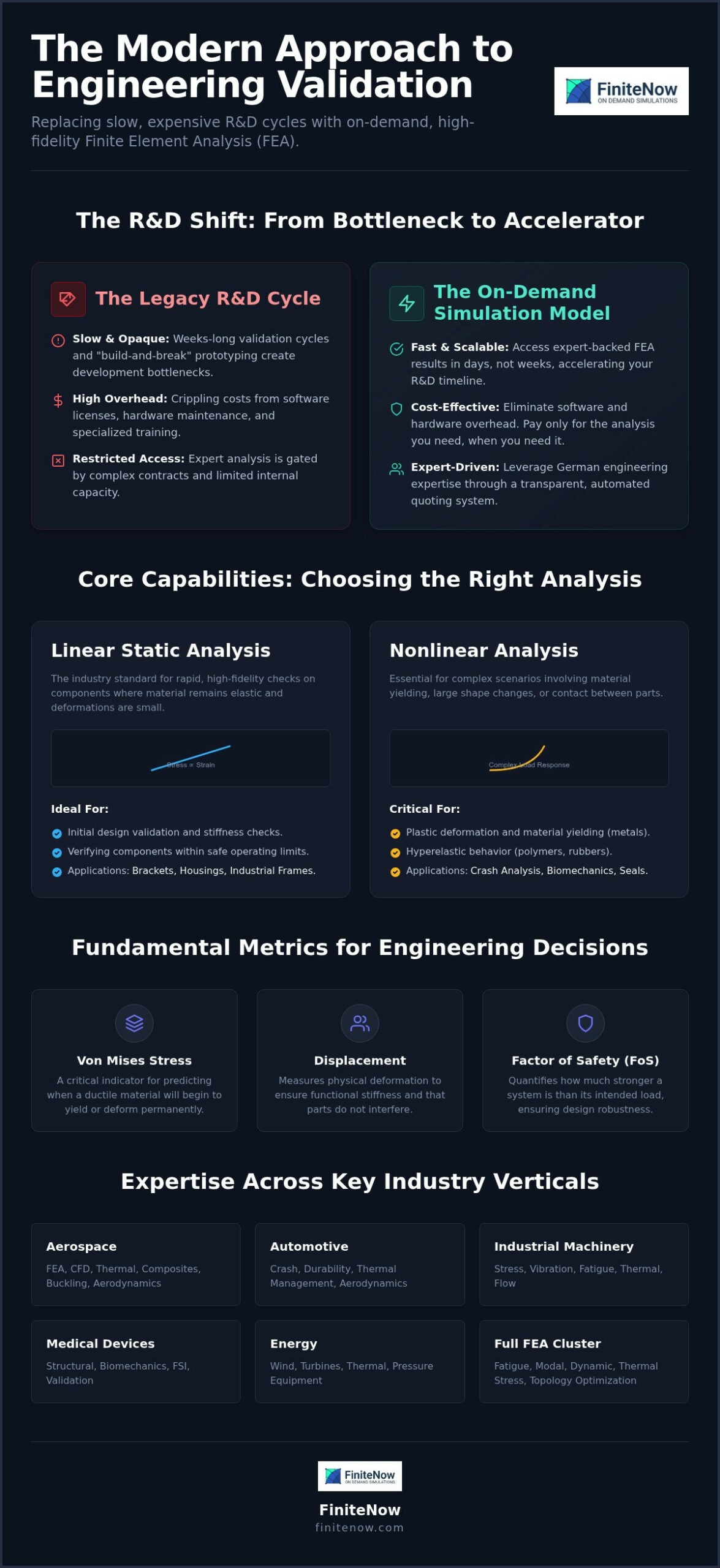
Fundamental metrics drive these simulations. We prioritize data that translates directly into engineering decisions:
- Von Mises Stress: A critical indicator for predicting material yielding in ductile components.
- Displacement: Measuring physical deformation to ensure clearances and functional stiffness.
- Factor of Safety (FoS): A ratio that quantifies how much stronger a system is than it needs to be for its intended load.
Mechanical Stress Analysis for Industrial Components
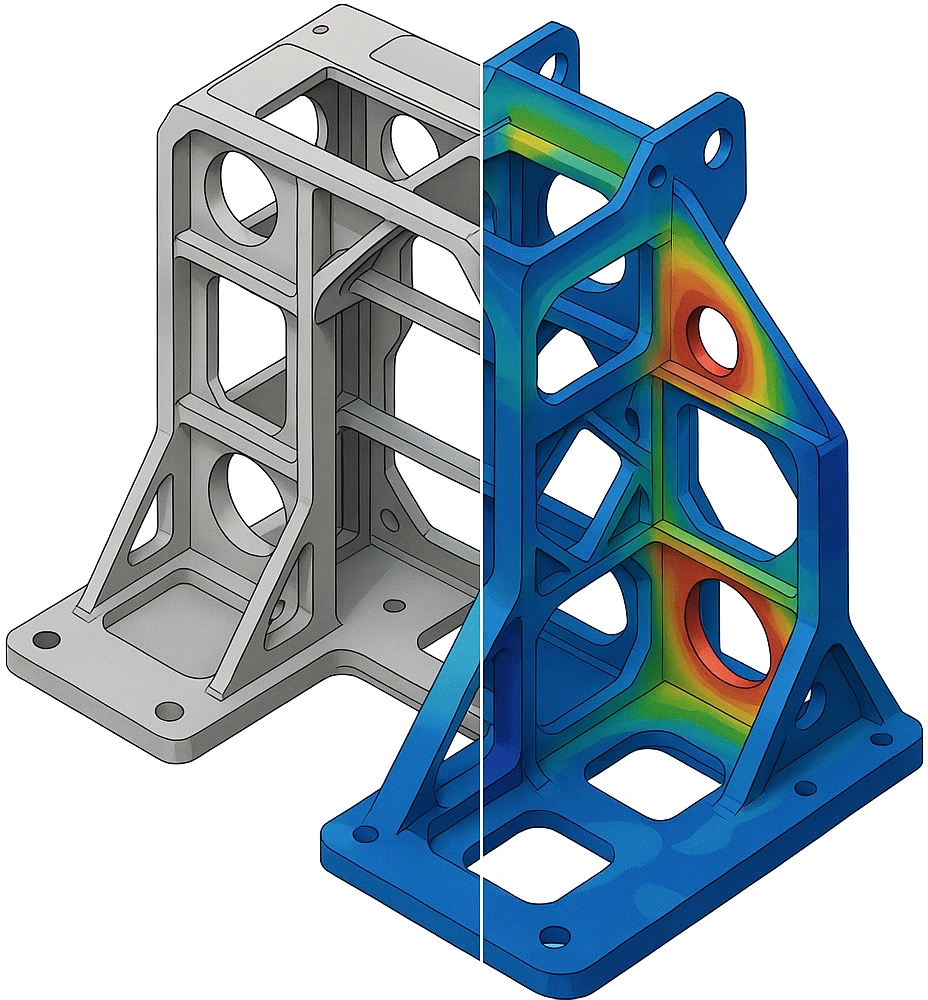
Heavy machinery and structural frames demand rigorous load-bearing assessments. A static structural analysis service identifies hidden stress concentrations that often lead to premature component failure. By evaluating these “hot spots” early, you can refine geometry or material selection before moving to expensive procurement phases. This proactive validation ensures that industrial equipment remains operational under maximum capacity without risk of structural compromise.
The Foundation of Structural Integrity Verification
Verification is about more than just avoiding failure; it’s about regulatory compliance. High-fidelity FEA acts as a digital twin, providing a precise performance prediction that matches real-world behavior. This data is essential for meeting industry-specific safety factors and long-term durability targets. By linking static results to reliability goals, you ensure that every design iteration is backed by empirical, validated data rather than guesswork.
Core Capabilities: Linear and Nonlinear Static FEA
Selecting the right static structural analysis service depends entirely on the complexity of your mechanical environment. Linear static analysis remains the industry standard for verifying components under small displacements where material behavior is perfectly elastic. It operates on the principle that stress is proportional to strain. This method provides rapid, high-fidelity feedback for initial design cycles. It’s the most efficient way to ensure that brackets, housings, and industrial frames stay within safe operating limits without permanent deformation.
Modern engineering often requires moving beyond these simplifications. Nonlinear FEA accounts for scenarios where the relationship between load and response isn’t constant. This includes material nonlinearity, such as metal yielding or the behavior of hyperelastic polymers. It also covers geometric nonlinearity, where the structure’s shape changes so significantly that it alters the load application. Ignoring these factors leads to inaccurate safety margins and potential field failures. If you’re unsure which path fits your specific project requirements, you can access expert guidance to determine the necessary simulation depth.
Nonlinear Material and Geometric Analysis
Accuracy in automotive crash components or medical biomechanics demands sophisticated nonlinear modeling. Plastic deformation must be captured to understand energy absorption and residual stress. For polymers and rubbers, hyperelastic material models are essential to predict large strain responses accurately. Geometric nonlinearities are equally critical; they account for effects where axial loads induce additional bending as the structure deflects. Our static structural analysis service captures these nuances, ensuring your digital validation matches real-world physical testing.
Assembly Stress Analysis Service
Products are rarely single-part systems. They’re complex assemblies held together by fasteners and contact interfaces. Our assembly stress analysis service utilizes advanced contact algorithms to model interactions like friction, sliding, and separation. This level of detail is vital for capturing how load transfers through a multi-part system. We don’t just look at parts in isolation; we analyze the entire assembly to identify interference or gap issues that only appear under load.
Bolted joint analysis is a specific focus within this domain. We simulate bolt pretension and thread engagement to ensure fasteners don’t loosen or fail under operational stress. By identifying these risks early, you can refine tolerances and assembly sequences before the first physical build. This precision transforms a standard simulation into a robust tool for design validation and regulatory compliance.
Strategic Evaluation: Selecting the Right Analysis Type
Engineering success depends on matching the physics to the problem. A standard static structural analysis service is your baseline tool for rapid design checks. Use it when you expect small displacements and elastic material behavior. It provides an immediate “pass/fail” on basic structural integrity. However, relying solely on linear models for complex systems is a risk. You must evaluate when your project demands specialized sub-types like buckling or fatigue life prediction to ensure complete validation before moving to production.
Slender structures require a different perspective. Compressive loads often trigger sudden instability long before a material reaches its yield point. If your design includes thin-walled aerospace frames or industrial towers, buckling analysis is mandatory to prevent sudden collapse. Similarly, if your components operate in high-temperature environments, you likely need thermo-mechanical analysis services. Thermal expansion generates internal stresses that can compromise structural integrity even without external mechanical loads. Identifying these drivers early in 2026 prevents costly redesigns and safety failures.
Buckling and Modal Analysis Integration
Assess slender structures for instability early. Buckling analysis identifies the critical load factor where a part will collapse. We pair this with modal analysis to map natural frequencies. This ensures your assembly doesn’t resonate at operational speeds. It’s a critical safety step for aerospace frames and heavy industrial machinery where vibration and compression converge. Our German engineering team utilizes these integrated workflows to provide a comprehensive view of structural stability that basic stress checks miss.
Fatigue Life and Durability Prediction
Static stress results are only half the story. Most mechanical failures stem from cumulative fatigue damage rather than a single overload event. Our static structural analysis service provides the foundational data needed to translate peak stress into cycle-to-failure estimates. In medical device engineering, this is vital for components like vascular stents. These devices undergo millions of loading cycles within the human body. Validating their fatigue life through high-fidelity FEA ensures long-term reliability and regulatory approval. This data-driven approach removes the guesswork from durability testing.
Industry-Specific Applications and Compliance
General simulation tools often fail to address the specific regulatory and technical nuances of high-stakes industries. A professional static structural analysis service must do more than solve equations; it must validate designs against stringent global standards. In 2026, the focus has shifted toward high-fidelity modeling of advanced materials and complex environments. Whether you’re validating the structural integrity of a wind turbine blade or ensuring a pressure vessel meets safety codes, the simulation must reflect the exact operational reality of your vertical.
Aerospace and energy sectors prioritize extreme weight-to-strength ratios and long-term durability. We analyze composites and slender aerospace frames for buckling under aerodynamic load cases to ensure flight-critical hardware remains stable. In the energy sector, we focus on wind turbine blade stress and pressure equipment validation. These components face constant environmental loads that require precise performance data to avoid catastrophic failure. Our static structural analysis service provides the technical oversight needed to secure these high-value assets.
Aerospace and Automotive Performance Standards
Meeting weight-to-strength targets is a non-negotiable requirement for aerospace hardware. We simulate aerodynamic loads on composite structures to identify potential delamination or buckling risks early. In the automotive sector, we focus on the structural integrity of chassis and suspension components. By simulating peak operational loads, we ensure that every part meets durability benchmarks. Our FEA reports are designed to meet the rigorous documentation standards required for international certification, streamlining your path to market.
Medical Device Validation and Biomechanics
Medical device engineering requires a deep understanding of how implants interact with biological systems. We provide structural integrity assessments for orthopedic implants and surgical tools, ensuring they withstand physiological loads without failure. For more complex interactions, we utilize coupled-field analysis services to model multiphysics environments. This approach is essential for validating device behavior using Fluid-Structure Interaction (FSI) in blood-contacting applications.
Compliance with FDA or MDR regulations hinges on verified simulation data. Our workflows prioritize accuracy and repeatability, supporting your regulatory submissions with clear, data-driven evidence of device safety. This professional static structural analysis service provides the necessary documentation for global market entry. If your project requires high-precision certification data, you can request a technical consultation to discuss your specific industry requirements.
The FiniteNow Advantage: On-Demand Engineering Simulation
Legacy engineering standards often force companies into rigid, high-overhead structures. FiniteNow breaks this cycle. We offer a “Simulation-as-a-Service” model that eliminates the need for internal software management and long-term staffing commitments. Transitioning to engineering simulation without software licenses allows your team to focus on design while we handle the technical validation. Our static structural analysis service combines German engineering precision with a global delivery model, ensuring your results are both accurate and fast.
Our operational framework relies on a pre-qualified network of simulation specialists. This scalability ensures that even the most complex projects receive high-fidelity oversight without the typical delays of traditional firms. We’ve optimized every step of the interaction, from the initial geometry upload to the final professional report. This isn’t just a consultation; it’s a high-performance partnership designed for the 2026 engineering market. We prioritize actionable data over dense, unusable blocks of text.
Instant Quote Engineering Simulation Platform
Traditional engineering consulting is plagued by the “request for quote” (RFQ) lag. Waiting days or weeks for a price estimate stalls design momentum. Our automated platform evaluates project complexity instantly. By uploading your CAD data, you receive immediate pricing based on the required physics, mesh density, and analysis type. This transparency enables engineers and procurement managers to budget and plan simulations in real-time. It moves your project from CAD to validated results in days, not weeks. We’ve removed the friction from procurement so you can maintain a rapid development pace without the traditional barriers of legacy consulting.
German Engineering Pedigree and Global Delivery
Reliability is built into our DNA. Our German-based engineering team oversees every project to ensure adherence to rigorous technical standards such as ASME V&V 10-2019. We combine this technical pedigree with a modern, agile workflow that prioritizes data security and intellectual property protection for our global client base. Collaboration is direct and efficient. We use scheduled video calls to refine simulation boundary conditions and discuss technical nuances with your lead engineers. This high-touch approach ensures that the digital twin we create perfectly reflects your real-world application. It is a methodical yet rapid progression that mirrors a well-oiled digital workflow, providing the expert-backed insights you need for design validation and regulatory compliance.
Modernizing Your Structural Validation Workflow
Reliable product development requires more than just intuition; it demands data-driven validation that keeps pace with your R&D cycle. We’ve explored how a professional static structural analysis service transforms complex engineering challenges into actionable results. By integrating nonlinear capabilities and fatigue life prediction, you ensure compliance and safety without the traditional bottlenecks of legacy consulting firms. These high-fidelity insights are the foundation of a successful launch in 2026.
FiniteNow removes the barriers of high software costs and slow turnaround times. You gain direct access to German engineering expertise and a scalable network of specialists without managing a single software license. Our automated system delivers the transparency you need to budget and execute projects in real-time. It’s time to shift from manual procurement to an agile, on-demand simulation model. Get an Instant Quote for Your Static Structural Analysis Project and secure your design’s integrity today. We’re ready to help you build safer, more efficient products with total technical confidence.
Frequently Asked Questions
What is included in a professional FEA report for static structural analysis?
Professional reports include mesh sensitivity studies, boundary condition definitions, Von Mises stress plots, displacement maps, and Factor of Safety calculations. We provide a clear executive summary and technical appendices that meet regulatory documentation standards. Every report is reviewed by our German engineering team to ensure the data is actionable for design validation and ready for stakeholder review.
How accurate are static structural analysis results compared to physical testing?
High-fidelity FEA results closely correlate with physical testing when boundary conditions and material properties are precisely defined. By adhering to ASME V&V 10-2019 standards, we minimize discretization errors and modeling uncertainties. This accuracy allows you to reduce physical prototyping cycles, using simulation as a digital twin to predict performance under peak operational loads with high confidence.
Can you perform static analysis on assemblies with complex contact conditions?
Yes, we specialize in modeling multi-part systems using advanced contact algorithms. Our static structural analysis service accounts for frictional, frictionless, and bonded interactions between components. We capture load transfer across interfaces, including bolted joints and interference fits, ensuring the entire assembly’s behavior is captured rather than just isolated parts in a vacuum.
What file formats are required to start a static structural analysis project?
We primarily require neutral CAD formats like STEP or Parasolid to ensure geometric integrity during the meshing process. While we can often work with native files from major CAD packages, neutral formats are preferred for our automated quoting system. Accurate material data sheets and defined load cases should accompany the geometry to accelerate the project setup phase.
How do I know if my project requires linear or nonlinear static analysis?
Linear analysis is suitable for small displacements where the material stays within its elastic limit. You need nonlinear static analysis if your design involves large deflections, material yielding, or hyperelastic materials like rubbers. Our automated platform and technical experts help evaluate your project’s physics to ensure you select the appropriate simulation depth for your specific engineering application.
Does your static structural analysis service include fatigue life prediction?
Yes, our static structural analysis service integrates fatigue life and durability prediction into the validation workflow. We translate peak stress results into cycle-to-failure estimates using industry-standard S-N curves and mean stress corrections. This is critical for components like medical implants or automotive chassis parts that face repetitive loading cycles over their intended operational lifespan.
What are the typical turnaround times for an on-demand FEA project?
On-demand projects typically move from CAD upload to final results in a matter of days. Because we eliminate the traditional RFQ lag through automated quoting and utilize a pre-qualified network, we bypass the bottlenecks of legacy firms. The exact duration depends on project complexity, but our agile workflow is optimized for rapid design iteration in the 2026 market.
How do you handle intellectual property and data security for sensitive engineering designs?
We treat intellectual property with the highest level of technical and legal rigor. All data is handled through secure servers, and our internal workflows are designed to protect sensitive engineering designs. As a German-based firm, we adhere to strict data protection regulations and provide clear non-disclosure agreements to ensure your proprietary information remains confidential throughout the entire simulation process.
Simulation Work Reinvented