


Every dollar spent on a physical crash prototype that fails is capital effectively incinerated. In the 2026 R&D cycle, relying on traditional consultancy bids and long lead times for physical validation isn’t just slow; it’s a competitive liability. You’ve likely felt the pressure of scaling simulation capacity during peak design phases, only to be met with the high costs of durability testing or software licensing bottlenecks. High-fidelity automotive component simulation offers a modern alternative, moving your validation process from the test track to a digital environment without sacrificing precision.
This article demonstrates how advanced FEA and CFD workflows replace costly physical iterations with data-driven certainty. You’ll discover how to achieve faster time-to-market by validating structural and thermal performance through specific examples, including battery cooling systems and crash impact analysis. We’ll examine how German-engineered simulation standards and on-demand expertise allow you to bypass legacy industry hurdles. By the end, you’ll understand how to integrate scalable simulation into your workflow to ensure your components meet ISO 26262:2018 standards while slashing development cycles.
Key Takeaways
- Transition from costly “build-and-break” cycles to digital validation to capture granular performance data that physical sensors often miss.
- Apply nonlinear FEA and fatigue life prediction to ensure the crashworthiness and long-term durability of chassis and suspension components.
- Leverage high-fidelity automotive component simulation to optimize battery cooling plates through Conjugate Heat Transfer (CHT) and extend EV range via aerodynamic drag reduction.
- Maintain result reliability by prioritizing mesh convergence analysis and transitioning from linear elastic to complex hyperelastic material models.
- Eliminate the bidding bottleneck and heavy software licensing fees by adopting an on-demand, pay-per-project model for specialized engineering tasks.
Digital Validation vs. Physical Testing in Automotive R&D
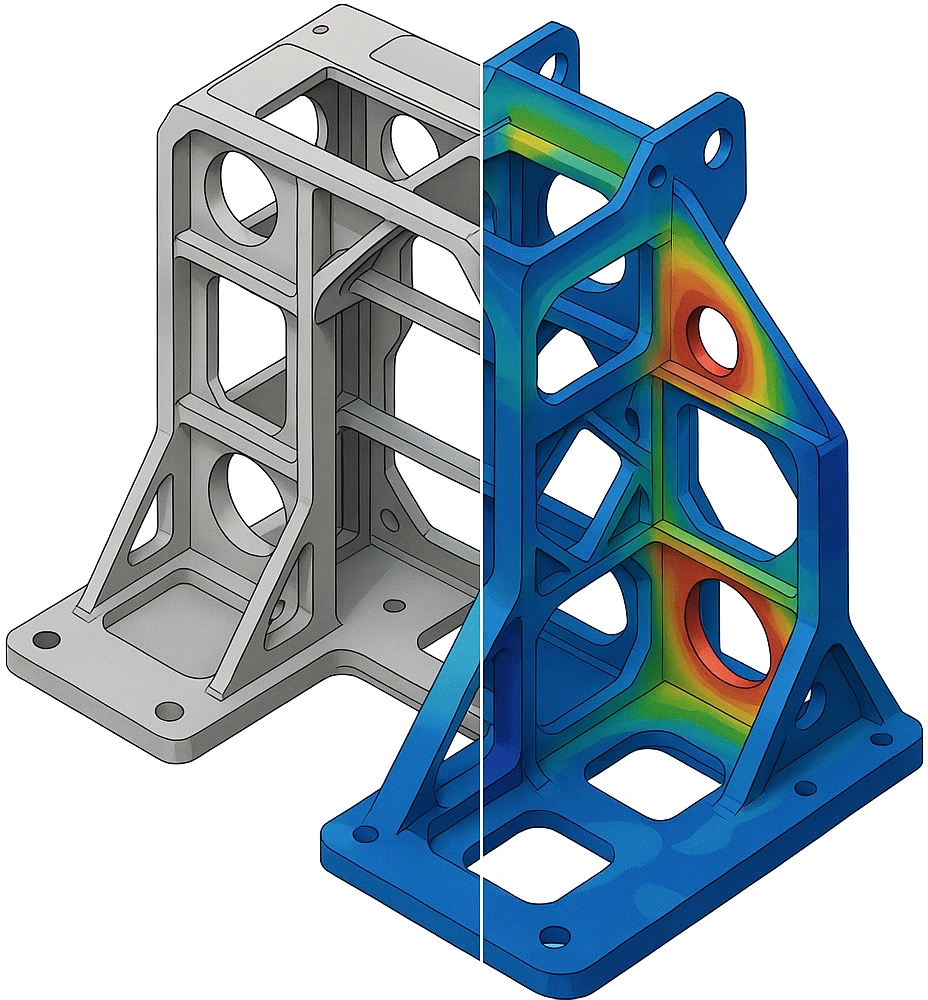
Traditional “build-and-break” prototyping cycles are a legacy burden. In 2026, the high costs of physical crash and durability testing can derail a project’s profitability before it reaches the assembly line. Physical sensors provide limited data points at specific locations; they often miss the root cause of a structural failure occurring millimeters away from a strain gauge. In contrast, high-fidelity automotive component simulation offers a comprehensive view of the entire stress field. This shift toward modeling and simulation allows engineers to observe internal material behavior, such as triaxial stress states and localized plastic deformation, that physical testing simply cannot capture.
High-fidelity digital twins provide granular insights into fatigue and thermal stress across the entire component geometry. This data leads directly to reduced warranty claims by identifying failure modes long before a single part is cast or stamped. Modern R&D workflows use these insights to meet tightening safety and environmental regulations. They ensure every component is optimized for both weight reduction and structural performance. You gain the ability to see exactly how a part fails, not just that it failed.
The ROI of Virtual Product Testing
Virtual validation drastically changes the financial landscape of automotive R&D. Running 100 virtual iterations costs a fraction of a single physical crash test. By identifying failure points during the CAD phase, you eliminate the need for late-stage design changes that often cost ten times more than early-stage fixes. This acceleration of the R&D timeline ensures a faster time-to-market for new components. It allows your team to explore more design variants in less time. For a deeper dive into these strategies, see our Virtual Product Testing Services: A Practical Guide to Digital Validation.
Regulatory Compliance through Digital Proof
Global standards like Euro NCAP and FMVSS increasingly recognize digital validation as part of the certification process. High-fidelity automotive component simulation provides the necessary proof of performance for complex assemblies. Professional FEA reports offer audit-ready documentation that maintains strict traceability from original CAD geometry to final results. This level of precision is critical for adhering to ISO 26262:2018 functional safety requirements. It ensures your documentation is robust, transparent, and ready for any regulatory audit. You don’t just guess at compliance; you prove it with data-backed validation.
Structural Integrity and Durability Simulation Examples
Validating the structural integrity of safety-critical parts requires more than simple linear calculations. High-fidelity automotive component simulation allows engineers to predict how chassis components behave under extreme, nonlinear loading conditions. Beyond simple stress checks, modern validation involves complex interactions between assemblies. Modal analysis helps eliminate NVH issues in cabin structures by identifying resonant frequencies early. Similarly, bolted joint analysis ensures that heavy-duty components don’t experience fastener fatigue or loosening under operational vibration. These simulations provide the technical certainty needed to sign off on a design before physical tooling begins.
Precision is the baseline for German engineering. By simulating these interactions digitally, you avoid the expensive realization that a suspension mount vibrates at the same frequency as the engine at cruising speeds. This proactive approach saves months of redesign work and ensures that every component is optimized for its specific duty cycle.
Nonlinear Analysis for Impact and Crash
Chassis components must absorb energy efficiently during a collision to protect passengers. Standard linear FEA can’t accurately model the plastic deformation and material failure that occur during high-velocity impacts. Nonlinear analysis simulates the folding of crush zones and the propagation of cracks in safety-critical parts. It accounts for strain-rate sensitivity and complex contact conditions between collapsing members. Using these advanced models ensures your design meets strict energy absorption targets without adding unnecessary weight. For a deeper technical breakdown, explore our Structural FEA: The Modern Engineer’s Guide to Stress and Failure Prediction.
Durability and Fatigue Life Prediction
Predicting the lifespan of suspension systems and powertrain mounts is essential to avoid premature field failures. Components undergo millions of dynamic load cycles; a single peak stress value doesn’t tell the whole story. Fatigue simulation calculates the cumulative damage over time, predicting exactly when and where a part will fail. In high-temperature environments, such as engine compartments, thermal stress analysis is integrated to account for the combined effects of heat and mechanical vibration. This holistic approach identifies potential failure points that traditional testing might miss. You can access our Fatigue Life Prediction Service: A Technical Guide to Durability Validation to see how we handle these complex cycles. If you’re ready to validate your own designs, our platform provides instant quoting for automotive FEA to get your project moving immediately.
Thermal Management and Aerodynamic Performance
Thermal performance is often the primary bottleneck in modern EV development. While structural integrity ensures safety, thermal management determines range and charging speed. High-fidelity automotive component simulation enables Conjugate Heat Transfer (CHT) analysis, allowing engineers to solve for fluid flow and solid-state conduction in a single model. This level of precision is mandatory for validating cooling plates where temperature gradients are steep and tolerances are narrow. It’s the only way to account for the complex interactions between high-voltage components and active cooling circuits in real-world duty cycles.
Optimizing Battery Cooling Systems
Battery trays present a unique fluid dynamics challenge. Coolant must navigate complex manifolds with minimal pressure drop while ensuring cell-to-cell temperature variations stay within a narrow target window. High-fidelity simulation identifies stagnant zones and hotspots that physical sensors might miss. Key focus areas include:
- Manifold Balancing: Ensuring equal flow distribution across all parallel cooling channels to prevent uneven cell aging.
- Pressure Drop Mitigation: Reducing parasitic pump losses to maximize overall vehicle efficiency.
- Interface Resistance: Modeling the thermal contact between cells and cooling plates accurately to ensure predictable heat rejection.
By optimizing the internal geometry of cooling plates, you can ensure uniform heat rejection and extend the overall life of the battery pack. Our CFD Simulation: The Definitive Guide to Optimizing Fluid and Gas Dynamics provides a deeper look at these optimization techniques.
External Aerodynamics for Efficiency
Aerodynamic efficiency is the most cost-effective way to increase EV range. High-fidelity CFD models capture the intricate turbulence around rotating wheel wells and the complex wake structures behind the rear diffuser. This data allows for the optimization of underbody airflow, which can significantly reduce the overall drag coefficient. Relying on digital validation instead of early-stage wind tunnel testing slashes R&D costs and speeds up the design freeze. It provides a granular look at air pressure distribution that helps refine body panels for maximum efficiency without compromising cooling intake requirements.
Internal flow analysis is critical for HVAC systems and engine cooling modules. Engineers must balance passenger comfort with the energy demands of the climate control system. Beyond comfort, high-fidelity modeling is the only safe way to simulate thermal runaway scenarios. It allows you to validate the effectiveness of thermal barriers and venting systems under catastrophic conditions without the risks of physical fire testing. Applying German engineering standards to these complex fluid problems ensures your automotive component simulation strategy is both efficient and safe. Our on-demand model removes the burden of software licensing, providing expert-level CFD results exactly when your project timeline requires them.

Criteria for High-Fidelity Automotive Simulation
High-fidelity automotive component simulation requires rigorous mathematical foundations. It’s not enough to run a simulation; you must prove its reliability through mesh convergence and sensitivity analysis. This process ensures that the results aren’t dependent on the element size or type. Accuracy also hinges on material model selection. Moving beyond linear elastic assumptions to complex hyperelastic or elastoplastic models is necessary for components like seals, gaskets, and energy-absorbing structures.
Boundary conditions must replicate real-world mounting and loading with clinical precision. If the constraints don’t mirror the physical assembly, the stress distribution will be fundamentally flawed. Validation and Verification (V&V) protocols provide the final layer of certainty. These protocols ensure a tight correlation between digital predictions and physical benchmarks, satisfying both internal quality standards and external regulatory bodies. Precision in these early stages prevents expensive failures during late-stage physical testing.
Selecting the Right Physics and Solvers
Choosing the correct solver is a strategic decision based on the event duration and complexity. Explicit solvers are the standard for high-velocity, short-duration automotive events like crash tests. Implicit solvers, however, excel in long-duration durability and vibration analysis. Many modern problems are multi-domain, requiring a synchronized approach to handle interacting physical phenomena. You can learn more about this in our Coupled-Field Analysis Services: A Technical Guide to Multiphysics Simulation.
The Human Element: Expert Interpretation
Software doesn’t solve problems; engineers do. Automated results are prone to the “garbage in, garbage out” trap, especially in complex automotive assemblies with non-obvious contact interactions. Every automotive component simulation at FiniteNow is validated by experienced German engineers who understand the underlying physics. Professional peer review ensures that every report is technically sound and actionable. This human oversight is the difference between a colorful image and a validated engineering decision. Ready to start? Get an instant quote for your next automotive simulation project and bypass the traditional bidding bottleneck.
Accelerating R&D with On-Demand Engineering
The technical precision of high-fidelity automotive component simulation is only valuable if it fits within your project’s timeline and budget. Traditional engineering workflows are often paralyzed by the “Request for Quote” (RFQ) cycle. Waiting weeks for a bid to clear procurement is no longer viable in 2026 automotive cycles. Modern R&D requires a shift toward simulation-as-a-service. This model treats engineering expertise as an on-demand utility. It allows your team to scale capacity instantly during peak development phases without the long-term commitment of increasing permanent headcount.
You gain access to a network of pre-qualified experts through a single, streamlined platform. This approach removes the friction of vetting individual contractors or managing multiple vendor relationships. It ensures that specialized tasks, such as battery thermal management or crash impact analysis, are handled by engineers with the specific domain expertise required for German-level precision. You don’t just get a result; you get a validated engineering conclusion.
Removing the Software Licensing Barrier
Annual software licenses represent a significant sunk cost that often remains underutilized. For many Tier 1 and Tier 2 suppliers, the overhead of hardware maintenance and license renewals outweighs the actual project value. Switching to a pay-per-project model converts these fixed costs into variable expenses. You only pay for the specific solvers and compute time your project demands. This strategic move provides access to high-end simulation tools without the six-figure entry price. Read more about this transition in our guide: Engineering Simulation Without Software Licenses: The Strategic Shift to On-Demand Expertise.
The Instant Quote Advantage
Transparency in engineering procurement is the final frontier of R&D speed. Legacy consultancies often obscure their pricing behind opaque bidding processes that take weeks to resolve. FiniteNow disrupts this by providing an instant quote system that moves your project from “concept” to “start” in minutes. This removes the bidding bottleneck and allows managers to make data-backed decisions in real-time. It’s a methodical progression that mirrors the speed of digital workflows. You can see how this accelerates your timeline here: Instant Quote Engineering Simulation: Accelerate R&D Without the Bidding Bottleneck.
By leveraging on-demand engineering, you ensure that high-fidelity validation is always available, regardless of your internal bandwidth. It’s the most efficient way to maintain technical rigor while hitting aggressive market launch dates. This agile approach ensures your automotive component simulation strategy remains a competitive advantage rather than a procurement hurdle.
Future-Proof Your Engineering Validation
High-fidelity automotive component simulation isn’t just a technical upgrade; it’s a strategic necessity for the 2026 development cycle. You’ve seen how digital twins provide granular data that physical testing misses, from crashworthiness to complex battery thermal management. By prioritizing mesh convergence and expert interpretation, you ensure your validation is both reliable and audit-ready. The transition from heavy software licensing to on-demand expertise allows your team to move faster without the burden of fixed overhead. This model ensures you have the right capacity exactly when your R&D phase peaks.
Efficiency doesn’t have to come at the expense of precision. FiniteNow delivers German-engineered results with the speed and transparency of a modern technology firm. You can bypass the traditional bidding bottleneck and secure transparent project pricing in minutes. There is no need for long-term contracts or expensive licensing fees to access high-level engineering physics. It’s time to replace costly physical iterations with data-driven certainty and streamlined procurement.
Get an Instant Quote for Your Automotive Simulation Project and take control of your engineering timeline today. Your next design milestone is closer than you think.
Frequently Asked Questions
How accurate is automotive component simulation compared to physical testing?
High-fidelity simulations achieve high correlation with physical tests when using accurate material models and boundary conditions. Digital twins capture granular data points across the entire geometry, whereas physical sensors are limited to specific locations. This allows for a more comprehensive understanding of failure modes. FiniteNow’s German-based engineers ensure results meet strict validation standards, providing a reliable digital alternative to traditional “build-and-break” cycles that often miss root causes.
What types of automotive components can be simulated using FEA?
FEA applies to a wide range of structural parts including chassis frames, suspension mounts, and battery trays. It’s essential for validating crashworthiness in energy-absorbing structures and predicting the fatigue life of powertrain components under dynamic loads. We also use automotive component simulation for bolted joint analysis and NVH reduction in cabin assemblies. This ensures every part meets durability requirements before you invest in expensive physical tooling and manufacturing.
Can simulation help reduce the weight of automotive parts?
Yes, simulation is a primary tool for mass optimization and lightweighting. By identifying low-stress areas through topology optimization, engineers can remove unnecessary material without compromising structural integrity. This is particularly critical for electric vehicles where every gram saved translates to increased range. Our high-fidelity models allow you to push the limits of material efficiency while maintaining safety factors and complying with global automotive standards for strength and durability.
How long does a typical automotive component simulation project take?
Project timelines vary based on complexity, but our on-demand model is designed for speed. Simple linear static analyses might be completed in a few days, while complex nonlinear crash or multiphysics thermal projects take longer. FiniteNow removes the bidding bottleneck with an instant quote system, allowing work to start immediately. This streamlined workflow is significantly faster than traditional engineering consultancies that require weeks for initial project scoping and contract negotiations.
What data is required to start an automotive CFD or FEA project?
You need to provide 3D CAD geometry in standard formats like STEP or IGES, along with detailed material specifications. Defining the operational environment is equally important; this includes mounting points, load cases, and thermal boundary conditions. For CFD, we require flow rates, fluid properties, and temperature ranges. Clear performance targets or safety standards help our German-based team align the simulation with your specific validation goals and regulatory requirements.
How does on-demand simulation save money compared to internal software licensing?
On-demand simulation converts fixed software costs into variable project expenses. Annual licenses for high-end solvers involve significant overhead for maintenance, hardware, and specialized training. By using FiniteNow, you eliminate these licensing fees and only pay for the specific compute time and expertise required for your current R&D phase. This model allows you to scale engineering capacity instantly without increasing permanent headcount or investing in depreciating IT infrastructure and software maintenance.
Is simulation data secure when using an on-demand platform like FiniteNow?
Security is a core priority for our professional engineering workflow. All project data is handled through secure, encrypted channels to protect your intellectual property. Our German-based team and pre-qualified suppliers adhere to strict non-disclosure agreements and data protection standards. This ensures that sensitive CAD files and performance results remain confidential throughout the validation process. You maintain full ownership of all simulation data and reports generated on our platform during every project.
What standards (like ISO or SAE) do your automotive simulations follow?
Our automotive component simulation workflows align with global industry standards including ISO 26262:2018 for functional safety. We also follow specific SAE guidelines and regulatory requirements such as Euro NCAP and FMVSS for crash and impact validation. Every report is structured to be audit-ready, providing the technical traceability required for formal certification. This ensures your digital validation results are recognized by regulatory bodies and internal quality management systems during the design sign-off.
Simulation Work Reinvented