


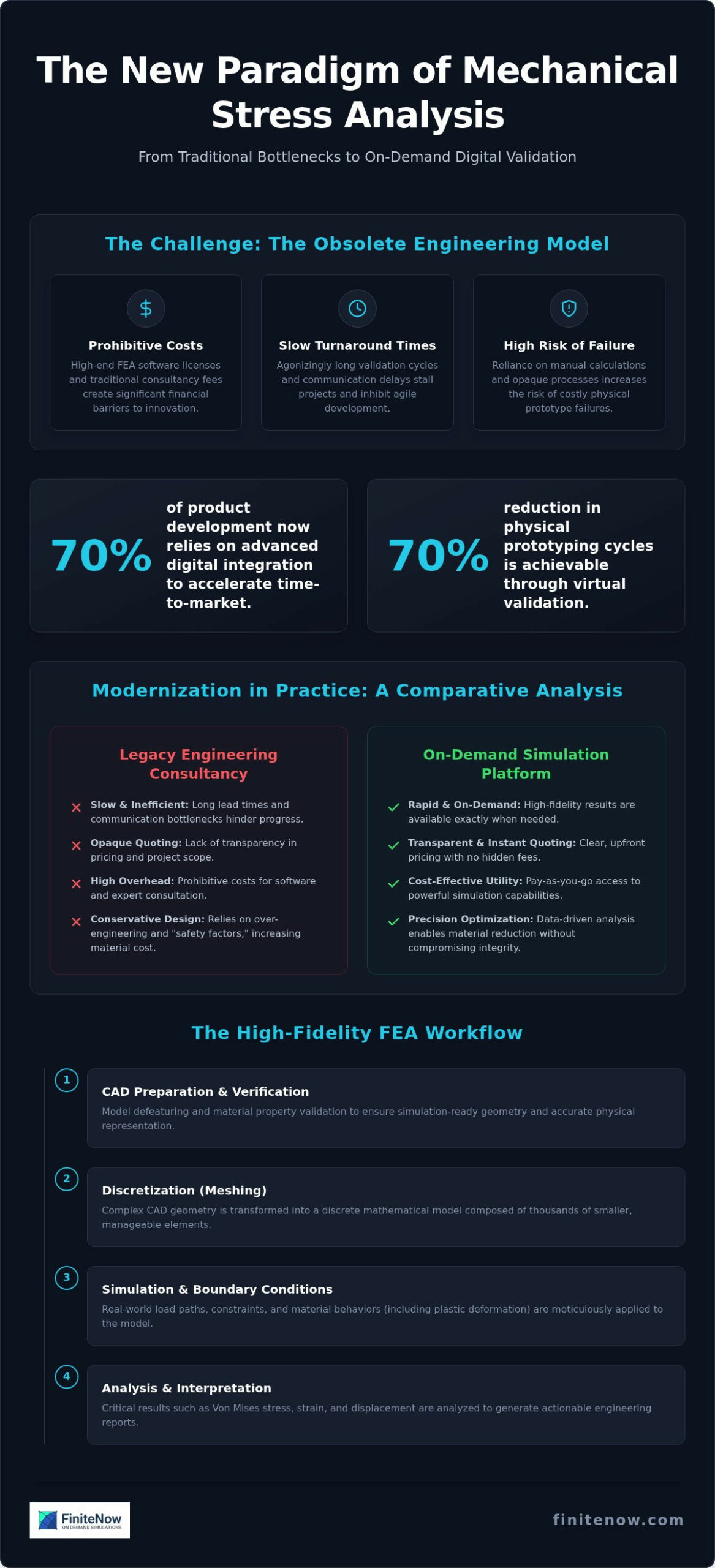
The traditional engineering consultancy model is officially obsolete. For years, R&D teams have been forced to choose between the prohibitive costs of high-end FEA licenses or the agonizingly slow turnaround times of legacy firms. You’ve likely experienced the lack of transparency in the quoting process or the looming risk of a physical prototype failure because the validation cycle took too long to complete. With over 70% of product development now relying on advanced digital integration, this friction-heavy approach simply doesn’t fit the pace of modern manufacturing.
This guide explores how a professional mechanical stress analysis service now functions as a scalable digital utility. You’ll learn how on-demand simulation replaces traditional bottlenecks with high-fidelity results and transparent, instant quoting. We’re moving beyond the “shift-left” trend to a reality where definitive proof of structural integrity is available exactly when you need it. We’ll break down how to reduce physical testing costs, secure actionable engineering reports, and leverage an expert engineering team to validate your most complex designs with precision and speed. It’s time to stop waiting for results and start engineering with confidence.
Key Takeaways
- Transition from conservative over-engineering to high-precision optimization by replacing traditional hand calculations with predictive structural modeling.
- Understand the fundamental FEA workflow, from discretizing complex parts into manageable elements to interpreting critical Von Mises stress and strain results.
- See why an on-demand mechanical stress analysis service is the faster, more transparent alternative to legacy consultancy firms and prohibitive software licensing costs.
- Learn essential CAD preparation techniques, including model defeaturing and material property verification, to guarantee actionable and high-fidelity simulation data.
- Discover how to scale your engineering capacity instantly using a streamlined digital workflow backed by expert German engineering and a global supplier network.
Beyond Hand Calculations: Why Professional Stress Analysis is Critical in 2026
Mechanical stress analysis is the predictive modeling of how structures respond to internal and external loads. It’s the difference between guessing if a part will hold and knowing exactly where it will fail. In 2026, the engineering landscape has shifted decisively away from the “safety factor” over-engineering of the past. Modern R&D demands data-driven optimization. Every extra millimetre of material adds weight, increases carbon footprints, and inflates production costs. Relying on a professional mechanical stress analysis service allows teams to trim the fat without compromising structural integrity.
The economic stakes are higher than ever. Research indicates that over 70% of modern product development cycles now rely on advanced digital integration to reduce time-to-market. By moving validation into a virtual environment, companies can reduce physical prototyping cycles by up to 70%. This isn’t just about saving money on raw materials; it’s about reclaiming months of development time that would otherwise be lost to failed lab tests and iterative redesigns.
The Limits of Manual Engineering Calculations
Hand calculations have their place in basic beam theory or initial sizing. They fall apart when faced with the complex geometries of high-performance assemblies. Manual methods often fail to capture non-linear behaviours or the intricate interactions between different materials in a single system. This creates “hidden” stress concentrations that lead to fatigue failure long before a product reaches its expected service life. A robust stress-strain analysis conducted via high-fidelity simulation reveals these invisible risks. In modern manufacturing, the safety-cost trade-off dictates that every gram of excess material is a direct hit to your bottom line.
Driving ROI through Virtual Product Testing
Virtual validation is now an economic engine for agile R&D. For medical devices and automotive components, the pressure to deliver is relentless. Utilizing a mechanical stress analysis service shortens the bridge between a CAD concept and a market-ready product. It provides the rigorous data needed to satisfy regulatory standards like ISO 26262 for automotive safety or ASME codes for pressure vessels. Beyond compliance, virtual testing acts as an insurance policy against the catastrophic costs of product recalls. It’s a methodical process that replaces physical risk with digital certainty, ensuring that your first physical prototype is also your final one.
The Mechanics of High-Fidelity Mechanical Stress Analysis
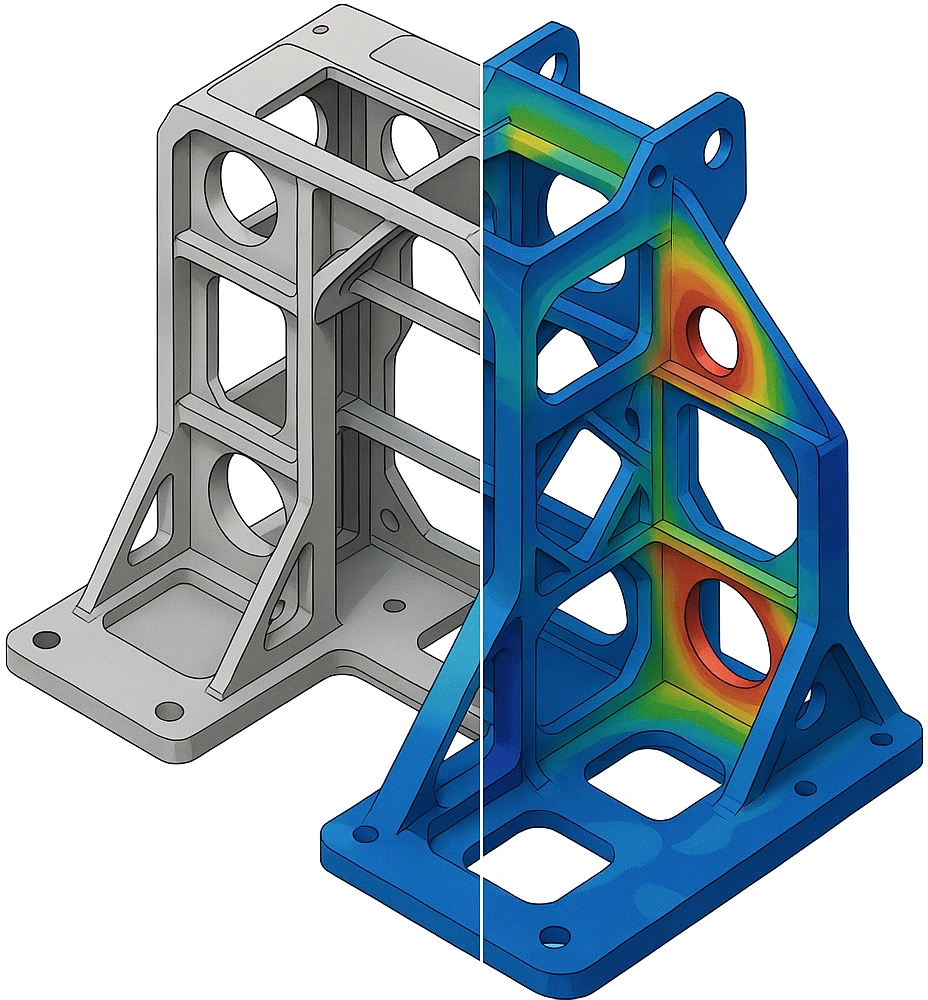
High-fidelity simulation isn’t just about pretty color plots. It’s about precision. A modern mechanical stress analysis service transforms continuous CAD geometry into a discrete mathematical model. This process, known as discretization, breaks complex parts into thousands of smaller elements. By solving the governing equations for each element, engineers map the distribution of forces across an entire assembly. This level of professional stress analysis ensures that every bolt hole and fillet is scrutinized for potential failure.
Understanding the results requires looking beyond simple force. Von Mises stress is the industry standard for predicting material yield in ductile metals. It combines multi-axial stresses into a single scalar value that you can compare directly against material yield strength. We also track displacement to ensure moving parts don’t interfere; we monitor strain to identify local deformation. Relying on a mechanical stress analysis service ensures your data reflects real-world physics, not just theoretical ideals. If you’re unsure which analysis type fits your project, our on-demand simulation platform provides immediate access to expert guidance.
Accuracy depends entirely on boundary conditions. If you don’t replicate real-world load paths and constraints perfectly, the results are worthless. Modern material modeling also accounts for plastic deformation. We don’t just assume materials stay linear. We model how they behave once they pass their elastic limit to reflect true physical performance under extreme conditions.
Static vs. Dynamic Stress Analysis
Static analysis handles steady-state loads. It’s the baseline for structural integrity. Dynamic analysis is different. It accounts for time-varying forces like vibration and impact. If your part experiences periodic loading, modal analysis identifies natural frequencies to prevent resonance. This helps you avoid structural “shaking” that leads to rapid degradation and ensures your design remains stable under its specific operational environment.
Non-linear and Fatigue Life Prediction
Linear assumptions fail when parts undergo large deflections or involve complex contact friction. Non-linear analysis captures these real-world complexities by updating the stiffness matrix during the simulation. Fatigue life prediction is equally vital. It calculates how many cycles a part survives before crack initiation. Fatigue analysis identifies microscopic crack initiation points that would otherwise remain hidden until a catastrophic field failure occurs. For a deeper technical foundation on these methods, our guide to structural FEA stress and failure prediction covers the full spectrum from nonlinear material modeling to advanced failure criteria.
Traditional Engineering Firms vs. On-Demand Simulation Platforms
The “Consultancy Bottleneck” is a project killer. Manual quoting and long lead times from legacy firms don’t align with the speed of modern manufacturing. A professional mechanical stress analysis service should feel like a digital utility, not a bureaucratic hurdle. Traditional firms often rely on a generalist staff that handles everything from civil engineering to basic CAD. This lack of specialization leads to slower results and a higher risk of error. Modern on-demand platforms solve this by utilizing specialized global engineering networks and automated workflows that prioritize speed and technical precision.
Cost structures represent another major divide. Legacy consultancies typically bill by the hour, creating a financial “black box” where final costs are difficult to predict. These firms must also charge premium rates to cover massive software overhead and underutilized personnel. In contrast, project-based, transparent fees allow for better budget predictability. This shift enables high-volume iterative design cycles that were previously cost-prohibitive for many engineering teams. You get the results you need without paying for a consultancy’s empty office space or idle workstations.
The Hidden Costs of In-House Simulation
In-house FEA isn’t just about the software. It’s the “Hardware + Software + Personnel” triad. High-end workstations and annual Finite Element Analysis licenses are significant investments that often sit idle. Maintaining expert-level proficiency is even harder. If your team only runs simulations once a quarter, they won’t master the nuances of complex contact physics or non-linear material models. Simulation-as-a-Service provides this high-level expertise without the permanent overhead of a full-time simulation department.
Transparency and Speed in the Quoting Process
Instant quoting transforms project bidding. It allows you to plan R&D cycles with precision. FiniteNow removes the administrative friction of engineering pricing by providing immediate, data-driven costs. This transparency reduces procurement delays and allows project managers to secure approvals in minutes rather than weeks. By utilizing a mechanical stress analysis service with a streamlined digital interface, you ensure that technical validation keeps pace with your design iterations. You don’t just get a report; you get a competitive advantage in time-to-market.
Preparing Your CAD Data for Professional FEA Simulation
High-fidelity simulation starts in the CAD environment. A raw manufacturing model is rarely simulation-ready. To get the most out of a mechanical stress analysis service, you must bridge the gap between design and validation. This preparation isn’t just about aesthetics; it’s about numerical stability and computational efficiency. An analyst needs a model that represents physical reality without the mathematical noise of production-level detail. Preparing your files correctly ensures that the simulation focuses on structural performance rather than fixing geometry errors.
- Step 1: Defeature the model. Remove non-structural features like embossed logos, small aesthetic fillets, and cosmetic threads. These details force the solver to create a dense mesh in irrelevant areas, slowing down the analysis without improving structural accuracy.
- Step 2: Define material properties. Ensure your Young’s Modulus and Poisson’s ratio are correct for your specific alloy or composite. Generic “Steel” isn’t enough for high-precision work; you need data that reflects your actual bill of materials.
- Step 3: Identify critical load cases. Determine your worst-case scenarios. Are you testing for peak impact, static weight, or fatigue over time? Clear load paths are essential for valid results.
- Step 4: Specify required outputs. Define exactly what you need in the final report. This might include Von Mises stress plots, safety factor distributions, or specific deformation maps to guide your next design iteration.
CAD Optimization for Mesh Quality
Clean geometry is the backbone of accurate FEA. When you submit a file to a mechanical stress analysis service, the analyst must first mesh the geometry. Slivers, overlapping faces, and gaps lead to mesh failure or poor convergence. For assemblies, simplify bolted joints into rigid or beam connections unless the bolt stress itself is the primary focus. Mesh density is always a trade-off. While a finer mesh increases local accuracy, it also drives up computational time and cost.
Communicating Design Intent to the Analyst
Clear communication prevents “garbage in, garbage out” scenarios. You must define clear pass/fail criteria for your project. If a part cannot deflect more than 0.5mm or must maintain a safety factor of 2.0, state that explicitly. Document all boundary conditions and load magnitudes clearly to avoid assumptions. To ensure your model is ready for the solver, review our High-Fidelity FEA Checklist before submission. This proactive step ensures your project kicks off without administrative delays.
FiniteNow: Fast, Transparent, and Scalable Stress Analysis Services
Most engineering firms hide behind “Contact for Quote” forms that take 48 hours or more to process. This delay kills project momentum and stalls R&D cycles. FiniteNow disrupts this legacy model by providing a professional mechanical stress analysis service built on speed and technical mastery. We combine a specialized German-based engineering team with a global network of pre-qualified suppliers. This hybrid approach ensures you get high-fidelity FEA results without the administrative friction or the high overhead of traditional consultancies.
Scaling your engineering capacity shouldn’t require expensive software licenses or restrictive long-term contracts. We offer project-based simulation that fits your specific needs, whether you’re validating a single part or an entire assembly. Your intellectual property is protected through secure, pre-qualified workflows; we treat data confidentiality with the same clinical precision we apply to our structural simulations. You don’t pay for a firm’s idle workstations or office space. You pay for results.
Our Process: From CAD Upload to Expert Results
FiniteNow simplifies complex engineering through a streamlined digital interface. Our three-step workflow removes the “black box” of professional simulation and puts control back in your hands. This methodical process ensures consistency across every project:
- Upload CAD: Submit your data through our secure, encrypted platform.
- Instant Quote: Receive a transparent, data-driven cost in minutes, not days.
- Collaborate: Work directly with German-based engineers to finalize your analysis.
Real-time project tracking keeps you informed at every stage of the validation cycle. You aren’t just a ticket in a queue; you’re a partner in a high-performance workflow. Our standardized, high-quality reporting is ready for stakeholders and regulators, providing the definitive proof of structural integrity needed for project sign-off.
Specialized Domains: From Biomechanics to Automotive
We handle more than basic structural checks. Our expertise covers specialized domains including biomechanics, where we simulate stent fatigue life with extreme accuracy to meet medical safety standards. We manage electronics cooling through advanced thermal analysis and optimize industrial machinery for long-term durability under harsh operational conditions. By leveraging custom simulation workflows, we solve unique physics challenges that generalist firms often overlook. Whether you’re in the medical device sector or high-performance automotive manufacturing, we provide the data-driven validation your project requires. Get an instant quote for your stress analysis project now and experience the efficiency of a modern mechanical stress analysis service.
Future-Proof Your Design Validation
The engineering landscape has evolved beyond the limitations of manual calculations and the friction of legacy consulting. By integrating a professional mechanical stress analysis service into your workflow, you replace guesswork with high-fidelity validation. You now have the tools to prepare your CAD data effectively and interpret the complex physics required for structural integrity. It’s time to leverage these insights to accelerate your product development cycles and significantly reduce physical prototyping risks.
FiniteNow offers a modern alternative to the traditional consultancy bottleneck. Our German-based engineering team provides the technical precision you demand without the burden of expensive software licenses or long-term contracts. We prioritize transparency through instant project pricing and real-time tracking, ensuring your validation stays on schedule and within budget. Don’t let slow turnaround times or opaque quoting hold your innovation back. Get an Instant Quote for Your Stress Analysis Project to secure definitive proof of your design’s performance today. Your next breakthrough is just one simulation away.
Frequently Asked Questions
How much does a professional mechanical stress analysis service cost?
Project costs depend on model complexity, the number of load cases, and the required deliverables. A basic evaluation of a single part differs from a comprehensive assessment of a multi-component assembly. Providing a 3D model and a clear scope of work allows for a precise, data-driven quote. This ensures you only pay for the specific engineering expertise your project requires without hidden consultancy overhead.
What file formats are required for an FEA stress analysis?
We recommend using neutral CAD formats such as STEP (.stp), IGES (.igs), or Parasolid (.x_t) for your mechanical stress analysis service. These formats maintain geometry precision during the transfer between your design software and our simulation environment. Using clean, neutral files prevents geometry slivers and overlapping faces that can lead to mesh errors or computational delays during the discretization process.
How long does it typically take to receive a stress analysis report?
Turnaround times vary based on the technical scope and the complexity of the simulation. Our instant quoting system removes the administrative delays common in traditional firms, allowing projects to kick off in minutes. Most standard structural reports are delivered within a few business days. Complex studies involving non-linear physics or large assemblies may require more extensive computational time to ensure accuracy.
Can you perform stress analysis on complex assemblies with moving parts?
Yes, we can simulate complex assemblies with moving parts using advanced contact modeling and kinematic constraints. This process identifies stress concentrations at joints, pins, and sliding interfaces. By replicating the real-world interactions between components, we provide a complete picture of how your entire system responds to operational loads and motion, ensuring that no hidden failure points remain in your design.
Is on-demand simulation as accurate as traditional engineering consulting?
On-demand simulation matches the accuracy of traditional consulting because it utilizes the same industry-standard solvers and expert oversight. The modern approach simply removes the overhead and administrative friction found in legacy firms. Our German-based engineering team applies rigorous validation protocols to ensure every result is technically sound, reliable, and ready for use in high-stakes production environments.
Do you provide certification-ready reports for regulatory bodies like the FDA or FAA?
We provide high-fidelity reports designed to satisfy the documentation requirements of regulatory bodies like the FDA, FAA, or ASME. These reports include detailed descriptions of boundary conditions, material properties, and mesh convergence studies. This level of technical transparency ensures your mechanical stress analysis service supports a smooth path toward certification and provides stakeholders with definitive proof of structural integrity.
What is the difference between linear and non-linear stress analysis?
Linear analysis assumes that materials stay within their elastic limit and deflections remain small relative to the part size. Non-linear analysis is necessary when parts undergo large deformations, involve complex contact friction, or use materials that experience plastic deformation. Choosing non-linear modeling provides a more realistic representation of how a part behaves under extreme loads or when reaching its physical failure point.
How do you ensure the confidentiality of my engineering designs?
We protect your intellectual property through a secure, encrypted digital workflow and strict non-disclosure protocols. Our global network consists of pre-qualified suppliers who must meet rigorous security standards before handling any client data. This methodical approach ensures your engineering designs and proprietary data remain confidential throughout the entire simulation process, giving you the confidence to innovate without risk.
Simulation Work Reinvented