

Your linear simulation is likely telling you a polite fiction that will eventually cost thousands in failed physical prototypes. While linear models are fast, they consistently under-predict failure in complex assemblies where materials yield or components interact. If you’ve ever seen a test rig snap while your software showed green, you’ve experienced the gap between theory and reality. Relying on professional nonlinear structural analysis services is the only way to bridge that divide with absolute precision.
You already know that traditional engineering firms move too slowly and internal expertise for hyperelastic or contact modeling is often out of reach. We’re here to change that. This article shows how high-fidelity nonlinear analysis eliminates the friction of physical iterations by providing the technical mastery needed for complex validation. We’ll break down the mechanics of plastic deformation, explain how to validate intricate contact interfaces, and demonstrate how virtual testing delivers a professional FEA report ready for stakeholder approval. It is time to stop guessing and start validating with a modern, results-oriented approach to structural integrity.
Key Takeaways
- Identify why linear models fail to predict real-world stress and how nonlinear analysis captures the non-proportional relationship between load and response.
- Master the technical pillars of structural behavior, including geometric instability and material plasticity, to ensure your designs survive extreme conditions.
- Slash development costs by replacing multiple physical prototype iterations with high-fidelity digital twins and virtual testing environments.
- Access specialized expertise through on-demand nonlinear structural analysis services to bypass the high costs of software licensing and legacy consulting delays.
- Optimize your project workflow with strategic CAD preparation and clear objective-setting to achieve faster solver convergence and stakeholder approval.
Beyond Linear Limits: Why Real-World Structures Demand Nonlinear Analysis
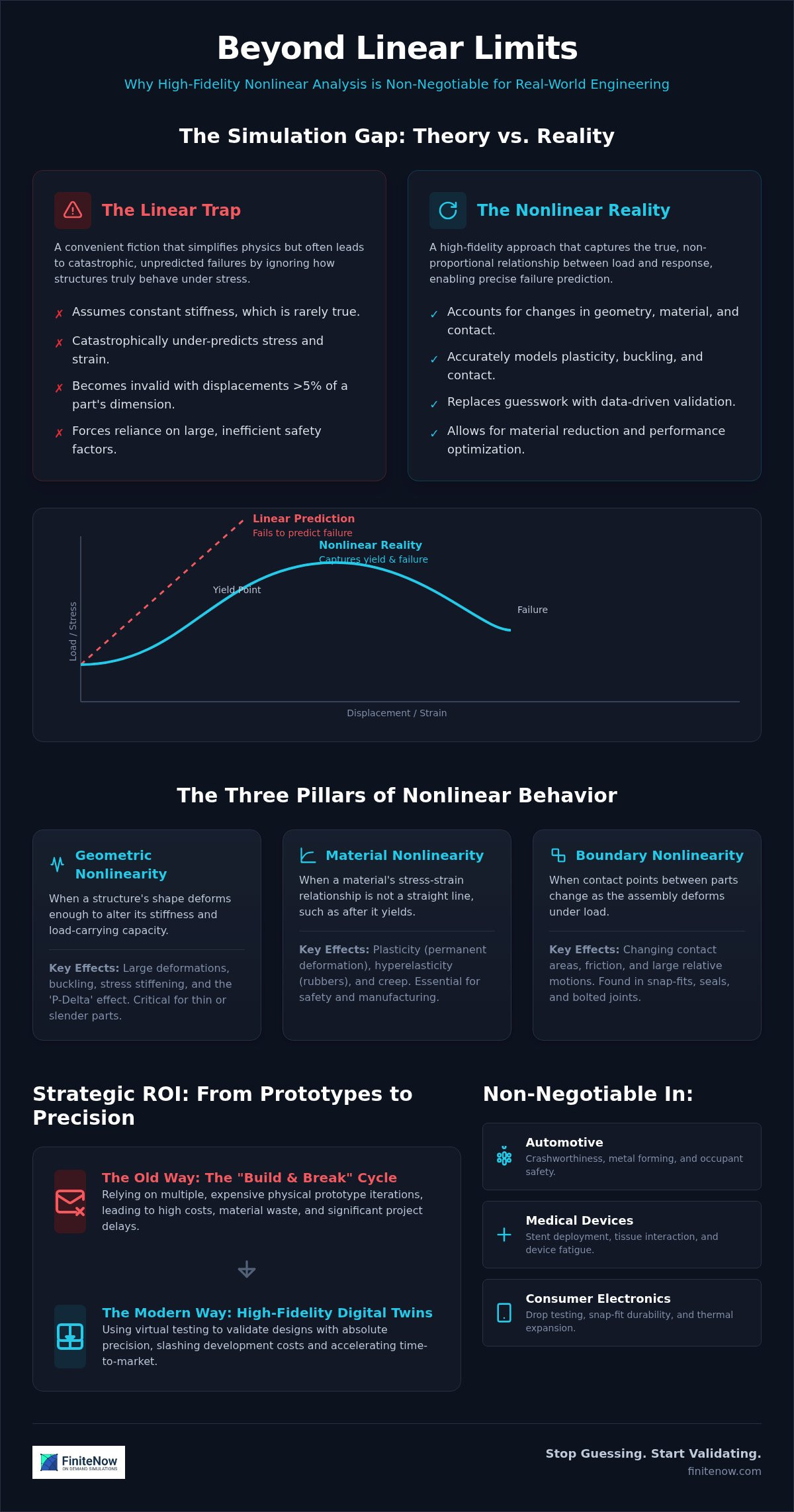
Linear elastic analysis is a convenient fiction. It assumes that materials return to their original shape perfectly and that stiffness remains constant regardless of the load. In the real world, physics isn’t that cooperative. Nonlinear structural analysis is the study of systems where the relationship between load and response is non-proportional. When you push a structure beyond its comfort zone, its geometry shifts, its material properties evolve, and its contact points change. Professional nonlinear structural analysis services capture these shifts, ensuring your digital model doesn’t just look good in a presentation but actually survives the test rig.
The “Linear Trap” is a common pitfall in traditional engineering. By assuming constant stiffness, engineers often catastrophically under-predict stress levels. This happens because linear solvers don’t account for the way a structure’s resistance changes as it deforms. A critical threshold exists: once displacements exceed 5% of a component’s characteristic dimension, linear assumptions are no longer valid. At this point, you aren’t just looking at a minor discrepancy; you’re looking at a fundamental failure of the simulation to represent reality. High-fidelity validation often requires Geometrically and materially nonlinear analysis with imperfections included (GMNIA) to account for the real-world imperfections that always exist in physical parts.
This shift moves the engineering process from relying on vague, theoretical safety factors to precise failure prediction. Instead of adding weight to cover for uncertainty, you use data to locate exactly where and when a part will yield. It’s a transition from guessing how much “extra” material you need to knowing exactly how the structure will behave under duress. Nonlinear analysis is the bridge between CAD and physical reality.
The Cost of Oversimplification in Modern R&D
Oversimplifying physics leads to two expensive outcomes: over-engineered products that are too heavy or under-engineered products that are unsafe. Legacy consulting firms often lean on linear models because they’re easier to run, but this forces you to use massive safety factors that kill your competitive edge. Modern R&D demands high-fidelity FEA to reduce these margins without increasing risk. By simulating the true nonlinear response, you can shave off excess material and optimize for performance, not just survival. It’s about engineering with confidence rather than caution.
Industries Where Nonlinearity is Non-Negotiable
- Automotive: Validating crashworthiness and complex sheet metal forming processes requires simulating massive plastic strain and rapid contact changes.
- Medical Devices: Designing stents involves managing fatigue and hyperelastic tissue interactions that linear models simply can’t process.
- Consumer Electronics: Drop testing and snap-fit assemblies rely on transient nonlinear events where geometry and contact interfaces shift in milliseconds.
The Three Pillars of Nonlinear Structural Behavior
Understanding nonlinear physics requires a structured framework. Most engineering failures aren’t caused by a single factor, but by the intersection of three distinct pillars: geometry, material, and boundaries. When you utilize nonlinear structural analysis services, you aren’t just running a simulation; you’re accounting for the reality that stiffness is a moving target throughout the loading cycle.
Geometric Nonlinearity and Large Deformations
When a structure’s shape changes enough to alter its load-carrying capacity, you’ve entered the realm of geometric nonlinearity. This is critical for thin-walled structures or long, slender beams where the ‘P-Delta’ effect takes hold. In these scenarios, secondary moments caused by initial deflections can lead to sudden, catastrophic collapse or buckling. Linear models assume the load path remains constant, but nonlinear solvers track every incremental shift in the mesh to maintain equilibrium as the geometry evolves.
Material Nonlinearity: Beyond the Yield Point
Most metals follow a predictable path until they reach their yield point. Beyond that, permanent deformation (plasticity) occurs. This is non-negotiable for crash safety or metal forming simulations. For polymers and rubbers, the challenge increases. These materials require hyperelastic constitutive models, like Mooney-Rivlin or Ogden, to describe their non-proportional response accurately. Additionally, high-temperature environments introduce time-dependent behaviors like creep and stress relaxation. Even early research, such as NASA’s simplified nonlinear analysis method, recognized the need for specialized approaches to handle these complex material states without overwhelming computational resources.
Boundary Conditions and Contact Mechanics
Contact analysis is the most frequent cause of convergence issues in FEA. It involves “changing status” boundaries where parts move into, out of, or along each other. Modeling the friction and sliding between complex mechanical assemblies requires sophisticated algorithms to prevent node penetration or numerical instability. If your current simulations are crashing during contact initialization, our structural FEA experts can help refine your contact definitions for stable, accurate results.
In complex assemblies, these three pillars rarely act in isolation. A plastic hinge (material) might trigger a local buckle (geometric), which then forces two components into a new contact state (boundary). Capturing this cascading failure sequence is exactly why high-fidelity nonlinear structural analysis services are essential for modern R&D. You cannot validate real-world performance by looking at these factors in a vacuum.
Strategic ROI: Reducing Physical Prototypes with High-Fidelity Simulation
Physical prototyping is a financial sinkhole. Traditional R&D cycles often rely on a “build-break-repeat” loop that drains resources and delays market entry. Transitioning to high-fidelity nonlinear structural analysis services allows you to break this cycle. Data suggests that one comprehensive nonlinear simulation can replace up to three physical prototype iterations, providing a massive return on investment by identifying failure points in a digital environment before a single cent is spent on tooling.
Accuracy is the primary driver of this ROI. Linear models often miss critical behaviors like snap-through buckling or localized yielding that lead to catastrophic field failures. By simulating these extreme conditions virtually, you mitigate the risk of late-stage design changes. This approach accelerates the “fail fast” philosophy essential for agile product development. You identify the limits of your design in hours rather than weeks, allowing your team to iterate with confidence. The academic rigor found in a Nonlinear Structural Analysis course at Stanford highlights how these complex theories are now essential for modern engineering validation.
The Digital Twin Advantage in Product Lifecycle
Modern R&D is moving away from the “Design-Build-Test” model in favor of a “Design-Simulate-Build” workflow. This shift creates a digital twin that serves as a virtual testing lab for extreme conditions. These simulation reports provide the high-fidelity data needed to satisfy demanding regulatory bodies such as the FDA, EASA, or ISO. Nonlinear FEA acts as a ‘Virtual Stress Test’ for unbuildable prototypes. It allows you to explore the performance of components that are too expensive or dangerous to test physically, ensuring that the final product is both optimized and safe.
SME Accessibility: Nonlinear Analysis Without the Software Tax
Internalizing high-end FEA capabilities comes with a heavy “software tax.” Licenses for industry-standard solvers like Abaqus, Ansys, or Marc can cost tens of thousands of dollars annually, not including the specialized hardware and personnel required to run them. For many small to medium enterprises, this barrier is insurmountable. On-demand nonlinear structural analysis services provide a more efficient alternative. You gain access to a German-based engineering team and elite technical mastery without the long-term overhead of software maintenance. This pay-per-project model ensures that high-stakes validation remains scalable and transparent, allowing you to focus your budget on innovation rather than infrastructure.
Scoping Your Project: Preparing Data for Nonlinear FEA Services
Precision starts with scoping. A vague objective leads to bloated computation times and reports that fail to answer your core engineering questions. Before engaging nonlinear structural analysis services, you must define your target: are you predicting a specific failure mode, optimizing weight, or seeking regulatory compliance? This decision dictates every subsequent step, from mesh density to the selection of convergence criteria.
Geometry Optimization for Nonlinear Solvers
Nonlinear solvers are sensitive to mesh quality. Small fillets, decorative logos, and non-structural details that seem harmless in CAD often cause severe mesh distortion. This distortion leads to numerical instability and prevents the solver from reaching a solution. You must simplify your geometry through defeaturing to ensure convergence. If you want a rapid turnaround, use symmetry or anti-symmetry to reduce the model size. This allows the iterative solver to process the physics without wasting cycles on redundant geometry.
Simulation-Ready CAD Checklist:
- Remove all fillets and rounds that don’t influence the primary stress path.
- Eliminate non-structural holes, text, and fasteners.
- Extract mid-surfaces for thin-walled components to use shell elements.
- Ensure all contact interfaces are clearly defined without initial penetrations.
Material Characterization: The Input Gap
Linear analysis only requires Young’s Modulus and Poisson’s Ratio. Nonlinear analysis demands much more. You need full stress-strain curves for plasticity or hyperelastic coefficients for elastomers. Finding this data can be a hurdle. While MatWeb provides a baseline, manufacturer-specific testing is often necessary for high-stakes validation. Temperature-dependent properties are also critical if your project involves multiphysics or thermal cycles that alter material stiffness.
If your internal data is sparse, our team can help bridge the gap. We specialize in defining accurate material models that reflect real-world behavior, even in complex hyperelastic or creep scenarios. You can get an instant quote to see how our expertise streamlines the path from raw CAD to a validated FEA report.
Finally, identify your load cases with precision. This includes transient loads, assembly sequences, and thermal gradients. A nonlinear solver doesn’t just calculate a final state; it tracks the entire history of the load. If your assembly sequence is wrong, your final stress state will be too. Scoping these details upfront ensures that your investment in nonlinear structural analysis services yields actionable, high-fidelity data.
Accelerating Validation: On-Demand Nonlinear Analysis with FiniteNow
Traditional engineering firms treat nonlinear work as a bespoke mystery. They demand weeks of back-and-forth emails before providing a manual estimate that often balloons once the project starts. FiniteNow removes this friction. We provide a faster, more transparent alternative to legacy standards by offering on-demand nonlinear structural analysis services through a streamlined digital platform. Our “Simulation-as-a-Service” model means you only pay for the physics you need. There are no long-term contracts, no software licensing fees, and no hidden overhead. It’s a methodical, rapid progression designed to mirror the speed of modern R&D.
The FiniteNow Workflow: Speed Without Compromise
Validation shouldn’t be a bottleneck. Our process is built on three clear steps: Upload, Quote, and Execute. You upload your simulation-ready CAD files, receive an instant quote based on project complexity, and our team begins the high-fidelity validation immediately. We don’t just deliver raw data. We provide a standardized, professional FEA report that is ready for stakeholder approval or regulatory submission. This workflow ensures that your project moves from a digital model to a validated design with momentum and purpose. Get an instant quote for your nonlinear analysis project today to see the difference in turnaround times.
German Engineering Excellence on Demand
High-stakes physics requires technical mastery that software alone cannot provide. While our platform is digital, our expertise is human. Every project is handled by a German-based engineering team specialized in complex structural, thermal, and fluid-structure interaction (FSI). We maintain a pre-qualified supplier network to ensure that your data is processed with clinical precision. Unlike traditional firms that hide their process, we prioritize transparency. You have direct access to our experts via video calls to discuss mesh density, material assumptions, or convergence results. This human-in-the-loop approach ensures that our nonlinear structural analysis services deliver more than just a colorful plot; they deliver reliable engineering truth.
Scalability is a core advantage of our on-demand model. We handle everything from single-component plasticity checks to massive assemblies with complex contact interfaces. Whether you’re a startup looking for your first FEA report or an established OEM needing to offload overflow work, FiniteNow adapts to your project’s intellectual rigor. Join the hundreds of engineering teams moving away from the software tax and legacy consulting delays in favor of streamlined, high-fidelity validation.
Engineering for Reality: Your Path to High-Fidelity Validation
Linear models often provide a sense of security that doesn’t hold up under real-world stress. By embracing the three pillars of nonlinearity, you eliminate the gap between simulation and reality. You’ve seen how virtual stress tests reduce physical prototype iterations and identify hidden failure modes before they reach the test rig. It’s the difference between guessing your safety margin and knowing your failure point with absolute precision.
Modern R&D doesn’t have time for the friction of legacy consulting. FiniteNow provides professional nonlinear structural analysis services that bypass the high costs of software licenses and the delays of traditional quoting. You’ll gain direct access to a German-based engineering team and on-demand expert consultation through a streamlined, pay-per-project model. Our instant automated quoting system ensures your project starts with momentum, not paperwork.
Stop over-engineering out of uncertainty and start validating with data-driven precision. Get an Instant Quote for Nonlinear Structural Analysis and experience the speed of an automated, high-performance workflow. Your next breakthrough is just a simulation away.
Frequently Asked Questions
What is the difference between linear and nonlinear structural analysis?
Linear analysis assumes a proportional relationship between load and displacement, meaning stiffness remains constant throughout the simulation. Nonlinear structural analysis accounts for the reality that stiffness changes as the structure deforms. This includes geometric shifts, material yielding, and changing contact conditions. While linear models are faster, they fail to capture the complex physics of real-world assemblies under extreme loads or large deflections.
When should I choose nonlinear FEA over a standard linear simulation?
You should choose nonlinear FEA when displacements exceed 5% of the part’s characteristic dimension or when material stresses surpass the yield point. It’s also essential for projects involving gaskets, rubber seals, or complex contact interfaces between moving parts. Standard linear simulations will significantly under-predict stress and failure in these scenarios, leading to unsafe designs or expensive failures during physical prototype testing.
What material data is required for a nonlinear plastic deformation study?
A plastic deformation study requires a full true stress-strain curve beyond the material’s yield point. You must provide the yield strength, hardening behavior, and the tangent modulus. For the high-fidelity nonlinear structural analysis services we provide, manufacturer-specific data is preferred over generic database entries. If your project involves thermal cycles, temperature-dependent stress-strain data is also necessary to capture changing material stiffness accurately.
How long does a typical nonlinear structural analysis take to complete?
Turnaround times depend on model complexity and convergence stability. A single component study might take 3 to 5 business days, while a massive assembly with complex contact mechanics can take 2 weeks or more. FiniteNow uses a streamlined digital workflow to beat traditional consulting averages, providing high-fidelity reports much faster than legacy firms that rely on manual quoting and slow internal administrative processes.
Can nonlinear simulation replace physical testing for regulatory compliance?
Nonlinear simulation acts as a high-fidelity virtual validation that significantly reduces the number of physical tests required for certification. While regulatory bodies like the FDA or EASA often require a final physical “witness” test, they increasingly accept FEA reports to justify design safety and reduce the total testing scope. Using digital twins allows you to identify failure modes that physical sensors might miss during a single test run.
What are the common causes of non-convergence in nonlinear FEA projects?
Non-convergence usually stems from poor mesh quality, specifically distorted elements in high-stress zones. Rigid body motion and abrupt changes in contact status also cause numerical instability that stops the solver. If the solver can’t find equilibrium during a load step, it will fail. Expert defeaturing and incremental load stepping are essential techniques we use to ensure stable convergence in even the most complex nonlinear models.
How does FiniteNow ensure the accuracy of complex nonlinear results?
Accuracy is managed through a human-in-the-loop process led by our German-based engineering team. We conduct mesh sensitivity studies to ensure results aren’t grid-dependent and perform energy balance checks to verify solver stability. Every nonlinear structural analysis services project undergoes a peer-review process where material assumptions and boundary conditions are validated against real-world physics and the latest industry standards.
Why is nonlinear analysis more expensive than linear FEA?
Nonlinear analysis is computationally intensive because the solver must find equilibrium through multiple iterations for every load increment. It requires significantly more expert time for CAD preparation, material characterization, and contact debugging. While the upfront cost is higher than linear FEA, it’s a fraction of the cost lost to failed physical prototypes, late-stage design recalls, or catastrophic field failures.
Simulation Work Reinvented