

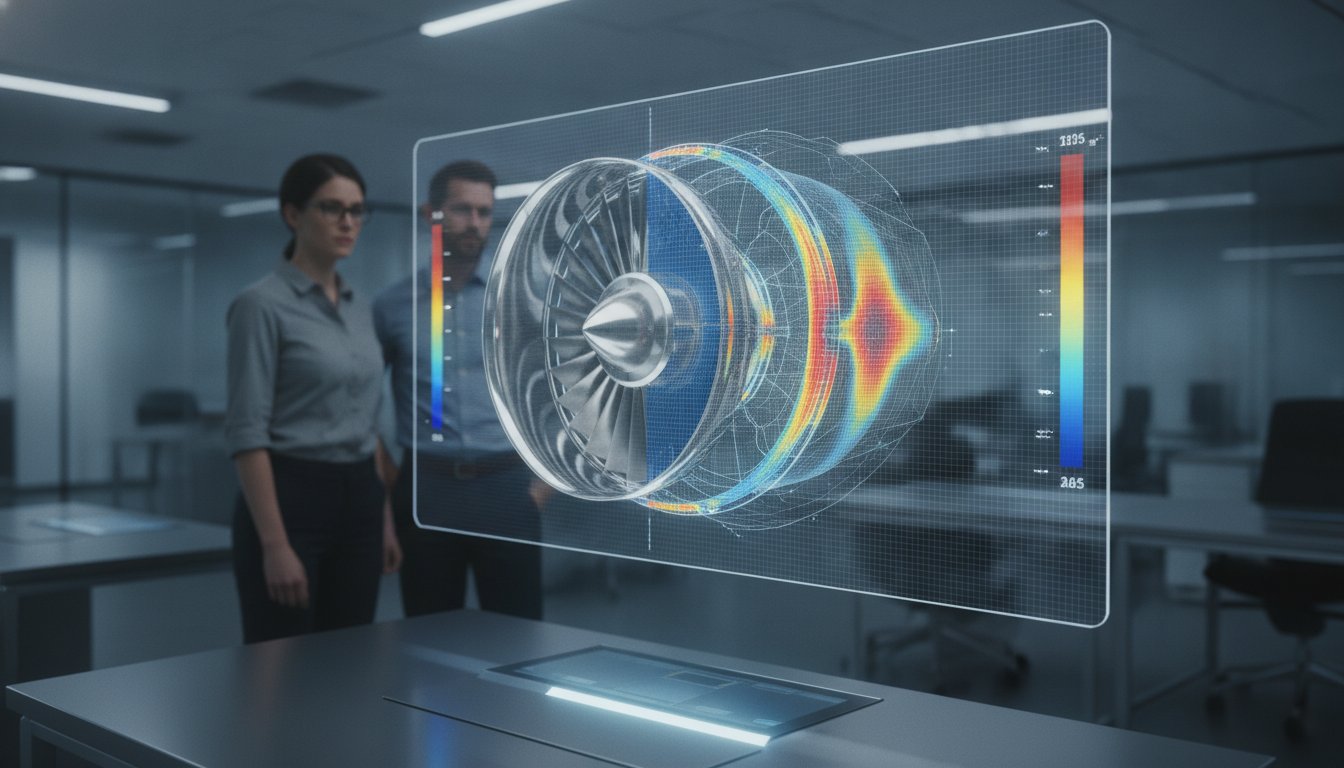
What if your “validated” simulation is actually a six-figure liability waiting to fail on the test stand? For many engineering leads, the gap between a colorful CAD-integrated plot and true structural certainty is dangerously wide. You already know that physical prototype failure is a project killer that drains budgets and destroys timelines. Relying on low-cost providers or surface-level analysis often leads to inconsistent results that can’t stand up to rigorous safety standards. To achieve a reliable digital twin, you need high-fidelity FEA services that prioritize verification and validation over mere visual output.
It’s time to move beyond the opaque pricing and slow delivery of traditional legacy firms. This article teaches you how to distinguish between basic simulations and the high-fidelity work required for test-ready designs. We provide a professional checklist to ensure your results meet benchmarks like ASME V&V 10-2019 or the latest ASME VVUQ 20.1-2024 standards. You’ll learn how to demand the transparent, German-engineered precision your product requires. We’ll examine everything from mesh convergence to uncertainty quantification to ensure your next project is grounded in data; not guesswork.
Key Takeaways
- Identify the technical requirements that separate high-fidelity FEA services from basic stress plots, including non-linear material behavior and refined mesh convergence.
- Implement a rigorous Verification and Validation framework to ensure your digital twin provides a mathematically sound and physically accurate representation of your product.
- Streamline your simulation workflow by following a five-step preparation checklist that prioritizes failure definitions and CAD optimization.
- Leverage on-demand German engineering and instant quoting to eliminate the traditional two-week wait times and heavy software licensing costs.
- Master advanced material modeling and dynamic response analysis to verify that your design meets stringent safety standards under real-world vibration and shock loads.
Beyond Basic Stress Analysis: What Defines High-Fidelity FEA Services?
Standard stress analysis is often treated as a commodity. Most CAD packages include basic simulation tools that produce colorful plots, but these results frequently lack the depth required for high-stakes engineering. Professional high-fidelity FEA services differentiate themselves by capturing real-world material behavior that linear models simply ignore. While a basic simulation might tell you if a bracket holds a static load, high-fidelity modeling accounts for the complex physics that govern actual failure modes. This involves a rigorous integration of non-linear material properties, refined mesh convergence, and precisely validated boundary conditions.
In safety-critical or high-performance applications, standard FEA often fails because it oversimplifies the environment. It assumes materials stay within their elastic limits and that joints are perfectly rigid. High-fidelity simulation serves as the backbone of a modern digital twin strategy. It provides a behaviorally accurate representation that predicts how a product will age, fatigue, and react to extreme stress. This level of detail transforms simulation from a simple design aid into a reliable predictive asset.
The Threshold of Fidelity: Mesh, Physics, and Convergence
Professional analysis relies on the Finite Element Method (FEM) to break complex geometries into manageable mathematical elements. The quality of these elements determines the reliability of your data. Mesh sensitivity analysis is the hallmark of professional work. It ensures the mathematical model remains independent of the grid density. You must capture three critical nonlinearities: geometry (large deflections), material (plasticity and hyperelasticity), and contact (complex interactions between parts). Mesh convergence is the point where further refinement no longer changes the results. Without this validation, your simulation remains an unverified estimate.
Economic Impact: High-Fidelity vs. Physical Testing
Investing in high-fidelity FEA services is a strategic move for risk mitigation. Traditional R&D cycles rely on “build and break” iterations, which are notoriously slow and expensive. High-fidelity simulation acts as a legitimate test replacement, significantly reducing the number of physical prototypes required before production. The true cost of “low-fidelity” errors is staggering. Cheap, surface-level simulations are often the most expensive because they provide a false sense of security. This leads to catastrophic failures during physical testing or, worse, after the product reaches the market. Shifting simulation from a design tool to a defensible test replacement accelerates your timeline and protects your bottom line.
The Technical Pillars of High-Fidelity Modeling
High-fidelity modeling rests on a foundation of mathematical rigor. While entry-level tools rely on linear approximations, high-fidelity FEA services utilize high-order elements to capture parabolic stress gradients. This choice prevents artificial stiffening and provides the precision needed for complex geometries. Engineering isn’t always linear. You need to account for plasticity when metals yield or hyperelasticity for polymers and elastomers. Without these models, your simulation won’t predict permanent deformation or the non-linear behavior of gaskets and seals.
Static loads rarely tell the whole story. Real-world products face vibration, sudden shock, and transient loads. High-fidelity modeling captures these time-dependent events accurately, ensuring a product survives a drop test or a decade of operational vibration. A fixed support is an idealization that rarely exists in the field. High-fidelity work uses realistic assembly constraints, modeling the stiffness of bolts and the friction of mated surfaces. If you need to validate these complex interactions, you can get an instant quote for structural analysis to see how precision boundary conditions change your results.
Nonlinear Analysis: Capturing Real-World Failure
Linear models often underestimate stress because they assume small displacements. In reality, large deformations change the load path. High-fidelity simulation accounts for material yielding and complex contact mechanics, such as friction and sliding between moving parts. This is critical for assemblies where components interact under load. By modeling the actual physics of contact, you avoid the over-conservative designs that add unnecessary weight and cost to your product. For assemblies where components yield or interact under extreme conditions, dedicated nonlinear structural analysis services provide the technical mastery needed to validate intricate contact interfaces and plastic deformation that linear solvers will consistently miss.
Multi-Physics Integration
Structural integrity doesn’t exist in a vacuum. Thermal loads often create significant internal stress through expansion and contraction. Integrating Thermal Analysis into your structural model ensures you don’t miss failures caused by temperature gradients. For aerospace and medical devices, Fluid-Structure Interaction (FSI) adds another layer of fidelity. This models how air or fluid flow deforms the surrounding structure. Capturing these interactions is essential for certifying designs that operate in extreme or high-velocity environments.
Verification and Validation: Trusting Simulation Over Physical Testing
Trust in a digital twin isn’t granted; it’s engineered through a rigorous process of Verification and Validation (V&V). While many providers deliver “results,” few offer the mathematical and physical certainty required to bypass physical testing. Verification is the process of ensuring the equations are solved correctly. It’s the proof that the math is right. Validation is the proof that the physics is right; it ensures you chose the correct equations to represent the real-world problem. Without both, your simulation is just a guess with a high price tag.
Industry leaders rely on established benchmarks to quantify this trust. The ASME V&V 10-2019 standard provides the framework for verification and validation in computational solid mechanics, while the updated ASME VVUQ 20.1-2024 defines metrics for validation in fluid dynamics and heat transfer. Professional high-fidelity FEA services don’t just follow these standards; they use them to build a legally defensible engineering asset. A high-fidelity report must include an error estimation to be considered valid. This transparency allows stakeholders to understand the margin of uncertainty before committing to production.
The German Engineering Standard for V&V
FiniteNow’s German engineering team provides the technical oversight necessary for high-stakes validation. Every model undergoes a strict internal peer review to eliminate human error and ensure compliance with international engineering codes. We don’t just run solvers; we interrogate the results against empirical data and established theory. This methodical approach ensures that every high-fidelity model we deliver meets the precision standards expected in the automotive, aerospace, and medical device sectors. It’s a faster, more transparent alternative to the opaque processes of legacy firms.
From CAD to Confidence: The Audit Trail
A reliable simulation requires a clear audit trail. Transparency is the enemy of simulation failure, so we document every assumption, from material nonlinearities to contact friction coefficients. We use sensitivity studies to identify which variables drive your design’s safety factor. By isolating these critical drivers, you gain a deeper understanding of your product’s performance limits. This structured workflow moves you from a raw CAD file to a state of total confidence, providing the data needed to justify design decisions to regulatory bodies or internal boards. We replace traditional obstacles with a streamlined, data-driven validation process that keeps your project moving at the speed of modern R&D.
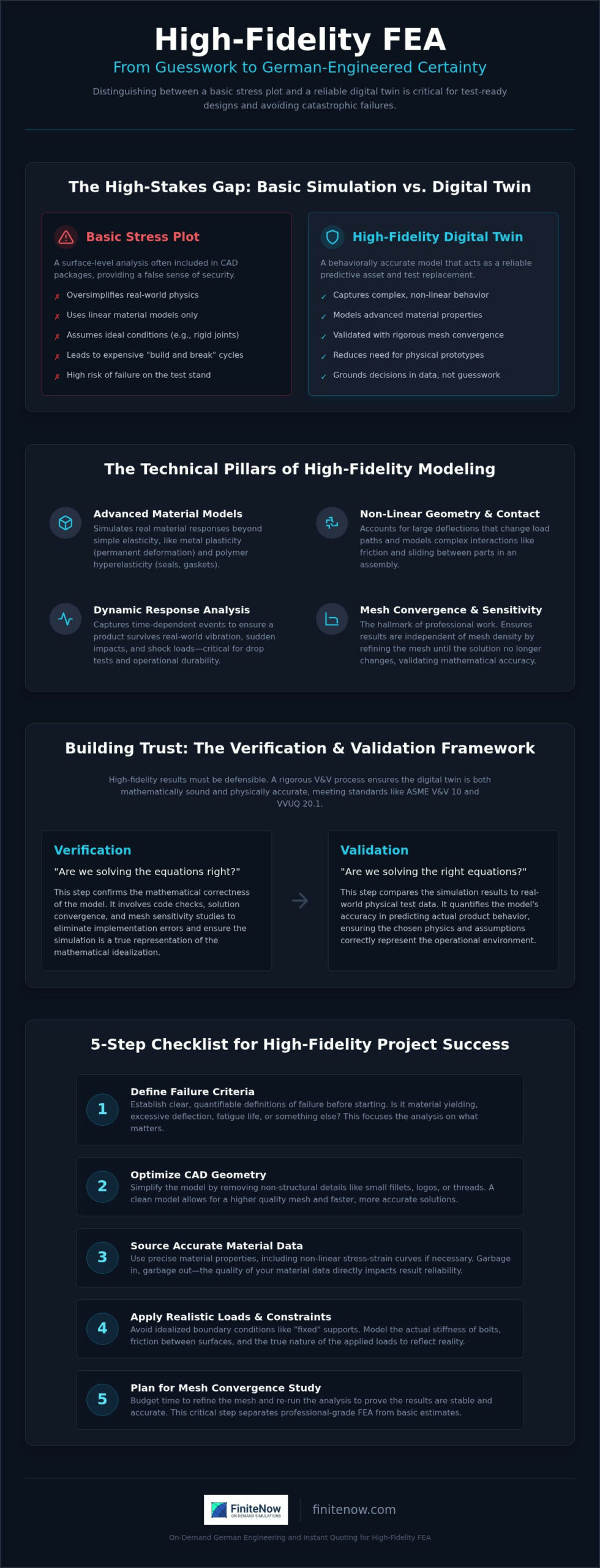
Preparation Checklist: 5 Steps to High-Fidelity Project Success
Precision in simulation starts long before you hit the “solve” button. Preparation dictates the accuracy of your results and the total efficiency of your engineering workflow. Many teams mistakenly treat high-fidelity FEA services as a magic box where raw CAD enters and truth emerges. In reality, the quality of your output is strictly capped by the quality of your inputs. Follow this five-step checklist to ensure your project is grounded in reality and test-ready.
- Step 1: Define the “Failure Definition” clearly. You must know exactly what you’re testing for. Are you looking for the first sign of yielding, a specific fatigue life, or total plastic collapse? A vague goal leads to a vague mesh and unreliable data.
- Step 2: Clean your CAD. Raw manufacturing files are often too cluttered for simulation. Remove non-structural fillets, small holes, and cosmetic features to optimize the mesh and significantly reduce solve times.
- Step 3: Source accurate material data. Don’t rely on generic library values for critical components. High-fidelity modeling requires specific stress-strain curves that capture the full range of material behavior.
- Step 4: Identify all load cases. Consider the entire operational envelope. Include “worst-case” scenarios and potential misuse cases to ensure your safety margins are robust in the field.
- Step 5: Establish acceptance criteria. Decide what numerical result constitutes a “pass” before you see the data. This prevents confirmation bias and keeps the validation process objective.
CAD Defeaturing for High-Fidelity Success
Effective simulation requires a delicate balance between geometric detail and computational efficiency. You don’t need every embossed logo or thread modeled to understand structural integrity. However, you must keep critical stress concentrators like internal radii that drive failure. Defeaturing simplifies the model without sacrificing the underlying physics. It’s a technical art form that ensures the solver focuses resources on the areas that matter most. If you’re unsure which features to keep, review our approach to Mechanical Stress Analysis for detailed CAD prep tips.
Material Data: The Garbage-In, Garbage-Out Rule
Professional high-fidelity FEA services require more than just a Young’s Modulus and a yield point. You need the full stress-strain curve to capture plastic behavior and energy absorption accurately. This is especially vital for 3D-printed parts or composites where material anisotropy changes performance based on print orientation. Gathering fatigue data is equally critical for long-term durability simulations. Without precise inputs, even the most advanced solver will produce flawed data. Ensure your material properties are verified before starting the analysis. You can upload your model for an instant quote to see how our German engineering team handles complex material data and non-linear properties.
Scaling Your R&D with On-Demand High-Fidelity FEA
Traditional R&D departments often face a binary choice: invest in heavy software licensing or wait weeks for external consultants to return a phone call. Modern engineering demands more agility. By shifting to project-based simulation fees, you eliminate the overhead of maintaining expensive, underutilized software seats. You gain access to high-fidelity FEA services only when you need them, allowing your budget to scale directly with project demand. This approach turns a fixed cost into a variable asset that aligns with your product development milestones. Engineering teams that have already made this transition are leveraging on-demand FEA services as a scalable digital utility, bypassing the rigid overhead of legacy CAE licenses entirely.
Scalability is no longer a hardware or staffing constraint. Whether you need to run a single validation or 100 simultaneous design iterations, our pre-qualified network delivers high-fidelity FEA services with the necessary compute power and specialized expertise. This on-demand model provides maximum precision without the long-term commitment of contracts or on-site staffing. It’s a faster, more transparent way to handle complex structural analysis that keeps your internal team focused on innovation rather than troubleshooting software solvers.
Instant Quotes: The Modern Engineering Workflow
Waiting two weeks for a quote is a bottleneck your R&D department cannot afford. In a fast-paced market, a 14-day delay in the procurement phase can push back entire product launches. FiniteNow’s instant quoting system removes this barrier, providing immediate transparency for project budgeting. You can get an instant quote for your high-fidelity FEA project now and move from concept to validation in hours, not weeks. This speed allows you to iterate faster and make data-driven decisions while your competitors are still waiting for a callback. Transparency in pricing ensures you don’t face hidden fees or mid-project “scope creep” common with legacy firms.
Collaborating with Global Experts
Managing complex simulations doesn’t require physical proximity. Digital platforms and video calls enable real-time collaboration with specialists regardless of location. Having a German-led engineering team overseeing your project ensures that your work meets the highest technical standards and international compliance requirements. This oversight is the quality benchmark for high-fidelity work, providing the intellectual rigor needed for safety-critical components. High-fidelity FEA is a competitive advantage in time-to-market. By integrating on-demand expertise into your workflow, you reduce the risk of prototype failure and accelerate the path to certification. You aren’t just buying a simulation; you’re securing a streamlined, defensible engineering asset that protects your intellectual property and your bottom line.
Accelerate Your Path to Market with Structural Certainty
High-stakes engineering demands more than just colorful stress plots. You’ve seen that true structural certainty depends on rigorous V&V standards and precise nonlinear material modeling. By applying our five-step checklist, you eliminate the “garbage-in, garbage-out” risks that often lead to catastrophic prototype failures. Integrating high-fidelity FEA services into your R&D workflow transforms simulation into a defensible engineering asset that bridges the gap between digital models and physical reality.
FiniteNow eliminates the traditional bottlenecks of opaque pricing and multi-week lead times. Our German-led engineering team provides the technical oversight required for global compliance, while our pre-qualified supplier network ensures your project scales with your ambitions. You don’t have to choose between speed and precision anymore. Move forward with the confidence that your design is optimized, validated, and ready for the test stand.
Upload your CAD and get an instant FEA quote. Your innovation deserves a foundation of mathematical rigor and modern efficiency.
Frequently Asked Questions
What is the difference between standard FEA and high-fidelity FEA services?
High-fidelity FEA services go beyond linear approximations to include non-linear material behavior, mesh convergence studies, and validated boundary conditions. While standard FEA often relies on automated meshing and default material properties, high-fidelity modeling captures complex physics like plasticity and hyperelasticity. This level of technical rigor ensures the simulation behaves like a true digital twin rather than just a visual design aid for basic stress plots.
How much does a high-fidelity FEA project typically cost?
Project costs are determined by the complexity of the geometry, the number of load cases, and the specific physics involved, such as non-linear contacts or multi-physics integration. Unlike traditional engineering firms with opaque hourly billing, modern workflows use instant quoting systems to provide clear, project-based pricing. This transparency allows you to budget accurately without worrying about hidden software licensing fees or long-term contract commitments.
Can high-fidelity FEA really replace physical destructive testing?
High-fidelity simulation can significantly reduce the need for physical testing by identifying failure points early in the design cycle. When performed according to ASME V&V 10 or 20 standards, these models provide a high level of confidence in structural integrity. While some regulatory bodies still require a final physical validation, high-fidelity modeling ensures your prototype passes the first time, saving thousands in failed hardware and re-testing cycles.
What file formats do I need to provide for a high-fidelity simulation?
We accept most industry-standard CAD formats, including STEP, IGES, and Parasolid files. For high-fidelity FEA services, providing the native CAD file from software like SolidWorks or NX is often beneficial as it preserves geometric metadata. If your project involves specific material behavior, you should also provide stress-strain data or technical datasheets to ensure the mathematical model matches your physical material precisely.
How long does it take to receive a high-fidelity FEA report?
Turnaround times vary based on project scope, but most reports are delivered within a few business days once the CAD and material data are finalized. Our streamlined workflow eliminates the two-week administrative delay common in legacy firms. By leveraging a pre-qualified global network and German-led oversight, we maintain high technical standards while meeting the aggressive timelines required for modern product development and rapid R&D iterations.
Are the results from high-fidelity FEA services legally defensible?
Yes, provided the analysis follows recognized international standards like ASME V&V 10-2019 and includes a comprehensive audit trail. Legally defensible reports document every assumption, mesh convergence study, and material property used in the calculation. This transparency is critical when presenting data to regulatory bodies or insurance providers, as it proves the simulation is a mathematically sound representation of the product’s real-world performance.
Do you provide the raw simulation files or just the final report?
We typically provide a comprehensive PDF report containing all findings, methodology, and validation data, but raw simulation files can be made available upon request. Providing the final report ensures that stakeholders can easily digest the critical safety factors and failure analysis without needing specialized software. Our goal is to deliver actionable insights that allow your team to optimize the design and move directly into production or certification.
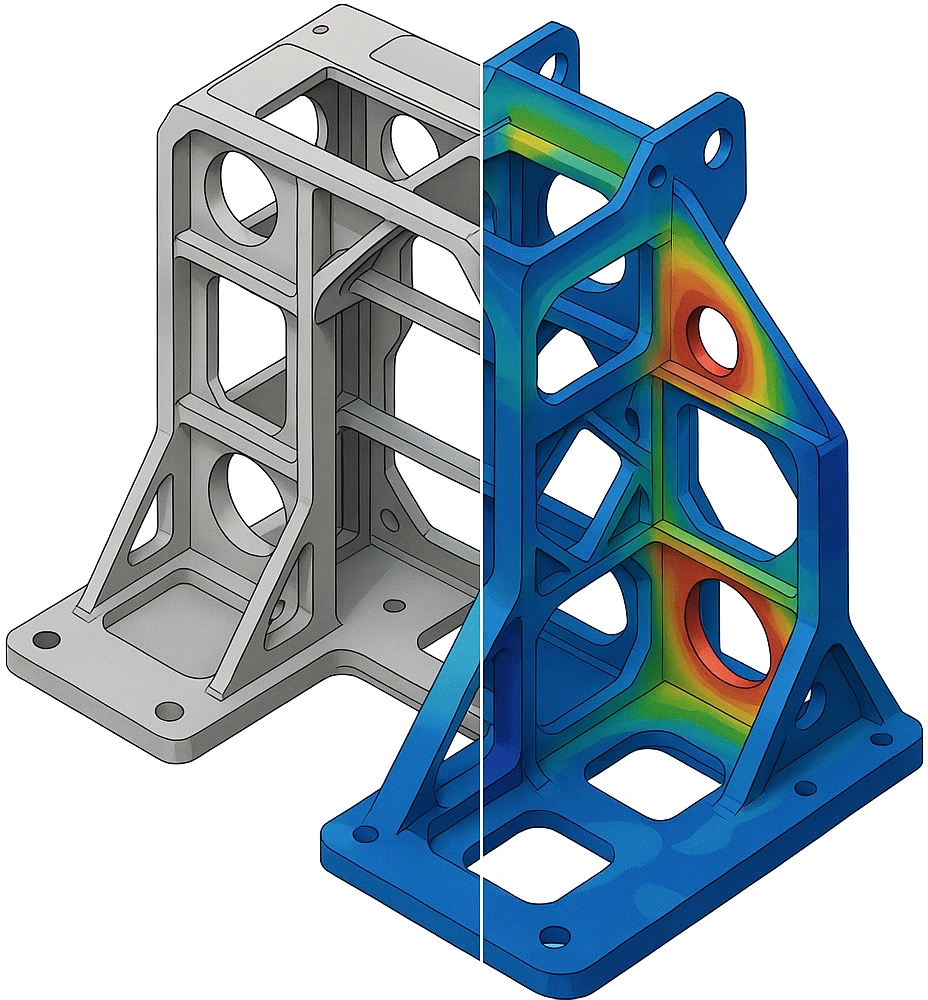
Simulation Work Reinvented