
Traditional CAE software licenses are no longer a competitive asset. For the modern engineering firm, they’ve become a rigid liability that drains budgets and stalls innovation. You’re likely familiar with the friction of paying five-figure annual fees for tools that sit idle, or the frustration of waiting weeks for a consultant to return a quote. Transitioning to on-demand FEA services isn’t just about outsourcing. It’s about treating high-fidelity simulation as a scalable digital utility. This model eliminates the overhead of legacy software and provides instant access to specialized expertise exactly when your project demands it.
We agree that the traditional procurement process for engineering simulation is broken. It’s too slow, too expensive, and lacks the flexibility required for today’s rapid product cycles. This guide promises to show you how to leverage on-demand FEA services to bypass licensing hurdles and secure verified structural integrity reports for your stakeholders. You’ll learn how to reduce physical prototyping costs through precision structural and thermal analysis. We’ll also preview the shift toward Simulation-as-a-Service, where elite engineering quality meets the speed of automated quoting to accelerate your path to market.
Key Takeaways
- Eliminate the financial burden of underutilized CAE licenses by shifting to a scalable, pay-per-project simulation model.
- Streamline your R&D procurement workflow by utilizing on-demand FEA services to bypass traditional consulting lead times and software overhead.
- Identify the critical break-even point between maintaining in-house simulation expertise and leveraging external, high-fidelity engineering support.
- Master specific CAD preparation and load-case definition strategies to ensure rapid, high-accuracy results from the first iteration.
- Combine the speed of AI-powered quoting with the reliability of German engineering standards to validate complex structural and thermal designs.
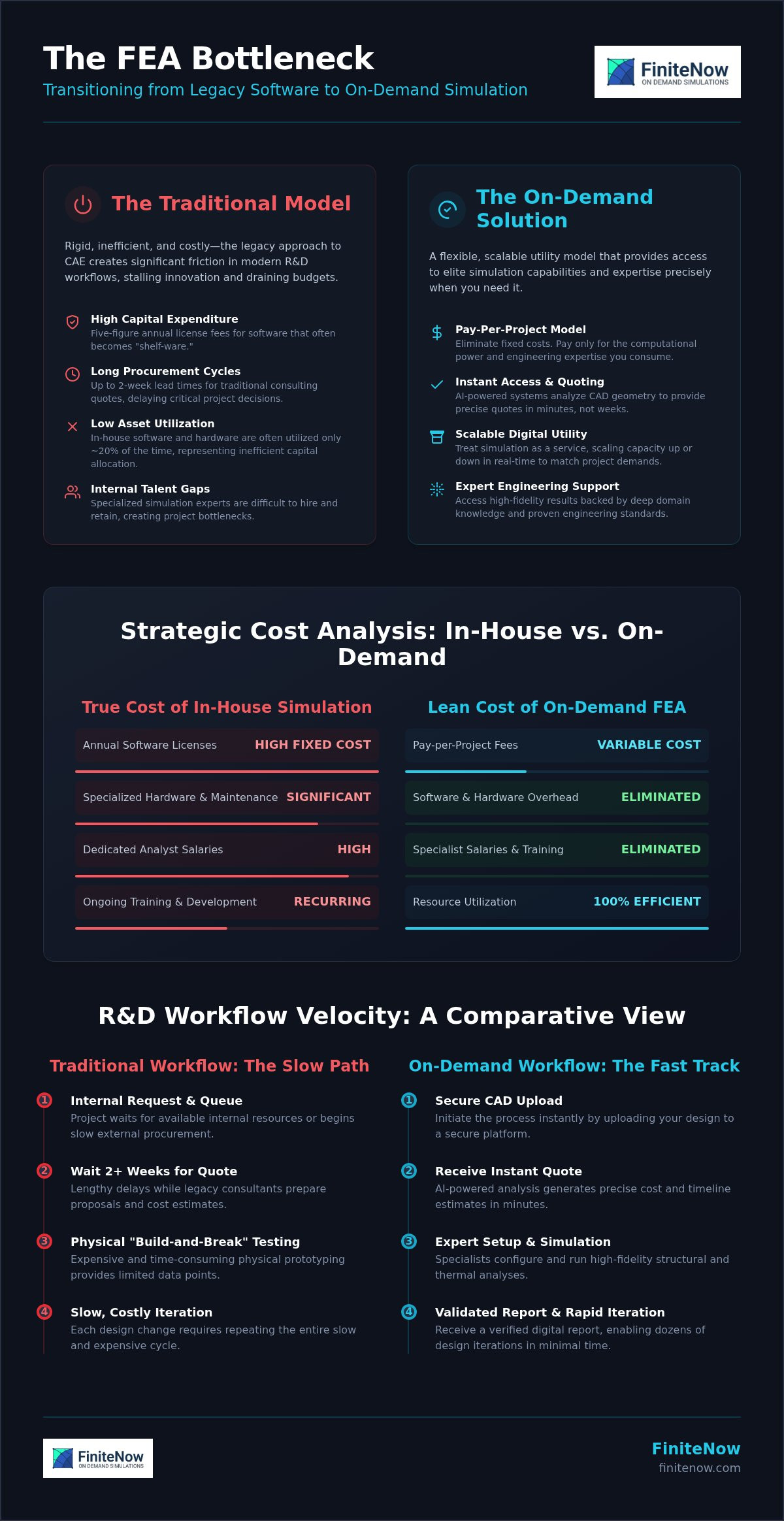
The FEA Bottleneck: Why Traditional Simulation Models Are Failing R&D
Traditional R&D workflows are struggling to keep pace with modern market demands. The primary friction isn’t found in the engineering challenges themselves, but in the outdated procurement and infrastructure models that support them. High-end CAE software licenses represent a massive capital expenditure that often results in “shelf-ware” during off-peak cycles. When you factor in the 2-week lead times for traditional consulting quotes, the momentum of agile design sprints evaporates. You can’t iterate at the speed of thought when your simulation queue is backed up by bureaucratic delays.
Relying solely on internal resources often reveals a significant talent gap. Specialized simulation experts are difficult to hire and even harder to retain in a competitive market. This creates a bottleneck where critical projects wait in a queue, or worse, are handled by non-specialists who lack the deep experience required for complex nonlinear problems. Transitioning to on-demand FEA services allows firms to bypass these structural hurdles. It provides instant access to high-fidelity results without the burden of long-term software or staffing commitments. It’s the difference between owning a power plant and simply plugging into the grid.
The True Cost of In-House Simulation
Maintaining an in-house simulation department involves more than just the annual license fee. You must account for specialized hardware maintenance, ongoing training, and the high salaries of dedicated analysts. Many firms fall into the “utilization trap,” where they pay for peak capacity but only utilize it roughly 20% of the time. This inefficient allocation of capital drains R&D budgets that could be better spent on product innovation. Without a dedicated expert, there’s also the persistent risk of “garbage in, garbage out” results. Relying on the Finite Element Method (FEM) requires deep domain knowledge to ensure that boundary conditions and mesh densities accurately reflect real-world physics. If your internal team only uses these tools occasionally, the risk of simulation error increases significantly.
Why Physical Testing is No Longer Enough
The “build-and-break” methodology is a relic of a slower era. In 2026, waiting for physical prototypes to fail in a lab is too expensive and too slow. Physical testing provides data only on the specific points where sensors are placed, potentially missing critical failure modes in complex geometries or internal structures. Modern on-demand FEA services provide a “simulation-first” approach that identifies these hidden risks before the first chip is cut. This proactive risk mitigation doesn’t just save money on material costs; it slashes time-to-market by validating designs digitally. You can iterate through dozens of load cases in the time it would take to ship a single physical sample to a testing facility.
Defining On-Demand FEA: How Simulation-as-a-Service Works
On-demand FEA is a paradigm shift from ownership to access. It replaces the traditional model of purchasing perpetual software licenses with a project-based, cloud-enabled utility. Instead of maintaining a fixed overhead of tools and personnel, firms use on-demand FEA services to scale their simulation capacity in real time. This “Simulation-as-a-Service” model ensures that you only pay for the computational power and engineering expertise you consume. Whether you need ten complex nonlinear simulations this month or zero the next, the infrastructure remains ready without costing you a cent in downtime.
The workflow is designed for maximum velocity. It begins with a secure CAD upload to a digital platform. Unlike legacy consulting firms that take days to respond, modern systems utilize algorithmic complexity assessment to provide feedback almost instantly. Once the scope is defined, the project moves through a streamlined digital pipeline: expert setup, high-performance computation, and finally, a validated engineering report. This process eliminates the administrative friction that typically stalls R&D, allowing engineers to focus on design decisions rather than procurement logistics.
The Technology Behind the Platform
Efficiency at this scale requires more than just cloud servers. It relies on AI-powered quoting systems that analyze geometry and physics requirements to generate precise estimates in minutes. This technological layer is backed by a global network of pre-qualified suppliers, ensuring that even niche physics problems are handled by specialists. Data security remains a top priority; modern platforms use enterprise-grade encryption and strict non-disclosure protocols to protect intellectual property throughout the engagement. You can explore how these automated workflows reduce lead times without compromising technical rigor.
Key Capabilities of On-Demand Providers
On-demand providers offer a breadth of technical depth that few internal teams can match. This includes:
- Structural FEA: Static, dynamic, and complex nonlinear analysis for durability and safety verification.
- Thermal and Fluid Dynamics (CFD): Managing heat dissipation and fluid flow to optimize cooling systems or aerodynamic profiles.
- Custom Simulations: Access to specialized domains like multibody dynamics and electromagnetics without the need for niche in-house tools.
By centralizing these capabilities into a single digital interface, firms gain the flexibility to tackle diverse engineering challenges. You no longer need to worry about whether your current software stack supports a specific physics module. If the project requires it, the platform provides it, backed by the precision of German engineering standards.
Strategic Analysis: In-House Software vs. On-Demand FEA Services
Engineering leadership often treats simulation as a binary choice: build it in-house or outsource it entirely. This is a false dichotomy. The modern strategic approach uses data to map simulation needs to the most efficient delivery model. Transitioning to on-demand FEA services often provides the best ROI for complex or variable workloads, while in-house tools remain viable for high-frequency, standardized tasks. The key is identifying the break-even point where the total cost of ownership for a license exceeds the cost of project-based results.
A perpetual license requires constant utilization to justify its cost. If your analysts spend more time on CAD cleanup or administrative tasks than on active solver runs, your cost-per-simulation skyrockets. Compare this to a project-based model where the price is fixed and the results are guaranteed. Speed to results is another critical metric. Internal lead times are often deceptive; while the solver might run in an hour, the queue to reach that solver can take days. On-demand platforms bypass this “backlog tax” by providing immediate access to a scalable network of experts.
When In-House Makes Sense
Standardized, high-volume simulations belong in-house. If your team performs the same linear static analysis daily with minimal variation, a dedicated license is a logical asset. This model also serves proprietary workflows that must remain behind an internal firewall for strict security or regulatory reasons. In these cases, an existing, highly-utilized simulation department acts as a core operational pillar that supports routine design checks without external intervention.
When On-Demand is Superior
Complexity and scalability are where on-demand models dominate. Highly nonlinear problems, such as stent fatigue life or complex biomechanical interactions, require specialized expertise that most firms don’t need on a full-time basis. Using nonlinear structural analysis services allows you to tap into this elite knowledge without the overhead of a permanent hire or specialized software modules. It also solves the problem of peak-shaving. When your R&D cycle hits a critical phase and internal queues grow to three weeks, on-demand platforms provide an immediate release valve to maintain momentum. For startups and SMEs, this variable cost structure preserves capital, turning a massive fixed expense into a manageable operational cost backed by the precision of German engineering standards.
The most sophisticated firms adopt a hybrid approach. They maintain in-house capacity for day-to-day iterations but leverage on-demand partners for high-stakes validation or specialized physics. This ensures that the internal team isn’t overwhelmed by complexity while the organization retains the ability to scale instantly when a project demands it. It’s about building a flexible engineering supply chain that prioritizes validated results over software ownership.
Maximizing ROI: How to Prepare Your Project for Rapid FEA Iteration
Success in simulation is determined long before the solver starts. High-fidelity results depend on the precision of your initial inputs. When leveraging on-demand FEA services, your preparation directly impacts both the cost and the speed of the delivery. Clean data allows the engineering team to focus on the physics of your problem rather than fixing geometric errors or resolving ambiguous constraints.
Step-by-Step CAD Cleanup for FEA
Non-structural details like small fillets, embossed logos, and tiny fasteners are the enemies of efficient meshing. These features force the solver to create thousands of unnecessary elements. This increases computation time without improving the accuracy of structural results. To streamline your on-demand FEA services engagement, focus on these three preparation steps:
- De-feature the model: Remove all non-structural features that don’t affect the primary load path.
- Simplify assemblies: Define critical contact points and constraints early to reduce assembly complexity.
- Standardize file formats: Export your simplified geometry as STEP or Parasolid files to ensure cross-platform compatibility and geometric integrity.
The Anatomy of a High-Quality FEA Brief
A vague brief leads to vague results. You must provide concrete boundary conditions: exactly where the part is fixed in space and where the loads are applied. Be specific about material properties. While standard library data is often sufficient for early R&D, high-stakes validation may require calibrated material data from physical testing to ensure the simulation mirrors reality. Clearly identify your areas of interest, such as specific stress concentrations or fatigue points, so the mesh can be refined in those critical zones.
To ensure total alignment, write a single sentence that defines the project’s primary goal. An example would be: “Verify the safety factor of the mounting plate under a 10kN static load.” This level of clarity allows for a more accurate quote and a faster path to a verified report. You can get an instant quote today by uploading your prepared CAD files to the secure FiniteNow platform.
Defining success early is the only way to maximize ROI. Whether you need a simple pass/fail check or a detailed fatigue life analysis, stating your goals upfront prevents scope creep and ensures the final report provides actionable insights for your stakeholders. This methodical approach transforms simulation from a bottleneck into a high-speed design utility.
FiniteNow: Bridging the Gap with Instant Quotes and German Engineering
FiniteNow isn’t just another service provider. It’s a technology-driven partner that redefines how engineers access simulation. By integrating an AI-powered quoting system with a team of elite specialists, we eliminate the traditional friction of CAE procurement. You get the speed of a modern digital platform paired with the rigorous oversight of German engineering. This combination ensures that your project benefits from both operational efficiency and technical precision. We don’t just solve equations; we provide the validation necessary to push your designs to the limit.
The instant quoting engine removes the ambiguity that plagues legacy consulting firms. You don’t have to wait days or weeks for a response. Instead, you receive a precise, transparent estimate in minutes. This level of transparency allows for immediate budget approval and rapid project initiation. It’s about empowering your R&D team to maintain momentum and move at the speed of the market. Using on-demand FEA services through FiniteNow turns simulation into a competitive advantage rather than a logistical hurdle.
Our Process: From 12-Minute Quote to Expert Results
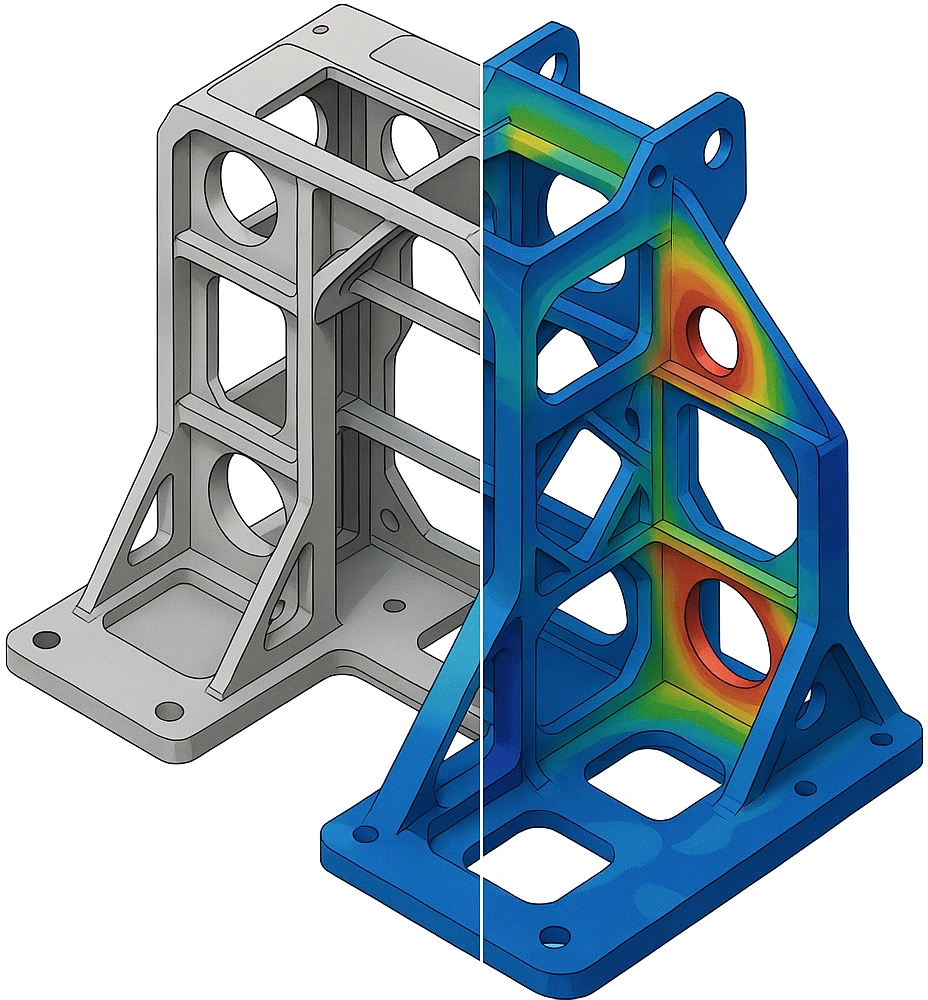
The journey from a 12-minute quote to a validated report is fast and methodical. Once you accept a quote, our internal German-based engineering team reviews the project for technical feasibility and mesh requirements. This isn’t a black-box service where data disappears into a void. We value collaboration, offering direct access to our simulation experts through scheduled video calls to refine boundary conditions and load cases. You won’t receive just colorful plots that look good in a presentation. You receive comprehensive, actionable engineering reports that provide data-backed conclusions for your stakeholders and regulatory bodies.
Beyond Standard FEA: Custom and Specialized Physics
Our technical depth allows us to tackle the most demanding engineering domains. We specialize in complex biomechanics and medical device validation, including high-stakes assessments like stent fatigue life. We also help firms optimize additive manufacturing processes through advanced process simulation, ensuring structural integrity and minimizing thermal distortion before the first layer is printed. To understand the full verification and validation checklist required for test-ready designs that meet standards like ASME V&V 10-2019, review our guide on validating structural integrity with high-fidelity FEA services. You can also learn more about our Structural FEA capabilities to see how we handle these high-stakes requirements. From automotive assemblies to life-saving implants, FiniteNow bridges the gap between the need for high-end on-demand FEA services and the logistical reality of modern product development. We provide the technical mastery required to validate your boldest designs with absolute confidence and streamlined precision.
Future-Proof Your Engineering Workflow
The shift from owning simulation software to accessing simulation results is the definitive move for agile R&D in 2026. By choosing on-demand FEA services, you eliminate the rigid costs of underutilized software licenses and the delays of traditional consulting. You’ve seen how strategic CAD preparation and clear goal setting transform simulation from a slow, bespoke task into a high-speed digital utility. This model ensures your capital is spent on validated engineering results rather than idle infrastructure.
FiniteNow bridges the gap between complex physics and rapid project cycles. Our German-based engineering team provides the technical mastery required for high-stakes validation, while our instant AI-powered quoting system ensures you never lose momentum to procurement hurdles. It’s time to stop paying for shelf-ware and start paying for verified results. Get an Instant Quote for Your FEA Project in Minutes and experience the precision of German-engineered simulation without the overhead. Your next breakthrough is just a simulation away.
Frequently Asked Questions
What is the typical turnaround time for an on-demand FEA project?
Standard projects typically conclude within a few business days once the technical scope is finalized. While traditional firms take weeks just to return a quote, our platform provides an instant estimate to initiate the project immediately. The total duration depends on specific complexities like mesh density or nonlinear solver requirements. Our German engineering team prioritizes efficiency to ensure your R&D cycle maintains its momentum.
How much do on-demand FEA services cost compared to software licenses?
On-demand FEA services eliminate the heavy capital expenditure of five-figure annual software licenses and high-performance hardware. You pay only for the specific simulation results you need rather than maintaining “shelf-ware” that sits idle during off-peak cycles. This variable cost model provides significant financial flexibility for tech-forward startups and SMEs. It successfully transforms a fixed overhead into a scalable operational expense.
Is my data secure when using an on-demand simulation platform?
We utilize enterprise-grade encryption and strict non-disclosure protocols to protect all uploaded CAD data and simulation results. Intellectual property protection is a core pillar of our digital workflow. Every project remains confidential and is handled solely by our pre-qualified engineering network. We ensure your proprietary designs never leave a secure, monitored environment throughout the simulation lifecycle. This reliability is central to our professional interaction.
Can on-demand FEA services handle nonlinear and dynamic analysis?
Our platform handles complex nonlinear and dynamic simulations that often exceed the capabilities of standard in-house tools. This includes large deformations, material nonlinearities, and transient events. Our expertise extends to specialized fields like biomechanics and stent fatigue life validation. Using on-demand FEA services provides the technical depth required to validate high-stakes components under real-world operating conditions without the need for expensive software modules. For projects involving plastic deformation or complex contact interfaces, our dedicated nonlinear structural analysis services are specifically designed to bridge the gap between linear approximations and real-world performance.
What file formats do I need to provide for an FEA quote?
We recommend providing geometry in STEP or Parasolid formats to ensure the highest level of geometric integrity. These industry-standard files prevent the translation errors often found in native CAD exports. Providing clean, de-featured geometry in these formats allows our AI-powered quoting system to assess complexity accurately. It also facilitates a much faster transition to the critical meshing and solving phases.
Do you provide a formal engineering report with the simulation results?
Every completed project includes a formal, validated engineering report detailing the methodology, boundary conditions, and conclusions. We don’t just deliver colorful stress plots. Our reports provide actionable insights and data-backed recommendations for your stakeholders. This documentation is designed to meet the rigorous standards of professional engineering reviews and regulatory submissions. It ensures that every simulation result is fully defensible and technically sound.
Can you simulate custom materials like composites or 3D-printed plastics?
We simulate a wide range of custom materials, including anisotropic composites and 3D-printed plastics with layer-dependent properties. Validating these materials requires specific constitutive models that our team is equipped to implement. Whether you’re working with advanced polymers or specialized alloys, we ensure the material behavior in the simulation accurately reflects the physical reality of your part. This precision is essential for modern additive manufacturing.
How do I know the simulation results are accurate and validated?
Accuracy is guaranteed through our rigorous German engineering standards and a multi-stage review process. Every simulation setup is verified by a senior analyst before the solver runs. We use industry-standard solvers and perform mesh convergence studies to ensure the results are numerically stable. This methodical approach provides the high-fidelity data you need to make critical design decisions with confidence and intellectual rigor.
Simulation Work Reinvented