


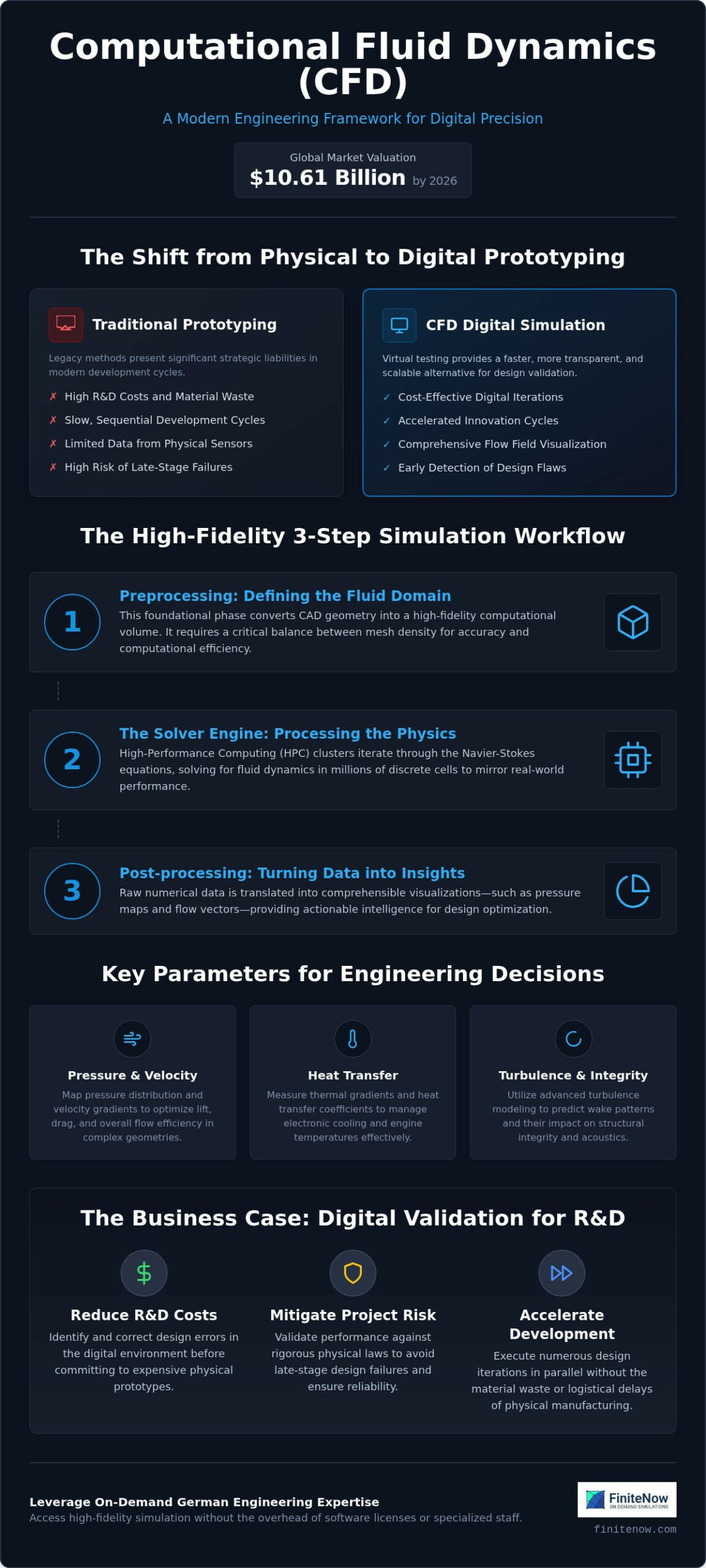
The global Computational Fluid Dynamics market has reached a $10.61 billion valuation in 2026 because physical prototyping is now a strategic liability. If you’re asking what is cfd in engineering, you’re looking for a way to replace trial and error with digital precision. You know the frustration of watching R&D budgets vanish into wind tunnels and failed prototypes. Traditional engineering cycles are simply too slow, and the uncertainty of fluid behavior in complex assemblies remains a constant risk for your team.
We’re here to change that. This primer helps you master the fundamentals of high-fidelity simulation to accelerate your product development. You’ll learn how to achieve expert-level results without the crushing overhead of software licenses or the need to hire full-time specialists. We’ll provide a framework for choosing simulation over physical testing and explain how to integrate German engineering expertise into your workflow to ensure your next project hits the mark with streamlined precision.
Key Takeaways
- Define what is cfd in engineering as a powerful numerical tool to predict fluid interactions and optimize product performance.
- Master the three-step simulation workflow and understand why high-fidelity discretization is essential for reliable results.
- Identify critical applications for CFD, including internal flow, external aerodynamics, and advanced thermal management solutions.
- Quantify the business value of digital validation to reduce R&D costs and mitigate the risk of late-stage design failures.
- Learn how to leverage expert German engineering on-demand without the financial burden of permanent software licenses.
Defining Computational Fluid Dynamics (CFD) in Modern Engineering
Defining Computational Fluid Dynamics (CFD) involves the use of numerical analysis and complex data structures to analyze and solve problems related to fluid flow. At its core, the objective is to predict with surgical precision how gases and liquids interact with physical surfaces. In 2026, understanding what is cfd in engineering is no longer optional for firms aiming to maintain a competitive edge. It serves as a critical pillar of design validation, operating alongside Structural FEA to provide a complete digital picture of product performance.
Traditional engineering sectors often relied on expensive wind tunnel testing and physical flow visualizations. These legacy methods are inherently limited by the number of sensors you can fit on a model and the high cost of each test run. Modern digital flow simulation provides a faster, more transparent alternative. It allows engineers to visualize the entire flow field, identifying recirculating zones and pressure drops that physical testing might miss. This technological mastery reassures stakeholders that complex problems are being handled with streamlined precision and a forward-thinking mindset.
The Shift from Physical to Digital Prototyping
Virtual testing has become the new standard for high-performance engineering because it prioritizes speed and scalability. Digital twins allow your team to execute infinite iterations, exploring radical design changes without the material waste or logistical delays of physical manufacturing. This approach removes the traditional barriers to innovation. CFD acts as a decisive cost-reduction tool for R&D departments by catching design errors in the digital environment. By the time you reach the physical prototyping stage, the design’s already been validated against rigorous physical laws.
Key Parameters: What CFD Actually Measures
To fully grasp what is cfd in engineering, you must look at the specific data points it generates to drive design decisions. High-fidelity simulations provide a clinical look at the physics governing your product. These metrics ensure that every component in a complex assembly performs as intended under operational stress.
- Pressure and Velocity: Mapping pressure distribution and velocity gradients across complex geometries to optimize lift, drag, and flow efficiency.
- Heat Transfer: Measuring thermal gradients and heat transfer coefficients at fluid-solid interfaces to manage electronic cooling and engine temperatures.
- Turbulence and Integrity: Utilizing advanced turbulence modeling to predict wake patterns and their subsequent impact on structural integrity and noise.
This data-driven approach replaces vague assumptions with validated results. It provides the intellectual rigor required to manage complex assemblies with total confidence. By focusing on these key parameters, engineers can optimize every step of the professional interaction between the product and its environment.
The Methodology: How CFD Simulations Work
The methodology behind high-fidelity simulation is a rigorous three-step workflow. It moves from raw geometry to actionable physics. Understanding what is cfd in engineering requires a look at this systematic progression. Each phase ensures that digital results mirror real-world performance. Discretization, or meshing, serves as the foundation. It breaks a continuous fluid volume into millions of discrete elements where equations are solved. Professional reports must include Validation and Verification (V&V) to ensure the model is mathematically sound and physically representative.
Preprocessing: Defining the Fluid Domain
Converting CAD geometry into a computational volume is the first hurdle. You must extract the “negative space” where the fluid resides. Engineers then face a critical balance between mesh density and computational efficiency. A mesh that is too coarse loses accuracy; one that is too fine wastes resources. Identifying inlet, outlet, and wall conditions is the final step in preprocessing. These boundary conditions must reflect actual operating environments to yield meaningful data.
The Solver Engine: Processing the Physics
This is where the heavy lifting happens. The solver iterates through the Navier-Stokes equations to find a numerical solution for every cell in the mesh. Depending on the project, you might use steady-state simulations for constant flows or transient models for time-dependent phenomena. Solving these complex fluid dynamics often requires high-performance computing (HPC) clusters to maintain speed. This level of technical depth is explored in NASA’s documentation on Core Applications: From Aerodynamics to Thermal Management.
Post-processing: Turning Data into Insights
Raw data is useless without professional interpretation. We visualize streamlines, pressure maps, and vector plots to identify performance bottlenecks or areas of high turbulence. Extracting actionable engineering data is the final step in defining what is cfd in engineering for a modern R&D team. FiniteNow delivers these insights through transparent, results-oriented reporting that eliminates guesswork for decision-makers. If you need to skip the learning curve and get straight to the data, you can request an instant quote for your custom simulation today.
By following this methodical yet rapid progression, we ensure that information is delivered with momentum. This approach mirrors a well-oiled digital workflow. It avoids unnecessary filler and focuses entirely on the insights that drive product development forward.
Core Applications: From Aerodynamics to Thermal Management
Computational Fluid Dynamics is a versatile tool for analyzing how fluids move through or around a system. Understanding what is cfd in engineering involves recognizing the clear distinction between internal and external flow regimes. Internal flow analysis focuses on what happens inside pipes, valves, and manifolds. External flow studies aerodynamics and the forces acting on surfaces like wings or vehicle bodies. For complex mechanical assemblies, we utilize Fluid-Structure Interaction (FSI) to analyze how fluid forces cause structural deformation. This integrated approach ensures reliability in high-stakes environments where fluid and solid physics are inseparable.
External Flow and Aerodynamic Optimization
Reducing drag and optimizing lift are the primary goals in external flow simulations. Whether you’re developing a high-speed vehicle or a small sensor housing, every surface must be aerodynamically sound. We model pressure distribution across large-scale structures to identify drag-inducing wake zones. Optimizing these profiles early improves fuel efficiency and operational stability. Our team specializes in Aerodynamic Performance Optimization, providing the data needed to refine external geometries without the need for physical wind tunnel iterations. For a deeper look at the systematic process behind reducing drag coefficients and enhancing vehicle stability, our professional guide on aerodynamic performance optimization outlines a digital-first framework that accelerates time-to-market.
Internal Flow and Thermal Management
Thermal management is a critical application for modern electronics and industrial machinery. As power densities increase, traditional cooling methods often fail. We use CFD to optimize heat sinks and liquid cooling loops for power electronics, ensuring components stay within safe operating limits. This involves managing pressure drops and flow distribution within manifold designs to prevent hotspots. In industrial machinery, predicting thermal stress at fluid-solid interfaces is vital. It prevents material fatigue and extends the lifecycle of expensive equipment by identifying potential failure points before they occur.
The versatility of these applications drives innovation across diverse sectors:
- Automotive: Optimizing under-hood cooling and reducing vehicle drag coefficients for better range.
- Aerospace: Validating wing profiles and engine combustion efficiency under extreme conditions.
- Industrial Machinery: Improving pump performance and ensuring uniform chemical mixing processes.
These applications demonstrate why asking what is cfd in engineering leads directly to superior product performance. By applying these digital validation techniques, you eliminate the uncertainty of fluid behavior before manufacturing begins. This methodical approach ensures that every design iteration is backed by clinical data rather than guesswork.
The Business Case: Why CFD is Essential for R&D
Traditional R&D cycles often stall at the physical prototyping stage. This bottleneck is where budgets expand and timelines collapse. From a managerial perspective, understanding what is cfd in engineering means recognizing it as a financial instrument for risk mitigation. It transforms fluid dynamics from an unpredictable variable into a manageable asset. High-fidelity simulation allows your team to achieve competitive differentiation by delivering validated performance data during the bidding process, well before a single part is manufactured. This level of technological mastery reassures procurement officers that your design is optimized for reliability and efficiency.
The impact on time-to-market (TTM) is decisive. By replacing months of wind tunnel scheduling with rapid digital iterations, you compress the development cycle. This speed doesn’t just save money; it captures market share. Firms that leverage digital flow simulation position themselves as agile innovators capable of handling complex engineering challenges with streamlined precision. It’s a shift from legacy industry standards toward a faster, more transparent alternative.
ROI: Reducing Physical Prototyping Costs
Physical testing is a high-stakes gamble. A single failed test in a wind tunnel or hydraulic rig can set a project back by weeks and cost thousands in material waste. Digital validation allows you to “fail fast” in a virtual environment where the cost of a design change is negligible. Simulation identifies subtle design flaws, such as localized turbulence or thermal bottlenecks, that physical sensors often miss. For decision-makers, the CFD simulation consulting model provides a clear path to high ROI by eliminating the need for expensive, underutilized software licenses. You pay for results, not overhead.
Scalability and Risk Mitigation
What is cfd in engineering if not a tool for exploring the impossible? Simulation enables you to validate designs under extreme conditions that are too dangerous or expensive to test physically, such as high-pressure surges or cryogenic flows. This capability is essential for safety compliance and professional engineering reports required by Tier 1 manufacturers. On-demand services empower SMEs to compete at this level without hiring a permanent team of specialists. You gain access to elite German engineering expertise precisely when your project demands it. This scalability ensures that your R&D department remains lean while maintaining the technical depth of a much larger organization.
Stop letting legacy prototyping methods drain your R&D budget. You can access on-demand CFD expertise today and start validating your designs with clinical precision.
Leveraging On-Demand CFD Without the Software Burden
Traditional engineering firms often operate under the misconception that high-fidelity simulation requires a massive capital investment in software. This legacy mindset creates a significant barrier to entry. When you redefine what is cfd in engineering as a professional service rather than a software purchase, you unlock immediate operational advantages. You no longer need to manage complex installations or negotiate annual renewals. Instead, you access technological mastery on your terms, ensuring that your R&D efforts remain focused on innovation rather than administrative overhead.
Integrating outsourced simulation into your existing workflow is a seamless process. It removes the friction of traditional procurement cycles. By partnering with a specialist provider, you gain a high-performance partner that values your time and intellectual rigor. This approach allows you to scale your simulation capabilities up or down based on project demand, providing a level of agility that internal departments rarely achieve. It is a methodical yet rapid progression that mirrors a well-oiled digital workflow.
The End of Heavy Licensing Contracts
Stop paying for idle software. The traditional license model forces you to pay for capacity you might only use 20% of the time. In contrast, the on-demand service model allows you to pay per project. This shift eliminates the hidden costs of specialized training and the need for high-end local hardware. You avoid the burden of maintaining a permanent stack of expensive workstations and the IT support they require. On-demand engineering fees are transparent and predictable, allowing for precise budget allocation across multiple project phases. It’s a faster, more transparent alternative to legacy industry standards.
Fast-Tracking Your Project with FiniteNow
FiniteNow has optimized every step of the professional interaction. Our process begins with an instant quoting system that delivers project-based fees without the wait. You simply submit your CAD data and receive a clear proposal that outlines the scope and expected outcomes. Our German-based engineering team then handles the technical heavy lifting, from complex meshing to high-fidelity solving. Professional collaboration via video calls ensures technical precision and keeps your internal team aligned with the simulation results. This direct approach guarantees that complex problems are handled with streamlined precision.
Don’t let software barriers slow your product development. You can get an instant quote for your CFD simulation project and leverage elite engineering expertise to validate your next design iteration today.
Digital Flow Validation: The Path to Engineering Precision
Computational Fluid Dynamics is no longer a luxury for elite firms; it’s a scalable tool that replaces physical trial and error with precise digital validation. By mastering the fundamental workflow, you’ve seen how high-fidelity simulation removes the uncertainty of fluid behavior in complex assemblies. Understanding what is cfd in engineering allows you to bypass the bottlenecks of traditional R&D and secure a competitive edge in your market.
You don’t need to manage prohibitive software licenses or hire a permanent team of specialists to access these benefits. FiniteNow provides a streamlined alternative. You get German-based engineering expertise and on-demand scalability for any project size. This disruptive model ensures your team stays agile and focused on innovation. It’s time to stop watching your budget vanish into wind tunnels and start leveraging clinical data to drive your product development forward.
Start your CFD simulation project with an instant quote and transform your design process today. Your next breakthrough is waiting in the digital domain.
Frequently Asked Questions
Is CFD as accurate as physical wind tunnel testing?
Yes, high-fidelity CFD is often as accurate as physical wind tunnel testing when executed with professional validation protocols. CFD provides a complete visualization of the entire flow field, identifying recirculating zones and pressure drops that physical sensors might overlook. While wind tunnels remain a valid tool for final verification, digital simulation allows for infinite design iterations at a fraction of the cost, making it the superior choice for rapid R&D.
How much does a typical CFD simulation project cost?
Project costs are determined by geometry complexity and the specific physics required for validation. FiniteNow utilizes an instant quote system for project-based fees, which removes the financial burden of annual software licenses. This model provides transparency for procurement officers and allows for precise budget allocation. By paying only for results, your firm avoids the significant overhead associated with maintaining internal software stacks and specialized high-performance hardware.
What kind of CAD files are required for a CFD analysis?
Standard neutral formats like STEP or IGES are the preferred requirements for a professional CFD analysis. These formats allow our German-based engineering team to clean the geometry and extract the fluid domain with maximum efficiency. High-quality CAD data is the foundation of every successful simulation. Ensuring your geometry is watertight and free of minor manufacturing details will accelerate the preprocessing phase and improve the overall fidelity of the mesh.
Can CFD be used for both liquid and gas dynamics?
Absolutely, CFD is designed to analyze both liquids and gases across a wide range of velocities and pressures. Whether you are optimizing a hydraulic manifold or analyzing the aerodynamics of an aerospace component, the numerical principles remain the same. Understanding what is cfd in engineering means recognizing its ability to handle multi-phase flows and compressible gases with surgical precision, providing reliable data for any fluid-based engineering challenge.
What is the difference between CFD and FEA?
CFD focuses on fluid flow and thermal behavior, while FEA measures structural stress and deformation in solid components. Although they utilize different numerical solvers, they are often used together to validate complex mechanical assemblies. FiniteNow provides both services to ensure a complete digital validation of your product. CFD predicts the pressure loads acting on a surface, which are then imported into an FEA model to determine structural integrity.
How long does it take to get CFD results for a complex assembly?
Timelines depend on the scale of the mesh and the complexity of the physics, but our on-demand model prioritizes speed. We utilize high-performance computing clusters to compress solving times, often delivering results within a few business days. This rapid progression mirrors a well-oiled digital workflow, ensuring your R&D cycle moves forward without the logistical delays or scheduling conflicts inherent in physical prototyping or wind tunnel testing.
Do I need to understand the Navier-Stokes equations to use CFD services?
You don’t need to master the Navier-Stokes equations to benefit from professional simulation services. Our experts handle the complex numerical analysis and solver configurations, allowing your team to focus on design decisions. We translate raw data into actionable engineering insights and transparent reports. This approach makes what is cfd in engineering accessible to any firm, ensuring you get the technological mastery required for complex problems without the steep learning curve.
What is Fluid-Structure Interaction (FSI) and when is it necessary?
Fluid-Structure Interaction (FSI) is a specialized simulation that couples fluid dynamics with structural analysis to see how they influence each other. It’s necessary when fluid forces cause significant deformation in a solid part, which then changes the flow pattern. Examples include flexible turbine blades or vibration in high-pressure piping. This advanced capability is essential for complex assemblies where fluid and solid physics are inextricably linked and must be solved simultaneously. For a comprehensive breakdown of coupling methodologies and fatigue life prediction, our fluid-solid interaction simulation reference guide provides a structured framework for selecting the right approach for your application.
Simulation Work Reinvented