


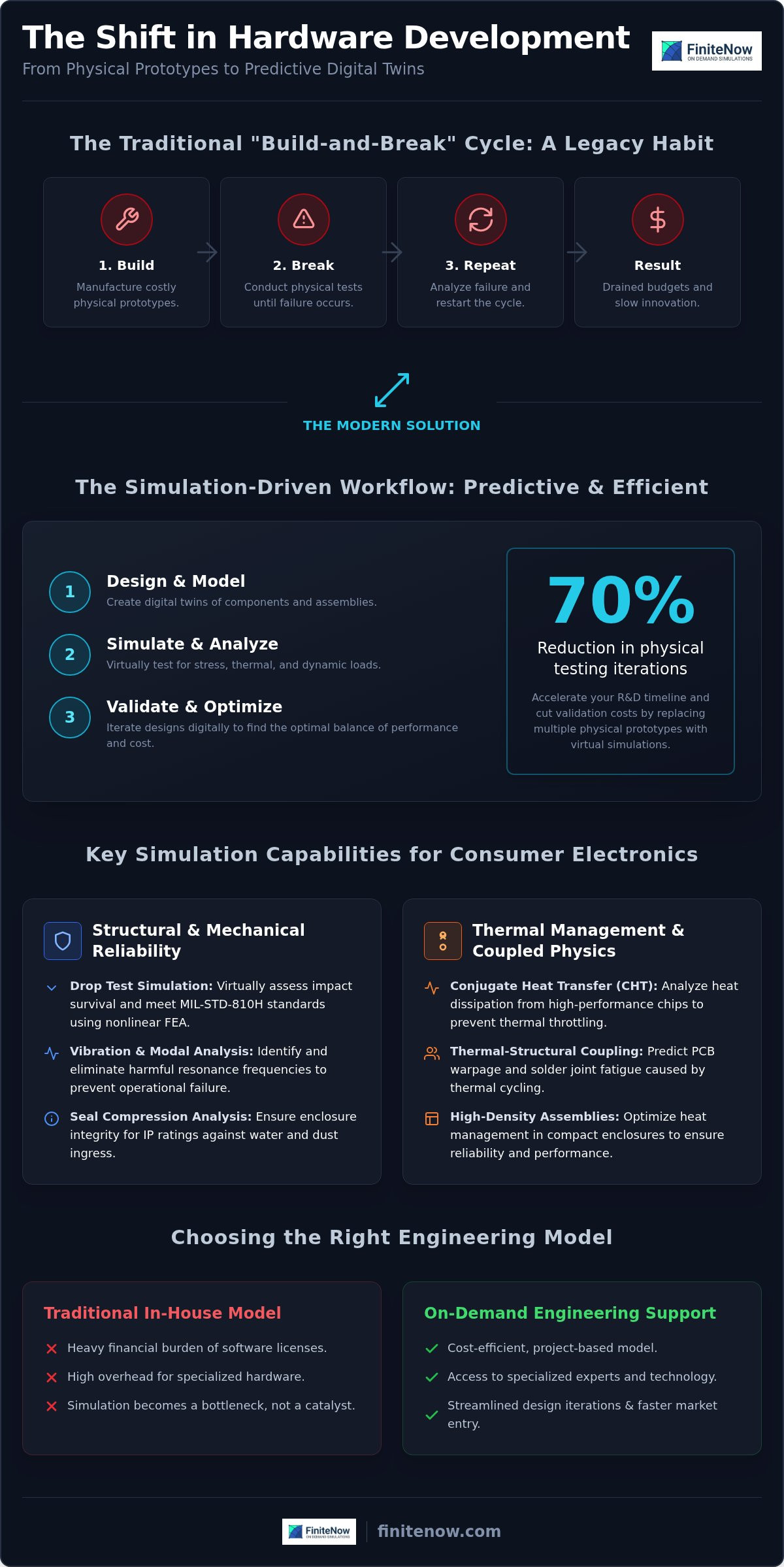
The traditional cycle of “build, break, and repeat” is no longer a viable strategy for modern hardware development. You’ve likely felt the pressure of shrinking product lifecycles and the massive costs associated with a failed physical drop test or a thermal throttling issue detected during final validation. Solder joint fatigue and heat dissipation in ultra-compact enclosures aren’t just engineering hurdles; they’re potential market exits if not addressed early. Relying on physical prototypes to catch these flaws is a legacy habit that slows down innovation and drains budgets.
Integrating advanced FEA for consumer electronics allows your team to move beyond reactive fixes toward proactive, data-driven design. We agree that the high cost of prototype failure is an unacceptable risk in a competitive market. This guide provides the technical frameworks you need to master structural, thermal, and electromagnetic simulations to ensure product reliability. We’ll examine how predictive failure analysis for impact and thermal management optimization for high-performance chips can scale your engineering capacity. You’ll learn to eliminate the overhead of traditional simulation models while accelerating your R&D timeline through streamlined, expert-backed validation.
Key Takeaways
- Replace physical “build-and-break” cycles with virtual validation to cut R&D costs and accelerate market entry.
- Apply nonlinear FEA for consumer electronics to simulate drop tests and impact survival, ensuring compliance with standards like MIL-STD-810H.
- Use Conjugate Heat Transfer (CHT) and thermal-structural coupling to predict PCB warpage and manage heat in high-density assemblies.
- Compare the cost-efficiency of on-demand engineering support against the heavy financial burden of permanent software licenses and internal overhead.
- Streamline your design iterations by utilizing instant quoting platforms and specialized German engineering for complex structural and thermal challenges.
The Role of FEA in Consumer Electronics R&D
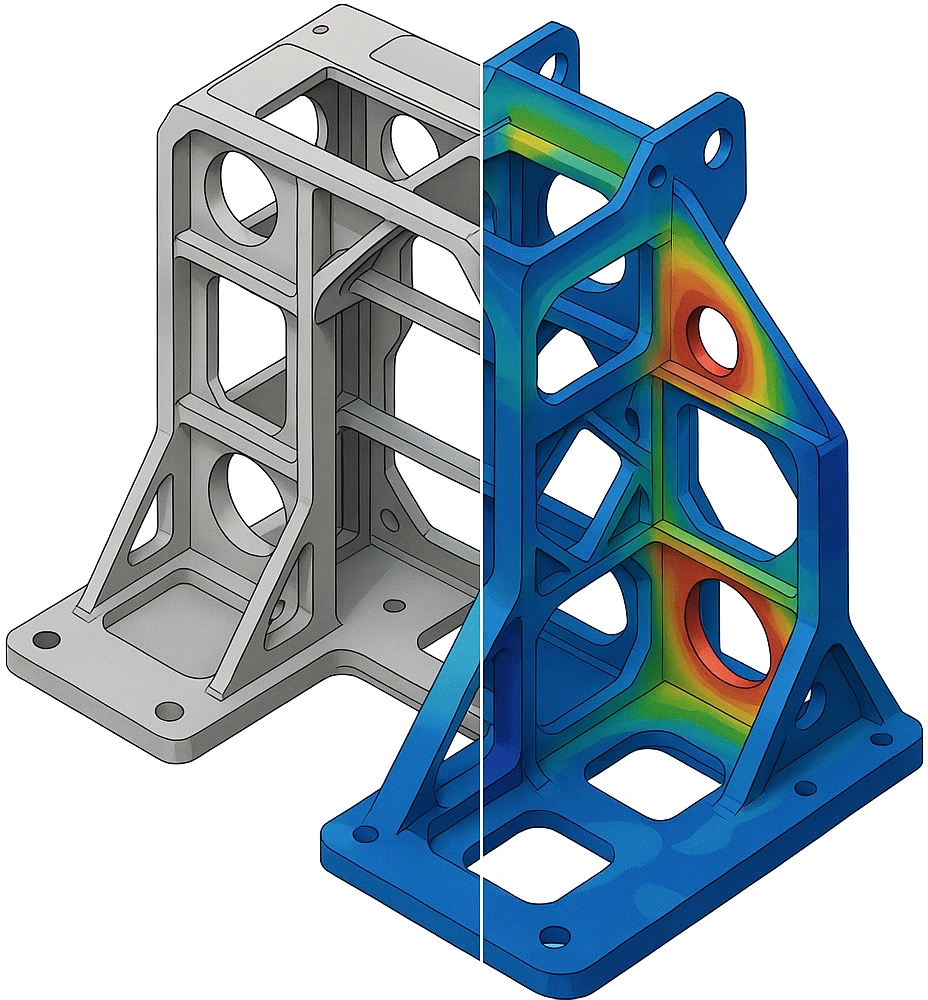
The engineering landscape for portable devices has shifted toward extreme density and complexity. High-performance assemblies now pack more processing power into smaller volumes than ever before. This trend makes traditional “build-and-break” cycles a significant financial and operational liability. Utilizing FEA for consumer electronics transforms the R&D process from a series of reactive corrections into a streamlined, predictive workflow. By applying the Finite Element Method (FEM) to digital models, engineers can visualize stress distributions and thermal gradients before a single component is manufactured.
This shift directly impacts your Time-to-Market (TTM) and Cost of Quality (CoQ). Catching a design flaw in the simulation phase costs a fraction of a late-stage recall or a re-tooling delay. You aren’t just looking at structural integrity; you’re managing a multiphysics environment where structural, thermal, and electromagnetic variables interact constantly. FiniteNow provides the specialized expertise to navigate these domains without the overhead of internal software licensing. Our approach prioritizes speed and precision, ensuring that simulation serves as a catalyst for innovation rather than a bottleneck in the development pipeline.
Digital Twins vs. Physical Prototypes
Moving toward virtual validation can reduce the number of physical testing iterations by up to 70%. It allows teams to simulate corner-case scenarios, such as high-velocity impacts at specific angles or extreme environmental shifts, that are difficult or impossible to replicate reliably in a physical lab setting. A digital twin is a predictive engineering asset that mirrors physical behavior within a simulated environment to forecast performance under stress. By testing thousands of design variations in parallel, you identify the optimal balance between weight, cost, and durability before committing to production hardware. This ensures that when you finally build a physical prototype, it’s for final validation rather than discovery.
Standard Compliance and Virtual Certification
Reliability isn’t just about survival; it’s about meeting rigorous global standards. Engineers use simulation to achieve specific IP ratings by performing seal compression analysis, ensuring that gaskets and enclosures maintain water and dust resistance under various loads. Aligning simulation results with international safety standards early in the cycle prevents costly certification failures. Leveraging Structural FEA during the initial design phase provides a feasibility baseline that guides material selection and geometry. This methodical approach ensures your device is compliant by design, not by chance, removing the traditional barriers to rapid global deployment.
Structural Integrity and Mechanical Reliability Analysis
Linear static analysis rarely suffices for portable hardware. Real-world device usage involves high-velocity impacts, repetitive mechanical cycles, and constant vibration. Advanced FEA for consumer electronics must account for material nonlinearities and transient dynamics to provide actionable design data. Relying on basic stress plots often misses the underlying cause of structural failure during a drop event. Engineers must interpret high-strain rate data to identify whether a housing will crack or if internal components will dislodge due to inertial loading.
Vibration and modal analysis ensure operational stability during transport and daily use. Identifying resonance frequencies early prevents catastrophic failures caused by harmonic excitation. Beyond survival, simulation now plays a role in haptic engineering. By simulating tactile feedback and button “click” feel, teams can tune the mechanical stiffness of domes and switches to meet specific brand requirements. This level of precision transforms simulation from a safety check into a tool for user experience optimization. If your team needs to validate these complex interactions without adding internal headcount, consider a project-based Structural FEA engagement to get rapid, expert results.
Drop Test Simulation and Impact Resistance
MIL-STD-810H compliance requires rigorous testing that often destroys dozens of physical units. Virtual drop testing uses nonlinear FEA to model high-strain rate behavior in plastics and chemically strengthened glass. Instead of general stress maps, focus on identifying stress concentrations in internal mounting bosses and screw towers. These are the most common failure points in handheld devices. Optimizing enclosure ribbing for maximum energy absorption allows the outer shell to protect sensitive internal PCBs. This proactive approach ensures your device survives real-world accidents while maintaining a slim, lightweight form factor.
Connector and Hinge Durability
Connectors and hinges are high-wear components that define a product’s perceived quality. Simulating insertion and extraction forces for USB-C and proprietary ports helps engineers predict wear and permanent deformation over 10,000+ cycles. For foldable devices or laptops, predicting fatigue life in mechanical hinges is essential to avoid field failures. Using a mechanism design simulation service allows you to validate kinematic movement and joint stress simultaneously. This ensures that every opening and closing cycle feels consistent throughout the product’s lifespan, protecting your brand’s reputation for reliability.
Thermal Management and Coupled-Field Analysis
Thermal throttling is the primary bottleneck for high-performance mobile devices. Effective FEA for consumer electronics goes beyond simple temperature maps; it requires understanding the interaction between heat generation and structural response. We use Conjugate Heat Transfer (CHT) to simulate how internal airflow interacts with solid components like heatsinks and SoC packages. This dual-domain approach identifies exactly where thermal energy accumulates and how it dissipates through conduction, convection, and radiation. It transforms vague thermal assumptions into precise engineering data.
Transient thermal analysis is essential for devices that operate in processing bursts. Steady-state simulations often overlook the rapid temperature spikes that occur during intense computational tasks, such as gaming or high-definition video rendering. By modeling these time-dependent thermal loads, you can optimize active and passive cooling strategies to prevent performance degradation. This data allows you to make informed decisions about vapor chamber sizing or the necessity of active fan curves without over-engineering the thermal solution. It ensures your hardware stays within safe operating limits while maintaining peak performance.
PCB Warpage and Solder Joint Reliability
Thermal loads don’t just affect performance; they threaten structural integrity. Different materials within a PCB assembly expand at different rates, a phenomenon known as Coefficient of Thermal Expansion (CTE) mismatch. This mismatch creates internal stresses that lead to PCB warpage and the premature fatigue of BGA and QFN solder balls. Predicting the fatigue life of these connections requires a coupled-field approach that links thermal gradients to mechanical deformation. Utilize specialized thermo-mechanical analysis services to quantify these risks and ensure long-term reliability in varying environmental conditions. This proactive validation prevents field failures and costly warranty claims.
Electronics Cooling and Airflow Optimization
Compact enclosures present extreme challenges for fluid dynamics. Small fans must overcome significant pressure drops to move air through dense component layouts. We use CFD simulation to identify thermal bottlenecks and “dead zones” where air stagnates. This analysis guides the placement of vents and internal baffles to maximize cooling efficiency. Effective airflow optimization involves several critical steps:
- Simulate fan curves to match airflow requirements with acoustic constraints.
- Optimize heatsink fin geometry for maximum surface area within volume limits.
- Validate the effectiveness of thermal interface materials (TIM) under operational pressure.
- Identify recirculating air paths that lead to localized overheating.
This level of thermal precision ensures your device maintains peak performance without compromising the user’s tactile experience or safety. By validating cooling strategies virtually, you eliminate the need for multiple heatsink iterations and accelerate your path to production.
Commercial Scoping: How to Outsource Electronics FEA
Traditional engineering departments often face a binary choice: invest in expensive internal infrastructure or rely on slow legacy consultancies. High-end FEA for consumer electronics requires significant capital expenditure in the form of annual software seats and high-performance computing (HPC) hardware. This model creates fixed costs that don’t scale with your actual R&D throughput. Transitioning to a project-based engagement allows you to bypass these barriers, accessing specialized simulation expertise exactly when your development cycle demands it. This agile approach ensures that your budget follows your innovation curve rather than subsidizing idle software licenses.
Evaluating a professional deliverable goes beyond looking at colorful stress plots. A high-value technical report must include detailed mesh sensitivity studies, clear boundary condition definitions, and actionable design recommendations. If a report doesn’t explain the “why” behind a failure prediction, it isn’t an engineering asset; it’s a liability. Data security is equally critical when managing pre-release IP. We utilize secure, encrypted collaboration workflows to ensure your proprietary designs remain protected while our German-based team executes complex simulations. To see how this model fits your current project, you can get an instant quote for your next simulation task.
The On-Demand Simulation Model
The strategic advantage of outsourcing lies in engineering simulation without software licenses. This removes the heavy financial burden of permanent overhead and allows your team to handle peak R&D loads without the friction of hiring full-time specialists for short-term needs. Scalability becomes a matter of project selection rather than headcount management. Our platform provides instant quoting transparency for procurement teams, eliminating the weeks-long negotiation cycles typical of traditional firms. This speed allows you to move from CAD export to simulation results in a fraction of the time, keeping your development timeline on track.
Technical Scoping Checklist
Successful FEA for consumer electronics depends on the precision of the initial scoping phase. Vague requirements lead to unreliable results. To ensure your simulation provides a high ROI, focus on these critical technical inputs:
- Material Properties: Obtain accurate stress-strain data for nonlinear plastics and chemically strengthened glass.
- Load Cases: Define operational, environmental, and accidental scenarios, including high-velocity impact and thermal cycling.
- CAD Preparation: Defeature non-structural elements like small fasteners or logos to optimize mesh density and solve time.
- Validation: Correlate simulation results with existing experimental data to calibrate the virtual model.
By standardizing these inputs, you reduce the risk of simulation error and create a repeatable framework for future product generations. This methodical preparation ensures that every simulation run provides a definitive answer to your most pressing reliability questions.
FiniteNow: Specialized FEA for Consumer Electronics
FiniteNow functions as a high-performance partner for agile hardware teams. We provide a faster, more transparent alternative to legacy consultancies that often struggle with the extreme complexity of modern devices. Our German-based engineering team applies clinical precision to every project, ensuring that your FEA for consumer electronics is grounded in rigorous data validation. By integrating structural, thermal, and fluid dynamics into a single digital workflow, we eliminate the siloed approach that frequently leads to late-stage design conflicts. This forward-thinking mindset allows you to handle complex multiphysics problems with streamlined precision and zero software overhead.
Expert-Backed Results
Accessing specialized simulation talent shouldn’t require a permanent staffing commitment or expensive annual licenses. FiniteNow connects your project with a pre-qualified network of engineers who understand the unique failure modes of high-density assemblies. We deliver high-fidelity reporting suitable for both regulatory compliance and executive-level review. Our team possesses deep expertise in coupled-field analysis services, allowing us to predict exactly how thermal loads will impact mechanical stability. For teams also working with 3D-printed enclosures or additively manufactured components, understanding structural analysis for additive manufacturing is essential to account for the layer-dependent residual stresses that standard FEA tools often miss. This technical precision ensures that your most complex reliability questions receive data-driven answers.
Getting Started with FiniteNow
The transition from CAD to actionable results is managed through a streamlined digital platform. You can upload your design files directly for an immediate project evaluation. This removes the administrative friction of traditional quoting, allowing for rapid design iteration during the most critical phases of R&D. Our workflow moves methodically from an instant quote to a comprehensive final report, providing a sense of momentum that mirrors your own development cycle.
We prioritize direct communication over dense blocks of text. You gain access to expert simulation engineers for design feedback through collaborative video consultations. This ensures that every finding is understood and can be immediately applied to improve your product. By removing traditional barriers to high-end simulation, we empower your team to focus on innovation while we handle the technical validation. It’s a methodical yet rapid progression that ensures your information is delivered with purpose and clarity.
Accelerating the Hardware Development Lifecycle
Transitioning to a virtual-first validation strategy isn’t just about saving prototypes; it’s about securing market share through speed and reliability. We’ve explored how integrated multiphysics can resolve the conflict between high-performance processing and compact thermal constraints. By mastering FEA for consumer electronics, your team can predict drop survival and solder joint fatigue long before the first tool is cut. This proactive approach eliminates the friction of late-stage recalls. It ensures your design meets rigorous global standards on the first attempt, protecting both your budget and your brand reputation.
FiniteNow removes the traditional barriers to high-end simulation. Our German-based engineering team provides the specialized precision your projects require without the burden of long-term software contracts. You can move from CAD to actionable results in days, using our instant quoting platform for transparent budgeting and rapid iteration. Stop letting legacy engineering cycles dictate your R&D timeline or drain your operational resources. Get an instant quote for your electronics FEA project today. It’s time to build more resilient hardware with streamlined confidence and technological mastery.
Frequently Asked Questions
What is the typical turnaround time for an electronics drop test simulation?
Turnaround times typically range from a few days to two weeks depending on the assembly’s complexity and the number of impact angles required. Our instant quoting platform accelerates the kickoff process by removing traditional administrative delays. High-strain rate nonlinear simulations for complex smartphones or laptops require significant compute power; however, our German-based team optimizes mesh density to deliver actionable results without compromising on precision or project momentum.
Can FEA predict solder joint failure due to thermal cycling?
Yes; thermo-mechanical analysis identifies fatigue in BGA and QFN solder balls by calculating the stress caused by Coefficient of Thermal Expansion (CTE) mismatches. We simulate the repetitive temperature fluctuations a device experiences during operational cycles to forecast long-term reliability. This predictive approach helps engineers select underfill materials or adjust PCB layouts to mitigate warpage. It’s a critical component of FEA for consumer electronics that prevents premature field failures and expensive warranty claims.
Do I need to provide material properties for my specific plastics?
Providing accurate stress-strain data for proprietary polymers is essential for high-fidelity results. While we maintain a library of standard material properties, the specific behavior of glass-filled resins or chemically strengthened glass often dictates the accuracy of an impact simulation. If you don’t have detailed data, we guide you on the necessary parameters to ensure the virtual model reflects physical reality. Precise inputs are the foundation of reliable structural FEA and thermal analysis.
How does electromagnetic simulation differ from structural FEA in electronics?
Electromagnetic simulation evaluates signal integrity, power distribution, and interference, while structural FEA focuses on mechanical durability and physical survival. Structural analysis predicts how a device handles drop impacts or vibration; electromagnetic solvers look at how internal components interact with radio frequencies and heat. FiniteNow specializes in the structural and thermal domains, providing the data needed to ensure your device remains physically intact and thermally stable under intense computational loads.
Is virtual drop testing as accurate as physical lab testing?
Virtual drop testing offers high correlation with physical results when boundary conditions and material nonlinearities are correctly defined. It doesn’t replace final certification but significantly reduces the number of destroyed physical prototypes by identifying failure points early. You can simulate hundreds of “corner-case” impact scenarios that are difficult to replicate in a lab. This ensures that the final physical test is a formality rather than a discovery phase for design flaws.
What CAD formats are best for electronics simulation projects?
We recommend using neutral CAD formats such as STEP (.stp) or Parasolid (.x_t) for most electronics simulation projects. These formats preserve geometric integrity across different software environments and allow for efficient defeaturing of non-structural elements like logos or small fasteners. Providing clean, well-organized geometry reduces the time required for mesh generation. This streamlined preparation helps our engineering team deliver faster results while maintaining the technical precision required for complex assemblies.
How do you ensure data security for sensitive consumer product designs?
Data security is integrated into our entire digital workflow through encrypted file transfers and strict internal access controls. Our German-based engineering team operates under rigorous non-disclosure agreements (NDAs) to protect your pre-release intellectual property. We prioritize transparency and safety; ensuring that your proprietary designs remain confidential while we execute specialized simulations. This professional B2B approach allows you to collaborate with external experts without compromising the security of your hardware innovation.
Can FEA help in reducing the weight of handheld devices?
FEA is a powerful tool for weight reduction through topology optimization and structural thinning. By identifying areas of low stress, engineers can remove unnecessary material from internal frames and enclosures without compromising impact resistance. This allows for slimmer profiles and lighter handheld products that still meet rigorous durability requirements. Applying FEA for consumer electronics in this way ensures that every gram of material serves a structural purpose while maintaining a lightweight user experience. When components are produced via 3D printing, teams should also consider structural analysis for additive manufacturing to address the anisotropic material behavior and residual stresses inherent to layer-by-layer fabrication processes.
Simulation Work Reinvented