

Your standard FEA software is likely blind to the thermal reality of your build chamber. While traditional simulations treat parts as isotropic solids, the layer-by-layer reality of industrial 3D printing introduces complex residual stresses and directional weaknesses that legacy tools simply can’t predict. You’ve likely felt the frustration of a high-cost Titanium or Inconel build warping or cracking mid-cycle, despite “passing” your initial stress tests. It’s a common bottleneck as the global AM market scales toward its projected $20.37 billion valuation in 2026.
In this guide, you’ll discover why high-fidelity structural analysis for additive manufacturing is the only way to achieve first-time-right results in regulated sectors like aerospace and medical devices. We’re moving beyond basic linear statics to explore process-aware workflows that account for layer-dependent properties and thermal history. You’ll learn how to validate structural integrity without the expensive trial-and-error iterations that drain your R&D budget. We’ll examine the shift from simple geometry checks to the rigorous validation required by emerging standards like EN ISO/ASTM 52959:2026 for metallic lattice structures.
Key Takeaways
- Transition from a reactive “Print and Pray” mindset to a predictive workflow that ensures production-grade reliability for complex 3D printed components.
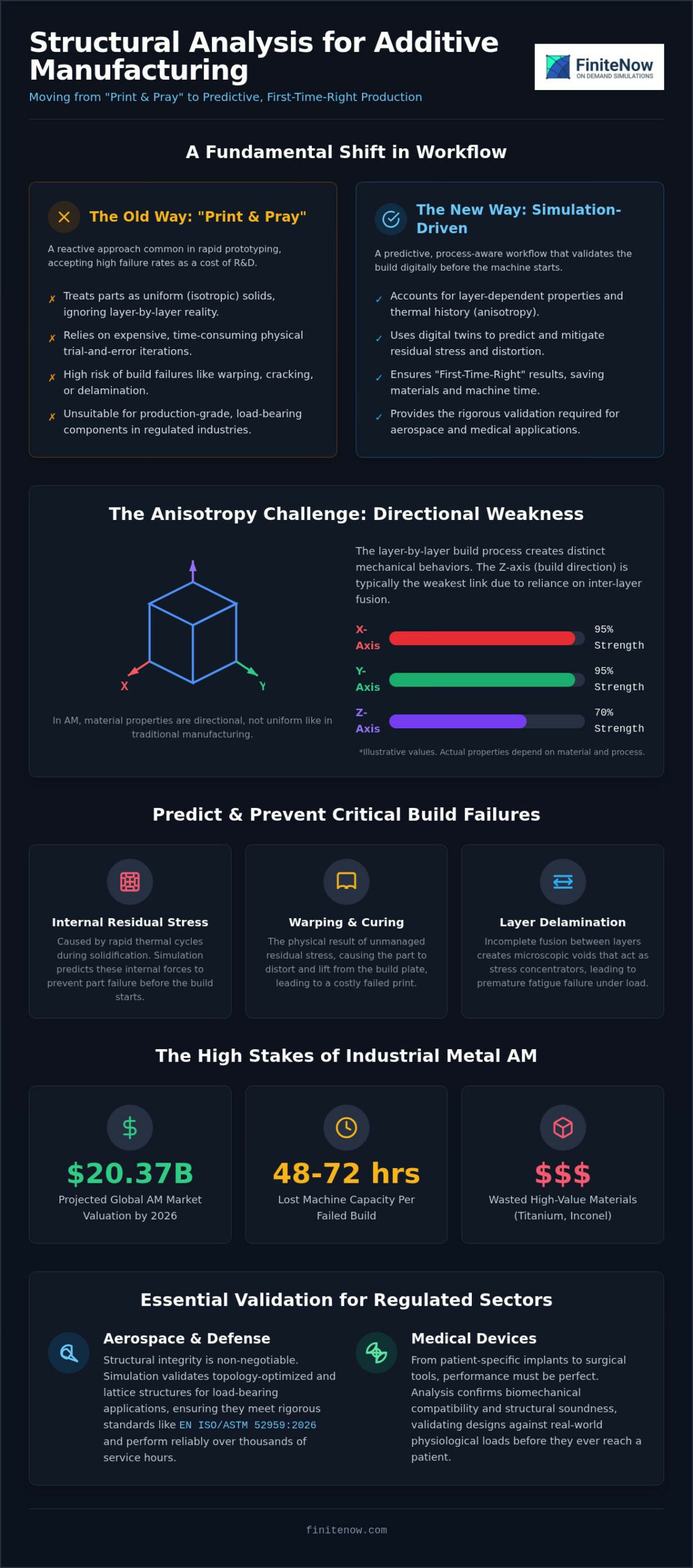
- Learn how specialized structural analysis for additive manufacturing accounts for anisotropy and layer-dependent mechanical properties across the X, Y, and Z axes.
- Identify and mitigate internal residual stresses caused by rapid solidification to prevent warping, curling, and expensive build failures in metal AM.
- Validate the structural integrity of topology-optimized parts and patient-specific implants to meet rigorous standards in the aerospace and medical sectors.
- Bypass high software licensing costs by leveraging an agile, on-demand simulation model backed by specialized engineering expertise.
The Evolution of Structural Analysis for Additive Manufacturing
The definition of structural analysis for additive manufacturing has fundamentally shifted. It is no longer just about validating a final geometry; it is a process-aware predictive workflow. Traditional engineering assumes material properties are constant throughout a part. In AM, properties are born during the build. Every laser path, layer thickness, and cooling cycle dictates the final mechanical performance. If you ignore the process, your simulation is just a guess.
The “Print and Pray” era of rapid prototyping is dead. In that mindset, engineers accepted high failure rates as a cost of innovation. Modern industrial production demands a different approach. We’ve moved toward simulation-driven production where the build is validated before the machine ever powers on. This involves using digital twins to bridge the gap between a sterile CAD file and the thermal reality of the build plate. It’s about ensuring that the internal grain structure and residual stress levels meet the design intent before committing to a physical run.
Beyond Rapid Prototyping
We are seeing a massive shift from visual mockups to load-bearing, production-grade components. When a part is destined for an aircraft engine or a surgical suite, the stakes change. Visual fidelity is irrelevant; structural integrity is everything. Build failures in industrial 3D printing carry a heavy economic burden. Beyond the wasted material, the loss of 48 to 72 hours of machine capacity can derail entire production schedules. This industrialization requires professional Structural FEA tailored specifically for additive workflows. You need to know exactly how the part will behave under load, considering the layer-by-layer history that created it.
The High Stakes of Metal AM
Metal additive manufacturing involves high-value materials like Titanium and Inconel. These powders are expensive. A single failed build can waste thousands of dollars in raw material alone. Because of these costs, “First-Time-Right” isn’t a luxury; it’s a financial necessity. Traditional safety factors are often insufficient for AM. If you over-engineer a part to hide your lack of data, you negate the lightweighting advantages that made AM attractive. High-fidelity validation is the only way to satisfy regulated industries like aerospace or medical. These sectors demand proof that your part won’t just survive its first hour of service, but its ten-thousandth. Structural analysis for additive manufacturing provides that proof by simulating the complex physics of rapid solidification and thermal contraction.
Solving the Anisotropy Challenge in 3D Printed Components
Most engineers treat 3D printed parts as isotropic solids. That’s a mistake. In traditional manufacturing, such as forging or casting, material properties are largely uniform throughout the volume. In additive manufacturing, the deposition direction creates distinct mechanical behaviors in the X, Y, and Z axes. The Z-axis, or build direction, is almost always the weakest link because it relies on the strength of the bond between layers rather than the continuity of the material itself.
Inter-layer fusion dictates the part’s fatigue life and fracture toughness. If the fusion is incomplete, microscopic voids form. These act as stress concentrators that trigger premature failure under cyclic loading. Standard FEA misses these nuances because it doesn’t account for the “weld” lines between layers. Effective structural analysis for additive manufacturing must integrate these directional weaknesses to predict how a part will actually behave in the field.
Infill patterns like gyroid or honeycomb architectures further complicate the simulation. You can’t simply mesh the outer shell and expect accuracy. The internal density and geometry change the global stiffness matrix of the component. Accurate modeling requires a mesh that respects these internal structures without becoming computationally prohibitive. If you’re struggling to balance mesh density with solve time, consider exploring our on-demand structural FEA services to streamline your validation workflow.
Modeling Directional Material Properties
You can’t use a single Young’s modulus for a 3D printed part. You need to assign orthotropic material properties in your simulation environment. This involves defining unique stiffness and strength values for each principal axis based on empirical test data. Build orientation is the most critical decision in the setup. It dictates how internal stresses align with external loads. Anisotropy in AM is the variation of mechanical properties based on build orientation.
Microstructure and Grain Orientation
Cooling rates are not uniform across the build plate. Rapid solidification in metal AM creates elongated grains that follow the thermal gradient. This microstructure influences local hardness and ductility, making some areas of the part more brittle than others. Multiscale modeling allows us to look at the melt pool physics and scale those effects up to the full assembly. Our Coupled-Field Analysis Services address these complex interactions by linking thermal history directly to structural performance, ensuring your simulation reflects the physical reality of the build.
Process Simulation: Predicting Residual Stress and Distortion
If your simulation ignores the build history, you aren’t performing true structural analysis for additive manufacturing; you’re just applying standard FEA to a complex shape. Process simulation tracks the thermal journey of every layer. Residual stress is the internal tension locked into parts during rapid solidification. As the laser melts the powder, the material expands. As it cools, it contracts against the cold, rigid layers below. This creates massive thermal gradients that lead to warping, curling, and eventual build failure.
Support structures are your primary defense against these forces. They don’t just hold the geometry in place. They act as heat sinks to pull thermal energy into the build plate and as mechanical restraints to fight distortion. Achieving the right balance requires thermo-mechanical coupling. You must simulate the thermal field and the mechanical response simultaneously to predict how the part will move. If you treat these as separate issues, you’ll miss the critical points where stress exceeds the material’s yield strength.
The Build-Process Simulation Workflow
A professional AM simulation follows a logical, four-step progression to ensure build success:
- Step 1: Thermal analysis of the laser or electron beam energy input to define the melt pool characteristics.
- Step 2: Prediction of the transient temperature field as the heat source moves across the powder bed.
- Step 3: Calculation of mechanical stress and part distortion during the cooling phase of each layer.
- Step 4: Compensation of CAD geometry. We “pre-deform” the original model in the opposite direction of the predicted warp so the final printed part settles into the correct dimensions.
Preventing Catastrophic Build Failures
Simulation is the only way to prevent a “Recoater Blade Crash.” This happens when a part curls upward due to residual stress and enters the path of the powder spreader. The resulting collision can damage the machine and cause days of downtime. By predicting this deformation early, you can stiffen support structures or adjust the print orientation to keep the part within tolerance.
Optimizing these supports is a delicate trade-off. They must be strong enough to restrain the part but thin enough to be removed without damaging the surface finish. Our Thermo-Mechanical Analysis Services provide the high-fidelity stress insights needed to find this equilibrium. We help you identify potential failure zones before you commit to an expensive metal build, ensuring your machine time is used for production, not troubleshooting.
Industry Applications: Where AM Simulation is Non-Negotiable
Simulation isn’t a generic step in the AM workflow; it’s the gateway to certification in high-stakes industries. While a failed prototype in a consumer goods lab is a minor setback, a structural failure in a flight-ready component or a medical implant is a liability. Precision structural analysis for additive manufacturing allows engineers to push the limits of topology optimization without compromising safety. We move beyond basic geometry to validate how these complex, organic shapes perform under real-world operational loads.
In the automotive sector, the focus has shifted toward high-performance tooling and complex heat exchangers. These parts often feature intricate internal channels that are impossible to inspect physically. Simulation provides the only window into their internal stress states and thermal efficiency. Similarly, industrial machinery manufacturers rely on FEA to predict the fatigue life of 3D printed manifolds. These components must withstand high-pressure cycles where internal surface roughness from the printing process can act as a catalyst for crack initiation.
Aerospace and Defense: Lightweighting Without Risk
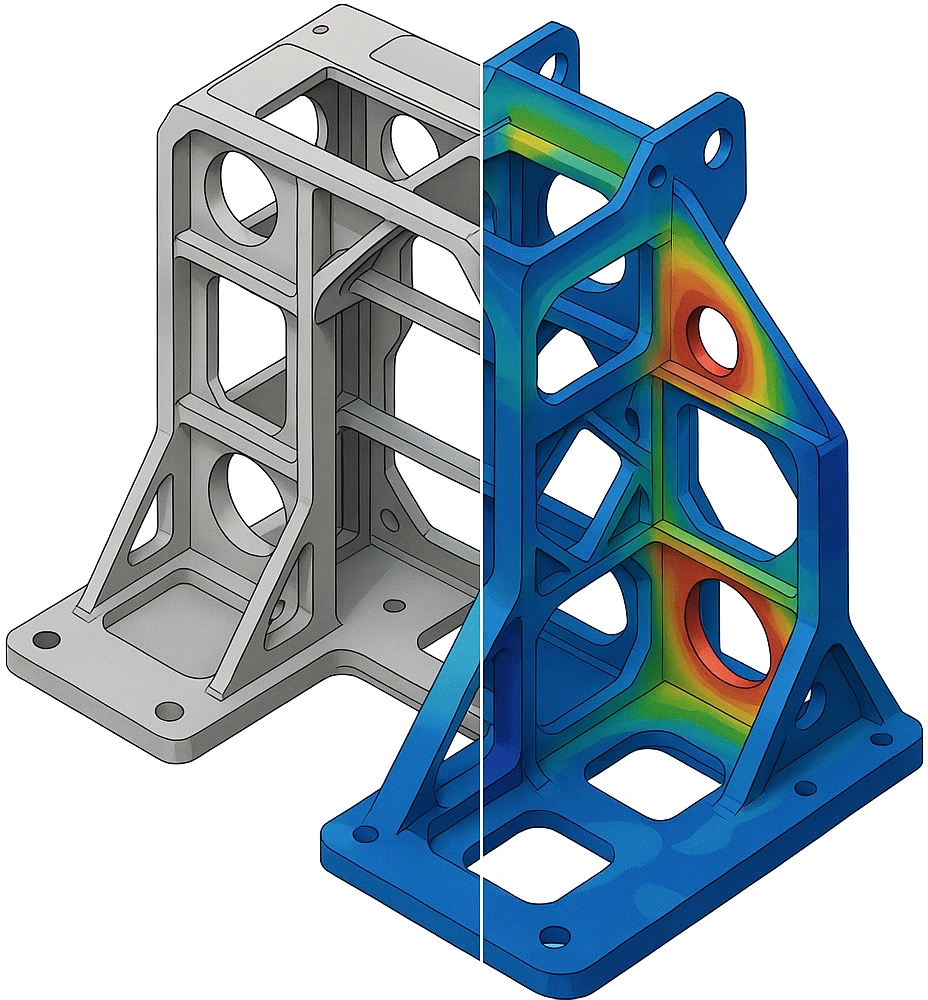
Aerospace procurement demands more than just a CAD file; it requires a data-backed validation of every gram saved. Topology-optimized brackets often feature thin-walled sections that are highly susceptible to buckling under compressive loads. We use advanced buckling analysis to ensure these lightweight structures maintain their stability. Validation also extends to fatigue and vibration, ensuring that flight-ready parts can survive the harmonic stresses of an engine environment. High-fidelity simulation reports provide the transparency needed to satisfy rigorous safety standards and streamline the move from design to deployment.
Medical Devices: Biomechanical Validation
In the medical field, simulation ensures that patient-specific orthopedic implants behave like the biology they replace. A major risk in metal implants is stress shielding, where an overly stiff titanium part carries all the load, causing the surrounding bone to degenerate. Engineers use structural analysis for additive manufacturing to design custom lattice structures that match the modulus of human bone.
This biomechanical alignment is critical for long-term implant success. Our guide on FEA for Medical Implants details how we use simulation to validate these porous architectures. For even more complex cases, such as 3D printed vascular stents, we apply Fluid-Structure Interaction (FSI) to analyze how the device deforms under pulsating blood flow. This level of precision is only possible through specialized engineering workflows. If you need to validate a critical AM component, contact FiniteNow for expert simulation support backed by German engineering expertise.
Navigating the AM Simulation Landscape: Expertise vs. Licensing
The “Licensing Trap” is a common hurdle for firms scaling their additive capabilities. Traditional software vendors push expensive annual subscriptions that demand significant internal resources to manage. You aren’t just paying for the code; you’re paying for the training, the high-end hardware, and the inevitable downtime. For many organizations, these licenses sit idle for months, yet the fixed overhead remains. On-demand structural analysis for additive manufacturing disrupts this cycle by replacing heavy capital expenditure with agile, project-based expertise.
Our German-based engineering team acts as a high-performance extension of your R&D department. We provide specialized validation for complex builds without the friction of legacy consultancy models. Instant quoting systems further accelerate the process, allowing SMEs and startups to verify designs in hours rather than weeks. This shift enables you to move from high-level theoretical design to actionable, validated project delivery with surgical precision. It’s about access to technological mastery without the burden of software ownership.
The Strategic Shift to On-Demand Simulation
SMEs are increasingly abandoning the burden of internal software maintenance. The technical complexity of AM simulation demands years of domain-specific experience that a generalist engineer might lack. By choosing Engineering Simulation Without Software Licenses, your team focuses on product innovation while we handle the high-fidelity physics. This model scales directly with your project load. You pay for the validation you need, when you need it, avoiding the “shelfware” problem that plagues traditional engineering departments.
Securing the Additive Supply Chain
Simulation serves as a primary quality gate for outsourced 3D printing. If you’re using a third-party print service, you need independent verification that the part will survive its intended environment. Professional FEA reports are essential for compliance and auditing in regulated verticals like aerospace or medical manufacturing. They provide the documented proof of structural integrity required by procurement teams and safety regulators. You can secure your supply chain today by requesting an instant simulation quote. We provide the technical mastery needed to validate your most ambitious AM projects with speed and transparency.
Mastering the Industrial 3D Printing Workflow
Additive manufacturing is maturing into a serial production powerhouse. To succeed, you must move beyond the limitations of standard isotropic FEA. High-fidelity structural analysis for additive manufacturing allows you to predict distortion and account for anisotropic properties before the laser ever fires. It’s the difference between a costly failed build and a certified, flight-ready component. You don’t have to accept trial-and-error as a standard operating procedure.
FiniteNow offers a streamlined path to this technical mastery. Our German-based engineering team provides specialized AM expertise with transparent, project-based pricing. You get high-fidelity reports ready for industrial validation without the overhead of expensive software licenses or internal training cycles. We handle the complex thermo-mechanical coupling so you can focus on product innovation. It’s time to replace software obstacles with actionable data.
Get an Instant Quote for Your Additive Manufacturing Simulation and start optimizing your production cycle today. Your next build should be your final iteration.
Frequently Asked Questions
How does structural analysis for 3D printed parts differ from traditional FEA?
Structural analysis for additive manufacturing differs from traditional FEA by incorporating the build history. Standard FEA assumes material properties are uniform throughout the part volume. AM-specific simulation accounts for layer-by-layer physics, thermal gradients, and the resulting anisotropy. It treats the part as a dynamic thermal system rather than a static solid. This ensures you capture the directional weaknesses and internal stresses that are inherent to the 3D printing process.
Can simulation predict if my 3D print will fail during the build process?
Yes, simulation identifies build failures before you power on the machine. By using thermo-mechanical coupling, we predict if a part will warp or curl beyond acceptable tolerances. This prevents the “Recoater Blade Crash,” where a deformed part strikes the powder spreader. It also highlights areas where support structures might fail under the internal tension of rapid solidification. This predictive workflow saves thousands in wasted material and machine downtime.
Why is anisotropy such a major concern for 3D printed structural components?
Anisotropy is a concern because 3D printed parts exhibit different mechanical strengths depending on the loading direction. The bond between layers is typically weaker than the material within a single layer. If your design places high tensile loads across the Z-axis without accounting for this, the part can delaminate. Simulation allows you to orient the part strategically so critical stresses align with the strongest material directions, ensuring structural integrity.
What information is required to get a quote for AM process simulation?
To provide an instant quote, we typically require your CAD geometry and the intended material, such as Titanium or Inconel. Providing details on build orientation and specific machine parameters helps refine the accuracy. Our automated system evaluates the complexity of the structural analysis for additive manufacturing to give you a transparent price. This project-based model removes the need for expensive software licenses and allows for rapid kickoff.
Is it possible to simulate the fatigue life of 3D printed metals?
You can simulate fatigue life by using nonlinear FEA that considers the unique microstructure of AM metals. We analyze how cyclic loads interact with potential internal voids and surface roughness. These factors often act as crack initiation sites that don’t exist in forged materials. High-fidelity modeling allows us to predict the number of cycles to failure, which is essential for validating flight-ready aerospace components or medical implants.
How does topology optimization work with AM process constraints?
Topology optimization generates high-performance shapes, but these must be validated against AM-specific constraints. The simulation ensures that the optimized design doesn’t include impossible overhangs or internal channels that are difficult to clear of powder. We balance the goal of maximum lightweighting with the practical need for support structures. This ensures the final geometry remains stable during the build and meets all structural requirements under real-world load conditions.
What is the most common cause of inaccuracy in AM structural simulations?
The most common cause of inaccuracy is using isotropic material assumptions. When engineers ignore the thermal history and the directional nature of the build, the simulation results become overly optimistic. Inaccurate thermal boundary conditions also lead to poor distortion predictions. High-fidelity simulation requires precise data on the melt pool physics and cooling rates. Without these process-aware inputs, the FEA results won’t match the physical reality of the printed component.
Do I need to simulate every part, or only critical load-bearing components?
You don’t need to simulate every visual prototype, but simulation is non-negotiable for critical load-bearing parts. If a component failure leads to machine damage or safety risks, validation is essential. High-value materials like Inconel or Cobalt-Chrome demand first-time-right builds to remain economically viable. Most engineering teams prioritize simulation for parts in regulated sectors where documented proof of structural integrity is a primary procurement requirement.
Simulation Work Reinvented