

Your engineering team’s innovation shouldn’t be held hostage by a six-figure software license. For too long, the industry has accepted a status quo where high-fidelity Structural FEA is gated behind prohibitive costs and agonizingly slow turnaround times from legacy firms. You understand that precise stress and strain data is non-negotiable for production-ready designs, yet the logistical friction of nonlinear material modeling often stalls your momentum.
We agree that the traditional model is broken. You need reliable validation, not a recurring subscription that drains your R&D budget. This guide promises to bridge that gap. You’ll learn how to master the fundamentals of structural simulation and secure high-fidelity results through a modern, on-demand approach that eliminates software overhead entirely.
We will examine the technical shift from legacy workflows to streamlined, project-based simulation. This overview covers everything from complex failure prediction to the benefits of transparent pricing models. By the end, you’ll have a clear roadmap for delivering validated, high-performance designs without the typical industry bottlenecks. It’s time to move faster and build smarter.
Key Takeaways
- Understand the transition from physical prototyping to digital twin validation through a structured five-step simulation workflow.
- Learn to distinguish between linear and nonlinear analysis to choose the most efficient level of complexity for your specific design constraints.
- Compare the hidden overhead of software licensing and hardware against the strategic advantages of on-demand Structural FEA.
- Gain insights into geometry preparation and material assignment techniques that prevent common simulation errors and ensure high-fidelity data.
- Explore how to leverage a global network of expert engineers to secure validated reports without the burden of permanent internal staffing.
What is Structural FEA? Bridging Math and Physical Strength
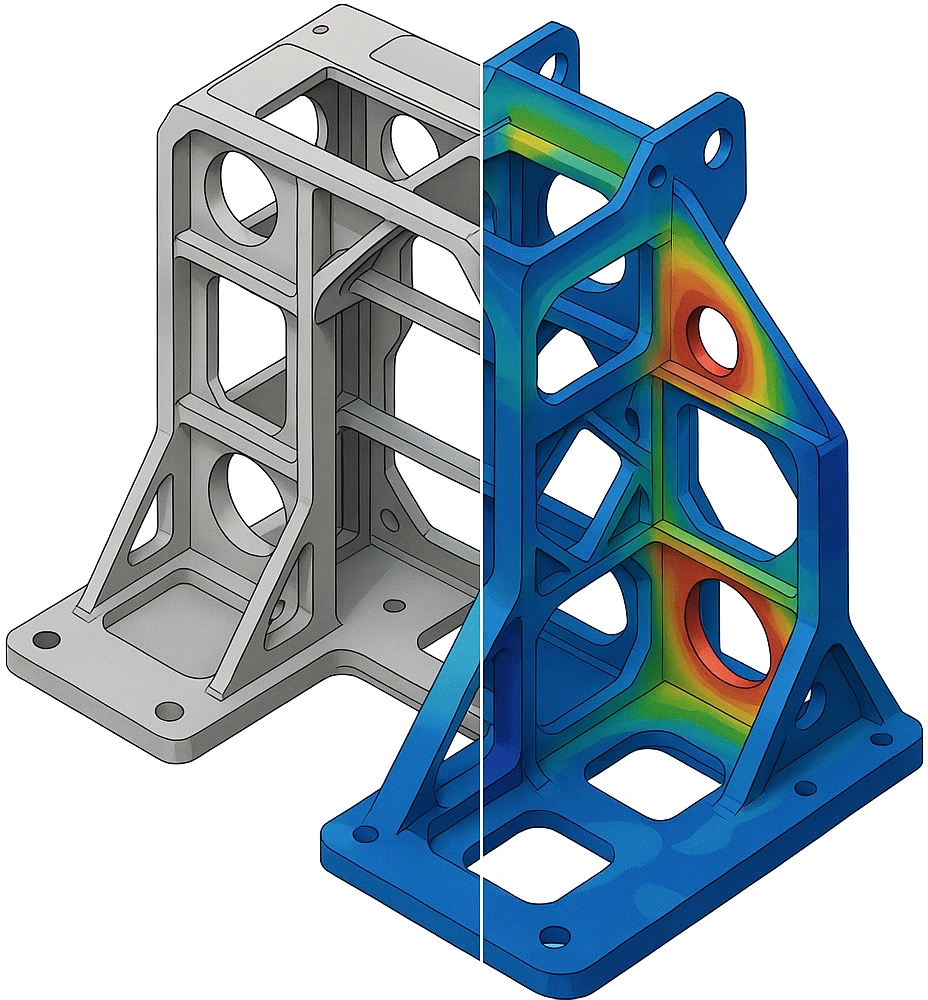
Structural FEA is the digital bridge between mathematical theory and physical reality. It uses the Finite Element Method (FEM) to decompose complex geometries into thousands of manageable elements. By calculating the interaction between these elements, engineers can predict how a product reacts to real-world forces like pressure, gravity, or thermal loads before a single physical prototype is built. This shift to digital twin validation isn’t just about speed; it’s about accuracy. You get granular visibility into critical performance metrics including stress, strain, displacement, and the factor of safety.
Many modern R&D teams are moving away from the heavy overhead of in-house software licenses. The prohibitive cost of high-end seats and the complexity of nonlinear material modeling create unnecessary friction. They’re choosing on-demand expertise to maintain agility and technical precision. This “Simulation-as-a-Service” model replaces legacy software licensing with a faster, more transparent alternative. It allows you to handle peak demand without permanent overhead or long-term contracts.
The Role of FEA in the Product Development Lifecycle
Simulation accelerates every stage of the development cycle. In early-stage design, you can iterate through dozens of versions in hours. This is a feat impossible with traditional physical testing methods. When a component fails in the field, Structural FEA acts as a forensic tool to identify the exact root cause. It shows you precisely where the material reached its limit. Beyond failure, it also drives material optimization. You can strip away excess weight without compromising structural integrity. This ensures your design is as lean as it is strong. It’s about delivering validated designs ready for production with streamlined precision.
Key Metrics: Von Mises Stress and Beyond
Success in simulation requires more than generating a colorful plot. You must understand the relationship between Von Mises stress and the material’s yield strength or ultimate tensile strength. A digital environment provides these metrics with surgical precision, but the data is only as good as its interpretation. “Pretty” stress plots can be misleading without professional validation and logical processes. Our German-based engineering team applies high-fidelity standards to ensure every result is scientifically sound. We don’t just deliver data. We provide validated insights that ready your design for production. This methodical progression mirrors a well-oiled digital workflow, ensuring your information is delivered with momentum and purpose.
The Structural FEA Workflow: 5 Steps to High-Fidelity Results
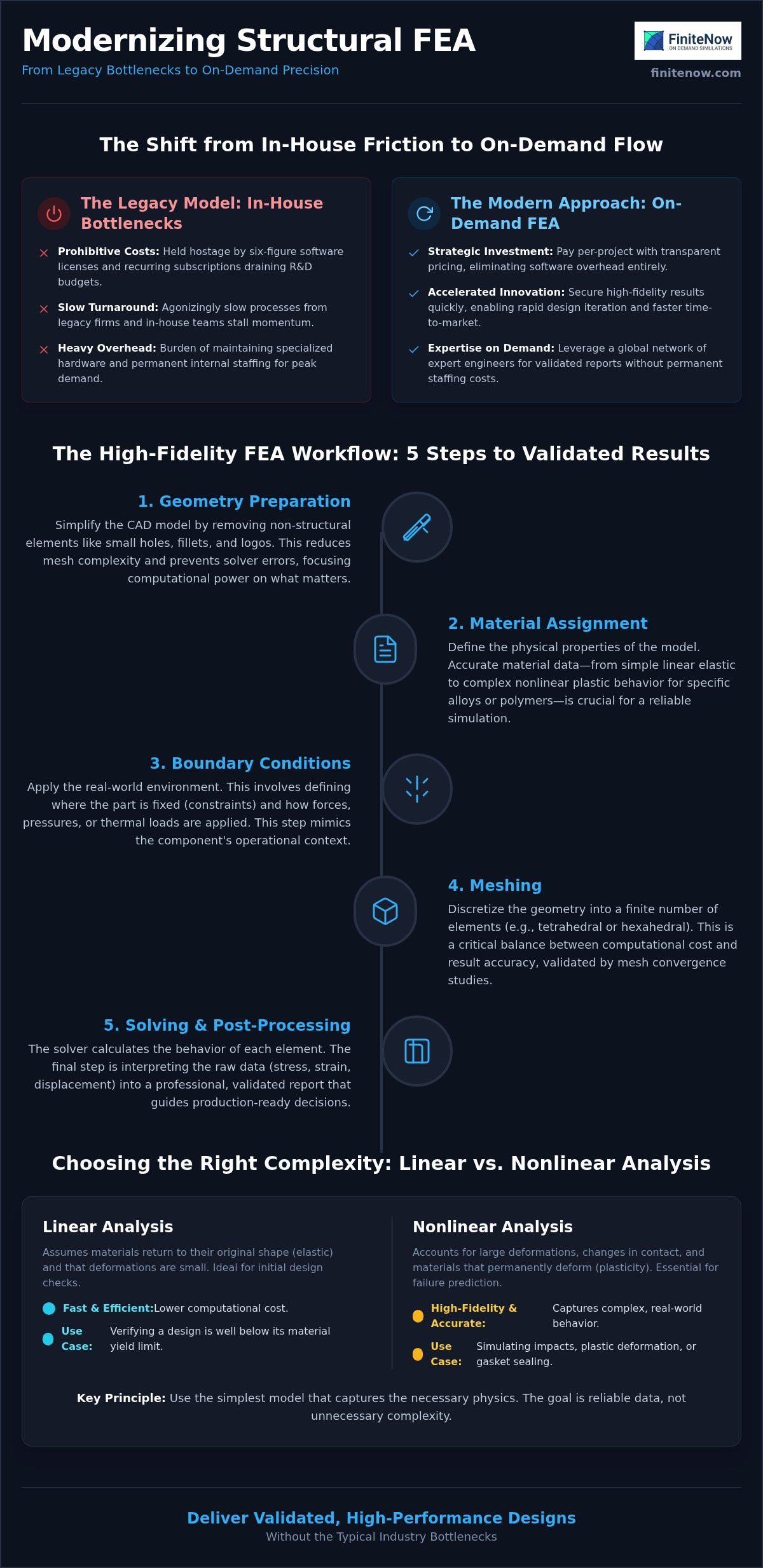
High-fidelity results aren’t accidental. They’re the product of a methodical execution of the principal steps of FEA. This process transforms raw CAD data into a validated engineering asset. Modern Structural FEA requires a disciplined approach to ensure the digital twin matches physical reality without wasting computational resources on unnecessary complexity. Follow these five essential steps to secure reliable data:
- Geometry Preparation: Start by stripping away “fluff.” Remove non-structural fillets, small holes, and logos that don’t impact load paths. This simplification reduces the mesh count and prevents solver errors.
- Material Assignment: Define the physics. Whether you’re using simple linear elastic properties or complex nonlinear plastic behavior, the material model must be accurate to the specific alloy or polymer being used.
- Boundary Conditions: Apply the real-world environment. This involves defining where the part is fixed and exactly where the forces are applied.
- Meshing: Discretize the geometry into elements. This is the critical balance between speed and precision.
- Solving and Post-Processing: Run the simulation and interpret the results. The goal is a professional report that guides production decisions rather than just a collection of colorful plots.
Meshing Strategy: Accuracy vs. Computational Cost
The choice between tetrahedral and hexahedral elements defines your simulation’s efficiency. Hex elements generally offer better accuracy with fewer nodes but are harder to generate for complex organic shapes. We use convergence studies to validate every model. Mesh convergence is the point where further refinement doesn’t change the results. If your stress values fluctuate wildly with mesh density, your results are likely mathematical artifacts, not physical reality. Achieving this balance is what separates professional simulation from amateur guesswork.
Load Cases and Boundary Conditions
Static loads provide a baseline, but dynamic loads reveal how parts behave under impact or vibration. A common pitfall is the “St. Venant’s Principle” trap, where over-constraining a model creates artificial stress concentrations that don’t exist in the real world. Our German-based engineering team ensures boundary conditions reflect physical mounting points and load transfers with clinical precision. If you need this level of validation without the software headache, you can get an instant quote for your specific project today. We focus on the physics so you can focus on the design.
Linear vs. Nonlinear Analysis: Choosing the Right Complexity
Choosing the right simulation depth is a strategic decision that impacts both your timeline and your budget. Linear analysis serves as a fast, efficient baseline. It operates on the assumption of small deformations and material behavior that stays within the elastic limit. If your design doesn’t yield and displacements are minimal, this is your most cost-effective tool for initial validation. It’s the standard for quick iterations where you need to confirm basic structural integrity without heavy computational overhead.
Nonlinear analysis is where the physics get real. You must move beyond the baseline when material yields, parts touch, or geometry changes significantly during loading. For R&D managers, this represents a critical trade-off. While nonlinear Structural FEA provides higher fidelity, it demands more computational power and specialized interpretation. You need this depth when working with complex materials like polymers or elastomers, as their stress-strain curves aren’t simple straight lines. It’s the difference between a “good guess” and a validated production design.
Geometric vs. Material Nonlinearity
Geometric nonlinearity occurs when large deflections change the load path of a structure. Think of a thin bracket bending so much that the direction of the applied force shifts relative to the original orientation. Material nonlinearity involves plasticity, hyperelasticity, and creep. Material nonlinearity is essential for simulating permanent deformation. Without it, you can’t accurately predict if a part will remain bent or if it will return to its original shape after the load is removed. This distinction is vital for ensuring long-term product reliability.
Contact Mechanics and Assemblies
Most engineering failures don’t happen in the middle of a part; they happen at the interfaces. Simulating contact mechanics involves friction and sliding interfaces between multiple components. This is technically challenging but critical for assembly-level analysis. Assembly-level Structural FEA provides significantly more value than single-part analysis because it reveals how tolerances and interactions affect the whole system. FiniteNow uses a high-performance partner network to manage these complex assembly simulations with streamlined precision. We don’t use a “one-size-fits-all” approach. We select the solver complexity that matches your specific design requirements, ensuring you get validated results without paying for unnecessary computational cycles.
The Business Case: Outsourcing vs. In-House FEA
Building an internal simulation department often looks like a strategic asset on paper. In reality, it frequently becomes a significant financial liability. High-fidelity Structural FEA requires more than just a software seat. It demands high-performance computing (HPC) hardware and a team of specialized engineers who stay current with evolving solver technologies. The total cost of ownership for an internal setup often outpaces the actual value generated, especially for firms with fluctuating R&D cycles.
Scalability is the primary driver for modern engineering teams. When your project load spikes, an internal team becomes a bottleneck that delays your time to market. Conversely, during slower periods, you’re left paying for idle software licenses and underutilized staff. The “Simulation-as-a-Service” model solves this by providing on-demand capacity. You pay for validated results instead of maintaining the infrastructure. This shift significantly reduces physical prototyping costs. Digital validation allows you to fail fast in a virtual environment, which is always cheaper than failing on the factory floor.
Eliminating the Software Licensing Burden
Small and medium enterprises (SMEs) frequently struggle with the $20,000 to $50,000 annual price tag associated with professional solvers. These costs are fixed, regardless of how many simulations you actually run. Transitioning to pay-per-project engineering simulation allows you to access Tier-1 simulation power on a flexible basis. You eliminate the software licensing burden and redirect that capital toward product development. For teams ready to make this transition, understanding the full strategic case for engineering simulation without software licenses can clarify exactly how to replace fixed CAPEX with a lean, on-demand model. This approach democratizes high-end engineering, giving smaller teams the same technical edge as global corporations without the massive upfront investment.
Speed to Market: The Instant Quote Advantage
Traditional engineering consulting is notoriously slow. The bidding process alone can take weeks of back-and-forth emails, stalling your design loop before it even starts. We’ve disrupted this legacy standard by replacing slow bids with an instant quoting platform. You get transparent, project-based pricing in seconds. This speed allows you to integrate simulation into every design iteration rather than saving it for a final, high-stakes check. Instant quotes remove the #1 friction point in engineering consulting. It empowers your team to make data-driven decisions at the speed of modern business. If you’re ready to accelerate your development cycle, get an instant quote for your next project and experience a faster way to validate your designs.
On-Demand Structural FEA with FiniteNow
FiniteNow isn’t just an engineering service; it’s a disruption of the legacy consulting model. We bridge the gap between high-level German engineering standards and a scalable global supplier network. This hybrid approach ensures every Structural FEA project benefits from rigorous validation and rapid execution. We’ve eliminated the stuffy, formal barriers of traditional firms to deliver a faster, more transparent alternative. You get the technical mastery of a specialist with the agility of a modern technology firm.
Reliability is built into our foundation. Our network consists exclusively of pre-qualified suppliers, ensuring that every simulation is handled by a vetted expert. This removes the risk of “pretty but wrong” results that often plague unverified freelance platforms. We prioritize your IP protection through robust data security protocols. Your sensitive design data remains confidential throughout the remote simulation process, allowing you to innovate with total peace of mind. We focus on data, validation, and logical processes to ensure your design is production-ready.
The FiniteNow Process: From Quote to Video Call
The journey begins with our instant quoting engine. It evaluates your project complexity in seconds, providing immediate transparency that empowers your decision-making. Once you upload your CAD, the collaboration becomes personal. You’ll refine simulation goals via video calls with experts who understand your intellectual rigor. This isn’t a “black box” service. It’s a high-performance partnership. The final output is a high-fidelity report that serves as a methodical roadmap for your design. It’s not just a data dump; it’s a validated asset grounded in clinical technical precision.
Custom Physics and Multiphysics Capabilities
Modern engineering rarely happens in a vacuum. While Structural FEA is often the core requirement, your designs may demand a multiphysics approach to capture real-world behavior. We integrate thermal analysis and CFD simulation to capture the full environmental reality of your product. Our expertise extends into specialized domains including stent fatigue life, electronics cooling, and complex biomechanics. For teams that also require a dedicated mechanical stress analysis service to validate component-level integrity alongside full assembly simulations, our on-demand platform scales to meet both needs without added overhead. We handle the technical precision so you can focus on the big picture. Get an instant quote for your Structural FEA project today and stop letting software licensing dictate your innovation pace. It’s time to move faster and build smarter with a partner that values your time.
Accelerate Your Path to Production-Ready Design
You’ve seen how modern simulation transforms the engineering workflow from a slow, physical process into a rapid digital evolution. Mastering the five-step workflow and choosing the right complexity between linear and nonlinear models ensures your designs are both lean and reliable. The high cost of software licenses and the friction of traditional consulting shouldn’t stall your innovation. By leveraging on-demand Structural FEA, you gain high-fidelity results without the permanent overhead of legacy tools.
FiniteNow provides the technical mastery of a German-based engineering team combined with instant transparent pricing. We’ve optimized every step of the professional interaction so you can focus on intellectual rigor and product performance. It’s time to stop waiting for physical test results and start validating your ideas in real-time. We handle the complex physics while you maintain total control over your development timeline.
Get an Instant Quote for Structural FEA today and experience a faster, more transparent way to build. Your next breakthrough is just a simulation away.
Frequently Asked Questions
What is the difference between FEM and FEA?
FEM (Finite Element Method) refers to the mathematical framework used to solve differential equations. FEA (Finite Element Analysis) is the practical application of this method to engineering problems. Think of FEM as the engine and FEA as the vehicle. In a Structural FEA context, we use the method to discretize complex geometries into finite elements, allowing us to simulate real-world stresses and strains with high-level technical precision.
How much does a typical structural FEA project cost?
Project costs vary based on geometric complexity, material nonlinearity, and the number of load cases required. We’ve eliminated the traditional “black box” bidding process by providing an instant quoting platform. This ensures you get transparent, project-based pricing in seconds rather than waiting weeks for a proposal. Our model focuses on scalability, allowing you to pay for validated results without the burden of software licensing or permanent overhead.
Can FEA replace physical testing entirely?
Simulation significantly reduces the need for physical prototypes, but it doesn’t always eliminate the final certification test. It allows you to iterate faster and fail in a virtual environment, which is much cheaper than failing on the factory floor. By the time you reach physical testing, your design is already validated through high-fidelity simulation. This methodical approach ensures higher success rates and faster speed to market for production-ready products.
What file formats do I need to provide for a structural simulation?
We primarily work with standard neutral CAD formats like STEP, IGES, and Parasolid (x_t). These formats ensure the highest level of data integrity when transferring geometry into our simulation environment. If you have native files from specific CAD software, our platform is designed to handle most industry-standard exports. Clean geometry is essential for efficient Structural FEA, as it allows for faster meshing and more accurate stress prediction.
How do you ensure the accuracy of the simulation results?
Accuracy is guaranteed through a combination of German engineering expertise and rigorous validation processes. We perform mesh convergence studies to ensure results aren’t artifacts of the discretization. Every project is handled by pre-qualified suppliers and verified by our senior engineering team. This clinical approach to data ensures that the stress and strain results you receive are scientifically sound and ready to guide your manufacturing decisions. For a deeper look at the standards and verification steps that separate reliable analysis from surface-level output, our guide to validating structural integrity with high-fidelity FEA services provides a comprehensive checklist aligned with industry benchmarks like ASME V&V 10-2019.
Is my IP safe when using an on-demand FEA service?
Your intellectual property is protected through robust data security protocols and legally binding non-disclosure agreements. Our platform is built on secure infrastructure designed for sensitive engineering data. We treat your IP with the intellectual rigor it deserves, ensuring that your innovations remain confidential throughout the simulation lifecycle. This transparency and reliability are why modern R&D teams trust us as their high-performance partner for remote analysis.
Do I need to understand FEA math to use your service?
You don’t need to be a mathematician to leverage high-fidelity simulation. Our German-based engineering team handles the complex calculus and material modeling for you. We translate dense technical data into actionable engineering reports that focus on design outcomes. You provide the design goals, and we deliver the validated results, allowing your team to focus on innovation rather than the underlying mathematical framework.
What is the typical turnaround time for a structural analysis report?
Turnaround times are significantly faster than traditional engineering firms due to our streamlined digital workflow. While standard structural projects often take a few business days, the exact timeline depends on the complexity of the assembly and the material models used. Our instant quoting engine provides a clear expectation of the schedule upfront. This speed allows you to maintain momentum in your design loop without the typical industry bottlenecks.
Simulation Work Reinvented