

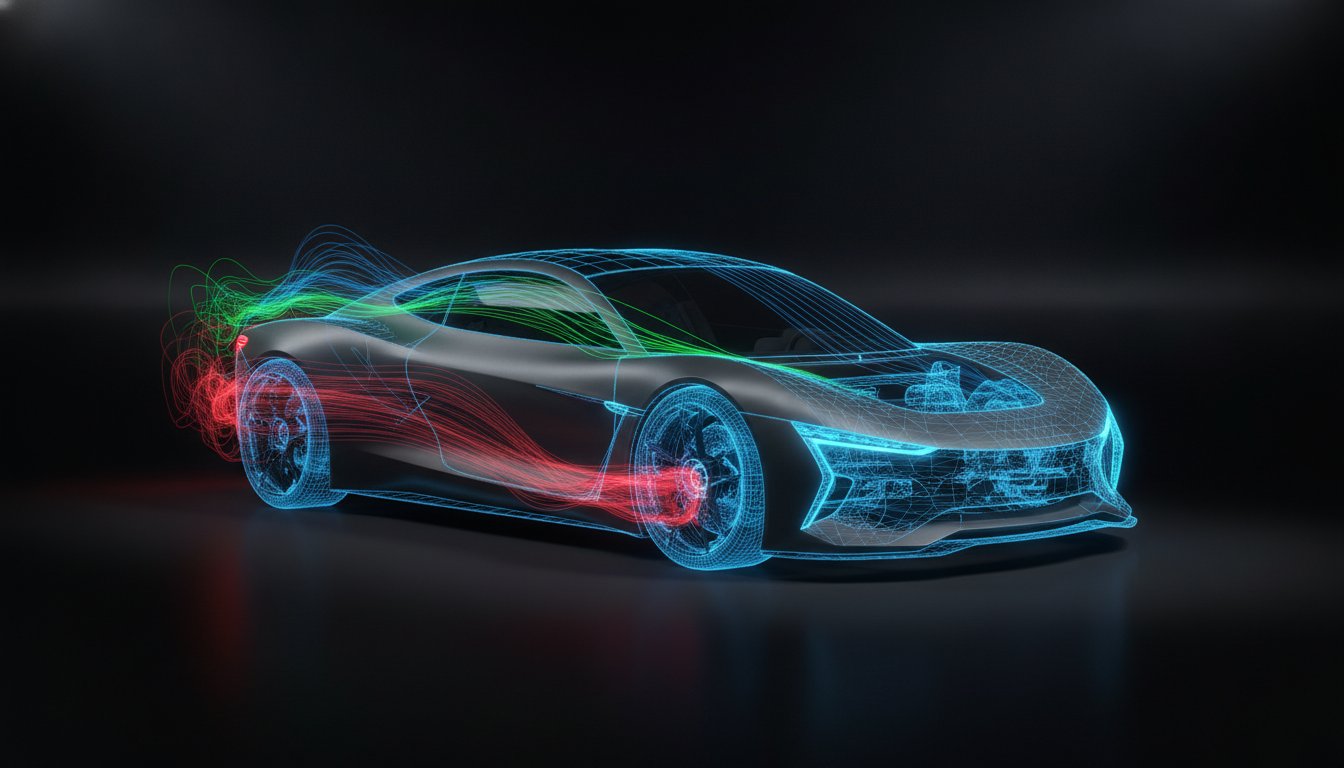
Physical wind tunnels and trial-and-error prototyping are becoming expensive relics of a slower engineering era. In the high-stakes world of product development, CFD simulation has evolved from a luxury for aerospace giants into a scalable, on-demand utility for any firm serious about precision. You already know that waiting weeks for physical test results or paying six-figure software licensing fees kills your momentum. That’s a bottleneck that keeps your best designs on the drawing board while more agile competitors move to market.
This guide will show you how to master the core principles of fluid dynamics and leverage expert-led analysis to validate performance without the traditional overhead. We’ll explore the shift toward cloud-native workflows, which now account for over 36% of new software licensing, and how project-based execution can slash your R&D cycles. Learn to transform complex gas and liquid dynamics into a predictable, cost-effective asset for your engineering team.
Key Takeaways
- Replace physical trial and error with predictive digital twins to significantly shorten your product development cycles.
- Master the full CFD simulation workflow, including mesh generation and grid independence, to ensure high-fidelity results.
- Maximize your R&D budget by opting for scalable simulation clusters instead of expensive physical wind tunnel testing.
- Streamline your CAD preparation with specific techniques like geometry defeaturing and fluid domain extraction for faster analysis.
- Leverage on-demand engineering expertise to secure validated performance results without the burden of long-term software contracts.
What is CFD Simulation and Why is it Critical for Modern Engineering?
Modern engineering doesn’t have time for guesswork. Computational fluid dynamics (CFD) is the digital intersection of fluid mechanics and high-performance computing. It transforms physical fluid behavior into a predictive digital twin. This transition from physical trial and error to high-fidelity CFD simulation allows teams to visualize invisible forces like pressure drops, thermal gradients, and turbulence before a single bolt is tightened. Aerospace and automotive sectors led this shift, but now medical device manufacturers and energy firms use these tools to mitigate risk. If you’re designing a heart valve or a wind turbine, waiting for a physical test to fail isn’t just slow; it’s a financial liability.
The Core Physics: Beyond Simple Flow
The foundation of any CFD simulation rests on the Navier-Stokes equations. These complex partial differential equations describe how the velocity, pressure, and temperature of a moving fluid interact. Engineers must distinguish between laminar flow, where fluid moves in smooth layers, and turbulent flow, characterized by chaotic eddies. Choosing the right turbulence model is critical for accuracy. Additionally, you’ll need to decide between steady-state analysis for constant conditions and transient analysis for systems that change over time, such as a pulsating pump or a rotating turbine. Understanding these regimes is the difference between a pretty visualization and a validated engineering tool.
The Business Case for Digital Fluid Dynamics
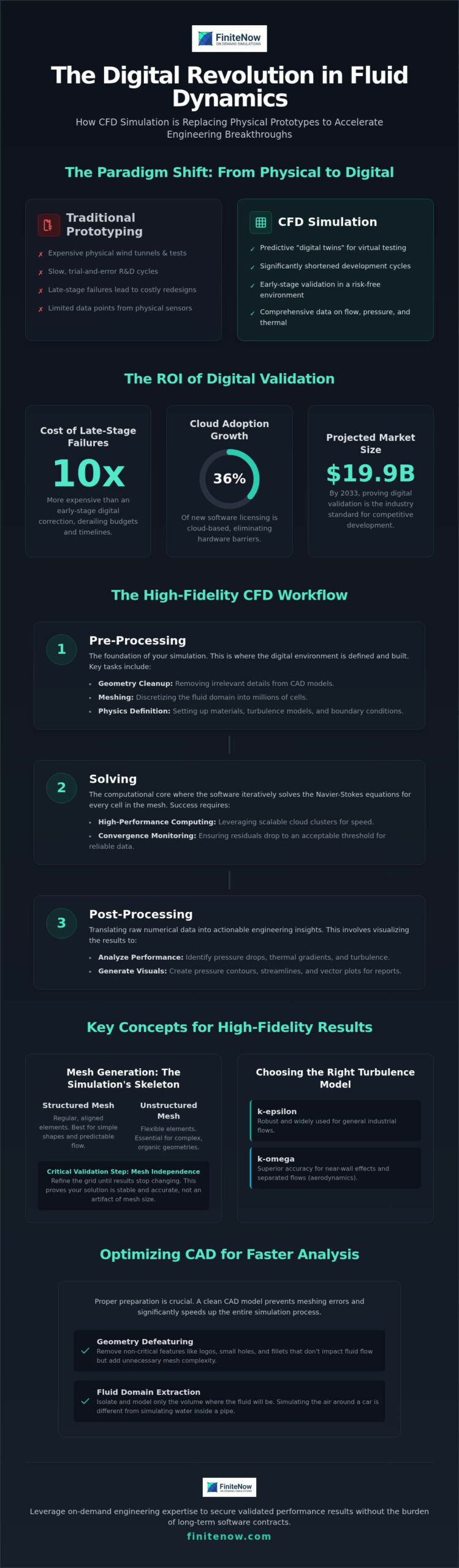
The ROI of simulation is found in the reduction of physical prototypes. Traditional R&D cycles often hit a wall during late-stage testing when a design failure requires a total rethink. These failures can cost ten times more than an early-stage digital correction. By adopting a “Virtual First” workflow, you validate thermal and fluid performance in a risk-free environment. This shift is about speed and scalability. With cloud-based deployment models accounting for over 36% of new software licensing in 2026, the barrier to high-performance computing has vanished. You get professional results without the legacy overhead of local hardware or permanent licenses. This market is projected to reach USD 19.90 billion by 2033, proving that digital validation is no longer optional; it’s the industry standard for competitive development. For a deeper foundation on what is CFD in engineering and how it drives modern product development, our results-oriented primer covers the core principles in detail.
The Mechanics of High-Fidelity CFD: From CAD to Results
High-fidelity CFD simulation requires more than powerful hardware. It demands a rigorous three-stage workflow: pre-processing, solving, and post-processing. Pre-processing is where you define the physics, clean your geometry, and build the digital environment. The solving phase is where the software solves the discretized Navier-Stokes equations across millions of mesh cells. Monitoring residuals is non-negotiable during this stage. If residuals don’t drop to an acceptable threshold, your simulation hasn’t converged, and the data is unreliable. Post-processing then translates these numbers into pressure contours, streamlines, and vector plots. This is where you identify recirculating zones or pressure spikes that could cause fatigue or inefficiency.
Accuracy depends heavily on your boundary conditions. If your inlet velocities, pressures, or wall temperatures are estimated poorly, your results will be flawed. This “Garbage In, Garbage Out” reality makes expert oversight essential for professional-grade validation. You must also select the right turbulence model for your specific regime. The k-epsilon model is widely used for general industrial flows due to its robustness. In contrast, the k-omega model provides superior accuracy for near-wall effects and separated flows, making it a staple for aerodynamic optimization. Choosing the wrong model can lead to significant errors in drag or heat transfer predictions.
Mesh Generation: The Foundation of Accuracy
The mesh is the skeleton of your simulation. Structured meshes use regular, aligned elements and work best for simple shapes where flow direction is predictable. Unstructured meshes offer the flexibility needed for the complex, organic geometries found in modern automotive or aerospace designs. To ensure high-fidelity results, you must employ boundary layer refinement. This technique adds dense layers of cells near solid surfaces, which is used to predict the drag, lift, noise, and heat transfer characteristics of a design accurately. You’ll also need to verify mesh independence. This is a validation step where you refine your grid until the results stop changing, proving your solution is mathematically stable rather than dependent on the mesh size.
Advanced Multiphysics and Specialized Domains
Modern engineering often requires looking beyond simple air or water flow. Fluid-Structure Interaction (FSI) is vital when fluid forces deform the surrounding structure, such as a flexible heart valve or a thin turbine blade. For electronics or engine components, conjugate heat transfer (CHT) models the thermal exchange between fluids and solids simultaneously. When thermal loads also induce structural stress, coupling your CFD results with thermo-mechanical analysis services allows you to predict structural integrity under combined thermal and mechanical loading before a single prototype is built. If your project involves chemical reactions or mixing gases, species transport models track how different substances move and interact within the flow. Handling these complexities requires a level of precision that goes beyond basic CAD-integrated tools. If you’re looking to bypass the learning curve and secure validated results, you can get an instant quote for expert-led analysis today.
Simulation vs. Physical Testing: Evaluating ROI and Accuracy
Legacy engineering relied on physical wind tunnels. These facilities are expensive. They’re also slow. A single test run can cost thousands in facility fees and model preparation. In contrast, high-fidelity CFD simulation runs on high-performance computing (HPC) clusters at a fraction of that cost. The scalability is the real disruptor here. You can’t build and test 100 physical wing profiles in a week. You can run 100 digital iterations simultaneously. This massive parallelization compresses R&D cycles from months to days. It’s the difference between testing a few safe designs and exploring the full potential of your engineering space.
The “accuracy gap” is a common concern, but it’s largely a relic of underpowered hardware. Modern solvers handle complex physics with high precision. While a physical test gives you a single data point from a sensor, a simulation gives you the full field. You see every pressure gradient and velocity vector in high resolution. It’s the difference between a flashlight and a floodlight. You aren’t just checking if a design works; you’re seeing exactly why it fails. This visibility allows for granular optimization that physical sensors simply can’t capture. Engineers who are new to digital validation will find a practical breakdown of what is CFD in engineering and how to apply it effectively in our 2026 primer.
When to Use Physical Prototyping
Physical testing isn’t dead. It’s just relocated to the end of the process. You should use it for final regulatory validation or edge cases with extreme multiphysics coupling that exceed current modeling limits. CFD simulation acts as the filter. It eliminates 95% of failing designs before you ever touch a CNC machine. It also optimizes your physical experiments by identifying exactly where to place sensors to capture the most critical data. This targeted approach ensures your final physical test is a confirmation, not a discovery mission.
The Economics of On-Demand Analysis
Software licensing is a legacy trap. Dropping $50,000 on an annual seat you only use 20% of the time is inefficient. When you factor in the high cost of specialized engineering salaries, the overhead becomes prohibitive for many firms. On-demand analysis flips this model. You pay for the project, not the idle software. This shift provides several advantages:
- Eliminate prohibitive upfront licensing fees.
- Access German-based engineering expertise without the full-time headcount.
- Use instant quoting to lock in project budgets immediately.
- Scale your simulation capacity up or down based on your current R&D load.
This project-based execution ensures that your budget goes directly toward design validation rather than software maintenance. It’s a faster, more transparent alternative to traditional consulting or in-house overhead. Teams looking to fully eliminate CAPEX from their simulation stack will find a detailed breakdown of engineering simulation without software licenses and the strategic shift to on-demand expertise particularly valuable. Engineering leaders looking to evaluate partners based on transparency and ROI will find a detailed framework in our executive guide to CFD simulation consulting selection and ROI.
Optimizing Your CAD for CFD: A Preparation Checklist
Raw CAD is rarely simulation-ready. Production-level models are often cluttered with manufacturing details that provide zero value to fluid dynamics. Throwing a “dirty” model into a CFD simulation is a fast track to solver instability and inaccurate results. Clean geometry is the price of admission for high-fidelity validation. If you want results that translate to real-world performance, you must treat CAD preparation as a dedicated engineering step rather than an afterthought.
- Step 1: Geometry Defeaturing. Remove non-essential details. Bolts, threads, microscopic fillets, and embossed logos add millions of unnecessary mesh cells. They don’t influence flow behavior, but they do skyrocket compute time and cost.
- Step 2: Fluid Domain Extraction. Define the volume where the fluid actually travels. In most cases, you aren’t simulating the solid part; you’re simulating the void inside or around it. Extracting this negative space is critical for accurate internal flow analysis.
- Step 3: Watertight Geometry Check. Ensure the digital volume is completely sealed. A single gap of 0.001mm can cause a “leaking” simulation where fluid escapes into the digital vacuum, causing the solver to crash.
- Step 4: Boundary Surface Identification. Label your surfaces before export. The solver needs to know exactly which face is an inlet, an outlet, or a symmetry plane. Clear naming in your CAD software saves hours of manual setup during the pre-processing phase.
Common CAD Pitfalls in CFD
Tiny gaps and “sliver” surfaces are the primary killers of simulation efficiency. These geometric errors force the mesher to create extremely small, high-aspect-ratio cells that degrade numerical stability. Similarly, overly complex fillets in non-critical areas can lead to massive mesh spikes. To stay agile, you should maintain parametric links between your simplified CFD model and your master production CAD. This allows you to push design changes through the pipeline without restarting the cleanup process from scratch every time you iterate.
Data Security and Technical Requirements
Standardize your file exports to maintain geometric integrity. We prefer Parasolid (.x_t) or STEP (.stp) formats because they preserve the underlying mathematical definitions of your surfaces better than mesh-based formats like STL. Proprietary designs require high-level security. At FiniteNow, we treat your intellectual property with strict engineering confidentiality and German-led precision. We utilize secure data transfer protocols to ensure your sensitive R&D data remains protected throughout the analysis. Ready to validate your design? You can get an instant quote for your project and move from CAD to results in days, not weeks.
On-Demand CFD: Professional Results Without the Overhead
Traditional engineering consulting is often a black box. You submit a request, wait days for a proposal, and then deal with billable hours that spiral out of control. FiniteNow disrupts this legacy model by treating CFD simulation as a transparent, on-demand service. This isn’t just about providing access to software. It’s about delivering validated, project-based results that integrate directly into your existing R&D cycle. You don’t need to manage complex hardware or maintain expensive licenses to move your product forward. If you’re evaluating whether to build internal capability or partner with specialists, our guide on selecting the right CFD simulation consulting partner covers the key criteria and cost trade-offs in detail.
The transition to on-demand analysis allows your team to focus on design while we handle the heavy lifting of numerical validation. By removing the barriers of software overhead and long-term contracts, you gain the agility of a much larger firm. This model is specifically designed for engineering teams that value speed and intellectual rigor. You get the technical mastery of a specialist partner without the commitment of a permanent headcount.
The German Engineering Advantage
Reliability is built into our DNA. Every project is overseen by a German-led engineering team that prioritizes precision and data integrity. We don’t just run the solver; we validate every report through a rigorous internal review process. This ensures that the insights you receive are technically sound and ready for implementation. If you have questions about the results, you can collaborate directly with our experts via video calls. This transparency ensures that the CFD simulation remains a collaborative tool rather than a static document.
Scaling Your Engineering Capabilities
Project loads are rarely constant. Hiring full-time simulation experts to handle peak R&D phases is often a financial drain during slower periods. Our platform allows you to scale your capabilities instantly. The process is streamlined for maximum efficiency: upload your optimized CAD, receive an instant quote, and initiate the execution. This workflow mirrors the speed of a modern technology firm, ensuring your information is delivered with momentum and purpose. It’s time to stop managing software and start validating performance.
Get an instant quote for your CFD simulation project and accelerate your development cycle today.
Scale Your Engineering Precision Today
Engineering excellence is no longer tied to massive software budgets or physical wind tunnels. You’ve seen how digital twins compress R&D cycles and how proper CAD preparation prevents solver failure. The shift toward high-fidelity CFD simulation allows your team to iterate faster while maintaining technical rigor. By replacing trial and error with predictive modeling, you eliminate the risk of late-stage design flaws and secure a competitive advantage in the market.
FiniteNow simplifies this transition through a disruptive, on-demand model. You get the precision of a German-based engineering team without the burden of long-term software licenses or contracts. Our platform provides instant quoting in seconds, ensuring your project moves forward at the speed of modern business. It’s time to stop managing overhead and start delivering validated performance.
Get an Instant CFD Simulation Quote and take the first step toward optimized fluid dynamics. Your next breakthrough is just a simulation away.
Frequently Asked Questions
How accurate is CFD simulation compared to real-world testing?
High-fidelity CFD is extremely accurate when boundary conditions are correctly defined. It often matches physical test results within a 1% to 5% margin. Unlike physical sensors that provide point data, simulation offers a full-field view of every pressure and velocity vector. It’s the best way to identify local phenomena that physical testing might miss, providing a more comprehensive validation of your design’s performance.
Do I need to own CFD software to work with FiniteNow?
You don’t need any software licenses or local hardware to work with us. We provide the expertise and the high-performance computing clusters required for the analysis. You’ll simply upload your CAD files and receive the validated results. This model eliminates the need for expensive annual subscriptions and the IT overhead associated with maintaining complex simulation environments in-house. For engineering teams ready to fully embrace engineering simulation without software licenses, our strategic guide outlines exactly how to make that transition. It’s a faster, more transparent way to work.
What file formats do I need to provide for a CFD analysis?
We prefer neutral CAD formats such as STEP (.stp), Parasolid (.x_t), or IGES (.igs). These formats preserve the mathematical integrity of your surfaces and allow for cleaner mesh generation. While mesh-based formats like STL are sometimes used, they often require significant cleanup before a high-fidelity CFD simulation can begin. Using high-quality geometric data ensures the solver remains stable and the results are reliable.
How long does a typical on-demand CFD simulation take?
Turnaround times depend on project complexity and the required mesh density. Most standard industrial simulations are completed within 3 to 7 business days. Our streamlined workflow and German-led engineering team prioritize rapid execution without compromising the rigor of the validation process. You’ll get the data you need to make design decisions quickly, effectively shortening your overall R&D cycle. It’s built for speed.
Can CFD simulate both liquids and gases in the same project?
Multiphase flow models allow us to simulate the interaction between different states of matter in a single project. This capability is essential for analyzing fuel atomization, tank sloshing, or aeration processes. We use specialized solvers to track the interface between liquids and gases with high precision. This ensures that complex interactions, such as surface tension and phase changes, are captured accurately and reliably.
What is the difference between steady-state and transient CFD?
Steady-state analysis calculates a time-averaged solution where flow properties remain constant. It’s the most efficient choice for continuous, stable processes. Transient CFD models time-dependent behavior, such as a rotating turbine or a pulsating valve. While transient runs demand significantly more compute power, they’re necessary for capturing dynamic instabilities and time-varying loads that a steady-state run would ignore. It’s about choosing the right tool for the job.
How much does a professional CFD simulation service cost?
Pricing is determined by the complexity of the physics and the computational resources required for the mesh. Our instant quoting platform provides a transparent price in seconds based on your specific project parameters. This project-based model’s a cost-effective alternative to traditional consulting. You’ll only pay for the validated results you need without any hidden fees or long-term contracts. It ensures your budget stays focused on design results.
Is my proprietary design data secure when using an on-demand service?
Data security is a non-negotiable priority for our engineering team. We use secure transfer protocols and strict confidentiality agreements to protect your intellectual property. Your proprietary designs are handled by our internal team under rigorous data protection standards. This ensures your sensitive R&D data remains proprietary throughout the CFD simulation process, providing peace of mind while leveraging external expertise. Your information is protected at every step.
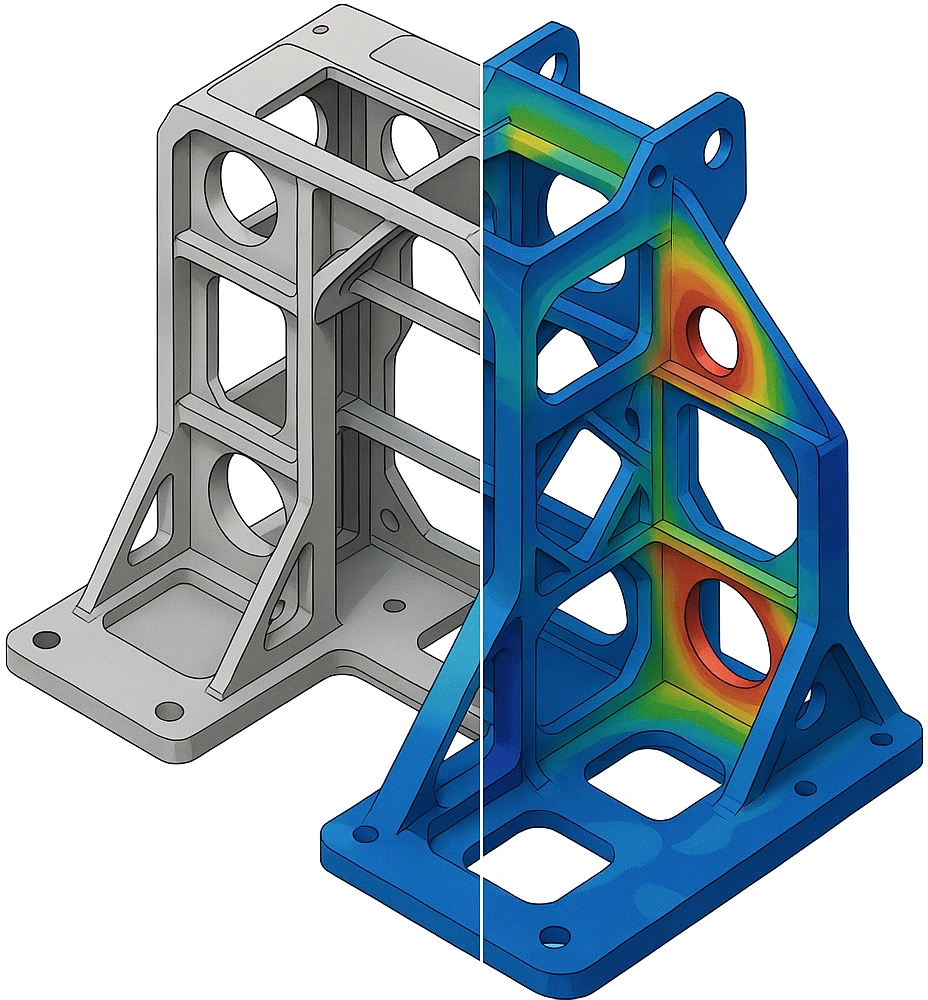
Simulation Work Reinvented