

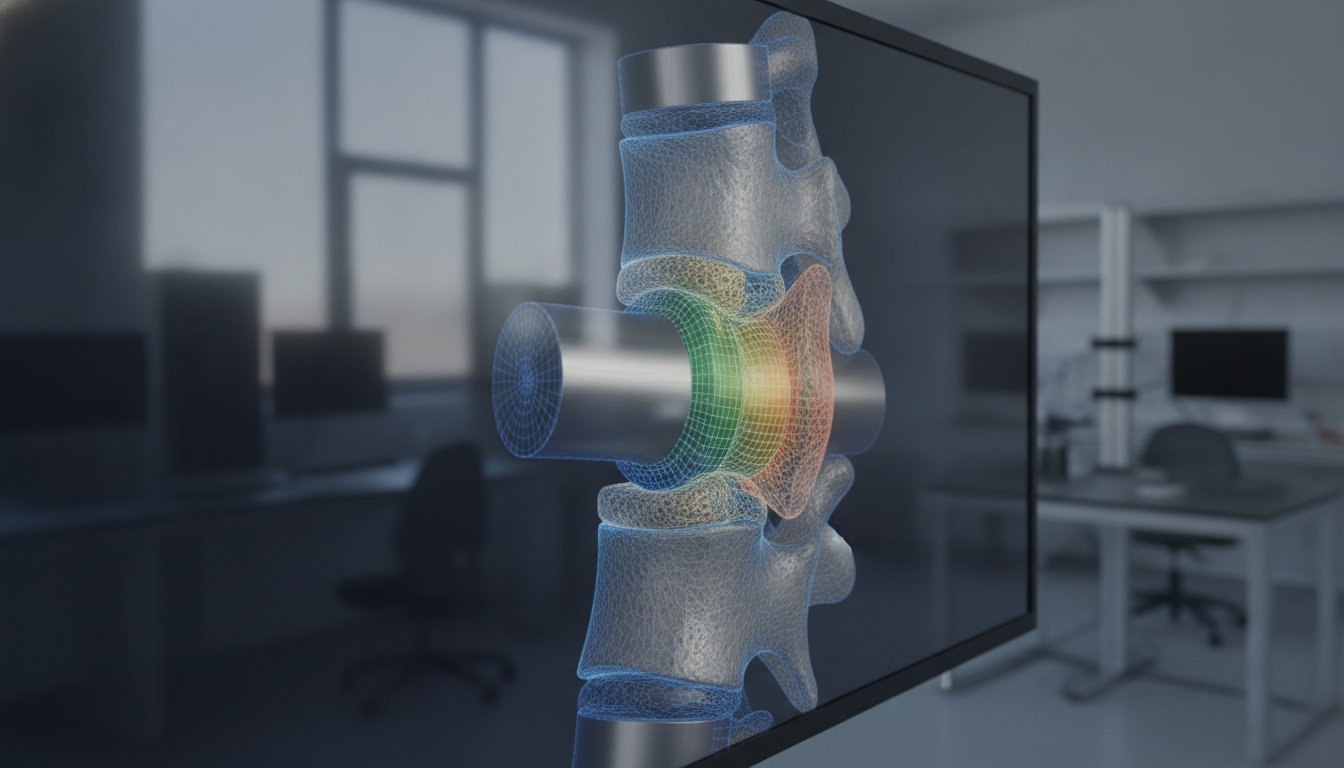
The era of relying solely on physical bench testing for medical device certification is officially over. Today, the FDA actively encourages in silico evidence to reduce reliance on costly animal trials and destructive testing. Yet, many engineering managers still face the same old bottlenecks: opaque pricing from legacy firms and lead times that threaten critical launch windows. You know that failing a physical prototype at the eleventh hour isn’t just a technical setback; it’s a massive drain on R&D resources. Utilizing high-fidelity FEA for medical implants is no longer a luxury for specialized research, but a baseline requirement for modern biomechanical validation.
In this guide, you’ll discover how to leverage advanced simulation to accelerate regulatory approval and ensure the structural integrity of complex implants. We’ll show you how to move away from unpredictable consulting fees toward a transparent, on-demand simulation model. You’ll learn about the shift toward patient-specific modeling and how to produce high-fidelity reports ready for ISO and FDA audits. We are breaking down the frameworks, including ASME V&V 40-2018, that turn computational models into credible, submission-ready data that gets your device to market faster.
Key Takeaways
- Learn how the FDA uses the ASME V&V 40 framework to evaluate FEA for medical implants, enabling the shift from physical bench testing to digital validation.
- Discover how Nonlinear FEA and Fatigue Analysis predict long-term performance and structural integrity in complex biological environments.
- Compare the commercial ROI of virtual testing against physical prototypes to accelerate design iteration cycles and reduce total R&D spend.
- Explore the critical requirements for high-fidelity reporting that ensure your simulation data is ready for rigorous ISO and FDA regulatory audits.
- Understand how on-demand engineering services bypass traditional procurement bottlenecks to deliver expert results without long-term contracts.
Why is FEA Critical for Medical Implant Design and Regulatory Approval?
Medical implant development is moving away from the “build and break” cycle. Traditional physical testing is slow. It consumes R&D budgets and delays patient access to life-changing technology. FEA for medical implants serves as a high-fidelity digital twin, simulating how a device behaves in vivo before a single prototype is manufactured. This methodology allows engineers to analyze complex biomechanical interactions under physiological loads that are difficult to replicate in a laboratory setting.
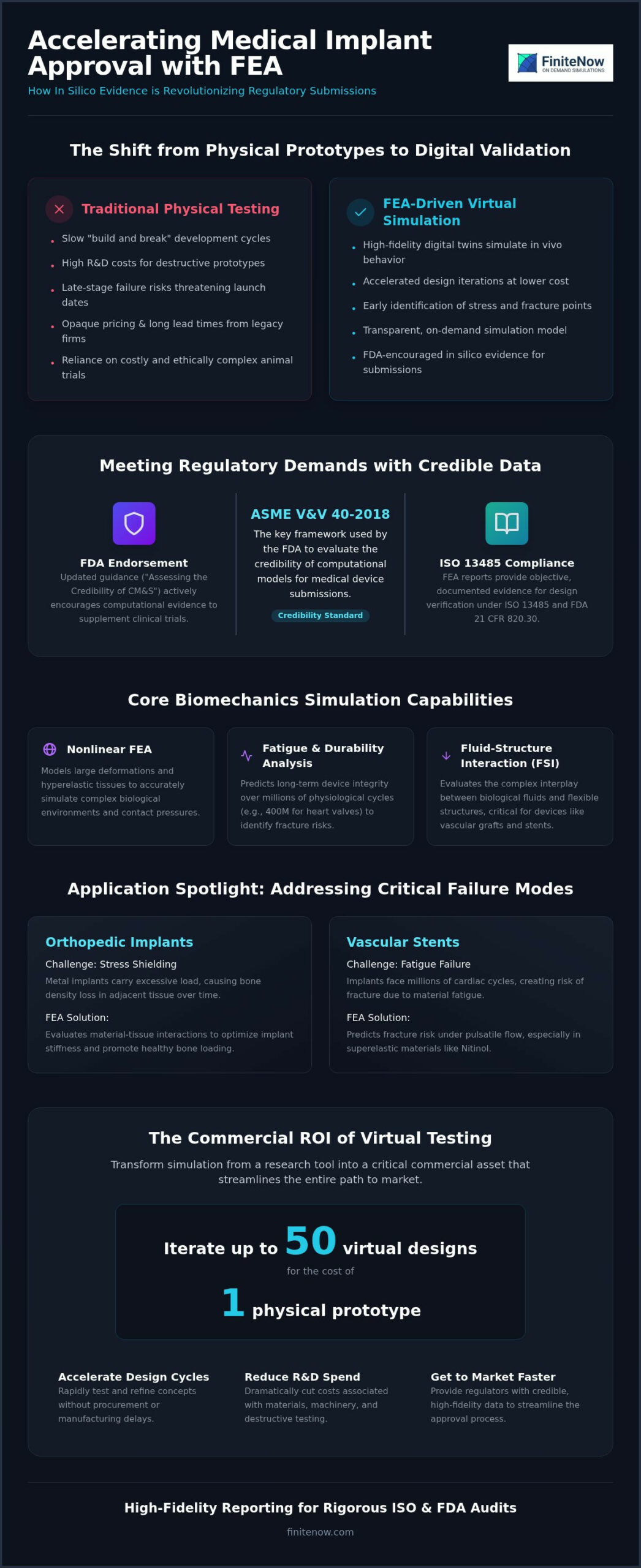
This shift isn’t just an internal preference; it’s a regulatory mandate. On November 16, 2023, the FDA released updated guidance titled “Assessing the Credibility of Computational Modeling and Simulation in Medical Device Submissions.” Regulators at the FDA and EMA now actively use computational evidence to supplement clinical trials. By using the Finite Element Method (FEM), engineers can identify stress concentrations and potential fracture points early in the design phase. This reduces the number of expensive bench tests required for submission. It transforms simulation from a research tool into a critical commercial asset that streamlines the entire path to market.
The Role of FEA in ISO 13485 and FDA Submissions
Simulation serves as a primary design verification output within the medical device quality management system. Under ISO 13485 and FDA 21 CFR 820.30, manufacturers must demonstrate that their device meets specified requirements through rigorous Design Controls. Professional FEA reports provide the objective evidence needed for the technical file. These reports document the boundary conditions, material properties, and mesh convergence studies that prove your device is safe for human use. High-fidelity simulation ensures your regulatory submission is grounded in validated data rather than guesswork, giving auditors the confidence they need to approve your device.
Addressing Failure Modes in Orthopedic and Vascular Implants
Predicting how an implant survives 10 to 20 years of physiological loading is impossible with short-term bench testing alone. Orthopedic implants often suffer from stress shielding, where the metal implant carries too much load and causes bone density loss in the surrounding tissue. Vascular stents face the risk of fatigue failure after millions of cardiac cycles. Specialized Structural FEA allows you to evaluate these material-tissue interactions in weeks rather than years. You can iterate through 50 design variants virtually for the cost of one physical test. This level of precision identifies common failure modes like wear and fatigue before they reach a patient, protecting both the user and your brand reputation.
Core Biomechanics Simulation Capabilities: From Nonlinear FEA to Fatigue Life
Simulation in the medical sector demands a departure from standard linear assumptions. Biological environments are inherently complex. They involve large deformations, hyperelastic tissues, and fluid-structure interactions (FSI). High-fidelity FEA for medical implants must account for these nonlinearities to provide actionable data. Whether it’s the contact pressure between a hip stem and a femur or the FSI required for vascular grafts, the accuracy of your results depends on sophisticated material modeling and solver settings.
Reliability is paramount. Fatigue analysis allows engineers to predict the long-term durability of devices that must endure millions of cycles. For instance, heart valves and stents are often tested to 400 million cycles to represent a ten-year lifespan. Physical testing at this scale takes months. Computational modeling achieves this in days, identifying potential fracture risks and wear patterns early. Following the FDA guidance for computational modeling ensures these simulations are documented correctly for regulatory review.
Stent Fatigue Life Simulation and Durability
Nitinol stents present a unique challenge due to their superelasticity and shape memory effects. Standard structural analysis isn’t enough. You need to model the phase transformation between austenite and martensite during deployment and physiological loading. Predicting fracture risk under pulsatile blood pressure requires high-cycle fatigue evaluation. By integrating coupled-field analysis services, you can evaluate how thermal changes affect the mechanical behavior of these smart materials. This multiphysics approach is essential for ensuring stent patency and preventing catastrophic migration or breakage.
Orthopedic Arthroplasty and Stress Shielding
Orthopedic implants must balance structural stiffness with biological compatibility. A common failure mode in hip and knee replacements is stress shielding. This occurs when the metal implant carries the majority of the load, causing the surrounding bone to atrophy due to lack of stimulation. Simulation allows for the detailed study of bone remodeling by analyzing stress distribution across the bone-implant interface. Modal analysis is also critical here. It identifies the natural frequencies of the assembly to prevent vibration-related loosening. If you’re looking to streamline this validation process, you can get an instant quote for specialized biomechanics support from our engineering team.
Virtual Simulation vs. Physical Testing: A Commercial Comparison
Physical bench testing is the traditional gatekeeper of medical device R&D. It’s a linear, slow, and expensive process. Transitioning to FEA for medical implants changes the commercial math entirely. You get actionable results in days. Lab testing often takes months. This speed isn’t just a convenience; it’s a competitive advantage that shortens your time-to-market and extends your product’s effective patent life.
The ability to iterate is where the ROI becomes undeniable. A single physical test for a spinal cage or hip implant requires expensive materials, machining, and lab time. Simulation lets you test 50 design variants virtually for the cost of one physical test. You can simulate extreme, worst-case scenarios like off-axis loading or high-velocity impact. These are often difficult or dangerous to replicate in a lab. FEA provides a level of data depth that physical sensors cannot match. While a strain gauge only measures surface data, simulation visualizes internal stress gradients, revealing exactly where a device might fail from the inside out. The same principle of replacing reactive physical testing with proactive simulation applies across industries; for example, FEA for consumer electronics uses identical predictive failure analysis frameworks to address solder joint fatigue and drop-test performance before a single prototype is built.
Reducing Physical Prototyping Costs
A failed physical test late in the R&D cycle is a financial disaster. It resets your timeline and burns through your budget. Use FEA as a rigorous “pre-test” to ensure first-time success in the lab. This proactive approach identifies weak points before you commit to manufacturing. Many firms are now making the strategic shift to engineering simulation without software licenses. This on-demand model removes the massive overhead of annual software seats and specialized training, allowing you to pay only for the results you need. For medical device teams adopting additive manufacturing to produce complex implant geometries, structural analysis for additive manufacturing goes beyond standard FEA to account for the layer-dependent residual stresses and anisotropic properties that standard tools miss, preventing costly build failures in Titanium and Inconel components.
When Physical Testing is Still Required
Simulation doesn’t replace physical validation; it optimizes it. The relationship between the two is a synergy known as Verification and Validation (V&V). Use FEA for medical implants to justify your “worst-case” selection for regulatory bodies. Instead of testing every size in a product family, you use simulation to prove which geometry is most likely to fail. This evidence allows you to reduce the total sample size required for statistical significance. You save on material costs and lab fees while maintaining a robust technical file that satisfies FDA requirements.
Validation Frameworks: ASME V&V 40 and High-Fidelity Reporting
Establishing model credibility is the most significant hurdle in regulatory submissions. Regulators don’t just want to see colorful stress plots; they want proof that your simulation accurately represents the clinical reality. The ASME V&V 40-2018 standard provides the definitive roadmap for this process. It moves FEA for medical implants from a “black box” exercise into a transparent, risk-based validation framework. By following this standard, you provide the objective evidence required to justify using a digital twin in place of physical bench testing.
The framework distinguishes between Verification and Validation. Verification focuses on the technical side: did you solve the equations correctly? This includes code verification and calculation verification through mesh convergence studies. Validation is the comparison to reality: does the model’s predicted strain match the experimental data from a cadaveric or synthetic bone test? To bridge the gap between these two, engineers must use sensitivity analysis to identify which input variables, such as bone density or friction coefficients, have the greatest impact on implant safety. Uncertainty quantification then accounts for the natural biological variance found across different patient populations.
Establishing Model Credibility for Regulatory Bodies
Model credibility starts with defining the Context of Use (CoU). You must clearly state exactly what the simulation is intended to do. Is it a low-risk sizing comparison, or is it a high-risk simulation replacing a clinical endpoint? The higher the model’s influence on the design decision, the more rigorous the validation requirements become. These same mechanism design simulation service principles are now being applied to surgical robotics, where the interaction between moving hardware and soft tissue requires extreme precision and validated kinematic models.
Generating Professional FEA Reports for Audits
An audit-ready report is more than a summary of results. It’s a document of traceability. It must justify every boundary condition, material property, and mesh density choice. Transparency is your greatest asset here. Models that claim “perfect” agreement with experimental data often raise red flags for auditors. Instead, high-fidelity reports should acknowledge assumptions and document the margins of error. This level of detail ensures that your technical file remains robust during ISO or FDA reviews. If you need a validation-ready technical file that meets these standards, you can access our on-demand simulation expertise to streamline your next submission.
Procuring On-Demand Biomechanics Expertise: The FiniteNow Advantage
Traditional engineering firms operate on a slow, opaque bidding cycle. You often wait weeks for a quote, only to face rigid contracts and hidden fees. FiniteNow disrupts this legacy model by providing a transparent, results-oriented alternative. Our platform allows you to procure high-fidelity FEA for medical implants without the administrative friction of standard consulting. By combining German engineering precision with an agile, on-demand infrastructure, we ensure your R&D projects remain on schedule and within budget. You get the expertise of a specialized core team without the burden of long-term commitments.
Scalability is built into our DNA. We’ve established a pre-qualified network of biomechanics simulation experts to handle surges in project volume. This means you don’t have to worry about our capacity when your development timeline accelerates. Whether you’re validating a single orthopedic screw or a complex vascular system, we provide the high-fidelity reports required for regulatory success. Our pay-per-project model offers the flexibility that agile R&D teams need to stay competitive in the fast-moving medical device market.
The On-Demand Simulation Workflow
Speed is a core component of our service delivery. We’ve optimized the engagement process to mirror the rapid development cycles of modern medical device firms. Our workflow is designed to move your project from CAD to validated results in a fraction of the time required by traditional firms. This efficiency doesn’t sacrifice quality; it removes the bureaucratic barriers that slow down technical innovation.
- Step 1: Upload your CAD files and define your specific biomechanical requirements through our secure portal.
- Step 2: Receive an automated, transparent quote instantly. You won’t have to wait for sales calls or back-and-forth negotiations.
- Step 3: Collaborate directly with our simulation experts via video calls to refine the model and review results.
Beyond Software Licenses: Accessing Results, Not Tools
Software licensing is a significant barrier to entry for many R&D teams. Annual seats for high-end multiphysics solvers are expensive. They also require specialized training and high-performance IT infrastructure. We eliminate these overhead costs. You pay for engineering insights, not the tools used to generate them. This allows you to allocate your budget toward actual device innovation rather than software maintenance or on-site staffing.
This flexibility is particularly valuable when dealing with complex environmental factors. For instance, medical equipment must maintain its structural integrity through rigorous sterilization cycles. Leveraging our thermo-mechanical analysis services helps you predict how repeated heat exposure affects material properties and tolerances. By focusing on high-fidelity results, you ensure your device is safe, durable, and compliant without the burden of managing a local simulation department.
Accelerating Your Path to Regulatory Approval
Modern biomechanics engineering moves faster than legacy consulting firms can handle. By integrating high-fidelity FEA for medical implants, you transform simulation from a research curiosity into a powerful regulatory and commercial asset. You’ve seen how the ASME V&V 40 framework provides the credibility required by the FDA, and how virtual iteration drastically reduces the risk of expensive physical prototype failure. This isn’t just about better math. It’s about getting your life-saving device to patients months ahead of the competition.
FiniteNow eliminates the traditional barriers of long lead times and opaque pricing. Our German-based engineering team delivers ISO-compliant reporting that stands up to the most rigorous audits. You don’t need to manage complex software licenses or wait weeks for a bid. You can get an instant quote for your biomechanics FEA project right now and start leveraging on-demand expertise for your next validation cycle. The future of medical device development is digital, transparent, and built on speed. We’re ready to help you lead that charge.
Frequently Asked Questions
Is FEA simulation accepted by the FDA for medical implant approval?
Yes, the FDA actively encourages the use of computational modeling and simulation (CM&S) to provide evidence for regulatory submissions. The current guidance, released in November 2023, outlines a risk-informed framework for establishing model credibility. By following the ASME V&V 40 standard, manufacturers use FEA for medical implants to supplement clinical trials and bench testing. This approach is a recognized method for demonstrating device safety and performance in a virtual environment.
How much does a typical biomechanics FEA project cost?
Project costs vary based on geometric complexity, material nonlinearities, and the number of physiological load cases required. FiniteNow removes the pricing opacity typical of legacy engineering firms by using an automated instant quoting platform. You pay per project without the burden of long-term contracts or expensive software licenses. This transparent model allows R&D managers to predict simulation spend accurately and allocate resources toward engineering insights rather than administrative overhead.
What is the difference between verification and validation in medical FEA?
Verification is the process of ensuring the mathematical model is solved correctly. It focuses on code accuracy and calculation precision through mesh convergence studies. Validation proves the model accurately represents the physical world by comparing simulation results against experimental bench data or clinical observations. Both steps are mandatory under the ASME V&V 40 framework. They establish the necessary credibility for using digital twins in regulatory technical files and design reviews.
Can FEA replace all physical testing for a new medical device?
FEA cannot replace all physical testing, but it drastically reduces the volume of bench tests required. Regulators usually require at least one physical test to validate the computational model’s accuracy. Once you’ve established this baseline, you can use simulation to justify “worst-case” scenarios across an entire product family. This strategy allows you to skip physical testing for intermediate sizes or minor design variations, saving significant material costs and lab time.
What file formats are required to start a biomechanics simulation?
You should provide high-quality 3D CAD data in neutral formats like STEP (.stp) or Parasolid (.x_t) to ensure geometric integrity. These formats allow for the high-fidelity meshing required in biomechanical analysis. If your project involves patient-specific anatomy, we can also work with STL files derived from CT or MRI scans. Along with the geometry, you’ll need to define material properties, intended load cases, and the specific boundary conditions for the simulation.
How do you ensure the confidentiality of sensitive medical device IP?
We protect your intellectual property through formal Non-Disclosure Agreements (NDAs) and secure, encrypted data exchange portals. Our core engineering team is based in Germany, which means we operate under some of the world’s strictest data protection and privacy standards. This geographical advantage provides an extra layer of legal and technical security for your sensitive R&D data. Your IP remains confidential from the initial instant quote through to the final report delivery.
What standards govern the use of simulation in the medical device industry?
The primary standard is ASME V&V 40-2018, which provides the framework for assessing the credibility of computational models. Additionally, the FDA’s 2023 guidance on computational modeling serves as the benchmark for regulatory submissions. Simulation results must also comply with ISO 13485 design control requirements. These standards ensure that FEA for medical implants is performed with the traceability and technical rigor necessary for international market certification and patient safety.
How long does it take to get results from an on-demand FEA service?
Lead times are significantly faster than traditional engineering consultancies. You receive an instant quote immediately upon uploading your project requirements to our platform. While the actual execution time depends on the simulation’s complexity, most high-fidelity results are delivered within days. Our German-based team and pre-qualified network are designed for speed. We remove the bidding bottlenecks that typically delay critical R&D cycles, allowing you to maintain momentum toward your launch date.
Simulation Work Reinvented