
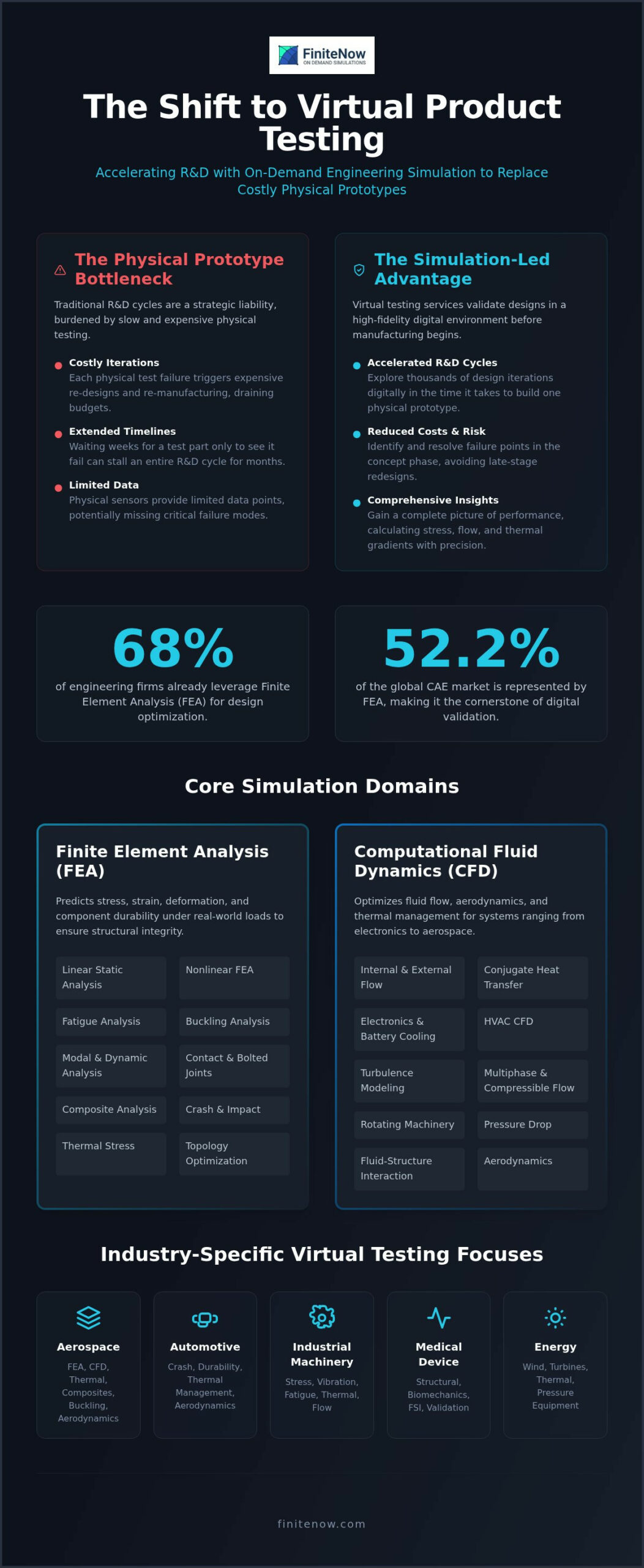
Your next physical prototype failure shouldn’t be the reason your R&D cycle stalls for three months. In a market where 68% of engineering firms already leverage Finite Element Analysis (FEA) for design optimization, relying solely on traditional manufacturing cycles is a strategic liability. You’ve likely felt the frustration of waiting weeks for a test part only to watch it fail under load. Utilizing virtual product testing services allows you to bypass these bottlenecks by validating engineering designs in a high-fidelity digital environment long before the first chip hits the floor.
Managing in-house simulation licenses and specialized hardware is a resource drain that distracts from your core engineering objectives. This guide demonstrates how to replace costly physical prototypes with high-fidelity engineering simulations to accelerate your R&D cycles. We will explore how on-demand FEA and CFD analysis provide fast, scalable results for critical applications in the aerospace, automotive, and industrial machinery sectors, ensuring your designs are validated without the overhead of legacy consultancy models.
Key Takeaways
- Accelerate R&D cycles by replacing expensive physical prototype iterations with high-fidelity digital validation.
- Use virtual product testing services to access specialized engineering expertise without the burden of software licensing or hardware maintenance.
- Apply advanced simulation domains like structural fatigue life prediction and CFD to ensure reliability across aerospace, automotive, and medical device sectors.
- Implement a streamlined digital workflow that transitions from optimized CAD geometry to validated results with transparent, on-demand pricing.
- Shift from legacy consultancy delays to an agile, simulation-led design approach that prioritizes speed and technical precision.
What are Virtual Product Testing Services in Modern Engineering?
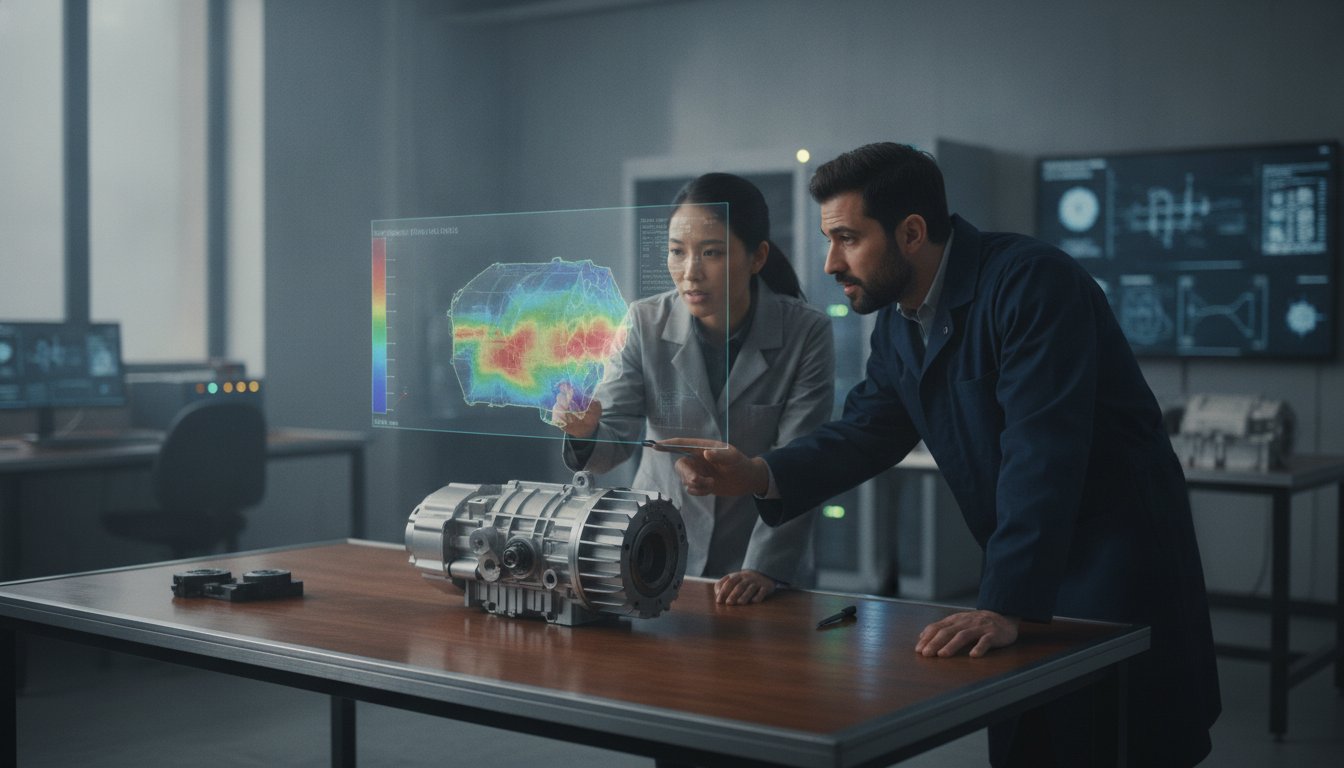
Modern engineering has moved beyond the “build and break” cycle. Virtual product testing services use high-fidelity numerical methods like Finite Element Analysis (FEA) and Computational Fluid Dynamics (CFD) to predict exactly how a product behaves under real world conditions. This is not a visual exercise. While virtual reality (VR) focuses on aesthetics and ergonomics, functional engineering simulation focuses on physics. It calculates stress distributions, fluid velocities, and thermal gradients with clinical precision. The core objective is simple. You validate strength, flow, and heat transfer before a single gram of material is purchased or machined.
In 2026, the industry has pivoted toward Simulation-Led Design (SLD). This methodology treats simulation as a primary driver of the design process rather than a final check. By moving validation to the earliest stages of R&D, firms avoid the “design-freeze” trap where late stage failures require expensive, ground-up redesigns. The fundamental concept of Virtual Prototyping serves as the foundation for this shift; it allows engineers to explore thousands of design iterations in the time it takes to manufacture one physical test rig.
The Role of Digital Twins in Product Validation
Digital twins create a continuous data loop between the virtual model and the physical product lifecycle. These aren’t static CAD files. They are dynamic representations that handle complex, time-dependent load cycles. By integrating high-quality CAD geometry with physics-based solvers, you can predict how a medical device responds to biomechanical stress or how an aerospace component handles buckling under extreme pressure. This level of insight ensures that your design is not just viable on paper, but robust in operation.
Why Physical Prototyping is Becoming a Secondary Step
Physical labs are a bottleneck. They are slow, expensive, and prone to measurement errors. A single failure in a physical test lab can set a project back by months. Virtual iteration costs a fraction of a physical build and provides a wider breadth of data. You can identify failure modes in the concept phase that a physical sensor might miss entirely. This is why engineering simulation for product development has become the standard for competitive R&D. It shortens time-to-market by ensuring that when you finally do build a physical prototype, it is for final certification, not for basic troubleshooting.
Core Simulation Domains: FEA, CFD, and Multiphysics
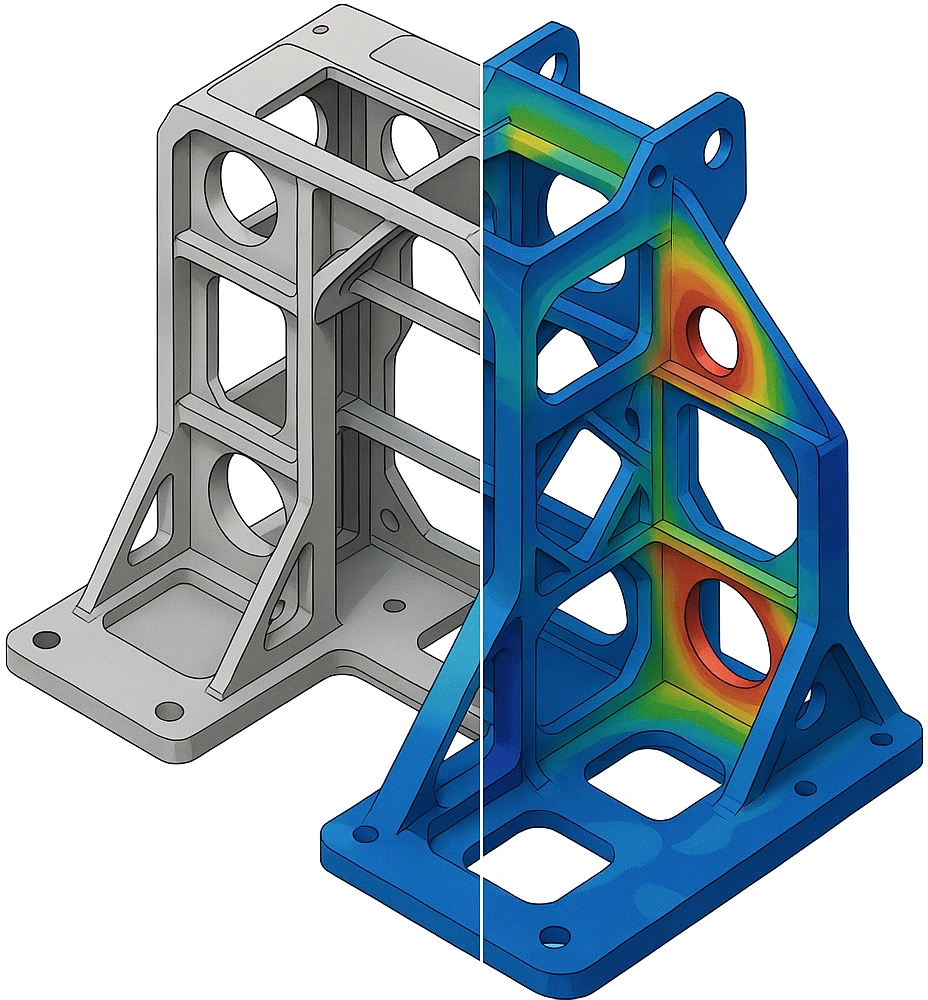
FEA is the cornerstone of modern digital validation. It represents an estimated 52.2% of the global CAE market in 2026. Structural FEA allows engineers to predict stress, strain, and deformation with high fidelity. This includes a specialized fatigue life prediction service to ensure long-term durability under cyclic loading. By utilizing virtual product testing services to identify potential failure points early, you avoid the prohibitive costs of physical lab failures.
CFD handles the fluid side. It optimizes internal flow, external aerodynamics, and pressure distribution. Recent advancements in solvers like Cradle CFD 2026.1, released in July 2026, now enable GPU-native computing and AI-driven predictive analytics. Thermal analysis manages heat dissipation in high-density electronics and industrial machinery. Multiphysics goes further by solving coupled challenges like fluid-structure interaction (FSI). This is critical when fluid forces cause significant deformation in solid components. High-performance virtual product testing services integrate these physics to provide a complete picture of product performance.
Industry-Specific Virtual Testing Focuses
Aerospace engineering requires rigorous composite analysis, buckling simulations, and high-speed aerodynamics. Automotive teams prioritize durability and crash/impact simulations to meet evolving safety standards. For a detailed look at how these methods apply in practice, automotive component simulation examples demonstrate how FEA and CFD workflows validate battery cooling systems and crash impact analysis with data-driven precision. Medical device manufacturers use biomechanics and stent fatigue life studies for regulatory validation under the EU AI Act’s new governance standards for testing software. Industrial machinery focuses on vibration, modal analysis, and bolted joint integrity to prevent field failures. For teams needing rapid results, you can get an instant quote for these specific technical domains.
Advanced Mechanical Analysis Sub-topics
Standard linear analysis doesn’t always suffice. Nonlinear FEA is required for complex material behaviors like hyperelasticity or plastic deformation. Topology optimization identifies the most efficient material distribution, which is essential for additive manufacturing process stability. Contact analysis and large deformation modeling are critical for complex assemblies where parts interact dynamically. These advanced methods ensure your design survives real-world operating conditions without the need for multiple physical prototypes.
Comparing Models: In-House Software vs. Virtual Testing Services
Owning the full simulation stack is a legacy strategy. It requires massive upfront investment in high-performance computing (HPC) hardware and recurring software subscriptions. In 2026, software continues to dominate the CAE market, accounting for approximately 74% of total spending. For many firms, this translates to “shelfware”—expensive licenses that sit idle during design lulls. Transitioning to virtual product testing services eliminates these fixed costs. You pay for the engineering results, not the tools.
Talent acquisition is another hurdle. Recruiting specialized simulation engineers is difficult; retaining them is harder. A specialized engineer’s time is often consumed by software maintenance or IT troubleshooting rather than core design. By choosing engineering simulation without software licenses, you bypass the recruitment bottleneck. You gain access to a German-based engineering team on demand. This model scales with your R&D peaks, providing the muscle you need for seasonal projects without increasing permanent headcount.
The Economics of On-Demand Engineering
The financial shift from Capital Expenditure (CAPEX) to Operational Expenditure (OPEX) provides immediate balance sheet relief. Traditional models require a “best-guess” approach to license counts. On-demand virtual product testing services offer project-based fees that are transparent and predictable. You don’t worry about version updates or hardware depreciation. This transparency allows engineering managers to allocate budgets with precision. Every dollar spent contributes directly to a validated design rather than maintaining a software ecosystem.
Transparency and Speed in Service Delivery
The traditional RFP process is a relic. Waiting weeks for a bid to clear procurement stalls your momentum. Modern workflows utilize an instant quote engineering simulation platform to remove this friction. You upload your parameters and receive a quote in minutes. This speed is supported by pre-qualified supplier networks that ensure high-fidelity results. You reduce the bidding bottleneck and keep your R&D timeline on track. It is a methodical, rapid progression that mirrors a modern digital workflow, ensuring that information is delivered with purpose and momentum.
How to Implement a Virtual Testing Workflow
Integrating virtual product testing services into your R&D pipeline requires a methodical approach that prioritizes technical precision over speed. Start by defining your technical objectives and the relevant physics domains. Whether you’re solving for buckling in an aerospace frame or thermal management in an EV battery, you must select the correct solver settings. Utilizing Structural FEA ensures the simulation addresses the specific failure modes unique to your component’s geometry and loading conditions.
Preparation determines accuracy. High-quality CAD geometry is the prerequisite for mesh generation. Once the mesh is established, you apply boundary conditions—forces, pressures, and constraints—that mirror the real-world operating environment. After execution, don’t just accept the first result. Perform a grid independence study to ensure your solution is mathematically stable. The final step is extracting actionable insights. Analyze the energy distribution and displacement vectors to identify weight reduction opportunities, then iterate on the design immediately within the digital environment to reach an optimized state.
CAD Preparation for Simulation Accuracy
Successful virtual product testing services rely on “simulation-ready” geometry. This process involves defeaturing, where you remove non-structural elements like small fillets, logos, or cosmetic threads to optimize solve time without compromising results. You must ensure your geometry is manifold with clean surface transitions. For complex assemblies, define contact interactions with care. Over-constrained or poorly defined contacts are the most common source of simulation divergence in nonlinear models.
Validating Results Against Real-World Data
Simulation is a tool for prediction, but validation builds confidence. Compare your virtual results to historical physical test data whenever possible to calibrate your models. Conduct a sensitivity analysis to understand how small changes in input variables, such as material thickness or load magnitude, affect the final outcome. This data-driven approach is essential for the certification process. Professional FEA reports provide the documented proof required by regulatory bodies in the medical device, automotive, and energy sectors.
Ready to accelerate your development? Upload your CAD for an instant simulation quote and start your validation today.
FiniteNow: The Future of On-Demand Virtual Testing
FiniteNow disrupts the traditional engineering consultancy model. We provide direct access to a specialized German-based engineering team without the friction of long-term contracts or software licensing. Our platform serves as a high-performance partner for firms that value time and intellectual rigor. By utilizing our virtual product testing services, you eliminate the high fixed costs associated with internal simulation departments. You pay for validated engineering results on a project-by-project basis. This flexibility allows startups and SMEs to compete with larger firms by accessing the same level of technological mastery. Our approach is grounded in data and logical processes, ensuring every simulation delivers actionable insights.
Scalable Simulation for Global Engineering Teams
FiniteNow supports high-stakes sectors by matching specific project needs with expert physicists. In Aerospace, our focus remains on composites, buckling analysis, and aerodynamics. Automotive projects often prioritize durability, thermal management, and crash simulation. Our Medical Device validation processes are built to handle structural biomechanics and fluid-structure interaction with high precision. We leverage a network of pre-qualified suppliers to ensure every simulation uses the most appropriate solver for the task. Data security is central to our operation. We protect your intellectual property through encrypted cloud-native workflows. This ensures your proprietary designs remain confidential while you benefit from the scalability of an on-demand engineering workforce.
Getting Started with Your First Virtual Test
The engagement process is built for modern efficiency. It starts with our instant quoting engine. You upload your CAD geometry and define your technical parameters to receive an automated quote in minutes. This removes the bidding bottleneck that often stalls R&D cycles. Once the project begins, you work directly with our engineers to refine your simulation requirements. We use integrated video calls and expert project management to ensure clear communication throughout the solve. You don’t just get a raw data file. You receive high-fidelity results that drive critical design decisions. These insights allow your team to iterate rapidly and finalize designs with confidence. It’s a faster, more transparent alternative to legacy industry standards that keeps your momentum high.
Modernize Your Engineering Validation
The transition from physical-first prototyping to high-fidelity digital simulation is no longer optional for competitive R&D teams. By leveraging virtual product testing services, you eliminate the manufacturing lead times and prohibitive costs associated with physical test failures. You’ve seen how structured workflows in FEA and CFD provide a scalable alternative to the heavy overhead of in-house software and specialized staffing. This shift allows your team to focus on core innovation while experts handle the complex physics of validation.
FiniteNow removes the traditional barriers to entry for advanced simulation. Our German-based engineering team delivers precise results through an instant automated quoting platform, requiring no long-term software licenses or recurring fees. This on-demand model ensures you only pay for the validation you need when you need it. It’s time to stop waiting for physical lab results and start driving your design decisions with data-driven precision. Get an Instant Quote for Your Virtual Testing Project today and secure your place at the forefront of engineering innovation. Your next breakthrough is just one simulation away.
Frequently Asked Questions
What is the difference between virtual testing and physical testing?
Physical testing involves real material failure in labs; it is slow and expensive. Virtual testing uses numerical methods like FEA and CFD to simulate these behaviors in a digital environment. While physical tests provide final certification, virtual methods allow for thousands of iterations during the design phase. This proactive approach identifies failure modes early. It reduces the risk of costly lab failures and manufacturing delays by validating designs before production begins.
Can virtual product testing services replace all physical prototypes?
Virtual simulation significantly reduces the number of prototypes but rarely replaces final physical validation for regulatory certification. Most industries use simulation to ensure the design is optimized and safe before building the final physical part. This strategy minimizes the total physical testing budget and accelerates R&D. You use virtual product testing services to arrive at a validated design, leaving physical testing as a final confirmatory step for compliance.
How accurate are virtual testing results compared to real-world behavior?
Simulation accuracy depends on mesh quality, boundary conditions, and solver selection. High-fidelity models often correlate within 1% to 5% of physical test results when material properties are accurately defined. Modern solvers handle nonlinear behaviors and dynamic loads with extreme precision. Validating virtual results against historical data ensures that the digital twin reflects real-world performance under operational stress. This level of precision is essential for aerospace and medical device sectors.
What industries benefit most from virtual product testing services?
High-stakes engineering sectors like Aerospace, Automotive, Medical Devices, and Industrial Machinery benefit most from these services. Aerospace firms use simulation for composites and buckling; medical device manufacturers focus on stent fatigue life and biomechanics. Any industry with high material costs or complex regulatory requirements uses virtual product testing services to maintain structural reliability. This approach ensures designs meet safety standards without the overhead of physical labs or expensive specialized staffing.
How much do virtual product testing services typically cost?
FiniteNow uses an automated instant quoting system to determine project-based fees based on technical complexity and physics requirements. This transparent model replaces the high CAPEX of software licenses and HPC hardware with predictable OPEX service fees. You don’t pay for idle software. You only pay for the engineering results delivered. Pricing is scalable; it makes high-end simulation accessible for both startups and established global engineering teams without the burden of long-term contracts.
What file formats are required for engineering simulation services?
Most engineering simulation services require standard neutral CAD formats such as STEP (.stp), IGES (.igs), or Parasolid (.x_t). These formats ensure that geometry transitions cleanly into the meshing environment without losing critical surface data. Native files from major CAD software may also be accepted for specialized multiphysics or custom simulations. Clean, manifold geometry is essential for mesh stability. It ensures accurate results in structural, thermal, or fluid domains by preventing mesh divergence.
How long does it take to receive a virtual testing report?
Lead times vary by project complexity but are significantly faster than traditional consultancy models. Simple structural FEA or thermal analysis results are often delivered within days rather than weeks. The FiniteNow platform removes the bidding bottleneck through instant quoting. This allows engineering work to begin immediately. This streamlined workflow mirrors the speed of modern digital manufacturing. It ensures your R&D cycles remain agile and on schedule, avoiding the delays of legacy industry standards.
Is my design data secure when using an on-demand simulation service?
Data security is managed through encrypted cloud-native workflows and strict intellectual property protections. FiniteNow uses a secure platform to handle sensitive engineering data. This ensures that proprietary designs remain confidential throughout the simulation process. All collaboration occurs within a protected digital environment. This professional approach provides the reliability of a German-based engineering team while maintaining the flexibility of an on-demand service. Your IP is protected at every step of the professional interaction.
Simulation Work Reinvented