


Why wait for a physical prototype to shatter on the shake table when you can predict the failure point before the first part is ever machined? In high-stakes sectors like aerospace and automotive, relying on trial and error isn’t just inefficient; it’s a liability. You likely recognize the frustration of discovering a catastrophic resonance issue during final testing, often because the high cost of specialized software licenses or the difficulty of interpreting complex mode shapes kept simulation out of reach during the early design phases.
Mastering modal analysis simulation is the most effective way to eliminate this “resonance gamble” and ensure structural integrity. This article provides the technical insights needed to identify critical natural frequencies and optimize your mass-to-stiffness ratios with surgical precision. We explore how to validate your designs against rigorous industry standards and translate raw data into actionable engineering decisions. By the end, you will understand how to integrate these advanced dynamic insights into your workflow without the overhead of legacy industry standards, moving your project from concept to validation with total confidence and modern efficiency.
Key Takeaways
- Understand natural frequencies and mode shapes to predict exactly how a structure deforms under dynamic excitation.
- Implement modal analysis simulation to identify critical resonance points before they cause catastrophic failure during physical testing.
- Optimize mass-to-stiffness ratios for specific industry standards in aerospace, automotive, and industrial machinery.
- Learn how to interpret complex eigenvalue data to drive design changes that shift frequencies away from operational ranges.
- Access high-level structural validation through on-demand engineering services that prioritize speed and technical transparency.
What is Modal Analysis Simulation in Structural Engineering?
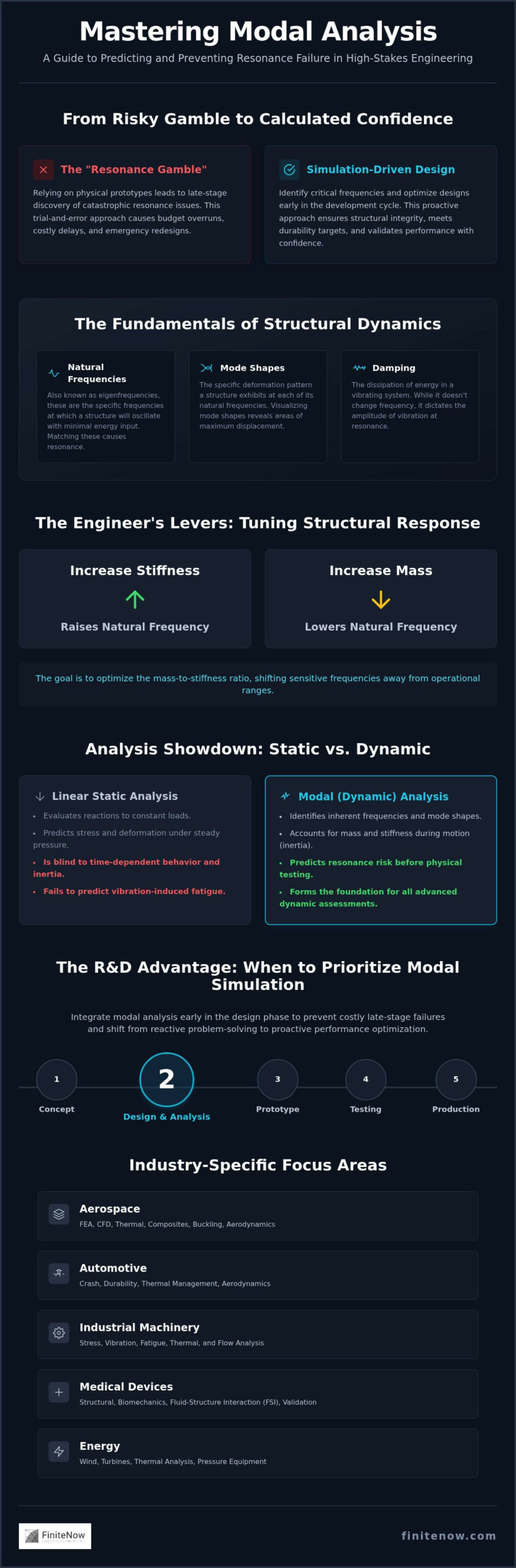
Modal analysis is the study of a structure’s dynamic properties in the frequency domain. It identifies how a system naturally oscillates when disturbed. Unlike basic stress tests, Modal analysis focuses on the inherent vibration characteristics of a design. Every physical object has a set of natural frequencies. If external forces match these frequencies, resonance occurs. This results in amplified displacements, noise, and eventual structural failure. Understanding these dynamics is not optional; it is a requirement for any component subjected to cyclic loading or high-speed operation.
A modal analysis simulation serves as the diagnostic foundation for all advanced dynamic assessments. You cannot accurately perform harmonic, random vibration, or transient response analyses without first establishing the modal baseline. It provides the eigenfrequencies and mode shapes that define the physical limits of your assembly. By identifying these parameters early, engineers can modify the design to shift sensitive frequencies away from operational ranges, effectively “tuning” the structure for its environment.
The Role of Linear Static vs. Dynamic Analysis
Standard Structural FEA evaluates how a part reacts to constant loads. It is effective for predicting yield and deformation under steady pressure, but it is blind to time-dependent behavior. Static analysis fails to predict vibration-induced fatigue because it ignores the relationship between mass and stiffness during motion. Modal analysis is the fundamental characterization of structural vibration. By transitioning from static to dynamic modeling, you account for inertia. This allows you to identify where cyclic loading will cause the most damage, even if the peak stresses remain below the material’s yield point.
When to Prioritize Modal Simulation in the R&D Cycle
Timing is everything in the product lifecycle. You should prioritize modal simulation during the early design phases to prevent late-stage prototype failures that blow budgets. In regulated sectors like aerospace and energy, this validation is a mandatory compliance step. It ensures that turbine blades or airframes don’t hit critical resonance during operation, which could lead to immediate catastrophic failure.
Integrating this into your engineering simulation for product development workflow removes the guesswork. It shifts the focus from fixing problems to optimizing performance. Modern engineering teams use these insights to refine mass distribution and support locations before a single physical unit is built. This proactive approach ensures that your final product meets durability targets without requiring costly, emergency redesigns or repeated physical testing cycles.
The Fundamentals: Natural Frequencies, Damping, and Mode Shapes
A structure’s dynamic signature is defined by the interaction of mass, stiffness, and damping. Every physical system possesses a unique set of natural frequencies, often called eigenfrequencies, where it will oscillate with minimal external energy input. A modal analysis simulation identifies these frequencies by solving the generalized eigenvalue problem. This process extracts the mathematical DNA of your design, allowing you to predict how it will react to operational loads before you commit to hardware.
Stiffness and mass are the primary levers for frequency control. Increasing stiffness typically raises the natural frequency, while adding mass lowers it. However, these variables are rarely independent. Adding a gusset to stiffen a frame also adds weight, which can negate the frequency shift you intended to achieve. Precision engineering requires optimizing the mass-to-stiffness ratio to ensure the structure remains stable within its specific operating environment.
Natural Frequencies and Eigenvalues
The calculation of natural frequencies is a direct result of the system’s mass and stiffness matrices. In technical terms, eigenvalues represent the square of the natural frequency. These values indicate the specific rates at which the structure is most vulnerable to resonance. Engineers must look beyond simple static safety factors; a part that is “over-engineered” for static loads can still fail if its natural frequency aligns with a motor’s operating RPM.
Damping ratios play a secondary but vital role. While damping does not significantly alter the natural frequency, it dictates the amplitude of the vibration at resonance. A system with low damping will experience extreme displacement when excited at its eigenfrequency, leading to rapid fatigue or immediate breakage. Understanding these ratios allows you to determine if a design needs structural changes or if supplemental damping treatments are sufficient.
Visualizing and Validating Mode Shapes
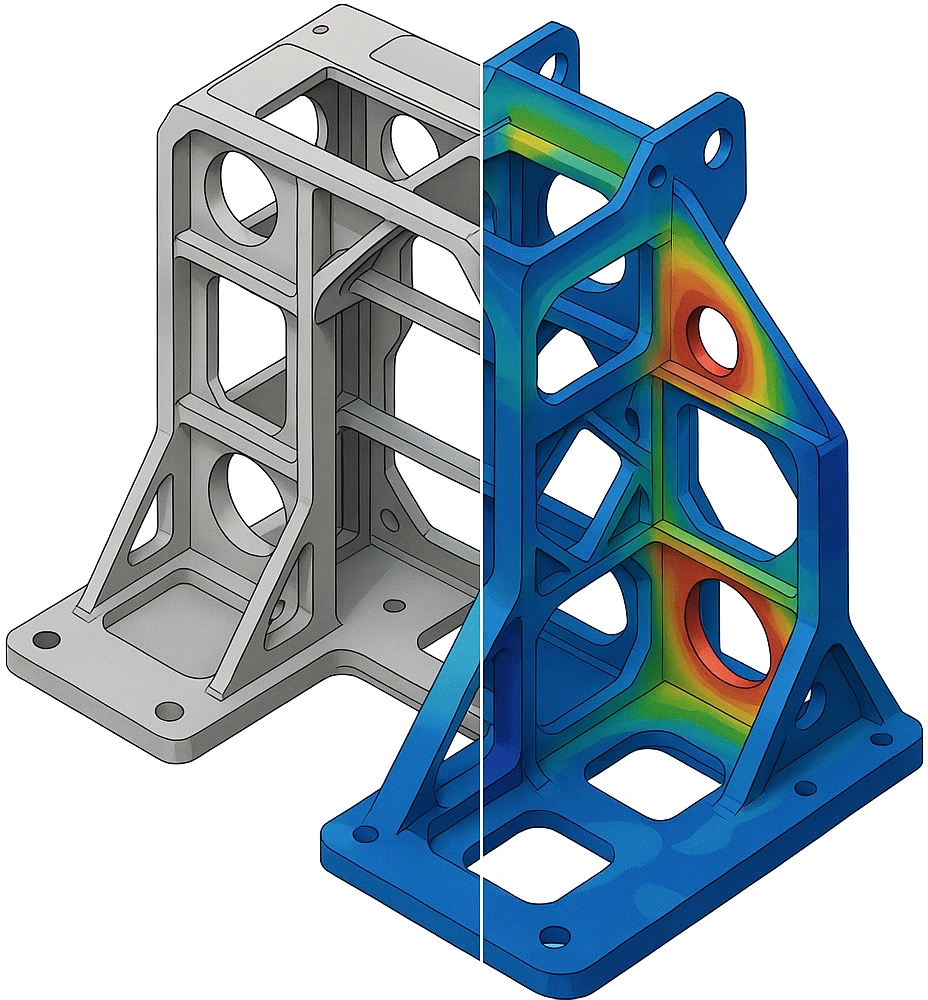
Mode shapes are the visual representation of how a structure deforms at each natural frequency. They are not absolute displacements but relative patterns that identify critical zones. In any mode shape, you will find nodes and anti-nodes. Nodes are locations where displacement is zero; anti-nodes are where the structure moves the most.
- Sensor Placement: Position accelerometers at anti-nodes to maximize signal clarity during testing.
- Support Optimization: Place rigid supports at nodes to prevent the transfer of vibration to adjacent components.
- Weight Reduction: Identify “dead” material in nodal zones that can be removed without affecting the specific mode’s frequency.
Correlation between your simulation and Experimental Modal Analysis (EMA) is the gold standard for validation. This step ensures that your digital model correctly captures boundary conditions and material damping. If your team faces tight deadlines or lacks the internal tools for these complex calculations, you can utilize on-demand structural FEA to obtain professional-grade results without the software overhead. This streamlined approach ensures your design is validated against real-world physics with minimal friction.
Industry-Specific Challenges: From Aerospace to Medical Devices
Every industry faces a unique set of vibration-related hazards. While the mathematical foundations of eigenvalues are universal, the operational environments dictate the specific complexity of a modal analysis simulation. Aerospace engineers prioritize high-frequency stability in thin-walled components, whereas automotive designers focus on the subjective experience of noise and harshness. Successfully navigating these challenges requires a vertical-specific approach to dynamic validation that accounts for real-world boundary conditions.
Aerospace and Automotive Dynamic Requirements
In aerospace, modal analysis is the primary defense against aeroelastic flutter. This dangerous phenomenon occurs when aerodynamic forces couple with a structure’s natural frequencies, leading to self-excited oscillations that can destroy an airframe in seconds. Engineers must validate turbine blades and wing skins against high-frequency vibration and potential buckling under extreme flight loads. Precision is mandatory; even a minor shift in a mode shape can compromise the aerodynamic efficiency of a composite wing or the cooling performance of a thermal shield.
The automotive sector shifts the focus toward Noise, Vibration, and Harshness (NVH) optimization. Modern vehicle design relies on modal decoupling to isolate the cabin from powertrain and road excitation. By ensuring the chassis frequencies don’t align with engine firing orders or tire rotation rates, designers significantly reduce interior decibel levels. This isn’t just about comfort; it’s about durability. Dynamic analysis also informs crash and impact behavior, allowing engineers to predict how energy-absorbing structures will deform during the millisecond-scale events of a collision.
Industrial and Medical Device Validation
Industrial machinery often operates at variable speeds, making resonance prevention a moving target. Rotating components like shafts, impellers, and gearboxes must be designed so their “critical speeds” fall outside the standard operating RPM range. Failure to account for these shifts leads to accelerated bearing wear and fatigue failure. In high-heat applications, such as power generation or chemical processing, integrating thermo-mechanical analysis services is essential. Thermal expansion changes a structure’s internal stress state and stiffness, which directly shifts its natural frequencies. A design that is safe at room temperature might move into a resonance zone as it reaches its operating point.
Medical device validation requires extreme precision to ensure patient safety and instrument reliability. Implants and surgical tools must maintain structural stability under physiological loads that are cyclic and often unpredictable. Modal simulation ensures that high-precision instruments don’t vibrate excessively during use. This is particularly critical for robotic-assisted surgery, where even microscopic resonance can affect the accuracy of a procedure. By validating the dynamic behavior of biomechanical systems, manufacturers ensure their products meet the rigorous standards required for long-term clinical success.
Beyond the Numbers: Interpreting Results for Design Validation
A modal analysis simulation delivers more than a list of eigenvalues; it provides a roadmap for structural survivability. Numerical accuracy is the baseline, but the value lies in how you apply that data to solve interference problems. You must compare the extracted natural frequencies against the operational spectrum of your system. If a structural frequency aligns with a motor’s RPM or a pump’s pulsation rate, you have a resonance risk that requires immediate intervention.
One of the most overlooked metrics in this process is the Effective Mass Participation Factor. This value identifies which modes are likely to be excited by base motion or external loads. A participation factor is a measure of a mode’s contribution to overall dynamic response. Modes with high participation factors move a significant portion of the structure’s mass and represent the highest risk for fatigue. By focusing your optimization efforts on these specific modes, you ensure the most impact with the least amount of design churn.
Frequency Response and Harmonic Analysis
Modal results are the prerequisite for performing harmonic analysis. This step moves from identifying frequencies to predicting real-world displacement and stress under continuous periodic loads. It allows you to quantify exactly how much a component will deflect when subjected to a specific input force at its resonant frequency. This data is critical for fatigue life prediction. It helps you determine if the resulting stresses exceed the endurance limit of your material, even if they stay well below the static yield point.
Design Iteration and Optimization Strategies
When a resonance issue is identified, you have two primary levers: frequency shifting through mass addition or structural stiffening. Increasing stiffness by adding gussets or ribs typically raises the natural frequency, while adding non-structural mass lowers it. The choice depends on your weight budget and the specific mode shape. You can use topology optimization to identify where material is most effective at resisting deformation for a given mode.
For systems operating in complex environments, you should validate your design using coupled-field analysis services. This ensures that factors like thermal expansion or fluid pressure, which alter structural stiffness, are accounted for in your dynamic model. If you need to accelerate your R&D cycle, you can get an instant quote for structural FEA and receive expert-backed insights that translate raw modal data into a validated, high-performance design.
Efficient Modal Analysis Without Software Overhead
Traditional engineering firms often face a significant bottleneck: the high cost of entry for advanced dynamics. Maintaining a full suite of FEA tools requires substantial capital for annual licenses and high-performance computing hardware. For many SMEs and startups, this overhead makes a comprehensive modal analysis simulation financially out of reach. FiniteNow disrupts this legacy model by offering on-demand engineering simulation services. You pay for the results, not the tools. This project-based approach ensures that even complex vibration studies are scalable and accessible without the burden of permanent software costs.
Procurement for specialized engineering services is often a slow, opaque process involving weeks of back-and-forth negotiations. Our instant quoting system streamlines this entirely. You receive a project-based fee immediately, allowing you to move from design to validation without administrative delays. Our German-based engineering team handles the technical heavy lifting, ensuring high-fidelity results that meet rigorous aerospace or automotive standards. This model removes the “black box” of traditional consulting, providing a faster, more transparent alternative for modern R&D cycles.
The Strategic Advantage of On-Demand FEA
Eliminating long-term software contracts and hardware maintenance cycles frees up your R&D budget for actual product innovation. Instead of training staff on complex eigenvalue solvers for a single project, you access specialized expertise for one-off complex assemblies. This is especially vital when dealing with intricate mode shapes in multi-component systems where precision is mandatory. You can read more about engineering simulation without software licenses to understand how this shift to on-demand expertise accelerates your time-to-market.
Scaling Engineering Precision with FiniteNow
FiniteNow provides a structured, transparent workflow from the initial project submission to the final technical report. We prioritize data security and technical validation through a team of pre-qualified experts. You aren’t just receiving a data dump; you’re gaining a partner in design optimization. Our process ensures that your modal analysis simulation is integrated into a larger validation strategy, moving your project from raw data to a certified, resonance-free design.
- Direct collaboration: Engage with experts via integrated video calls to discuss specific structural modifications and frequency shifting strategies.
- High-fidelity reports: Receive clear visualizations of mode shapes and participation factors that drive actionable engineering decisions.
- Scalability: Increase your simulation capacity during peak R&D cycles without increasing fixed headcount or software seat numbers.
Secure Your Structural Integrity with Advanced Dynamics
Predicting how a structure responds to vibration isn’t just about passing a test; it’s about ensuring long-term reliability in demanding environments. By identifying natural frequencies and mode shapes early, you eliminate the risk of resonance-induced failure. Whether you’re validating aerospace components for flutter or optimizing automotive NVH, a precise modal analysis simulation is your most effective tool for data-driven design. It transforms complex dynamic variables into actionable engineering insights that prevent catastrophic late-stage prototype failures.
FiniteNow removes the traditional obstacles of high-tier software licenses and rigid consulting contracts. Our German-based engineering team provides high-fidelity structural FEA on demand, ensuring your project meets rigorous technical standards with streamlined precision. You don’t need to manage complex infrastructure or internal overhead to get expert results. You can get an instant quote for your modal analysis project today and access transparent, project-based pricing that scales with your R&D needs. Take control of your structural validation and move forward with total technical confidence.
Frequently Asked Questions
What is the difference between modal analysis and harmonic analysis?
Modal analysis identifies inherent dynamic properties like natural frequencies and mode shapes without external loads. Harmonic analysis calculates the steady-state response to continuous periodic loads at specific frequencies. Think of modal as the diagnostic foundation and harmonic as the simulation of real-world operation. You must perform a modal study first to know where the harmonic peaks will occur. This sequence ensures you capture the amplified displacements that lead to structural failure.
How many modes should I calculate for a reliable simulation?
You should calculate enough modes to capture at least 80% to 90% of the cumulative effective mass in the directions of interest. For simple components, the first 10 modes are often sufficient. Complex assemblies with high-frequency excitation might require hundreds. Always verify the mass participation factors in your modal analysis simulation report. This ensures you haven’t missed significant dynamic behavior that could be excited during operation.
Does modal analysis take damping into account by default?
Standard undamped modal analysis ignores damping to solve for pure eigenvalues and mode shapes. While damping exists in every real-world structure, it has a negligible effect on natural frequencies for most engineering materials. However, damping is critical when you move to harmonic or random vibration analysis. In those subsequent stages, damping determines the peak amplitude of the vibration at resonance. It prevents the infinite displacements that would otherwise be calculated at a resonant peak.
Can modal analysis be performed on nonlinear structures?
Modal analysis is fundamentally a linear elastic procedure. If your structure has nonlinearities like large deflections or contact, the solver linearizes the system at a specific state. For highly nonlinear behavior, you might require a complex modal analysis or a transient dynamic study. Most engineering validations focus on the linear range to identify baseline resonance risks. Our German-based engineering team can help determine if your project requires specialized nonlinear dynamic handling.
Why is modal analysis necessary before a random vibration test?
Random vibration analysis uses the modal superposition method to calculate responses efficiently. This requires the natural frequencies and mode shapes as an input. Without a prior modal analysis simulation, the solver cannot map the power spectral density (PSD) of the vibration onto the structure’s physical characteristics. It ensures the simulation captures how the structure amplifies specific frequencies within the random noise spectrum. This is a standard requirement for aerospace and automotive durability testing.
How does mass distribution affect natural frequencies?
Natural frequency is proportional to the square root of stiffness divided by mass. Adding mass generally lowers the natural frequency, but the location is the deciding factor. Adding mass at an anti-node has a significant impact on lowering that specific mode’s frequency. Conversely, adding mass at a node has almost no effect. Precise mass distribution is a primary strategy for shifting frequencies away from operational interference without increasing the overall weight of the assembly.
What is the participation factor in modal results?
The participation factor measures how much a specific mode contributes to the overall dynamic response in a given direction. It indicates how easily an external force can excite that mode. Modes with high participation factors move the most mass and are the most likely to cause structural failure if they align with operating frequencies. Engineers use these factors to prioritize which modes require structural modification. You should always focus your optimization on high-participation modes.
Is modal analysis required for medical device validation?
Yes, modal analysis is often a critical part of the validation process for high-precision medical instruments and implants. It ensures that devices don’t experience resonance during use, which could compromise surgical accuracy or cause fatigue failure. Regulatory bodies frequently require dynamic validation to prove that biomechanical systems withstand physiological loads. FiniteNow provides these services with instant quotes, allowing you to validate medical device designs without the burden of expensive software licensing costs.
Simulation Work Reinvented