

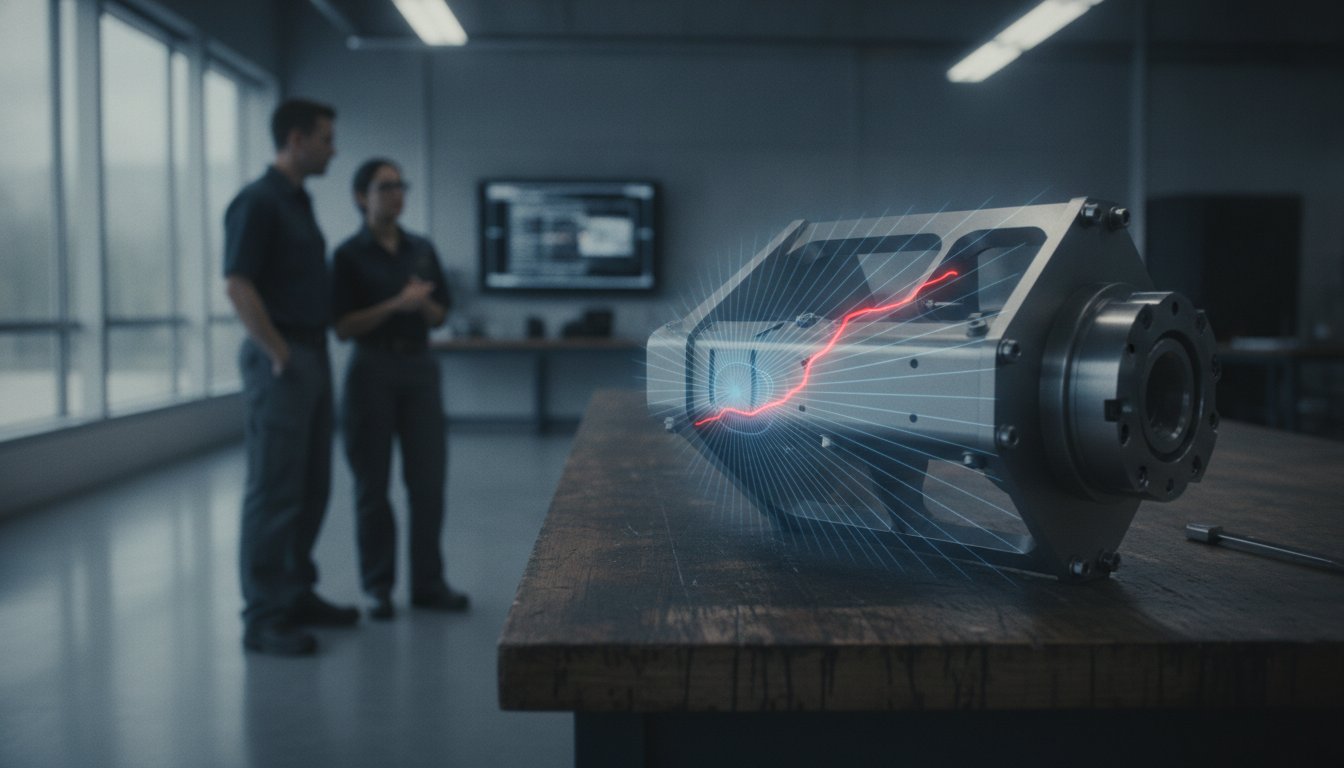
Owning high-end CAE software is often the least efficient way to validate the structural integrity of your safety-critical components. You’re likely aware that predicting fatigue life and crack propagation requires more than just a license. It demands PhD-level expertise and a deep understanding of standards like ASTM E1820-25de2. The burden of perpetual licensing fees and the scarcity of specialized fracture experts often turn a necessary validation step into a costly project bottleneck. Engaging a fracture mechanics simulation service allows you to bypass these technical obstacles and focus on engineering results.
This guide explains how professional fracture mechanics simulation identifies critical crack growth risks and accelerates your R&D cycle without the overhead of internal software management. You’ll learn how to secure validated fatigue life predictions and expert-backed technical reports while significantly reducing your physical testing expenditures. We’ll examine the shift from traditional software ownership to an on-demand model that provides the precision of a German-based engineering team with the speed of an automated quoting system, specifically tailored for high-stakes aerospace, automotive, and industrial applications.
Key Takeaways
- Transition from “safe-life” to “fail-safe” engineering philosophies by adopting virtual validation for damage-tolerant designs.
- Quantify stress intensity factors and model fatigue crack propagation to predict the remaining life of critical structural components accurately.
- Replace high annual CAE software overhead and specialized staffing requirements with a project-based fracture mechanics simulation service.
- Secure expert-backed technical reports for aerospace and automotive verticals through a streamlined workflow with German-based engineers.
- Accelerate R&D cycles by leveraging instant automated quoting and a pre-qualified supplier network for rapid technical validation.
The Shift to Digital Fracture Mechanics Simulation
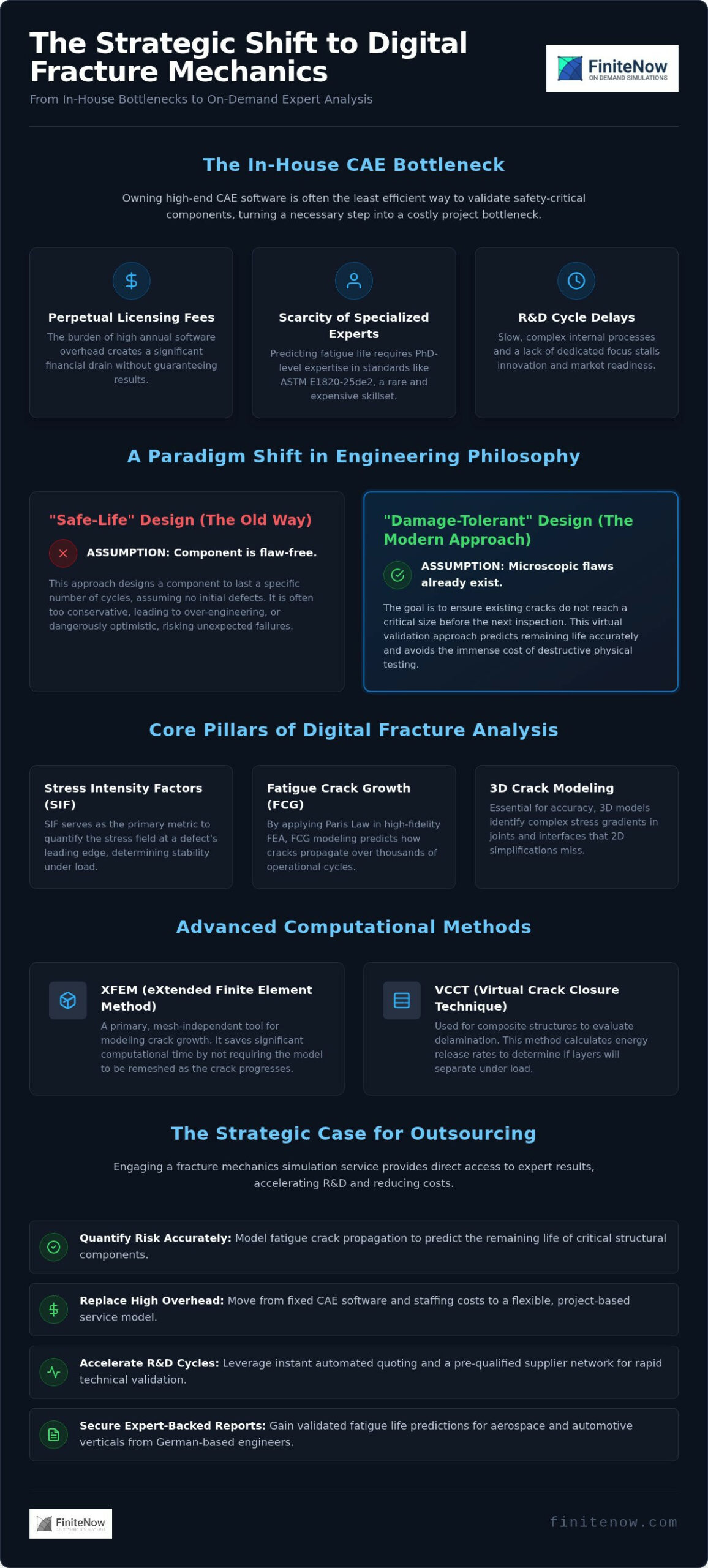
Modern engineering has moved past the “safe-life” design philosophy. In the past, teams assumed components were flaw-free and designed them to last a specific number of cycles. This approach is often too conservative or dangerously optimistic. Today’s damage-tolerant philosophy assumes that microscopic flaws already exist. The goal is to ensure these cracks don’t reach a critical size before the next inspection. A professional fracture mechanics simulation service provides the virtual environment needed to validate these designs without the immense cost of destructive physical testing.
Digital twins have replaced the slow, expensive tradition of physical fatigue rigs. Instead of running test benches for months, high-fidelity Structural FEA models simulate crack initiation and growth in hours. This shift allows R&D teams to explore more design iterations while maintaining confidence in the final product’s reliability. It’s about moving from reactive testing to proactive, data-driven validation.
Linear Elastic Fracture Mechanics (LEFM) vs. Elastic-Plastic Models
Choosing the right mathematical framework is critical for accuracy. LEFM is the standard for brittle materials and high-cycle fatigue scenarios where the plastic zone at the crack tip remains small. It relies on Stress Intensity Factors to determine stability. However, ductile materials or high-load applications require nonlinear elastic-plastic models. In these cases, we use J-Integral or Crack Tip Opening Displacement (CTOD) methods to account for significant plastic deformation. Traditional hand calculations simply can’t handle the complex 3D geometries and varying stress fields of modern parts. A specialized fracture mechanics simulation service eliminates these computational blind spots by applying the correct Fracture Mechanics principles to your specific geometry.
Predicting Residual Strength and Critical Crack Size
The primary output of a simulation is the critical crack size. This is the maximum allowable flaw length before catastrophic failure occurs. By determining this threshold, engineers establish reliable inspection intervals and safety factors. We evaluate structural integrity under both peak loads and cyclic conditions to ensure the part remains stable throughout its service life. For components in high-temperature environments, such as turbines or exhaust systems, we integrate these findings into thermo-mechanical analysis services. This holistic approach ensures that thermal expansion and material softening don’t accelerate crack propagation beyond safe limits.
Core Technical Domains in Professional Fracture Analysis
Understanding crack behavior requires quantifying the stress field at the defect’s leading edge. Stress Intensity Factors (SIF) serve as the primary metric for this assessment. In a professional fracture mechanics simulation service, we move beyond static snapshots to model dynamic Fatigue Crack Growth (FCG). By applying the Paris Law within high-fidelity FEA, engineers predict how cracks propagate over thousands of operational cycles. Real-world validation demands 3D crack modeling. 2D simplifications often miss the complex stress gradients found in bolted joints and contact interfaces. Identifying these risks in complex assemblies prevents the localized failures that traditional stress analysis frequently overlooks.
Computational Methods: XFEM and VCCT
Advanced simulation relies on sophisticated numerical techniques to handle geometry changes. The eXtended Finite Element Method (XFEM) is a primary tool for modeling crack growth because it’s mesh-independent. You don’t need to remesh the model as the crack progresses. This saves significant computational time while maintaining high accuracy. For composite structures, we utilize the Virtual Crack Closure Technique (VCCT) to evaluate delamination. This method calculates energy release rates to determine if layers will separate under load. Achieving mesh convergence is a non-negotiable step in these workflows. Without it, energy release rate calculations remain unreliable, leading to skewed safety margins. Accurate computational modeling ensures your design remains robust without the weight penalties of over-engineering.
Fatigue Life Prediction and Durability
Durability isn’t just about surviving a single peak load. It’s about enduring variable amplitude loading over years of service. Professional simulation models how these fluctuations impact crack retardation and acceleration. This data is essential for Metal Fatigue Life Prediction in safety-critical sectors. When components operate at constant temperatures, integrating a steady-state thermal analysis service allows us to evaluate crack stability under thermal equilibrium. This provides a clear picture of how temperature affects material toughness and propagation rates. The resulting technical reports offer actionable data for maintenance scheduling and life extension programs. You can determine exactly when an inspection is required or if a part can stay in service longer. If you need to validate a complex assembly quickly, you can get an instant quote for specialized simulation today.
Industry Verticals for Fracture Simulation Services
Generic FEA validates stress levels. A specialized fracture mechanics simulation service validates survival. Aerospace engineers prioritize damage-tolerant airframe structures, which require modeling crack growth in complex composites and assessing buckling risks under extreme loads. Automotive OEMs focus on the durability of high-strength steel and aluminum components. In these sectors, crashworthiness isn’t just about deformation. It’s about ensuring fractured sections don’t compromise passenger safety. For heavy equipment, integrating Thermal stress analysis for machinery helps identify where extreme thermal gradients accelerate crack propagation in vibration-heavy environments.
Medical Device Validation and Biomechanics
Medical device validation requires extreme precision. Biomechanics simulation for implants must address Fluid-Structure Interaction (FSI), especially for cardiovascular devices. We model the fatigue life of nitinol stents and orthopedic implants to ensure they survive millions of loading cycles inside the human body. Nitinol’s unique superelastic properties require specialized material models that standard FEA packages often lack. High-fidelity simulation provides the rigorous data needed for FDA and CE marking. It proves regulatory compliance and safety margins before expensive clinical trials begin. This virtual validation reduces the risk of late-stage design failures that can cost millions in lost time.
Aerospace and Energy: High-Temperature Fracture
Energy and aerospace components face the harshest operational environments. Turbine blades and pressure equipment must manage severe thermal gradients that create localized stress concentrations. We predict creep-fatigue interaction to prevent premature failure in power generation components. This analysis is vital for life-extension programs in aging plants. Structural integrity is also directly linked to aerodynamic performance. If a blade’s geometry changes due to minute crack growth or deformation, efficiency drops long before the part actually fails. Our fracture mechanics simulation service delivers the clarity needed to optimize these parts for both durability and performance. We ensure that your high-value assets meet their intended service life without unexpected maintenance shutdowns.
The Strategic Case for Outsourcing Fracture Mechanics
Software manuals often claim that internal simulation is the most efficient path. This perspective ignores the heavy burden of “Heavy Licensing” and the constant need for specialized training. A fracture mechanics simulation service offers a project-based alternative that converts fixed overhead into variable costs. You gain immediate access to German engineering expertise without the friction of long-term contracts. This model allows your team to focus on design while we handle the computational heavy lifting. It’s a faster, more transparent approach than traditional software ownership.
Adopting engineering simulation without software licenses eliminates the financial risk of underutilized assets. R&D peaks shouldn’t force you to increase permanent headcount or buy additional seats of expensive CAE suites. Scalability is about having high-performance resources available exactly when you need them. You can handle complex validation tasks during the design phase and scale back once the project moves to production. This elasticity is essential for maintaining a lean, agile engineering department.
Buy vs. Outsource: A Decision Framework
The hidden costs of software maintenance, high-end hardware, and expert retention are substantial. While keeping simple linear FEA in-house makes sense for daily design checks, complex fracture mechanics requires a different level of rigor. It involves deep knowledge of stress intensity factors and energy release rates in non-trivial 3D geometries. Outsourcing these high-stakes analyses provides an independent, third-party validation report. These documents carry significant weight during procurement audits and safety reviews, offering a layer of professional accountability that internal reports may lack. If you need to validate a critical component now, you can request a technical consultation and quote to get started.
Data Security and Workflow Integration
Data integrity is a primary concern when moving simulation outside your internal network. Modern service models protect your proprietary CAD data through secure, on-demand platforms. The workflow is designed for seamless integration. We provide standardized reports that plug directly into your internal design reviews, ensuring that technical insights are easy to digest for both engineers and managers. Collaboration doesn’t happen in a vacuum. You can interface with remote experts via integrated video calls to discuss mesh convergence, loading conditions, and material models. This ensures the simulation results align perfectly with your real-world operational requirements without the need for on-site staffing.
FiniteNow: On-Demand Fracture Simulation Workflow
Traditional engineering consulting is slow. Most legacy firms still rely on two-week bidding cycles that stall R&D momentum and inflate project timelines. FiniteNow disrupts this pattern with an instant quote engineering simulation model. Our fracture mechanics simulation service operates on a modern, digital-first platform. We’ve replaced the traditional consulting approach with a transparent, automated system. This allows you to budget for complex fatigue analysis or nonlinear FEA in seconds. It’s a scalable extension of your internal R&D, providing the technical rigor of a German-based engineering team without the burden of software licensing or permanent headcount.
We’ve eliminated the barriers that often prevent SMEs from accessing high-fidelity validation. The process is built for speed. From CAD upload to the final professional fracture report, every step is optimized for efficiency. You don’t have to wait for a salesperson to call you back. You get the data you need to move to the next design iteration immediately. This workflow ensures that safety-critical parts in aerospace, automotive, and medical device sectors meet their requirements without the friction of traditional procurement.
The Instant Quote Process
Getting started is straightforward. You upload your CAD files to our secure platform and specify your analysis requirements. Our system analyzes the geometry and project scope to generate an immediate price. This cost structure is based on project complexity, not hourly billing that can spiral out of control. We prioritize clarity and immediate impact. You select the specific technical focus, whether it’s 3D crack propagation or delamination in composites, and receive a firm quote. This removes the uncertainty of “estimated” costs and allows for rapid decision-making in fast-paced development environments.
Collaborating with German-Based Experts
Speed doesn’t come at the expense of depth. While the quoting is automated, the analysis is performed by a specialized German-based team. You gain direct access to experts for non-linear FEA and complex crack growth scenarios. We use integrated video consultations to align on critical details like boundary conditions, load cases, and mesh convergence. This ensures the simulation reflects real-world physics accurately. Unlike generic service providers, we deliver both the professional technical report and the raw simulation data. This transparency allows your internal team to perform their own design iterations based on our validated findings. It’s a collaborative, high-performance partnership designed for the pace of modern industry. Whether you’re validating a medical implant or an aerospace airframe, you get expert-backed results with the efficiency of a digital workflow.
Accelerate Your Structural Validation Strategy
Transitioning to a damage-tolerant design philosophy is no longer a choice for safety-critical sectors; it’s a requirement. By integrating a specialized fracture mechanics simulation service into your R&D cycle, you secure validated fatigue life predictions without the overhead of perpetual software licenses. Digital twins and high-fidelity FEA have replaced slow, destructive physical tests, allowing for faster iterations and higher confidence in component durability. This shift ensures that your engineering team focuses on innovation rather than troubleshooting catastrophic failures.
FiniteNow provides the German-engineered precision your projects demand through a scalable, project-based model. Whether you’re addressing delamination in aerospace composites or stent fatigue in medical devices, our workflow eliminates traditional bidding delays. You gain immediate access to expert-backed technical reports and raw simulation data, ensuring your internal design reviews are grounded in physical accuracy. Stop letting software costs and staffing shortages bottleneck your progress. You can Get an Instant Quote for Your Fracture Mechanics Project today. We’re ready to help you validate your most complex designs with streamlined precision and reliable data.
Frequently Asked Questions
How much does a fracture mechanics simulation service typically cost?
Costs depend on project complexity, CAD quality, and the number of load cases. Unlike traditional firms that use opaque hourly billing, FiniteNow uses an instant automated quoting system. This provides a firm price before you commit any resources. You avoid the hidden overhead of software licenses and training. Factors like the number of crack tips and material nonlinearity influence the final price for a fracture mechanics simulation service.
What is the turnaround time for a fatigue crack growth report?
Turnaround times vary based on the complexity of the 3D crack propagation model. Simple linear assessments are often completed in a few business days. Complex 3D models with variable amplitude loading or non-linear material behavior take longer. Our streamlined digital workflow reduces the friction of traditional consulting. You’ll check specific lead times through our instant quoting platform after uploading your project files to our secure system.
Do I need to provide the initial flaw size for the simulation?
Providing the initial flaw size is the standard approach for damage-tolerant analysis. This size usually comes from your NDT inspection limits or industry standards like ASTM E1820-25de2. If you don’t have a specific value, our German-based engineering team can help determine a conservative detectable flaw size based on your inspection methods. This ensures the simulation remains valid for regulatory compliance and safety-critical structural validation.
How accurate are fracture simulations compared to physical testing?
High-fidelity fracture simulations correlate closely with physical testing when material properties and boundary conditions are accurate. We use advanced methods like XFEM and VCCT to ensure mesh-independent results. While physical tests provide a single data point, a fracture mechanics simulation service allows you to explore hundreds of load scenarios. This digital validation reduces the number of physical prototypes required and identifies failure modes that single tests might miss.
Can on-demand services handle nonlinear elastic-plastic fracture mechanics?
Yes, our on-demand engineering team specializes in nonlinear elastic-plastic fracture mechanics (EPFM). We apply J-Integral and CTOD methods to handle ductile materials where LEFM is insufficient. These complex simulations require deep expertise in material nonlinearity and large deformation theory. Our German engineers use high-performance computing resources to deliver these advanced analyses without requiring you to maintain expensive, specialized software licenses in-house for your projects.
What file formats are required for fracture simulation projects?
We accept most standard 3D CAD formats for fracture simulation. STEP (.stp) and IGES (.igs) are preferred for their compatibility with our FEA pre-processors. For complex assemblies, native formats from SolidWorks, CATIA, or Siemens NX are also supported. Ensuring clean geometry with well-defined surfaces helps accelerate the meshing phase. You’ll upload these files directly through our secure platform to receive an instant technical quote for your project.
How is my intellectual property protected during the simulation process?
Intellectual property protection is integrated into our digital workflow. We use secure, encrypted platforms for all CAD uploads and data transfers. Our engagement model includes standard non-disclosure agreements (NDAs) to protect your proprietary designs. Because we operate as a scalable extension of your R&D team, all raw simulation data and final reports remain your property. This ensures your technical innovations stay secure throughout the entire design validation process.
Is fracture simulation suitable for medical device regulatory validation?
Fracture simulation is a core component of medical device validation for FDA and CE marking. It’s used to prove the fatigue life of nitinol stents and orthopedic implants over millions of cycles. Our high-fidelity reports provide the rigorous data needed to satisfy regulatory bodies. By using validated material models and FSI techniques, we help you demonstrate safety margins that are difficult to capture through physical bench testing alone during development.
Simulation Work Reinvented