

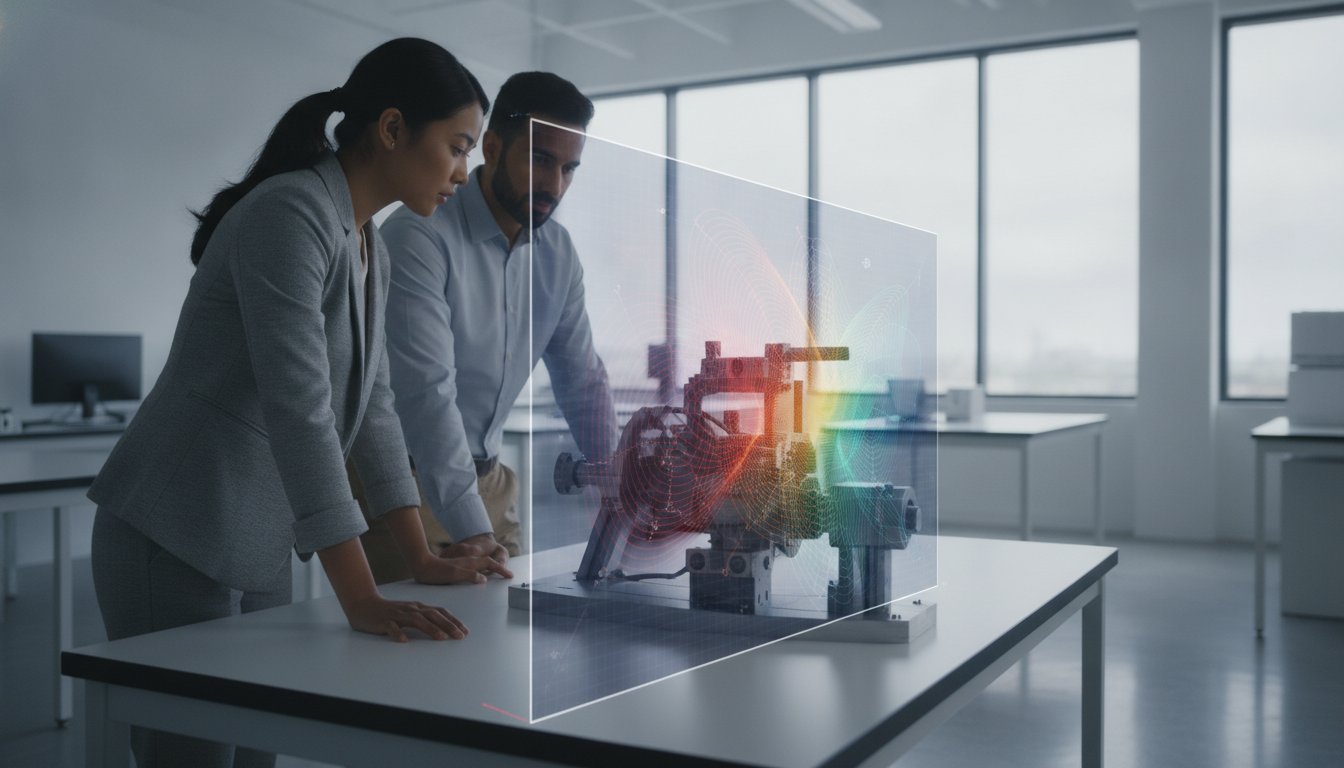
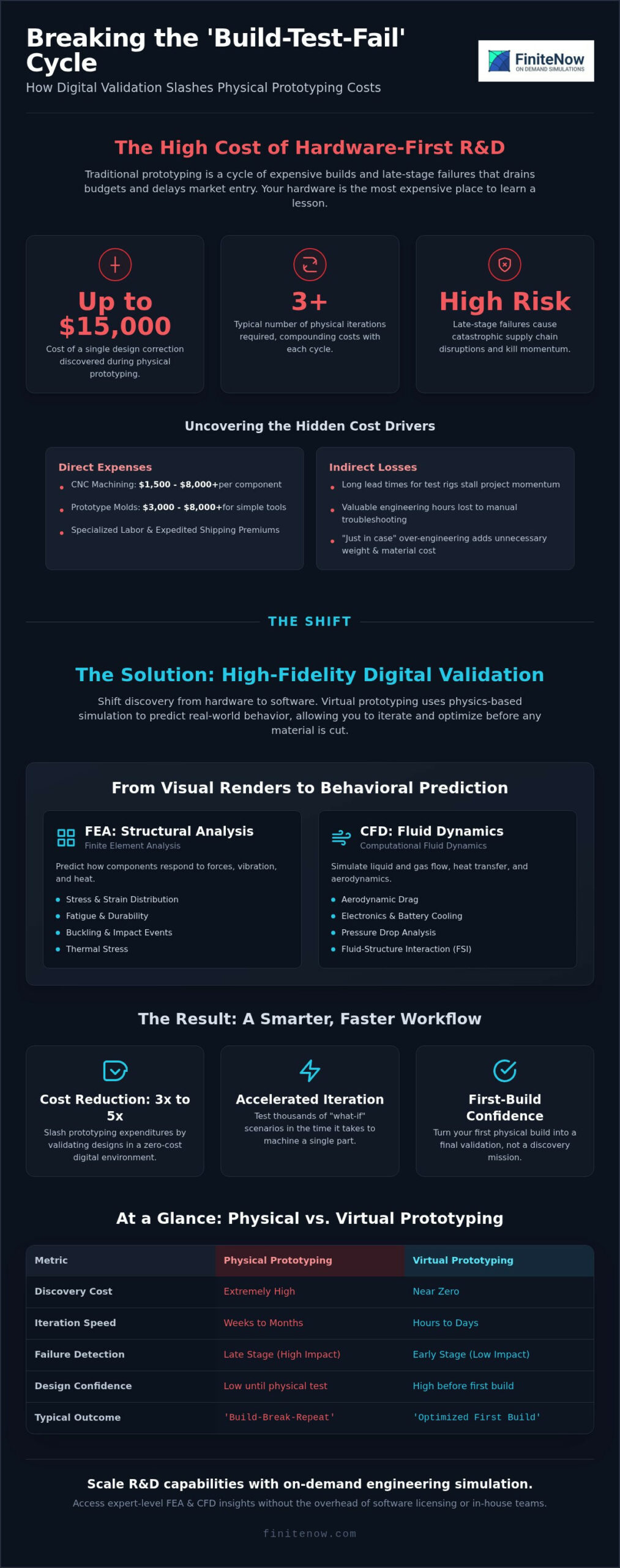
A single design correction discovered during physical prototyping can cost your team up to $15,000 in wasted materials and specialized labor. When you factor in that most projects require three or more iterations, the financial burden on your R&D budget becomes unsustainable. You don’t have to accept these “build-test-fail” cycles as an unavoidable cost of doing business. Learning how to reduce physical prototyping costs starts with moving your validation phase from the machine shop to a high-fidelity digital environment.
We recognize the frustration of rising material prices and the long lead times for physical test rigs that stall your momentum. It’s a legacy approach that no longer fits a high-speed market. This article demonstrates how to eliminate late-stage failures by shifting your primary validation to advanced FEA and CFD simulations. We’ll examine how digital-first workflows provide higher confidence in your first physical build while significantly lowering R&D expenditure. You’ll see exactly how to replace expensive physical iterations with precise, scalable digital insights that move your project forward faster.
Key Takeaways
- Identify hidden cost drivers like material procurement and the opportunity costs associated with long lead times for physical test rigs.
- Transition from basic 3D CAD to high-fidelity simulation to predict real-world behavior through physics-based digital environments.
- Implement a strategic framework to reduce physical prototyping costs by validating high-risk failure modes like buckling and thermal stress before hardware is built.
- Evaluate the functional limitations of rapid tooling compared to the predictive precision of advanced structural FEA and CFD analysis.
- Scale R&D capabilities using on-demand engineering expertise to eliminate the financial barriers of software licensing and long-term overhead.
The Hidden and Direct Drivers of Prototyping Costs in 2026
Engineering budgets are leaking. Most teams look at the bill of materials for a test rig and assume that’s the primary expense. It isn’t. The real drain comes from the “build-break-repeat” cycle that defines traditional R&D. Material procurement for low-volume builds is notoriously inefficient. You’re paying premiums for specialized labor and fast-tracked shipping to keep a project on schedule. These costs compound every time a physical test yields an unexpected failure. To reduce physical prototyping costs, you must first acknowledge that your hardware is the most expensive place to learn a lesson.
Direct vs. Indirect Prototyping Expenses
Functional prototypes are expensive assets. A single CNC machined component often costs between $1,500 and $8,000. If your project requires injection molding, simple aluminum prototype molds often run from $3,000 to $8,000. These are just the entry fees. You also have to account for third-party certification costs and testing facility rentals. The indirect losses are even more severe. Valuable engineering hours are lost to physical troubleshooting and manual teardowns. Virtual prototyping shifts this burden. It allows you to identify structural or flow issues in a digital environment, protecting your budget from these physical sinks.
The Risk of Late-Stage Failure
Late-stage failures represent the greatest risk to your bottom line. In the automotive sector, a single correction discovered during the physical prototyping phase can cost between $2,000 and $15,000. If this happens during the final validation stage, the ripple effect through your supply chain is catastrophic. It delays your Time-to-Market and gives competitors a window to act. Long lead times for test rig fabrication further exacerbate the problem. You’re often waiting weeks for a physical setup only to watch it fail in minutes. This lost momentum is an opportunity cost that few firms can afford.
Uncertainty also leads to significant waste. To reduce physical prototyping costs, you have to eliminate the “just in case” over-engineering that plagues unvalidated designs. Without high-fidelity data, engineers add thickness, weight, and complexity to ensure survival. This makes every physical unit more expensive to produce and test. Simulation provides the clarity needed to strip away excess and build with precision from day one. You gain confidence in the first physical build, turning your hardware stage into a victory lap rather than a discovery mission.
Virtual Prototyping: Shifting Discovery from Hardware to Software
High-fidelity simulation isn’t just a digital representation of a part. It’s a mathematical model of reality. While 3D CAD provides the geometry, virtual prototyping provides the behavior. This shift is how modern firms reduce physical prototyping costs by three to five times. Instead of building hardware to see if it breaks, you build a digital twin to predict exactly where it will fail. This discovery phase happens in software, where the cost of failure is zero.
Physics-Based Validation vs. Visual Rendering
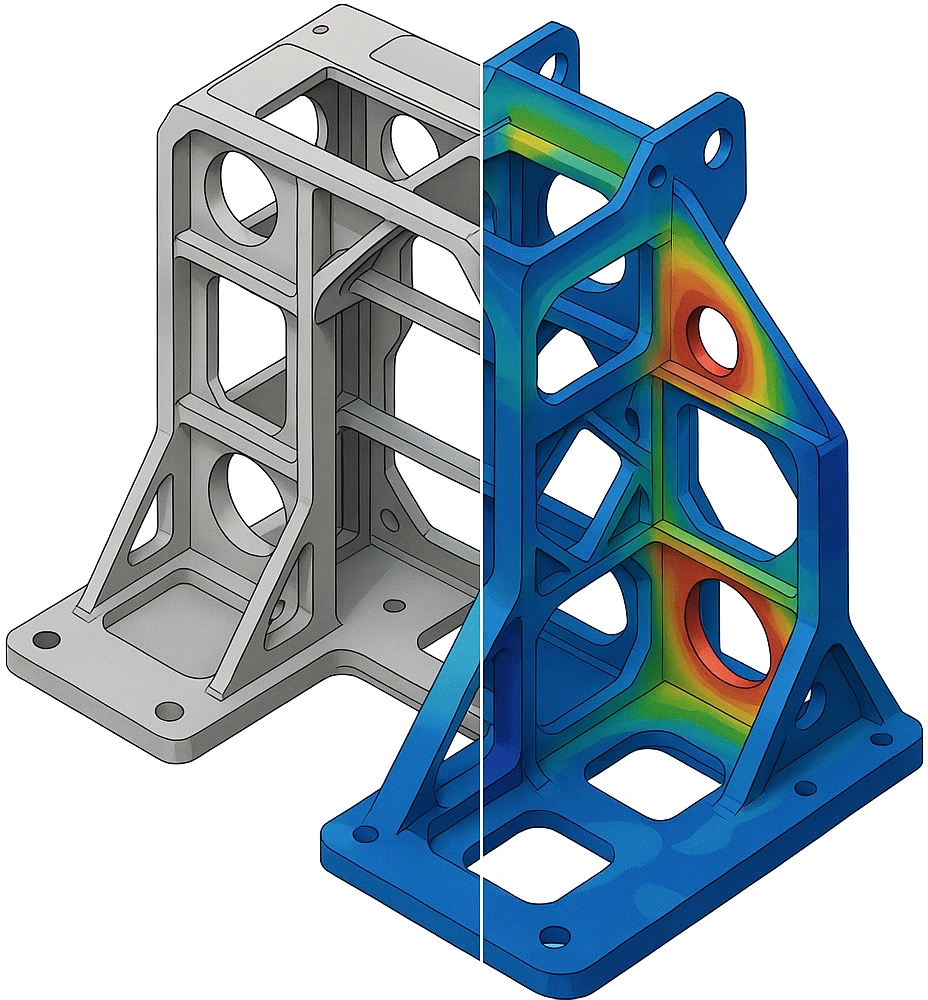
Visual renders are for marketing. They show how a product looks under studio lighting but offer no insight into how it handles a 50G impact or a 400-degree thermal load. To truly validate a design, you need Structural FEA to predict stress distribution and fatigue life. Similarly, CFD simulation replaces expensive wind tunnel testing by calculating aerodynamic drag and cooling efficiency digitally.
Research into Collaborative Virtual Prototyping shows that integrating these physics-based models early leads to technically superior systems with significantly less hardware waste. By using these tools, you move beyond aesthetics to functional certainty. You aren’t just guessing how a fluid will flow or how a bracket will bend; you’re measuring it before the first piece of metal is cut.
Iterative Design in a Digital Environment
The greatest advantage of software-based discovery is the ability to iterate at scale. You can test a thousand “what-if” scenarios in the time it takes to machine a single aluminum block. Topology optimization allows the software to find the most efficient material distribution automatically, often resulting in designs that are lighter and stronger than human intuition would suggest. This process removes the guesswork from complex geometry and ensures every gram of material serves a specific purpose.
This level of precision allows you to reduce the reliance on arbitrary safety factors. Instead of over-designing a component by 300% to account for uncertainty, you can optimize for the exact load cases it will face. Precision engineering requires more than just tools; it requires expertise. If you need to validate complex assemblies without the overhead of in-house licenses, exploring Structural FEA services can bridge the gap between design and production. By shifting your discovery to software, you ensure that the first physical build is a final validation, not an expensive experiment. This is the most effective way to reduce physical prototyping costs in a competitive market.
High-Fidelity Simulation vs. Traditional Cost-Reduction Methods
Traditional cost-reduction strategies like Design for Manufacturability (DFM) are essential for production efficiency, but they aren’t validation tools. DFM optimizes the part you have. It doesn’t confirm if that part will fail under load. To truly reduce physical prototyping costs, you need a method that predicts performance before a single dollar is spent on tooling. Relying on legacy engineering spreadsheets or hand calculations often leads to over-engineering. These methods simply cannot account for complex non-linearities or multi-part interactions found in modern assemblies.
When Rapid Prototyping Falls Short
Rapid prototyping has revolutionized form and fit checks. However, 3D printing and soft tooling frequently fail when functional data is required. 3D printed materials often exhibit anisotropic properties. Their strength varies based on the print orientation, making them unreliable for structural validation. These low-fidelity models also struggle to capture complex fluid-solid interaction (FSI) where physics-based behavior is non-linear.
Soft tooling remains a significant financial gamble. A soft-steel bridge mold can cost up to $20,000 according to 2026 industry data. If the design fails its first physical test, that investment is gone. High-fidelity simulation prevents these losses by identifying failure modes like buckling or fatigue in a digital environment first. You don’t need to cut metal to know if a design is viable.
The Superior ROI of Simulation-First R&D
The most effective way to reduce physical prototyping costs is to front-load validation into the design phase. While simulation requires an initial investment, it saves millions by preventing late-stage production changes. By focusing on the “Number of Prototypes to Launch” metric, firms can track the direct impact of virtual validation on their bottom line. It’s a shift from reactive fixing to proactive engineering.
Consider the shift from five physical iterations to just one. In traditional workflows, each iteration requires a new build, a new test rig, and weeks of delay. High-fidelity simulation identifies stress concentrations and thermal bottlenecks digitally. You solve problems in a virtual environment where iterations are nearly free. This results in a superior ROI compared to the “build-test-fail” cycle. It ensures your first physical prototype is used for final verification rather than expensive troubleshooting.
Strategic Implementation: A Decision Framework for Engineering Teams
Implementing a simulation-first strategy requires a structured transition from discovery to validation. You can’t simply run a simulation and expect costs to drop. You must integrate it into your decision-making process. Start by identifying high-risk failure modes. In structural components, analyze buckling and fatigue life. For power systems, prioritize thermal stress. Once you’ve mapped the risks, deploy targeted simulations to validate these critical components. This data allows you to refine your design digitally, ensuring the “Final” physical prototype is already optimized for performance. You then execute a single physical test for regulatory compliance or final validation. This methodical process is the most reliable way to reduce physical prototyping costs while maintaining engineering rigor.
Industry-Specific Prototyping Strategies
Different sectors face unique validation hurdles. Medical device manufacturers use biomechanics simulation to meet strict regulatory standards without exhaustive bench testing. In industrial machinery, engineers prioritize vibration and modal analysis to prevent catastrophic field failures. Aerospace teams rely on thermal and composite analysis to achieve weight reduction targets while ensuring structural integrity. Each vertical uses high-fidelity simulation to replace a specific set of expensive physical tests, accelerating the path to market. By targeting industry-specific failure modes, you eliminate the “guess and check” work that bloats R&D budgets.
Managing Expertise and Resource Constraints
The primary barrier to this shift is often the “Expertise Gap.” High-fidelity simulation isn’t a push-button process. It requires specialized knowledge in mesh sensitivity, material non-linearity, and convergence. Many firms struggle to maintain this level of expertise in-house. Choosing between building an internal team and structural analysis outsourcing is a strategic decision. Outsourcing provides immediate access to senior-level expertise without the overhead of permanent staffing or expensive software maintenance. It allows you to scale your engineering capacity based on project demand rather than fixed overhead.
Establishing a seamless workflow between design and simulation teams ensures that insights are actionable. If your team is facing R&D bottlenecks, you can get an instant quote for on-demand simulation to see how digital validation fits your current project timeline. This approach allows you to reduce physical prototyping costs by leveraging specialized skills only when they are needed. You move from a rigid, hardware-dependent cycle to an agile, data-driven workflow that prioritizes speed and precision.
Scaling R&D with On-Demand Engineering Simulation
High-fidelity simulation shouldn’t be gated by six-figure software budgets. Traditional engineering firms often pay for perpetual licenses that sit idle 70% of the time. This is a capital-intensive model that slows down innovation. Moving to Engineering Simulation Without Software Licenses allows you to allocate your budget toward actual R&D results rather than digital maintenance. This shift is a critical lever to reduce physical prototyping costs, as it democratizes access to advanced validation tools without the upfront software tax.
Benefits of the On-Demand Model
The primary advantage of a pay-per-project engineering simulation model is financial transparency. You eliminate the overhead of underutilized software seats and the need for expensive high-performance computing (HPC) hardware. You also bypass the “Expertise Gap.” Accessing specialized physics like nonlinear FEA, fluid-structure interaction (FSI), or thermal management doesn’t require a permanent hire. Scalability becomes a core feature of your department. You can handle peak R&D loads during a product launch without a permanent increase in headcount. It’s a lean approach to complex engineering that prioritizes speed and precision.
Getting Started with FiniteNow
FiniteNow removes the procurement bottlenecks that traditionally stall simulation projects. Our instant automated quoting system provides clarity in seconds, not weeks. This speed allows you to integrate simulation into your design sprint without missing critical deadlines. You collaborate directly with a German engineering simulation services team that understands the nuances of complex assemblies and global regulatory requirements. We provide the technical mastery needed to reassure stakeholders that your designs are optimized for the real world before you commit to hardware.
Transitioning your team to a simulation-first culture is about trust in data. When you reduce physical prototyping costs through digital validation, you empower your designers to be bolder. They can explore aggressive weight reductions or innovative materials knowing the physics are verified. The first physical build is no longer a gamble. It’s a confirmation of a well-engineered digital model. This methodical progression mirrors a well-oiled digital workflow, ensuring that information is delivered with a sense of momentum and purpose, avoiding unnecessary filler in favor of actionable engineering insights.
Accelerate Your R&D with Digital-First Validation
Transitioning to high-fidelity simulation is no longer a luxury; it’s a competitive necessity. Shifting discovery from the machine shop to digital environments eliminates the expensive “build-break-repeat” cycle that drains engineering budgets. This strategic move allows your team to reduce physical prototyping costs while increasing the precision of your first physical build. Targeted FEA and CFD analysis identify critical failure modes like thermal stress or buckling before hardware exists, turning final physical testing into a formality rather than a high-stakes risk.
The financial barriers of legacy software licensing are gone. You can now access German engineering simulation services and specialized physics on a project-by-project basis. FiniteNow provides instant transparency on project costs with no long-term contracts or hidden fees. It’s time to stop guessing and start validating with streamlined precision. Get an instant quote for your simulation project and move your design toward production with absolute confidence. Your next breakthrough shouldn’t be stalled by hardware lead times or licensing overhead.
Frequently Asked Questions
How much can simulation actually reduce physical prototyping costs?
High-fidelity simulation typically eliminates two to three hardware iterations by identifying structural or fluid flaws in a digital environment. By shifting validation to software, you avoid the $1,500 to $8,000 cost associated with functional machined prototypes. This strategic shift can reduce physical prototyping costs by 50% or more. You’re replacing expensive material waste and specialized labor with precise digital insights, ensuring your first physical build is for final validation rather than discovery.
Can simulation completely replace physical prototyping in 2026?
No, but it drastically reduces the total volume of hardware required. Physical testing remains a requirement for final regulatory certification and real-world validation in high-stakes industries. However, high-fidelity simulation handles the discovery phase where 90% of design failures occur. In 2026, over 58% of engineering firms have integrated advanced solvers into their workflows to cut design cycles. The goal is a single, successful physical build rather than a “trial and error” hardware cycle.
What is the difference between virtual prototyping and 3D rendering?
3D rendering is a visual check for aesthetics, while virtual prototyping is a physics-based check for performance. Renders show how a part looks under studio lighting. High-fidelity simulation uses Structural FEA and CFD to predict how it reacts to stress, heat, and fluid flow. A render won’t tell you if a bracket will buckle under a 10kN load; simulation provides the mathematical proof of structural integrity before you commit to production.
Is engineering simulation accurate enough for regulatory validation?
Yes, provided it’s executed with high-fidelity mesh sensitivity and verified material properties. Modern FEA and CFD are standard in medical device biomechanics and aerospace structural validation. Regulatory bodies often accept simulation data to support or even replace certain bench tests. Working with a German-based engineering team ensures the technical mastery required to meet these rigorous standards, providing the data needed for first-pass compliance and higher confidence in the final build.
What industries benefit most from reducing physical prototypes?
High-stakes sectors with expensive material costs and strict safety requirements gain the most from digital validation.
- Aerospace: Validating composites and buckling behavior.
- Medical Devices: Simulating stent fatigue and fluid-structure interaction.
- Automotive: Optimizing crash durability and thermal management.
- Industrial Machinery: Predicting vibration and modal response.
In these fields, discovering a flaw in hardware is exponentially more expensive than fixing it in a digital twin.
How do I know if my design is too complex for virtual testing?
Very few designs exceed the capabilities of modern multiphysics solvers. If your project involves non-linear material behavior, complex contact interactions, or turbulent fluid flow, it requires specialized expertise rather than just more computing power. Our custom simulations handle multi-component assemblies that traditional hand calculations can’t touch. Our instant automated quoting system evaluates project requirements to determine the appropriate simulation fidelity for your specific design, removing the guesswork from the procurement process.
What are the main barriers to adopting a simulation-first R&D strategy?
High entry costs and the “Expertise Gap” are the primary obstacles. Perpetual licenses for advanced tools can cost $22,000, and hiring specialized PhD-level engineers adds significant overhead. Many firms also struggle with long procurement lead times for software. Transitioning to an on-demand model is the most effective way to reduce physical prototyping costs without the financial burden of permanent software licensing, on-site staffing, or expensive high-performance computing hardware.
How does the on-demand simulation model compare to buying software licenses?
The on-demand model prioritizes results over overhead. Buying a license requires a large upfront investment, annual maintenance fees, and dedicated hardware. On-demand services like FiniteNow provide instant quotes and access to German engineering expertise on a per-project basis. You don’t pay for idle software seats or training. It’s a scalable, transparent alternative that mirrors a modern digital workflow, allowing you to pay only for the validation you actually use.
Simulation Work Reinvented