

The traditional logic dictates that high-fidelity R&D requires a massive upfront investment in software seats. However, owning a perpetual license is often a strategic liability rather than an asset. Many engineering departments find themselves trapped in a cycle of paying for expensive shelfware that remains underutilized for months. Transitioning to engineering simulation without software licenses allows your team to bypass these heavy CAPEX requirements. It replaces fixed overhead with a lean, on-demand model. Results matter more than tool ownership.
You’ve likely felt the pressure of maintaining a simulation stack that demands constant training and high maintenance fees. It’s a bottleneck for managers who need expert-level insights but lack the internal bandwidth to master complex workflows. This article demonstrates how to eliminate those barriers by leveraging specialized simulation services. We’ll break down the shift toward pay-per-project scalability and explain how accessing expert German engineering expertise reduces R&D overhead. You’ll learn how to scale your capacity instantly while keeping your focus on product development, not software management.
Key Takeaways
- Identify the hidden financial drain of “shelfware” and underutilized software seats that increase the total cost of ownership for R&D departments.
- Discover the strategic methodology for performing engineering simulation without software licenses by transitioning from tool ownership to on-demand expertise.
- Access high-fidelity results for complex Nonlinear FEA and Fluid-Structure Interaction (FSI) without the need for expensive multiphysics license bundles.
- Calculate the ROI of shifting from heavy license CAPEX to a project-based OPEX model that eliminates mandatory maintenance and upgrade fees.
- Follow a practical two-step audit process to evaluate current software utilization and identify high-complexity physics needs for external scaling.
The Hidden Cost of Engineering Simulation Software Licenses
Traditional Computer-Aided Engineering (CAE) procurement is built on a flawed premise. Most firms assume the primary expense is the sticker price of the solver. In reality, the initial purchase is just the tip of the iceberg. Total Cost of Ownership (TCO) in engineering simulation refers to the sum of all direct and indirect expenses associated with a software license, including the initial purchase price, annual maintenance fees, hardware infrastructure, IT support, and personnel training costs.
The “shelfware” problem is a silent budget killer. Industry reports frequently suggest that up to 30% of engineering licenses go underutilized. You’re paying for peak capacity that you only need 10% of the time. This mismatch creates massive waste. Beyond the license, you must account for hardware overhead. Complex CFD or nonlinear FEA requires high-end workstations or dedicated clusters. These machines depreciate quickly and demand constant IT maintenance. Choosing engineering simulation without software licenses bypasses this entire infrastructure burden. It shifts the focus from managing assets to generating results.
CAPEX vs. Opportunity Cost in R&D
Large upfront license fees drain innovation budgets. For SMEs, spending five or six figures on a single seat means less capital for physical testing or talent acquisition. You’re also risking vendor lock-in. If your project requirements shift from structural analysis to complex fluid dynamics, your current solver might become obsolete. Transitioning to an on-demand model ensures your capital remains fluid. You pay for results, not for a tool that might not fit your next challenge.
The Skill Gap: The Real Cost of Software Training
Software ownership doesn’t guarantee engineering insight. The time-to-value delay is significant as staff struggle with complex UIs and meshing protocols. Training takes weeks; mastery takes years. When a specialized engineer leaves your firm, that software knowledge walks out the door. You’re left with an expensive license and no one to drive it. By moving to engineering simulation without software licenses, you decouple R&D progress from your software inventory and eliminate the training lag.
The Rise of Simulation-as-a-Service (SaaS) in 2026
The engineering landscape is shifting. Just as companies moved local servers to AWS or Azure, R&D teams are now outsourcing the heavy lifting of solvers. Owning a tool is no longer a prerequisite for innovation. This model prioritizes “Insights Access” over “Tools Ownership.” It’s a direct response to the inefficiencies of legacy procurement. By opting for engineering simulation without software licenses, you gain the ability to generate high-fidelity data without the burden of maintaining the environment. This transition mirrors the broader move toward decentralized, cloud-based infrastructure where performance is measured by output rather than asset accumulation.
Transparency is the new standard. Traditional consulting often involves weeks of back-and-forth for a simple quote. The modern approach utilizes automated systems to provide instant, project-based pricing. This removes the friction for non-specialist teams who need precise validation but don’t want to navigate the complexities of CAE vendor contracts. It democratizes access to high-end physics across the entire organization. Projects that once stalled due to procurement red tape can now move forward with clear, upfront costs that fit into existing operational budgets.
Scalability Without Infrastructure
Engineering workloads aren’t linear. Buying extra seats for a three-month project spike is financially irresponsible. On-demand models allow you to scale your capacity instantly. You can access specialized solvers for Structural FEA or Fluid-Structure Interaction (FSI) only when the physics of your product demands it. This elastic approach ensures your budget matches your actual R&D activity. You pay for the results you use, not the idle time of a workstation. It eliminates the pressure to “find work” for an expensive license seat during slow cycles. For a deeper look at how to build a truly scalable engineering simulation strategy that decouples expertise from rigid software constraints, our strategic guide covers the full framework.
Global Collaboration and Expert Networks
The value isn’t in the code; it’s in the validation. Moving to a service-based model lets you tap into pre-qualified networks of specialists. When you work with a German-based engineering team, you’re buying a validated report that meets rigorous standards. You’re no longer just “buying a seat” and hoping your internal staff can handle the edge cases. You’re securing an expert partner who delivers precision on every project. This shift toward “buying a validated report” ensures that your design decisions are backed by deep domain expertise and proven methodologies. If you’re ready to streamline your workflow, you can get an automated quote for your simulation needs today.
Accessing High-Fidelity Physics Without In-House Solvers
Owning a solver isn’t the same as solving the problem. High-fidelity physics demands more than just code; it requires validated workflows and high-performance computing (HPC) clusters. Many firms attempt to use open-source hobbyist tools to avoid costs, but these often lack the rigorous validation required for professional liability. Opting for engineering simulation without software licenses provides a direct path to expert-level results in complex Linear and Nonlinear FEA. You bypass the need for expensive multiphysics bundles when managing Fluid-Structure Interaction (FSI), accessing these advanced solvers only for the duration of the project. For scenarios where structural and thermal physics interact simultaneously, coupled-field analysis services provide the rigorous multiphysics methodology needed to capture real-world behavior that isolated simulations consistently miss.
Achieving convergence in complex CFD Turbulence Modeling is a specialized skill. Remote expert solvers handle the mesh sensitivity and solver settings that typically frustrate in-house generalists. This results-oriented approach allows you to tailor the solver to the specific physics of your problem rather than forcing the problem to fit the software you already own. Custom engineering simulation workflows allow for a level of precision that off-the-shelf software packages often struggle to match. By working with an on-demand partner, you can implement specialized material models or custom boundary conditions tailored specifically to your hardware.
Industry-Specific Applications: Aerospace and Automotive
Aerospace engineering requires precise validation of buckling, composite failure, and external aerodynamics. These aren’t just simulations; they’re safety-critical data points. Similarly, the automotive sector demands high-fidelity durability, thermal management, and crash simulation results to meet global safety standards. Leveraging a CFD Simulation expert ensures your fluid dynamics optimization is grounded in verified physics, not software defaults. You get the data you need without the overhead of a dedicated aerodynamics department or the recurring cost of specialized automotive solvers.
Specialized Domains: Medical Devices and Industrial Machinery
In the medical device industry, biomechanics and stent fatigue life simulations must meet strict regulatory scrutiny. Expert-backed validation reports are essential for FDA or CE marking submissions. For industrial machinery, the focus shifts to structural integrity under load. This includes vibration analysis, modal analysis, and bolted joint integrity. Using engineering simulation without software licenses allows you to scale your technical depth instantly. You’re not just buying a result; you’re securing a validated engineering conclusion that satisfies both internal quality standards and external regulators. This ensures that the simulation accurately reflects real-world performance, providing a higher degree of confidence in your R&D outcomes without the burden of license management. For applications where components are exposed to elevated operating temperatures, thermo-mechanical analysis services provide the predictive capability to identify thermal stress hotspots and validate material selection before a single prototype is built.
Financial Analysis: Project-Based OPEX vs. License CAPEX
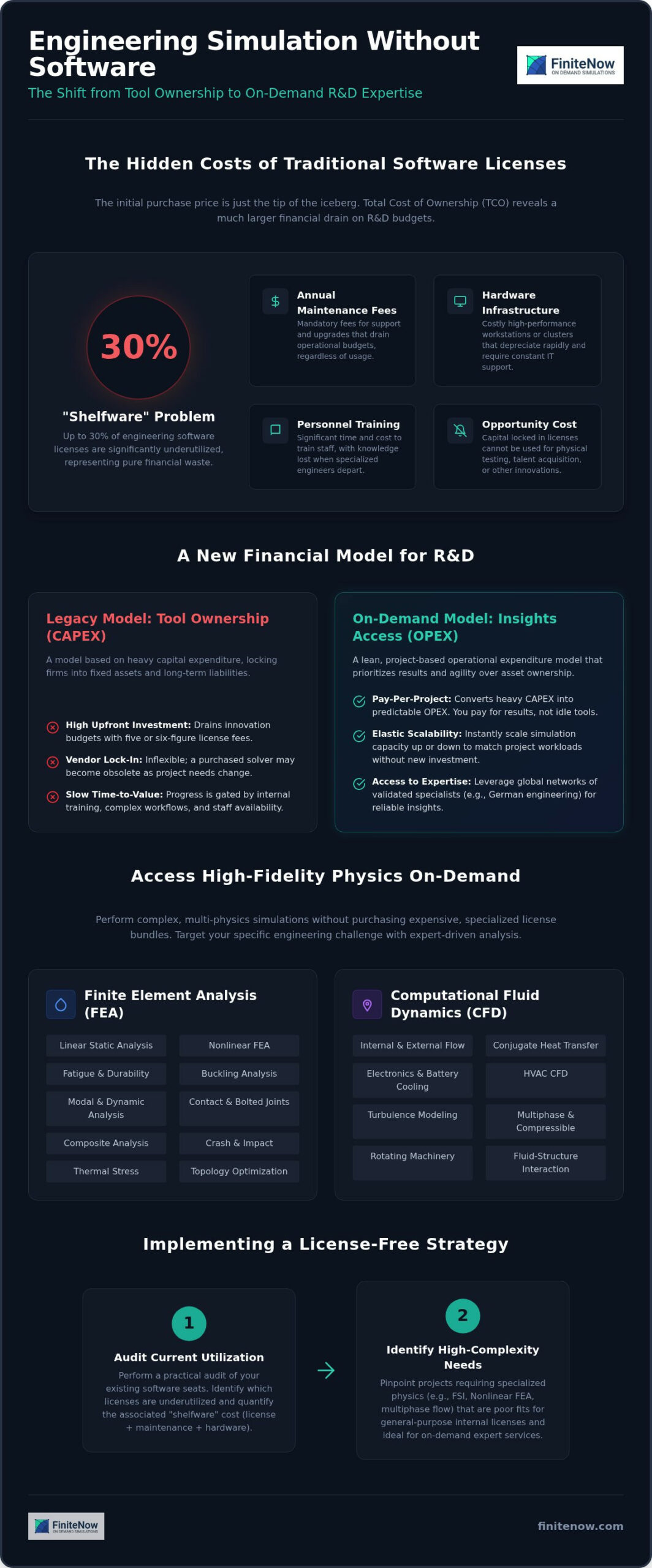
The financial architecture of engineering departments is undergoing a fundamental restructuring. Traditional procurement models rely on heavy capital expenditure (CAPEX) to secure software seats. This approach forces companies to amortize high costs over several years, regardless of project volume. In contrast, engineering simulation without software licenses utilizes an operational expenditure (OPEX) model. This shift allows for immediate tax deductibility of service expenses rather than long-term asset depreciation. It aligns your spending directly with your R&D output.
Predictable budgeting is a luxury in traditional CAE environments. Annual maintenance fees and mandatory version upgrades create recurring financial pressure. These costs often escalate annually without a corresponding increase in utility. By using a project-based model, you gain access to instant automated quoting. This stabilizes your forecasting. You know the exact cost of a structural validation or a thermal analysis before the project begins. There are no hidden fees or surprise workstation upgrades.
The Pay-Per-Project ROI Framework
Analyzing the return on investment requires a look at the full lifecycle. If your team only executes a handful of major projects annually, the cost per project using an enterprise license is astronomical. You’re paying for 365 days of access but only deriving value for a fraction of that time. Pay-per-project engineering simulation service fees typically represent a fraction of the total cost of ownership (TCO) compared to annual enterprise license fees and their associated infrastructure requirements. You also eliminate the hidden cost of engineering hours spent on software troubleshooting, IT configuration, and license server maintenance.
Eliminating the “Learning Curve” Tax
Software ownership comes with an invisible tax: the learning curve. Inexperienced internal users often produce “bad data” due to incorrect solver settings or poor meshing strategies. This leads to costly design iterations or, worse, physical failure. Accessing a German-based engineering team provides immediate results. You reduce your time-to-market by bypassing the months required for staff training. Your internal talent can focus on high-level design iteration rather than getting lost in solver setup. If you’re ready to optimize your R&D budget, you can get an instant quote for your next simulation today.
Implementing a License-Free Simulation Strategy
Transitioning to engineering simulation without software licenses requires a methodical approach. It isn’t just about cancelling subscriptions. It’s about optimizing your R&D pipeline for maximum efficiency. Follow these four steps to move from an asset-heavy model to a results-oriented workflow:
- Step 1: Audit software utilization. Review your current maintenance agreements. Determine how many seats actually generate value versus those sitting idle as “shelfware.”
- Step 2: Identify high-complexity physics needs. Categorize your projects by technical demand. Simple checks might stay in-house, but complex Nonlinear FEA, CFD, or Thermal Analysis should be earmarked for on-demand experts.
- Step 3: Utilize instant quoting. Use automated platforms to check project feasibility. This provides immediate cost transparency before you commit resources.
- Step 4: Establish a digital workflow. Standardize your CAD submission process and report review protocols. This ensures that data moves securely and results are integrated directly into your design iterations.
By following this framework, you decouple your engineering capacity from your software budget. You gain the agility to scale up for intensive validation phases without the permanent overhead of new software seats. It’s a strategic shift that prioritizes engineering output over tool ownership.
Selecting the Right Simulation Partner
Technical breadth is the primary metric for evaluation. Your partner must handle everything from Linear Static Analysis to advanced Topology Optimization. Look for teams that offer video-call collaboration rather than just static email exchanges. Direct communication with the engineering team ensures that the simulation boundary conditions align perfectly with your real-world constraints. Data security is equally critical. Ensure your partner uses encrypted transfer protocols and has robust intellectual property protection measures in place. When working with a German-based engineering team, you’re not just hiring a solver; you’re securing a partner that adheres to rigorous validation standards. For a comprehensive overview of procurement options and pricing structures, the 2026 buyer’s guide to on-demand CAE provides a detailed framework for evaluating pay-per-project engineering simulation providers.
The Future of the “Engineering Knowledge Graph”
The industry is moving toward the “Engineering Knowledge Graph,” where simulation data is a living asset. This involves digital twins and virtual product testing services that provide continuous value throughout the product lifecycle. FiniteNow positions itself as the digital twin of your in-house department, delivering fast, transparent, and scalable engineering simulation results. This model removes the traditional barriers of entry for high-fidelity analysis. You get expert-level insights with the speed of a modern technology firm. If you’re ready to eliminate licensing friction and accelerate your development cycle, you can Get an instant quote for your next simulation project today.
Future-Proofing Your R&D Pipeline
The transition to engineering simulation without software licenses isn’t just a cost-saving measure; it’s a strategic evolution. By decoupling your innovation potential from rigid software contracts, you’ve unlocked a more agile development cycle. You’ve seen how removing shelfware and maintenance fees allows for a leaner budget that prioritizes validated results over tool ownership. Accessing German-engineered precision on a pay-per-project basis ensures that your design decisions are grounded in high-fidelity data without the burden of internal training or hardware overhead.
This on-demand model provides the scalability required for modern engineering challenges. You can eliminate the friction of traditional procurement and gain instant access to expert-level solvers. There’s no need for long-term contracts or upfront license fees. If you’re ready to streamline your workflow and focus on product performance, it’s time to act. Get an Instant Quote for Simulation Services and start optimizing your R&D today.
Frequently Asked Questions
Is it possible to perform FEA or CFD without buying a software license?
Yes. Companies can transition to “Simulation-as-a-Service” models. This shift allows teams to access high-fidelity results without the heavy CAPEX of perpetual licenses or annual subscriptions. By utilizing on-demand expertise, you bypass the software procurement process entirely. This approach is becoming the standard for agile R&D departments that prioritize validated reports over tool ownership. It’s about securing actionable engineering data, not managing software seats.
How much does engineering simulation cost on a per-project basis?
Pricing varies based on the complexity of the physics and the required level of validation. Instead of fixed license costs, on-demand models use project-specific quotes based on the actual engineering hours and solver resources required. This ensures that your budget matches your specific R&D needs exactly. Most service providers utilize automated systems to provide transparent, upfront pricing before any technical work begins, stabilizing your forecasting.
How do on-demand simulation services ensure the accuracy of results?
Accuracy is maintained through rigorous validation protocols and expert oversight. Specialized engineering teams use established benchmarks and mesh sensitivity studies to ensure solver convergence. Working with a German-based engineering team provides an additional layer of precision, as results are verified against industry-specific standards. This expert-led approach eliminates the risk of “bad data” often produced by inexperienced internal software users who lack deep solver mastery.
What industries benefit most from license-free engineering simulation?
Regulated sectors such as Aerospace, Automotive, and Medical Devices benefit significantly. These industries require complex physics like Nonlinear FEA and CFD but often face high software overhead. License-free models allow Aerospace firms to validate buckling and composites without long-term contracts. Similarly, Medical Device manufacturers can access specialized biomechanics solvers for stent fatigue life simulations only when a specific regulatory submission is required, reducing unnecessary R&D expenditure.
Can I use on-demand services for regulatory validation (e.g., FDA or FAA)?
Yes, provided the service partner delivers comprehensive validation reports. Expert-backed simulations are frequently used to support FDA or CE marking submissions for medical devices and FAA certifications for aerospace components. These reports must include detailed descriptions of material models, boundary conditions, and solver settings. Utilizing engineering simulation without software licenses ensures you have the necessary documentation without the burden of maintaining a complex internal CAE infrastructure.
How does FiniteNow protect my intellectual property and CAD data?
Data security is managed through encrypted transfer protocols and strict non-disclosure agreements (NDAs). All CAD submissions and simulation reports are handled within a secure digital workflow to prevent unauthorized access. This professional approach mirrors the security standards of traditional in-house departments. Protecting your intellectual property is a core component of the engagement process, ensuring that your proprietary designs remain confidential throughout the entire analysis and reporting phase.
What is the turnaround time for an outsourced simulation report?
Turnaround times are typically faster than internal queues because service providers operate with dedicated solver capacity and specialized workflows. While simple structural checks can be completed quickly, complex fluid dynamics or thermal analysis projects depend on the model complexity. The use of automated quoting and streamlined digital submission processes allows for a rapid progression from CAD upload to final report delivery, often reducing total R&D lead times.
Do I need specialized hardware to receive simulation results?
No. One of the primary advantages of engineering simulation without software licenses is the total removal of hardware overhead. The service provider handles all high-performance computing (HPC) requirements and solver infrastructure. You receive a comprehensive, easy-to-read PDF report and any requested data files. This allows your team to review high-fidelity results on standard office workstations without ever investing in expensive, high-end local hardware or workstation maintenance.
Simulation Work Reinvented